

A mushroom head push button is a type of push button switch with a large, rounded actuator that resembles a mushroom cap. Its wide surface makes it easy to press quickly, even when an operator is wearing gloves or needs to react under pressure.
These switches are commonly used in industrial machinery, control panels, production lines, and equipment where quick and reliable manual operation is important. Depending on the design, a mushroom head push button can be used to start or stop equipment, activate a control function, or provide an emergency stop.
But how does a mushroom head push button actually work? What makes it different from a regular push button, and how do you choose the right one for your application?
Let’s take a closer look.
1. What Is a Mushroom Head Push Button?

A mushroom head push button is a manual control switch featuring an enlarged, rounded or dome-shaped button head. Unlike standard push buttons with relatively small actuators, its wider surface provides a larger contact area for the operator.
This design offers several practical advantages:
- Easy to operate: The large head is easier to locate and press.
- Quick response: Operators can activate the switch without needing to precisely position their fingers.
- Glove-friendly: The larger surface makes operation more convenient when wearing work gloves.
- Clear identification: Its distinctive shape makes it easy to recognize on a control panel.
Mushroom head push buttons are available in different colors, sizes, mounting dimensions, and contact configurations.
One important distinction: a mushroom-shaped button is not automatically an emergency stop switch. Some are designed for general control functions, while others are specifically engineered and certified for emergency stopping applications.
2. How Does a Mushroom Head Push Button Work?
Although the actuator looks different from a standard push button, its basic operating principle is similar. Pressing the button causes an internal mechanical movement that changes the electrical contact state.
Here is how the process works:
- Step 1: Press the actuator
The operator presses the mushroom-shaped head, moving the internal mechanism. - Step 2: The contacts change state
Inside the switch, the movement operates the electrical contacts. Depending on the contact configuration, the circuit may open or close.
For example:
A normally open (NO) contact closes when the button is pressed.
A normally closed (NC) contact opens when the button is pressed. - Step 3: The connected equipment responds
The electrical signal is sent to the connected control system, such as a PLC, relay, or motor control circuit. The equipment then performs the programmed action. - Step 4: The button returns or remains activated
This depends on the switch mechanism.
Momentary type: The button returns to its original position when released.
Latching type: The button stays in its activated position until it is reset or released through a designated mechanism.
For emergency stop applications, latching mechanisms are commonly used so that the stop command remains active until the operator deliberately resets the switch.
For emergency stop applications, latching mechanisms are commonly used so that the stop command remains active until the operator deliberately resets the switch.
3. Mushroom Head Push Button vs. Regular Push Button
The biggest difference is the actuator design and how easily the operator can interact with it.
| Feature | Mushroom Head Push Button | Standard Push Button |
|---|---|---|
| Button Shape | Large, rounded head | Usually smaller and flatter |
| Contact Area | Larger | Smaller |
| Operation | Easy to press quickly | Requires more precise positioning |
| Glove Operation | Generally more convenient | Depends on button size |
| Common Applications | Industrial control, emergency stop, machinery | General equipment control, start/stop functions |
| Available Mechanisms | Momentary or latching, depending on model | Momentary or latching, depending on model |
4. Where Are Mushroom Head Push Buttons Used?
Mushroom head push buttons are widely used in industrial and commercial equipment. Their large actuator makes them particularly useful in environments where operators need convenient access to manual controls.
Here are some common applications:
- Industrial Machinery
On production lines, packaging machines, and automated equipment, mushroom head push buttons can be used to start, stop, or control specific machine functions. - Control Panels
They are frequently installed on industrial control panels, allowing operators to interact with electrical systems through clearly identifiable manual controls. - Manufacturing Equipment
In manufacturing facilities, these switches provide convenient access to machine controls, particularly when operators frequently wear protective gloves. - Emergency Stop Systems
Red mushroom-shaped actuators are widely used in emergency stop devices. When properly designed and installed as part of a compliant safety system, they allow operators to stop hazardous machinery in an emergency.
For emergency stop applications, the complete device must meet the applicable safety requirements. A red mushroom-shaped actuator alone does not make a switch an emergency stop device.
5.Can Mushroom Head Push Buttons Be Customized?
Yes. Many industrial mushroom head push buttons can be customized to meet different equipment requirements.
Depending on the manufacturer and product series, customization options may include:
- Actuator Design: Different head sizes, shapes, colors, and marking options.
- Mounting Dimensions: Different panel mounting diameters to suit existing equipment.
- Contact Configuration: NO, NC, or combined contact arrangements.
- Operating Mechanism: Momentary or latching designs.
- Electrical Specifications: Different voltage and current ratings.
- Protection: Different IP protection levels and housing materials.
For OEM and ODM projects, customization can be especially useful when standard switches do not fully match the equipment’s design or electrical requirements.
ONPOW Mushroom Head Push Buttons
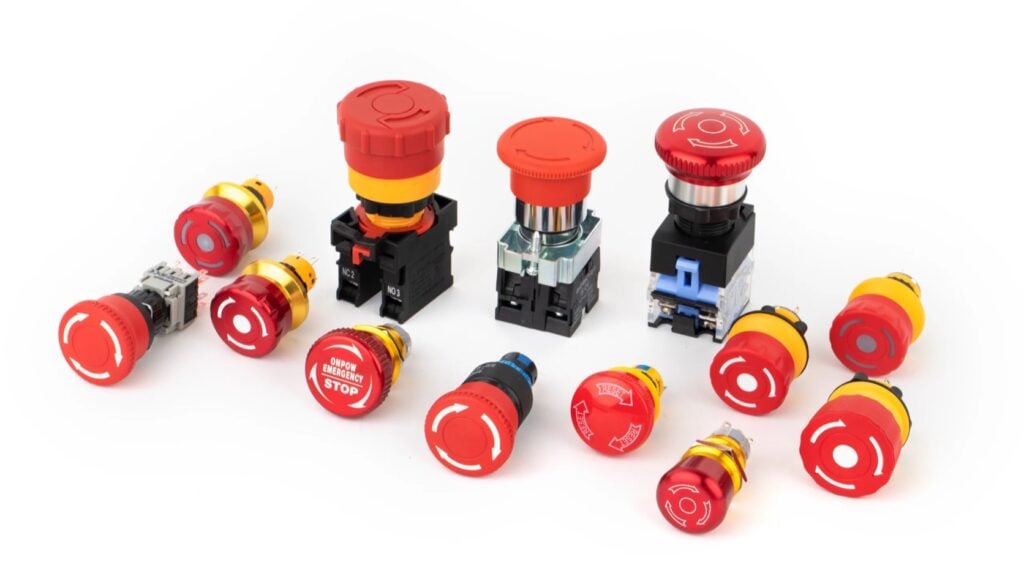
- The switch performance is stable, and the market has been tested for more than 10 years
- Various types can be customized
- Certificate: CCC/CE/UL



