

A continuous buzzer sounds without planned silent gaps while its alarm command is active. A pulsed buzzer alternates sound and silence according to an internal pattern or an external control command. Choose between them from the required operator response, the surrounding alarm system, and the way the device is driven. The pattern is not the tone frequency or the sound level: two alarms can share a pitch and loudness yet convey different messages through their timing. Before buying an industrial buzzer, define what the signal means, who must hear it, how it ends, and how its installed behavior will be verified.
Separate pattern, tone and sound level
Pattern describes the sequence over time: steady sound, regularly interrupted sound, or another documented sequence. Tone describes the sound’s acoustic character, including pitch or frequency content. Sound level describes a measured acoustic quantity under stated conditions. Treating these as separate selection fields prevents a supplier from answering an incomplete request with the wrong feature.
An instruction such as “make the alarm stronger” is ambiguous. It could mean louder sound, a more recognizable pattern, a different tone, better placement, or clearer visual identification. Establish the actual problem before changing the device. An unnecessary increase in loudness can affect other workers without resolving masking, confusion, or poor placement.
For the acoustic distinction, see industrial buzzer frequency selection. This article focuses on the time pattern and control behavior. The related topic of installed sound level addresses distance, background noise, and measurement conditions separately.
Two ways to create an interrupted signal
Some buzzers produce their own interruption pattern when supplied with the specified continuous input. Other devices require the external controller to switch their input. These arrangements are not interchangeable. Ask the supplier whether the offered version is a continuous-supply sounder, an internally pulsed sounder, or a device whose acoustic generation requires a particular drive waveform.
The supply voltage on a product page does not answer that question by itself. The exact model documentation must establish the input interface, polarity where relevant, operating limits, and behavior after the command changes. Do not assume that rapidly cycling the supply of any buzzer creates an acceptable alarm pattern.
A controller-driven pattern also depends on the control program and output hardware. The command timing, restart conditions, acknowledgement behavior, and output compatibility must be defined as part of the machine design. Where the alarm has a protective role, involve the responsible safety and control team rather than treating the pattern as a cosmetic preference.
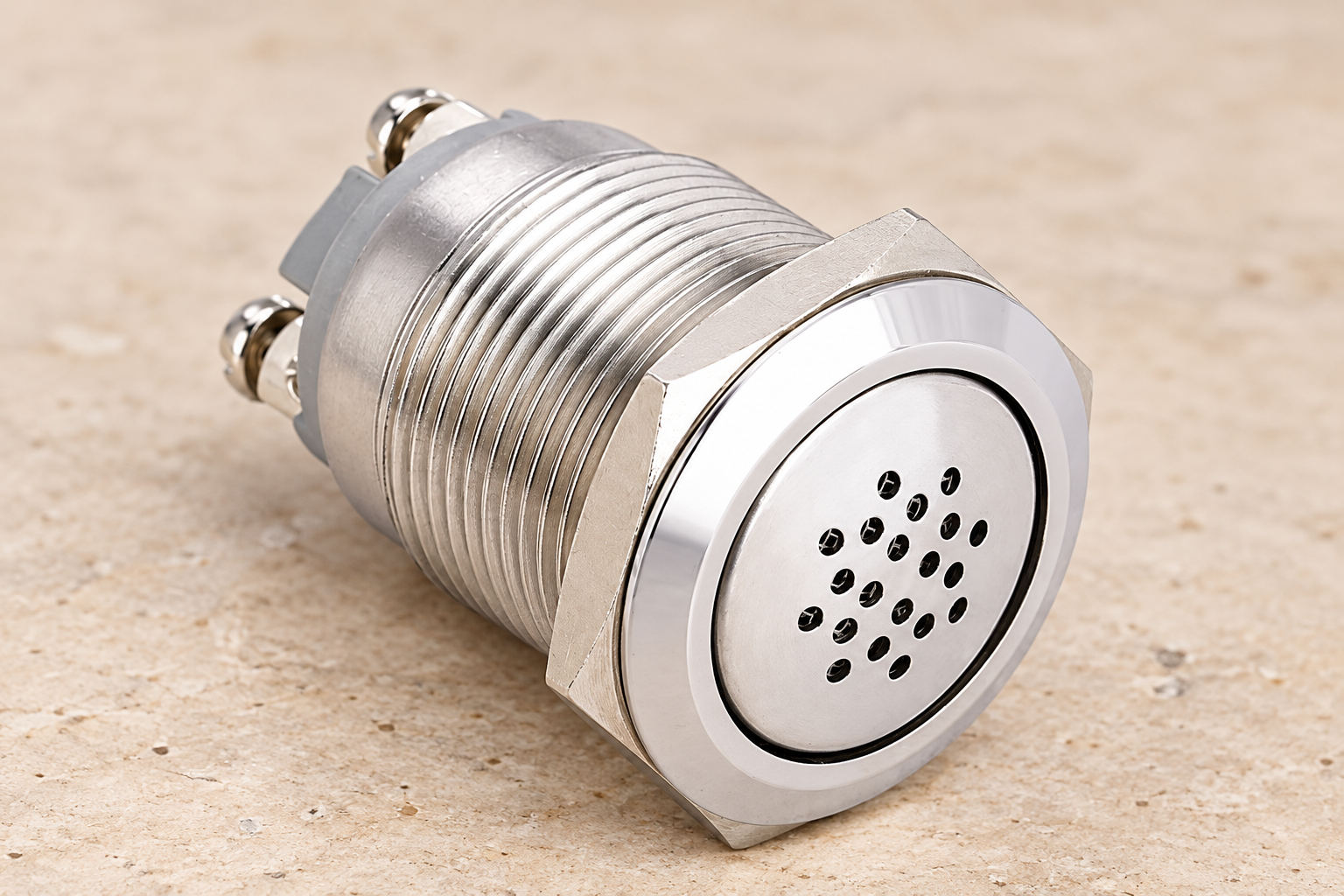
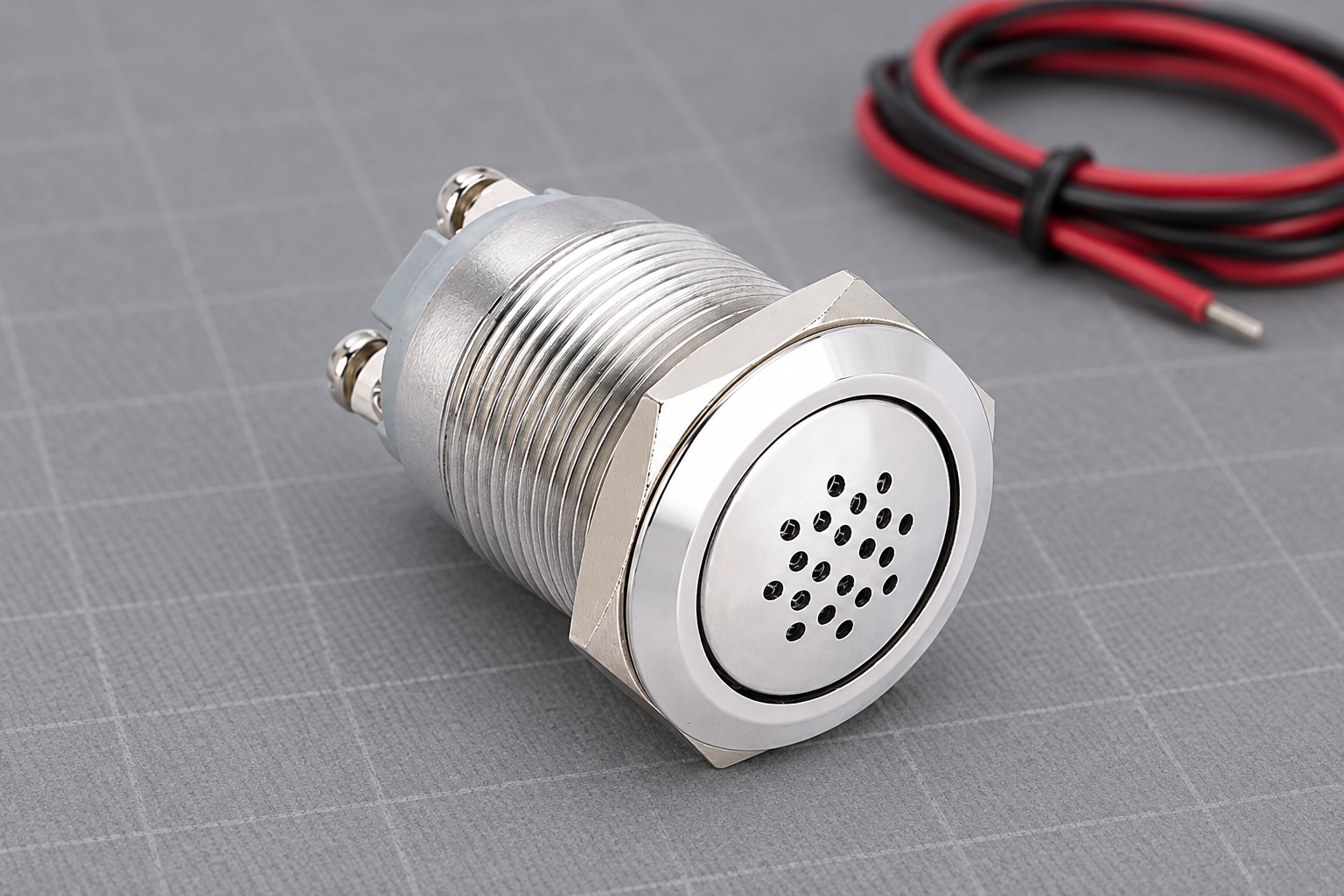
The ONPOW metal panel buzzer provides a real product starting point for an inquiry. Its visible perforated face and threaded mounting body identify the assembly form. They do not establish whether a particular supplied version is continuous or pulsed; request that information explicitly.
When a continuous pattern makes sense
A continuous signal can communicate that a condition remains present until the specified response occurs. It avoids silent gaps during which a person arriving at the area might miss the sound. However, the meaning must be trained and consistent with the site’s other alarms. “Continuous” alone does not tell an operator which machine or condition requires attention.
Consider how the signal is stopped. Does the sound end when the condition clears, when an operator acknowledges it, or only after another authorized action? Separate acknowledgement from clearing the underlying condition. A silent alarm that remains active should have an appropriate remaining indication if the application requires it.
Evaluate the effect of a sustained signal during a long fault. Workers may find a continuously sounding alarm intrusive or confusing when several machines alarm together. That observation should lead to review of alarm priorities and response design, rather than an unplanned decision to silence every warning automatically.
When a pulsed pattern makes sense
An interrupted pattern can be more distinguishable from a constant background sound in some environments. It can also support a documented distinction between different alarm meanings. These benefits depend on the actual listening conditions and operator training; they are not guaranteed by the word “pulsed” on a catalogue page.
Define the timing precisely enough to obtain the intended supplied version or control behavior. Record the on-time, off-time, repetition, and any sequence changes using the units and conventions required by the actual system. If no universal timing requirement applies to the application, do not invent one merely to make the purchase specification look complete.
Check whether a short command produces a recognizable signal. An internally patterned sounder may behave differently when its supply is repeatedly interrupted. Likewise, the first audible part of an externally generated sequence may be missed if the input and sounder have relevant response behavior. Use documented information and an installed verification plan.
A pattern-selection decision table
| Selection question | Continuous signal considerations | Pulsed signal considerations |
|---|---|---|
| What must the operator do? | Define the sustained condition and the action that ends or acknowledges sound | Define what the pattern means and how it differs from other alarms |
| Who may enter after the alarm begins? | Sound remains present while commanded | Check whether silent gaps delay recognition for a newly arriving listener |
| How is timing produced? | Confirm the required supply or drive interface | Confirm internal timing or the exact external control responsibility |
| Can other machines alarm together? | Identify potential masking and source confusion | Check whether overlapping patterns become difficult to distinguish |
| What happens after acknowledgement? | Specify whether the condition remains visually indicated | Specify whether pulsing stops, changes, or continues under the approved design |
| How is operation accepted? | Observe correct start, persistence, stop and restart behavior | Observe the complete sequence and its behavior after interruption or restored power |
For U.S. workplaces with employee alarm systems, 29 CFR 1910.165 addresses alarm recognition and related system requirements. Its scope should be checked for the particular installation. It does not mean every machine buzzer must use one universal pulse pattern.
Avoid confusing an equipment signal with a site alarm
A local machine signal and a building evacuation or employee alarm can have different purposes, audiences, and response procedures. Coordinate a proposed machine pattern with the site’s established signals. An operator should not have to guess whether an unfamiliar pulsing sound means a process fault or a need to leave the area.
Keep the response instruction close to the signal’s intended context. A visual indicator can help identify the source, while operating instructions explain the required action. The comparison of tower lights and panel indicators discusses the role of visual location and visibility. Sound and light should communicate compatible meanings rather than contradict each other.
If a purchasing request merely says “warning buzzer,” ask which alarm system it belongs to and whether an existing pattern must be matched. Matching the electrical supply while changing the acoustic message can leave the replacement electrically operational but functionally unsuitable.
Verify the output interface before choosing the pattern
Check the exact buzzer’s documented current requirement and the controller output’s suitability. A control output may need an approved interface device. The output type, leakage behavior, polarity, protection, and available supply all matter. Use the actual documents rather than a generic wiring example.
For an externally switched pattern, establish whether the command comes from a transistor output, relay output, or another interface. Frequent operation can have implications for the selected output hardware. No universal switching frequency or relay-life value can be assigned without the actual parts and operating conditions.
For an internally pulsed version, identify what happens at the input when the sound is silent. Acoustic silence does not necessarily mean the electrical load has disappeared. This distinction matters when interpreting current measurements or deciding whether the controller has turned the signal off.
The industrial buzzer wiring guide provides complementary interface questions. It should be used alongside the exact supplied buzzer and controller instructions, not as a replacement for them.
Test recognition in the installed environment
A bench test can confirm basic sound production, but the intended listener may hear a different result in the machine area. The enclosure, mounting, noise sources, distance, listener position, and hearing protection can affect recognition. Define representative operating conditions before evaluating the selected pattern.
Test the full sequence from the operator’s perspective. Can the person identify the source and the required action? Can someone arriving partway through the sequence recognize it? Do nearby alarms or normal machine sounds create confusion? Record the observations rather than reporting only that the buzzer sounded.
Where noise exposure is relevant, 29 CFR 1910.95 provides U.S. occupational-noise requirements. Alarm audibility and acceptable worker exposure must both be addressed. An alarm-selection test is not by itself a noise-exposure assessment.
For further learning, the accompanying neutral educational video explains sound waves. It supports understanding of acoustic signals; it does not specify the timing or acceptance criteria for an industrial alarm.

Write an inquiry that produces a usable answer
Include the intended alarm meaning, installed environment, required listener positions, electrical input, mounting details, and existing signals that the new alarm must complement. State whether continuous or interrupted sound is required and who is responsible for producing the timing. Ask for the exact order code and documentation for the offered version.
Also describe acknowledgement and return-to-normal behavior. Request information on what happens when power is removed and restored, and how any internally generated pattern begins. These questions prevent a replacement from behaving differently after a brief supply interruption.
Keep the accepted specification, supplied part identity, controller configuration, and installed verification record together. If the pattern is changed later, treat the change as an alarm-behavior change requiring review, rather than an undocumented maintenance preference.
Často kladené otázky
Is a pulsed buzzer always easier to hear?
No. Recognition depends on the pattern, tone, sound level, background noise, listener position, and other alarms. Verify the complete installed signal under representative conditions.
Can I make any continuous buzzer pulse by switching its supply?
Do not assume this is permitted or effective. Check the exact device’s input requirements and behavior, and verify the proposed controller interface and timing.
Does pulsed operation always reduce electrical current?
No universal reduction can be assumed. Internal electronics may remain supplied during acoustic gaps. Use the documented electrical requirements and measurements appropriate to the actual version.
Is pulse rate the same as tone frequency?
No. Pulse rate describes repetition of sound and silence; tone frequency concerns oscillation within the audible sound. Specify them separately when required.
What should be recorded for an accepted alarm pattern?
Record its meaning, order code, timing responsibility, control behavior, acknowledgement and restart behavior, listening conditions, and the installed recognition test results.



