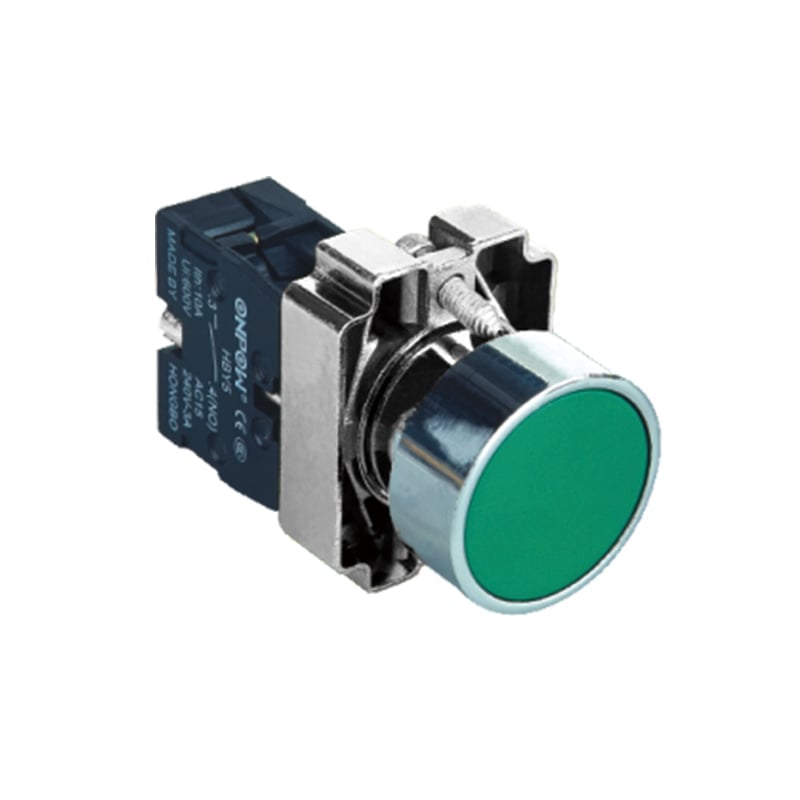
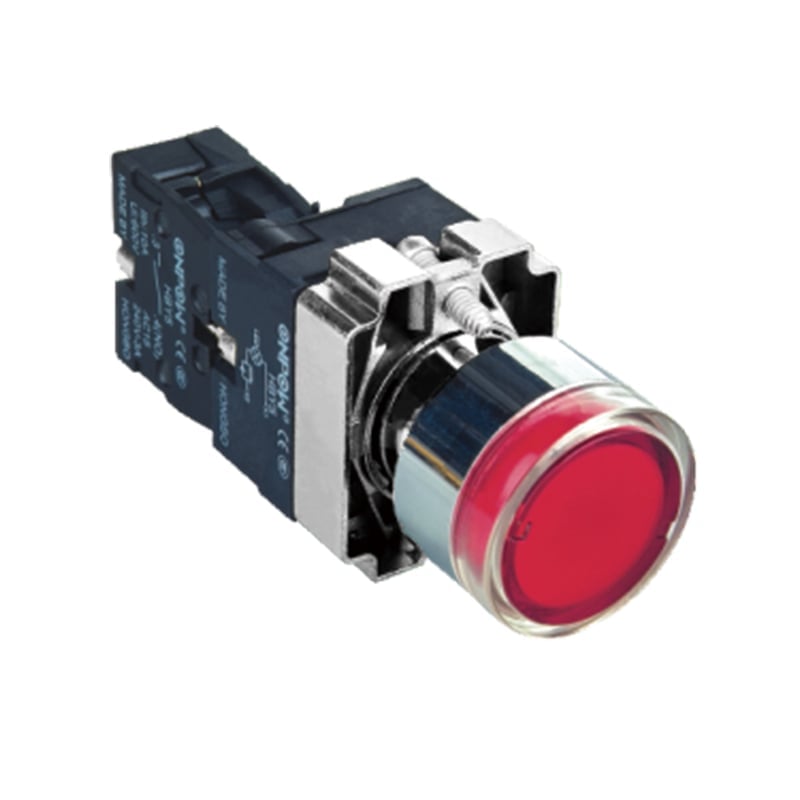
Push button plastic thermal expansion evidence is useful only when its material, measurement direction and temperature interval are identified. A coefficient from a specimen is not a finished switch operating temperature, a mounting clearance guarantee or a complete thermal design approval. For purchasing review, connect the report to the relevant component, preserve the test conditions and ask an engineer to assess the assembly implications. This guide explains what to request and how to avoid comparing incompatible values. It provides no thermal expansion coefficient for an ONPOW product; the photographs are product identification examples rather than evidence of material composition or thermal performance.
Identify the property before using the number
Thermal expansion concerns dimensional response to a temperature change. It is a different question from how rapidly heat moves through a material, how a specimen bends under a specified heated load, or how performance changes after prolonged heat exposure. The names can appear close together on a datasheet, but they should remain separate fields in a purchasing file.
The BSI ISO 11359-2 listing and public scope identifies a TMA method for linear expansion of solid plastics and determination of glass transition temperature. Read the report’s actual method and output. A reference to this method does not mean every number on the sheet is an expansion coefficient or an approved service temperature.
For basic physical context, Saint Mary’s University’s expansion demonstration shows how temperature related dimensional changes can affect fit. The demonstration uses metal objects; it is not a plastics TMA procedure or a source of ONPOW material data. Its purpose here is to explain why dimensions and temperature need to be discussed together.
State the assembly question separately
A buyer may be concerned about a plastic operator body installed in a metal panel. Before requesting an expansion report, record the exact concern: a specified interface, a documented temperature exposure, or an observed change in fit. Give this information to the responsible engineer. The relevant evidence may include component drawings, installation information and application testing alongside material data.
Do not start by assigning an assumed coefficient to the entire switch. The head, body, retaining hardware and panel may be different materials with different constraints. A material report does not describe all those interfaces. Even a clearly identified coefficient needs qualified interpretation before it can contribute to an assembly calculation.
The HBY5 product information identifies an ONPOW example for an inquiry. Specify the ordered configuration and named component instead of treating the family name as a material declaration. Ask ONPOW which available evidence covers the component and what installation documentation applies to the order.
Keep direction and temperature interval attached
A coefficient should remain linked to the direction and interval stated by its issuer. If a report contains several values, preserve each label. Do not average them to create one convenient number without an approved basis. If the direction is described relative to a specimen or manufacturing reference, request the drawing or explanation needed to interpret it.
Likewise, do not extend a result beyond its stated temperature interval merely because a spreadsheet accepts the input. An engineer may need additional data or a different model for another range. Procurement’s role is to preserve the actual conditions and obtain the right review, rather than to turn an interval specific measurement into a universal property.
Check the units carefully. Coefficients may be presented with a multiplier or exponent in a table heading. Copy the heading and units with the value, and ask the issuer to clarify ambiguous formatting. A missing multiplier can cause a large interpretation error even when the numerical digits were copied correctly. Preserve the original document for reference.
Review the material and specimen history
Request a controlled material reference, specimen identification and preparation description. Find out whether the specimen represents the material in the named component or another sample. A report on a generic resin can be useful background, but its relationship to the supplied item must be documented before it is accepted for a specific purchasing purpose.
Ask for the reported conditioning and thermal history, together with any stated limitations. If the report distinguishes different measurement runs or directions, do not collapse them into one unexplained average. Let a qualified reviewer decide how the record should be interpreted. A second curve is information to investigate rather than a reason to choose whichever result seems more favorable.
Where the supplier’s formulation is confidential, use a controlled code and scope statement. The purpose is traceability, not unnecessary disclosure. Make clear which component and configuration the code represents and who is responsible for communicating changes. Without that connection, an apparently detailed laboratory report may still fail to address the item you are buying.
Use a practical evidence table
This table is a purchaser’s review aid. It contains no standard mandated acceptance limits and does not replace the TMA method or an engineering calculation.
| Pole pro přezkoumání | Požadované podklady | Podpora rozhodnutí |
|---|---|---|
| Component | Ordered configuration and named plastic part | Relevance to the purchase order |
| Materiál | Grade or controlled supplier reference | Traceability to the tested sample |
| Output | Linear coefficient or other clearly named result | Correct interpretation of the number |
| Směr | Measurement axis and specimen reference | Compatible comparison of directional data |
| Teplota | Reported interval and thermal history | Identification of the measurement scope |
| Assembly | Drawings, constraints and applicable instructions | cURL Too many subrequests by single Worker invocation. To configure this limit, refer to https://developers.cloudflare.com/workers/wrangler/configuration/#limits |
cURL Too many subrequests by single Worker invocation. To configure this limit, refer to https://developers.cloudflare.com/workers/wrangler/configuration/#limits.
Know when a clearance estimate needs more evidence
cURL Too many subrequests by single Worker invocation. To configure this limit, refer to https://developers.cloudflare.com/workers/wrangler/configuration/#limits.
cURL Too many subrequests by single Worker invocation. To configure this limit, refer to https://developers.cloudflare.com/workers/wrangler/configuration/#limits.
cURL Too many subrequests by single Worker invocation. To configure this limit, refer to https://developers.cloudflare.com/workers/wrangler/configuration/#limits.
Separate expansion from the other thermal reports
The průvodce tepelnou vodivostí plastů cURL Too many subrequests by single Worker invocation. To configure this limit, refer to https://developers.cloudflare.com/workers/wrangler/configuration/#limits.
The cURL Too many subrequests by single Worker invocation. To configure this limit, refer to https://developers.cloudflare.com/workers/wrangler/configuration/#limits cURL Too many subrequests by single Worker invocation. To configure this limit, refer to https://developers.cloudflare.com/workers/wrangler/configuration/#limits.
cURL Too many subrequests by single Worker invocation. To configure this limit, refer to https://developers.cloudflare.com/workers/wrangler/configuration/#limits informace o tlačítkových spínačích and the exact product documentation. State the application environment when asking ONPOW for assistance. Request available evidence and identify the open questions rather than asking for a general statement that a button is suitable for every heated control panel.
Compare offers and document the outcome
Suppose one supplier provides a coefficient without direction or interval, while another supplies a full report for a clearly named specimen. The first offer needs clarification; it should not be assigned the same evidence confidence simply because both tables contain a number. Ask for the supporting report and component mapping before deciding whether the results are comparable.
If both reports are complete but their conditions differ, retain those differences in the comparison. Ask the technical reviewer whether the documents support the limited decision you need or whether controlled additional evidence is necessary. Do not construct an unsupported correction to force a ranking. A documented conclusion that the offers cannot yet be compared is preferable to false precision.
Save the accepted report, configuration mapping and engineering decision together. Record which future material or component changes require review. If a revised report arrives, preserve the earlier version and explanation of the change. This allows repeat purchasing to use historical evidence responsibly without silently extending its scope to a modified product.
Často kladené otázky
Is an expansion coefficient the maximum operating temperature?
No. They are different kinds of information. Use the exact product's applicable operating documentation and keep material expansion evidence within its reported conditions. Do not turn a coefficient or a TMA transition result into a product temperature rating.
Can one coefficient describe the whole button assembly?
Do not assume so. Identify the relevant components, materials and constraints. A qualified engineer must determine whether the available evidence is sufficient for the assembly question, particularly where several materials and interfaces are involved.
Can values with different intervals be compared directly?
Keep the intervals visible and obtain qualified interpretation. A value measured over one range should not be treated as universally applicable. Ask for matching evidence if the purchasing decision requires a controlled comparison.
What should an inquiry include?
Send the ordered configuration, component of concern, application temperature information and the decision you need to make. Request available material evidence, its measurement direction and interval, and the applicable drawings and installation instructions.
Další informace
Saint Mary’s University demonstrates thermal expansion and contraction using metal objects. This illustrates dimensional change only; it supplies no plastic expansion coefficient or ONPOW temperature rating.