

Industrial buzzer sound level is meaningful only when the measurement conditions are known. A catalogue value needs a distance, operating input, acoustic setting, and measurement convention before it can be compared with another device. Installed audibility also depends on background noise, the listener’s location, the enclosure, and any hearing protection. Choose a buzzer by defining the required alarm recognition at the actual listening positions, then verify the installed signal. A larger advertised decibel value does not by itself demonstrate that an operator will identify the alarm correctly or that workplace noise exposure is acceptable.
What a decibel value actually describes
Decibels express a level relative to a reference. Sound-pressure level, sound-intensity level, and sound-power level describe different quantities. They must not be treated as interchangeable catalogue fields. Ask what quantity the supplier reports and how it was measured before comparing two numbers.
Frequency weighting and time response also matter. A value identified as A-weighted includes a particular frequency-weighting convention. A peak or maximum reading can answer a different question from an average over a measurement interval. Preserve the units and qualifiers instead of shortening every result to “dB.”
The OpenStax explanation of sound intensity and sound level provides the physical background. For purchasing, the immediate practical step is to obtain a complete measurement statement. If a webpage supplies only an approximate level without the rest of the conditions, request the missing information rather than treating it as a guaranteed installed result.
Start with the listening position
List the places where the intended people may be when the alarm starts. An operator at the panel, a maintenance worker behind the machine, and someone approaching along an aisle may have different acoustic paths. Walls, cabinets, guards, and machine structures can change those paths.
Define the operating condition during which recognition is required. A test in a quiet stopped workshop does not represent an alarm that must be heard during normal production. Include relevant noise sources and the conditions under which they run. Record where a listener stands and faces rather than reporting simply that “the room was tested.”
The required response also affects the test. Hearing an unusual sound, recognizing which equipment produced it, and knowing what action to take are different outcomes. A signal that is audible but indistinguishable from another machine’s alarm can still be unsuitable for its purpose.
Read the product value without overextending it
Use the full order code when requesting acoustic data. Supply version, operating conditions, and product arrangement may affect the offered information. A page showing the same housing is not proof that every version has the same output. Do not borrow a rating from a similar-looking device.
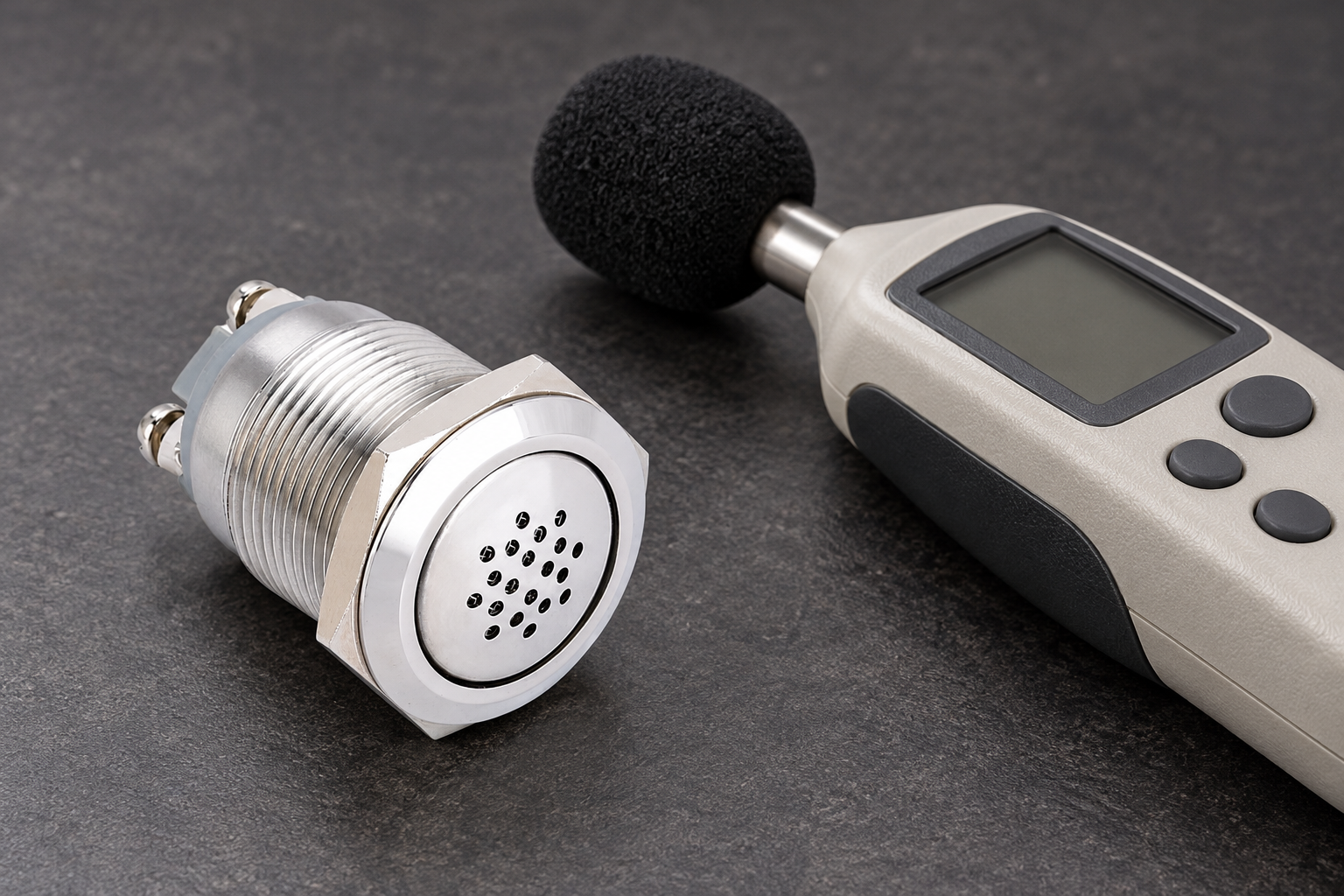
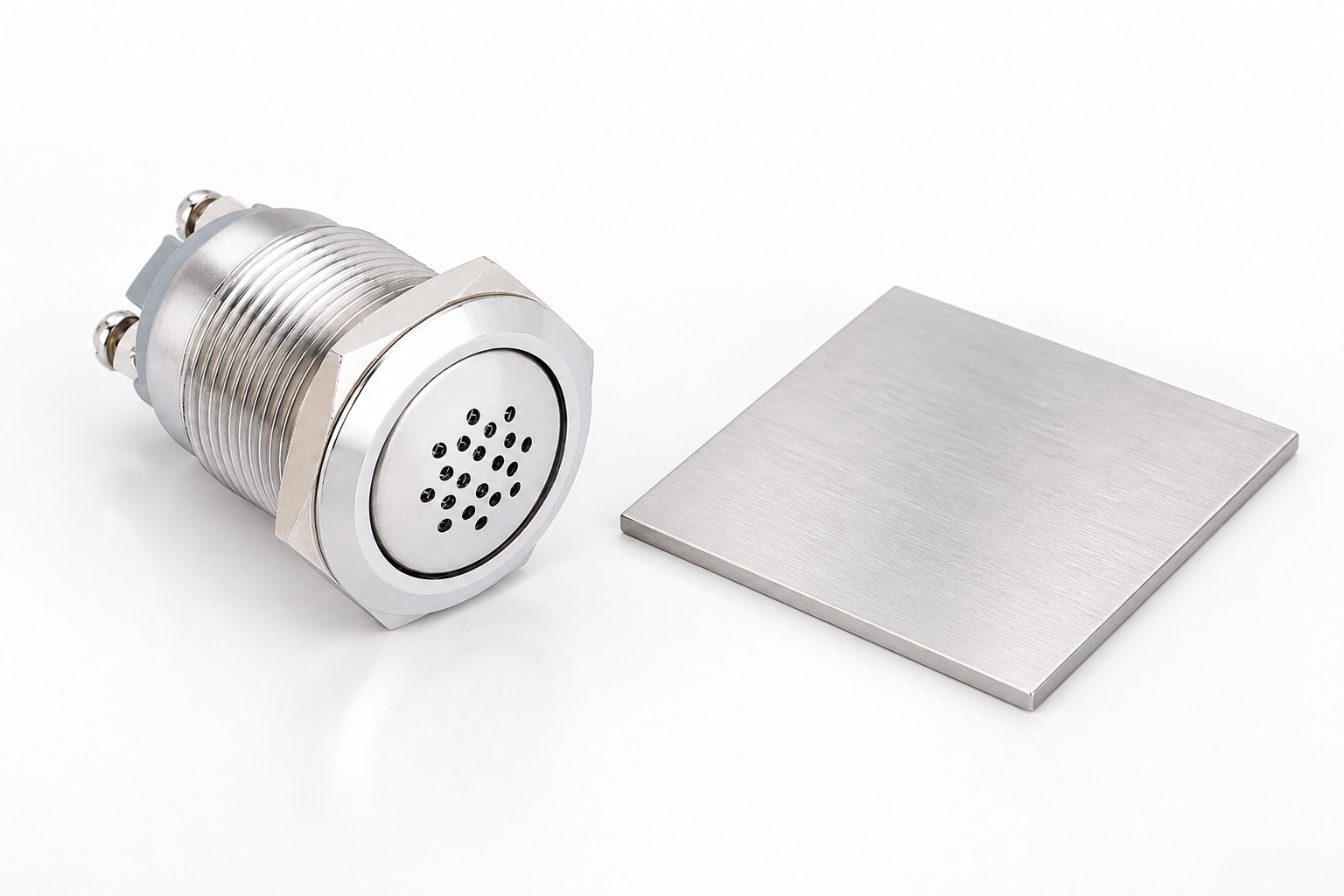
The ONPOW metal panel buzzer is a real assembly with a perforated face, threaded body, and rear connection arrangement. That visible geometry is useful for identification and mounting discussions. It does not provide an independent measurement of loudness, frequency, or suitability at a particular distance.
Keep acoustic and electrical requirements together in the inquiry. A supplier’s reported sound level applies under a specified input condition; it cannot automatically be expected when the device is driven by a different supply or interface. Verify the proposed industrial buzzer wiring and drive arrangement before evaluating acoustic performance.
Distance estimates: useful but limited
In an ideal free field, the intensity of a point source spreading uniformly decreases with the square of distance. Under that model, the change in sound level can be estimated as:
Change in level = −20 × log10(new distance / original distance).
The distances must use the same units, and both must be positive. Doubling distance gives an ideal decrease of approximately 6 dB. For example, moving from a reference distance of one metre to two metres gives approximately that change under the stated model. This is a calculated illustration, not a claim about an ONPOW product.
The estimate assumes an appropriate source approximation and an unobstructed field without relevant reflections or additional sources. A real workshop often violates those assumptions. The enclosure can be directional, nearby surfaces can reflect sound, and the listening point can be affected by other noise. Treat the result as a planning estimate requiring installed verification.
The logarithmic calculation also means that ordinary arithmetic is inappropriate for combining decibel readings. Do not subtract a background level from an alarm level as though the values were linear sound pressures. Use a qualified measurement method when the background materially affects the result.
Enclosures and mounting change the acoustic path
A buzzer installed inside a cabinet can sound different outside it than the same device on an open bench. Panel material, openings, orientation, and surrounding objects can affect the path. Closing a cabinet door after a test can therefore change the practical result even if the electrical command remains correct.
Do not create an unapproved opening or remove a guard solely to make the sound louder. Review the complete installation, including enclosure protection, electrical safety, and the signal’s intended location. A proposed acoustic improvement must remain compatible with the equipment design.
Mounting instructions and sealing arrangements matter separately. A component’s ingress rating does not establish the protection of the assembled cabinet or its suitability for outdoor exposure. An acoustic opening and a sealing requirement can create a design tradeoff that needs manufacturer documentation and installation review.
A sound-level comparison checklist
| Field to compare | What a usable statement includes | Risk when omitted |
|---|---|---|
| Acoustic quantity | Sound-pressure, intensity or power level as actually reported | Comparing different quantities as if they were the same rating |
| Distance and orientation | Microphone position relative to the sounder | Expecting a close-range result at a distant or obstructed listening point |
| Electrical input | Actual supply and drive conditions | Assuming a changed interface preserves acoustic output |
| Measurement convention | Weighting, time response and reported statistic | Treating peak, maximum and average results as equivalent |
| Acoustic environment | Relevant free-field, room or installation conditions | Applying a laboratory result directly to a reflective workshop |
| Background sound | Representative machine operation and measurement method | Accepting a quiet-room demonstration as production proof |
| Listener conditions | Position, task, hearing protection and required response | Proving sound production without proving recognition |
The table is an inquiry and comparison tool. It does not establish a universal required level or a pass/fail limit for every machine alarm.
Audibility and noise exposure are different questions
An alarm must perform its intended signaling role while the workplace also addresses worker exposure. Increasing an alarm’s output can affect people closer to it more strongly than those at the intended remote position. A purchase specification should therefore identify both the recognition problem and the exposure considerations.
For U.S. workplaces, 29 CFR 1910.95 addresses occupational-noise requirements. Where an installation is an employee alarm system, 29 CFR 1910.165 has additional relevant requirements. Confirm the actual scope with the responsible workplace team rather than assigning one generic buzzer level to every application.
Hearing protection changes the listener’s experience and should be included where it is normally used. A test performed without required protection may not represent the actual task. Do not ask workers to remove protective equipment merely to demonstrate that the alarm is audible.
Improve recognition before simply increasing output
Review placement, sound character, pattern, and visual source identification. A different location may provide a clearer path. A different tone may be more distinguishable from a particular background. An appropriate pattern may help identify the meaning, while a visual indicator can identify the source.
These changes need application-specific verification. A higher-pitched signal is not automatically better, and a pulsed signal is not automatically easier to recognize. The industrial buzzer frequency guide explains the separate tone question. The tower-light versus panel-indicator comparison discusses visual visibility and location.
Avoid solving source confusion by adding several identical alarms without reviewing their combined behavior. When nearby equipment can alarm together, test those conditions. Operators need an understandable response, not just an increase in the total amount of sound.
Record an installed acceptance test
Define the test conditions before measuring or demonstrating the alarm. Include equipment state, listening positions, background sources, buzzer command, supply condition, enclosure configuration, and the applicable acceptance procedure. Use suitable equipment and the required competence for acoustic measurements.
Record numerical measurements with their qualifiers and also record the recognition observations required by the application. Separate a microphone reading from a person’s ability to identify the source and action. If some operating conditions were not available during the test, list them as unverified rather than assuming the result extends to them.
Retain the supplied part identity and installed configuration with the results. If the cabinet, buzzer position, process noise, or alarm control is later changed, review whether the original evidence still applies. A useful acceptance record describes a reproducible installation, not merely a successful bench demonstration.
The following educational video introduces sound-wave behavior. It helps explain the acoustic background but is not a measurement or acceptance procedure for industrial alarms.

Frequently asked questions
Can I compare two catalogue decibel values directly?
Only when their acoustic quantities and measurement conditions are sufficiently comparable. Obtain distance, input, weighting, statistic, orientation and environment information before treating one value as higher performance.
Does doubling distance always reduce the alarm by 6 dB?
That is an ideal free-field point-source estimate. Reflections, obstructions, directionality and other sound sources can change the installed result. Verify the actual listening positions.
Is a louder buzzer always the best replacement?
No. Recognition, source identification, electrical compatibility, mounting and workplace exposure all matter. Establish the reason the existing signal is unsuitable before choosing a replacement.
Does a waterproof enclosure preserve the bench sound level?
No general conclusion can be made. The complete mounting and acoustic path can affect the sound heard outside. Check the actual installed arrangement without compromising protection.
What should an acoustic test record contain?
Record the device and supply, measurement conventions, equipment state, enclosure arrangement, background conditions, listener positions, required response and limitations of the test.



