

Gold vs silver switch contacts is a question about the complete contact system and the electrical duty, not which metal sounds more premium. Gold-based contact surfaces are commonly considered for low-level signals where surface films can interfere with conduction. Silver-based contact systems are widely used for other switching duties, but their suitability still depends on the exact alloy, geometry, contact force and approved load range. Select the manufacturer’s verified contact option for the actual circuit. A maximum current rating alone does not establish reliable switching at a tiny input current, and the colour of the outside terminal does not identify the internal contact material.
Start with the signal the switch must deliver
A panel button may command a controller input, energise a relay coil or switch a load directly. Those duties are different even if the operator head looks identical. Record the supply voltage, current through the closed contact, open-circuit voltage, switching frequency and expected service environment. For an electronic input, ask for the input circuit characteristics rather than using the panel supply voltage as a complete description.
Distinguish a stable closed-state signal from a circuit that is only sampled briefly. An intermittent contact can be missed by a slow test or appear as an occasional lost command. State how the controller recognises a valid input and whether the application has monitoring that detects a failed command. This information helps the supplier assess the whole requirement.
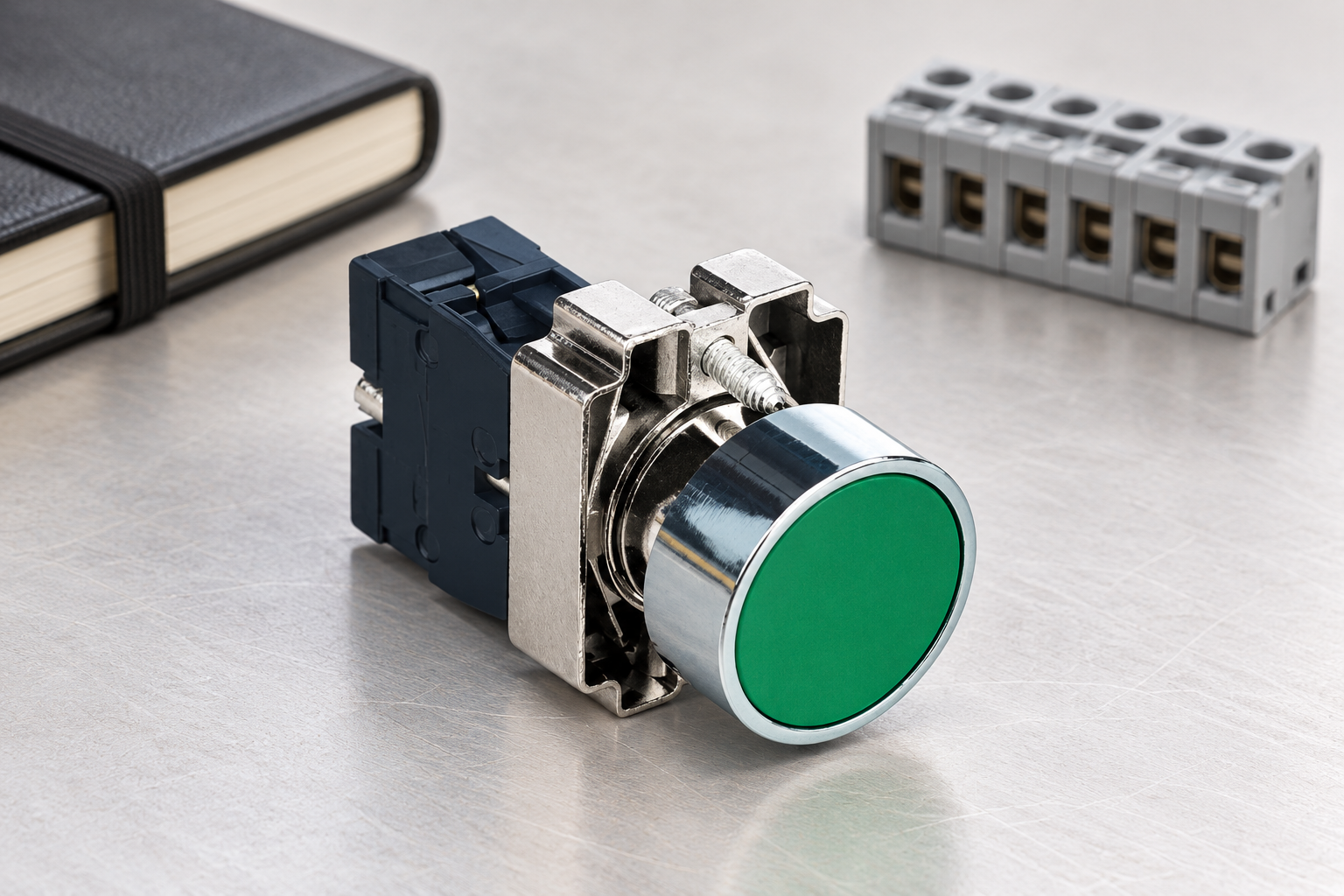
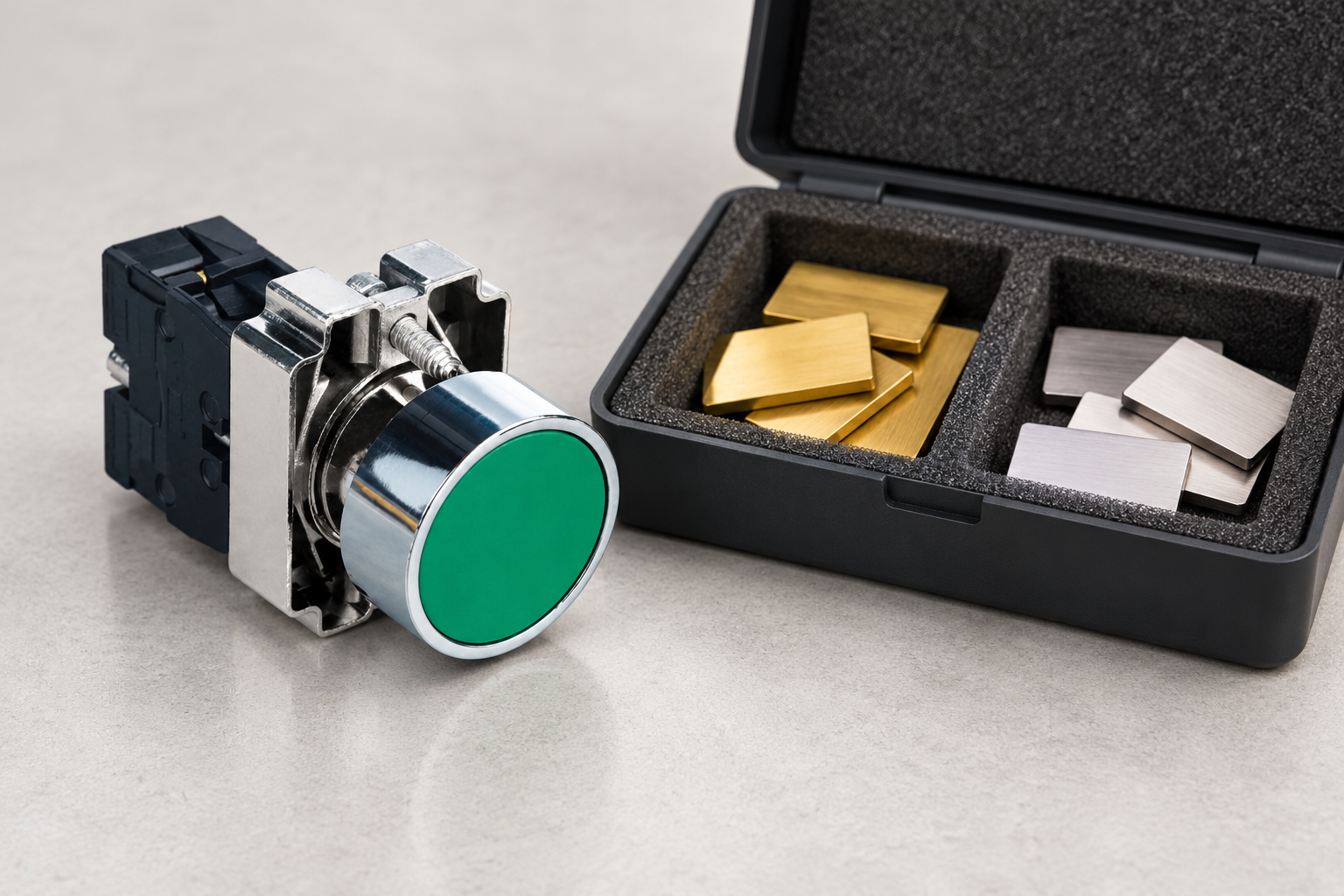
The ONPOW HBY5-11 product page is a real operator reference for a control-panel enquiry. Do not infer a gold-contact option from its appearance or from the metal colour in a photograph. Ask ONPOW to identify the contact material, available configuration and applicable load range for the exact order code before treating any option as confirmed.
Separate bulk material from the working surface
An electrical contact can combine a base material, an intermediate layer and a working surface. A phrase such as “gold contact” may describe a solid alloy, an overlay or a plated surface. These constructions are not automatically interchangeable. Ask what the description means and which test evidence supports the proposed application.
The visible screw terminal is also different from the internal switching interface. A terminal finish may be selected for wire connection or corrosion performance without telling you anything about the moving contact pair. Never scrape a contact or dismantle a saleable assembly to guess its composition. Use supplier documentation and, when necessary, an agreed laboratory analysis.
Gold finishes do not make an assembly immune to every environment. A NASA investigation of gold-plated connector corrosion documents a specific case in which porosity and chemical exposure allowed underlying material to corrode. That connector case is not a push-button qualification rule, but it illustrates why finish description alone cannot replace construction and environmental evidence.
Compare the actual decision points
The table below is a qualitative purchasing framework. It is not a set of ONPOW material specifications or a claim that every gold or silver contact behaves alike. The approved contact design and its test conditions must decide suitability.
| Decision point | Gold-based option: ask for | Silver-based option: ask for |
|---|---|---|
| Low-level input | Confirmed minimum load and signal reliability | Evidence that the exact contact system supports the input |
| Load switching | Approved duty and limits for the construction | Approved duty, current, voltage and load type |
| Surface construction | Plating or overlay details relevant to service | Alloy or surface details relevant to service |
| Umwelt | Evidence for storage, contamination and exposure | Evidence for films, exposure and enclosure conditions |
| Qualification | Repeated results under the actual low-level circuit | Repeated results under the actual switching circuit |
| Maintenance | Approved handling and replacement instructions | Approved handling and replacement instructions |
Why maximum rating and minimum load are different
A maximum switching rating concerns operation within specified upper conditions. Low-level reliability asks whether the contact consistently conducts under much smaller electrical excitation. Passing one does not logically establish the other. Procurement should therefore request both the relevant upper duty and the applicable lower-load information where the application needs it.
Do not use a high-current switching test as the first investigation of a low-level intermittent fault. Electrical conditioning can change the surface condition you are trying to observe. Agree the test sequence and preserve initial results. The companion guide to switch contact resistance measurement explains how measurement conditions can affect what the test reveals.
Avoid adding an improvised resistor simply to increase current through a troublesome input. That changes power dissipation, input behaviour and potentially the fault response. Any change to the circuit needs engineering review and supplier confirmation. A contact system selected for the actual input is a better starting point than a field workaround without an approved design basis.
Consider switching energy and contact history
The same contact assembly can have a different history after carrying a significant load. If a design relies on a low-level surface condition, ask whether the manufacturer permits later low-level use after higher-energy switching. Keep qualification samples representative of their intended service history instead of testing one sample under every conceivable load and assuming the sequence does not matter.
Do not assume that a contact material choice solves inductive-load switching by itself. Coil characteristics, switching frequency and any suppression arrangement remain relevant. The guide to relay contact ratings and load types addresses the separate load-selection problem. A surface choice is one part of an electrical design, not a substitute for matching the switching duty.
Where one machine design has several input types, document which switch configuration belongs to each circuit. A shared operator appearance can simplify the panel while different contact modules serve different duties. The bill of materials and maintenance instructions must preserve that distinction so a replacement does not silently change the contact system.
Qualify the complete assembly under realistic conditions
Define what failure means before starting the test. A missed controller input, a resistance above an agreed limit and an intermittent open are different observations. Select an instrument and test arrangement capable of detecting the relevant event. A slow handheld display may be unsuitable for recording a brief interruption.
Include the actual wiring interface, mounting arrangement and expected operating action where they influence performance. Record sample identity, circuit conditions, test sequence and environment. Use the agreed acceptance method rather than choosing a limit after seeing the results. Supplier and buyer should be able to reproduce the same test question independently.
The ASTM B539 standards page identifies a recognised framework for resistance testing of electrical connections within its stated scope. Product qualification may require other methods as well. Refer to the applicable method explicitly instead of using “tested to international standards” as an unqualified statement.
Control storage and handling as well as selection
Keep assemblies in their approved packaging until needed and avoid contaminating exposed connection areas. Record storage conditions if long delays or chemical exposure could matter to the application. A change in packaging material, cleaning agent or nearby process can be relevant to an investigation even when the switch order code is unchanged.
Do not polish, abrade or chemically clean internal contacts without an approved procedure. Such treatment can remove a functional surface or leave residues. If receiving inspection finds unstable behaviour, preserve the sample and its packaging before making changes. Ask the supplier what handling is permitted and whether the part should be replaced.
For maintenance, identify the complete replacement configuration. The contact block selection guide explains why mechanical fit alone is insufficient. A block that clips into place may still have a different contact arrangement, duty or material option. Update stock labels so visually similar variants are not mixed.
Put a precise requirement in the enquiry
A useful request states the machine function, signal voltage and current, input type, switching frequency, intended life, environmental exposure, required contact arrangement and mounting constraints. Add the proposed acceptance method and the consequence of a missed command. Ask the supplier to confirm suitability or identify the information still needed.
Request a configuration-specific drawing or specification, not just a family brochure. If the supplier offers more than one contact option, record the order-code difference and the circumstances under which each is approved. Freeze those details in the bill of materials and change-control process before ordering production quantities.
Do not claim that gold contacts automatically make an ordinary switch suitable for a safety function. Safety-related control requires the appropriate architecture, component evidence and validation for the application. Contact finish can be relevant to reliability while remaining only one characteristic of a much larger system.
Frequently asked questions
Are gold contacts always better than silver contacts?
No. The appropriate contact system depends on the electrical duty, construction and environment. Select a verified configuration rather than ranking metals without a circuit requirement.
Can I identify the internal material from the terminal colour?
No. The external terminal and the internal contact interface are different features. Ask for the specification of the exact assembly.
Does a large current rating guarantee low-current reliability?
No. Request the minimum-load information and evidence relevant to the actual signal. Upper switching limits and low-level reliability answer different questions.
What should I send when a low-level input is intermittent?
Provide the complete switch code, controller input details, wiring diagram, sample history, environment and recorded symptom. Preserve initial measurements and avoid unapproved cleaning or conditioning before investigation.
Further learning
University background on corrosion and surface degradation, relevant to the discussion of contact finishes. It does not establish the material or performance of any pictured switch.
Lecture 01: Introduction to the course & understanding corrosion — NPTEL IIT Bombay



