

Si está comprando o seleccionando un interruptor de palanca, una de las primeras cosas que querrá saber es simple: ¿Qué posición es ENCENDIDO y qué posición es APAGADO?
En la mayoría de los interruptores de palanca, la posición marcada “Yo” significa ENCENDIDO, mientras que “O” significa APAGADO. En un interruptor con palabras en lugar de símbolos, la posición etiquetada ENCENDIDO es la posición activa y APAGADO es la posición inactiva.
Sin embargo, las marcas son solo una parte de la historia. El comportamiento eléctrico real de un interruptor de palanca depende de su configuración de contactos, como SPST, SPDT o DPDT. Comprender esto puede ayudarle a elegir el interruptor correcto y evitar problemas de cableado.
¿Qué significan ON y OFF en un interruptor de palanca?
El interruptor de palanca más simple funciona como una puerta eléctrica básica.
Encendido El circuito está cerrado, permitiendo que la corriente fluya.
APAGADO El circuito está abierto, impidiendo que fluya la corriente.
Por ejemplo, si un interruptor de palanca controla una luz, moverlo a ON completa el circuito y la luz se enciende. Moverlo a OFF interrumpe el circuito y la luz se apaga.
Muchos interruptores utilizan símbolos estándar en lugar de las palabras ON y OFF:
I = ENCENDIDO
O = APAGADO
Esto es particularmente común en equipos eléctricos e industriales.
¿Hacia qué lado es ENCENDIDO en un interruptor de palanca?
No existe una regla universal que diga que el interruptor deba estar ENCENDIDO cuando la palanca apunta hacia arriba, hacia abajo, hacia la izquierda o hacia la derecha.
El La posición de encendido (ON) depende del diseño del interruptor, la dirección de instalación, las marcas y la aplicación.
Para un interruptor de palanca simple de dos posiciones, es posible que vea:
ENCENDIDO — APAGADO
o
I — O
Si el interruptor no tiene marcas visibles, no asuma que la posición hacia arriba es automáticamente ENCENDIDO. El interruptor debe comprobarse con su diagrama de cableado o probarse con un multímetro.
Esto es especialmente importante al reemplazar un interruptor existente. Un repuesto puede tener la misma apariencia pero una disposición de contactos diferente.
Interruptores de palanca ONPOW para aplicaciones industriales
Para equipos industriales y paneles de control, la confiabilidad de los interruptores importa tanto como la función de ENCENDIDO/APAGADO.
ONPOW fabrica una gama de interruptores de palanca diseñados para aplicaciones donde son importantes la conmutación fiable, las clasificaciones eléctricas adecuadas y el rendimiento mecánico constante. Los compradores pueden seleccionar diferentes configuraciones y especificaciones según sus requisitos de equipo e instalación.
Para aplicaciones industriales y de OEM, elegir la configuración correcta al principio puede ayudar a evitar cambios de cableado y problemas de compatibilidad más adelante.
ONPOW7116 Interruptores de palanca
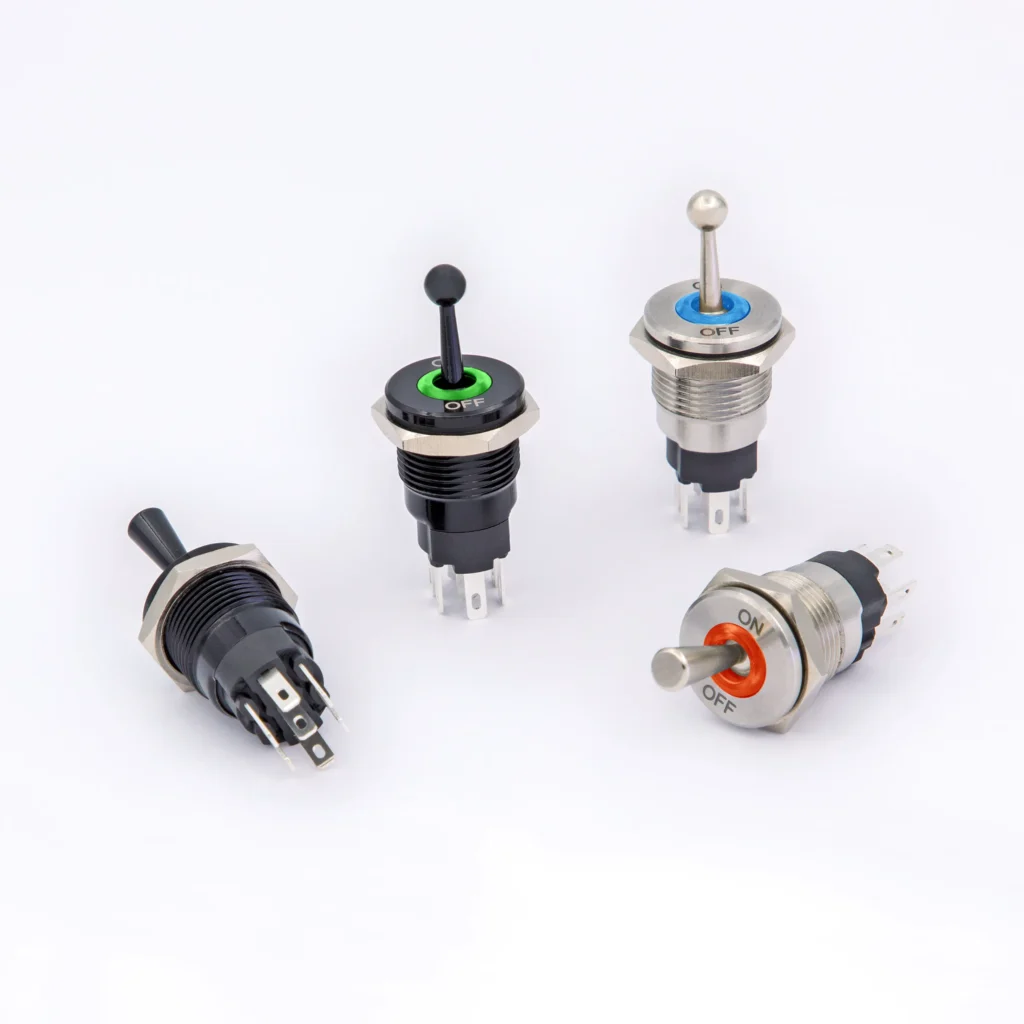
- Estructura de contacto:1NO1NC
- Color de LED: LED tricolor RGB
- Modo de operación2 posición
- Nivel de IP:IP67
- Certificación: CE RoHS REACH CCC
- Voltaje del LED:6V,12V,24V u otro voltaje puede ser personalizado
- Vida mecánica500.000 ciclos
- Vida electrónica:50.000 ciclos
Si tiene alguna necesidad de personalización, por favor contactar a ONPOW !



