

A push button plastic thermogravimetric mass loss report shows how an identified sample’s mass changes during a defined temperature or time program. Read the curve together with the atmosphere and specimen description: a final residue percentage alone cannot explain the complete measurement. For procurement, the main task is to connect the sample to the ordered molded component and determine whether the reported investigation answers the material question. A TGA curve is not a switch operating temperature, an electrical rating or a service-life guarantee. This guide explains how to review the evidence without assigning unverified material properties to ONPOW products.
Start with the question behind the test
Before requesting thermogravimetric analysis, write the concern in plain language. A buyer might need to compare the mass-change profiles of an approved material and a proposed replacement, investigate an unexpected residue, or clarify a supplier’s material report. These questions require different conclusions. A generic request for a “thermal certificate” can result in a technically valid document that does not resolve the purchase decision.
El Middle East Technical University laboratory overview describes thermogravimetry as measurement of mass change against temperature or time. It distinguishes programmed heating from measurements at a constant temperature. Its description also connects meaningful relative comparisons with consistent experimental conditions. This gives buyers a useful foundation, but it supplies no result for an ONPOW component.
Choose the laboratory question before choosing the pass statement. If the concern is dimensional deformation under load, a mass curve addresses a different property. If the concern is complete equipment suitability, material analysis can only be one part of the evidence package. Keep the final decision with the engineering and quality personnel responsible for the application.
Map the specimen to the ordered component
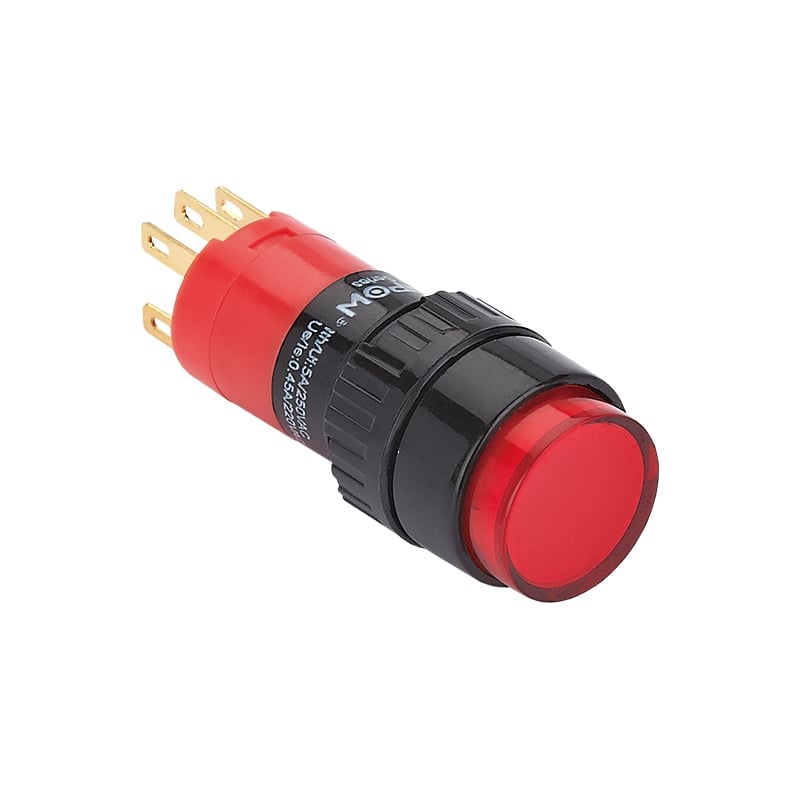
El Página del producto ONPOW LAS1 can help the buyer identify the product family when requesting documentation. Identify the specific visible part of interest as well as the ordered operator configuration. The photographs here show manufacturer products for identification; they do not identify polymer chemistry, filler level, decomposition behavior or verified thermal performance.
Ask whether the laboratory received a pellet, a cut piece from a molded part or an assembly containing several materials. Request the sample photograph or drawing reference, production lot and revision. A pellet profile cannot automatically be treated as the profile of every molded part in an operator. A mixed specimen also needs an explanation of what its result represents.
If a small piece was removed from a component, record its location. The report should make it possible for a later reviewer to understand what was analyzed without relying on an email participant’s memory. Preserve sample selection instructions and any supplier statement that links the specimen to the order. Missing traceability should remain a visible limitation.
Read the program before reading the curve
Locate the method reference and edition, temperature program and gas information before comparing any result. The EVS listing for ISO 11358-1:2022 identifies the standard covering general principles for thermogravimetry of polymers. Obtain the applicable method through the laboratory; a public listing does not replace the controlled procedure.
Record whether the run used a temperature ramp, a hold or several stages. Record the atmosphere during each stage and any gas change. A report that omits these details may not support a fair comparison with an earlier run. Ask the laboratory to explain the missing conditions instead of inferring them from the shape of a plotted line.
The following is an evidence review table. It is not a suggested instrument setup, and none of its entries sets a universal acceptance limit for a switch component.
| Campo de evidencia | Why a buyer needs it | Useful clarification request |
|---|---|---|
| Specimen and lot | Connects the curve to the purchased material or part | Identify the sampled component and production reference |
| Initial mass and basis | Defines how reported percentages were normalized | Confirm the initial reference used for calculations |
| Temperature or time program | Defines the conditions associated with each stage | Supply the full ramp and hold sequence |
| Atmosphere sequence | Helps explain which environment applied to each region | Identify the gas and any changeover points |
| Full TG curve | Preserves the sequence hidden by a single endpoint | Provide axes, units and readable annotations |
| Evaluation convention | Defines the meaning of onset or other reported markers | cURL Too many subrequests by single Worker invocation. To configure this limit, refer to https://developers.cloudflare.com/workers/wrangler/configuration/#limits |
| cURL Too many subrequests by single Worker invocation. To configure this limit, refer to https://developers.cloudflare.com/workers/wrangler/configuration/#limits | cURL Too many subrequests by single Worker invocation. To configure this limit, refer to https://developers.cloudflare.com/workers/wrangler/configuration/#limits | cURL Too many subrequests by single Worker invocation. To configure this limit, refer to https://developers.cloudflare.com/workers/wrangler/configuration/#limits |
| cURL Too many subrequests by single Worker invocation. To configure this limit, refer to https://developers.cloudflare.com/workers/wrangler/configuration/#limits | cURL Too many subrequests by single Worker invocation. To configure this limit, refer to https://developers.cloudflare.com/workers/wrangler/configuration/#limits | cURL Too many subrequests by single Worker invocation. To configure this limit, refer to https://developers.cloudflare.com/workers/wrangler/configuration/#limits |
cURL Too many subrequests by single Worker invocation. To configure this limit, refer to https://developers.cloudflare.com/workers/wrangler/configuration/#limits.
Interpret mass change with appropriate restraint
cURL Too many subrequests by single Worker invocation. To configure this limit, refer to https://developers.cloudflare.com/workers/wrangler/configuration/#limits“
A mass-change stage may require additional evidence before its chemical cause can be assigned. Do not label a loss as water, a particular additive or a specific polymer fraction merely because the curve has a step. The laboratory should explain the strength of the identification and whether another technique is needed. This is especially important when the supplier’s formulation is undisclosed.
Likewise, remaining mass is associated with the test conditions. A residue after one atmosphere and temperature program should not automatically be renamed as mineral filler. Keep the laboratory’s terminology and request clarification if a commercial summary makes a stronger claim than the analytical report supports.
Check a simple mass balance
For a defined interval, mass loss percentage = mass lost during that interval divided by the initial reference mass, multiplied by 100. Confirm the denominator used by the laboratory. A percentage normalized to the original specimen differs from one normalized to the remaining material at a later stage. The report’s convention controls the interpretation.
As an arithmetic illustration only, suppose an initial 10.00 mg reference becomes 7.00 mg at the stated endpoint. The loss is 3.00 mg, or 30.0% of the initial reference; the remaining fraction is 70.0%. These fictional numbers are not ONPOW data, proposed limits or a description of any particular material. They demonstrate why both the mass reference and endpoint matter.
For multiple stages, check whether reported losses and residue use a consistent basis before adding them. Do not force rounded published values to balance by changing the report. Request the underlying values if the difference affects acceptance. A correctly balanced calculation still cannot establish a chemical identity or a complete switch performance claim.

Compare materials without confusing the tests
A material substitution review should use an agreed comparison plan. Ask whether the reference and candidate specimens have comparable identities and histories and whether the laboratory applied the same conditions. Preserve all curves rather than selecting only the most similar region. Record what was compared and what remains outside the analysis.
La guía de molding shrinkage report guide concerns dimensional evidence from molding. Such dimensional evidence and a TG curve can be complementary, but one does not stand in for the other. Matching observations from different measurements requires a justified interpretation rather than a casual alignment of two screenshots.
For a dimensional question, consult the thermal expansion evidence guide. A component may need dimensional evidence even when its mass curve looks unchanged under a particular investigation. Ask which property the application actually depends on before expanding the analytical program.
Keep material analysis separate from operation
Do not transfer a decomposition marker into the temperature field of an equipment specification. A small specimen in a laboratory program does not reproduce the complete operator, electrical loading, mounting arrangement and intended duty. Request the manufacturer’s documented limits for the ordered configuration and use the applicable equipment design process.
A laboratory might conclude that two samples have similar profiles under the reported conditions. That remains narrower than interchangeability. The supplier’s change process must also address the relevant dimensional, mechanical, optical and electrical requirements. Do not approve a substitution solely because one curve resembles another.
Utiliza el laboratory accreditation scope review to check how the proposed analysis fits the laboratory’s competence statement. Method availability does not itself prove that a particular submitted report was issued under accreditation. Read the report’s own scope and qualifications.
Prepare a useful request for evidence
Send the supplier the exact ordered model, component of concern, reason for the investigation and reference material where available. Ask for a complete report including specimen identity, program, atmosphere, graph and evaluation notes. State whether the purpose is characterization, a batch comparison or investigation of a specific discrepancy.
In the review record, separate observations from interpretations. “The supplied curve includes two reported mass-change regions” is an observation. “The second region proves a particular additive” requires independent support. Ask the laboratory to distinguish confirmed findings from possibilities and preserve that distinction in the purchase decision.
For ONPOW inquiries, use the product family and marked component image to begin the discussion, then request documentation for the actual configuration. If the necessary material evidence is unavailable, record that limitation and decide with the responsible engineer what alternative evidence is suitable. Do not replace a missing result with a generic educational chart.
Preguntas frecuentes
Does a TGA decomposition temperature define operating temperature?
No. A marker on a mass-change curve belongs to the specimen and laboratory conditions. Obtain the documented operating limits for the ordered switch configuration and evaluate the complete equipment requirements separately.
Is final TGA residue always the filler content?
Do not assume this. Residue must be interpreted with the atmosphere, endpoint and material information. Ask the laboratory whether its evidence supports a particular composition statement or whether further analysis is required.
Can TGA and DSC reports be compared directly?
They measure different responses. Compare each report using its own axes, program and evaluation conventions, then ask a qualified analyst whether a combined interpretation is justified. A similar temperature label does not establish the same event.
What should be done if the report contains only one percentage?
Request the full graph, specimen identity and conditions associated with that percentage. Until those are available, retain the figure as incomplete evidence rather than treating it as a verified material profile for the purchase.
Información adicional
Dr Daniel Belton introduces thermogravimetric analysis and its instrumentation. This supports understanding a mass-change report; it does not provide measured composition or temperature ratings for ONPOW products.

Thermogravimetric Analysis – Introduction and Instrumentation — ChemEngTutor



