

A push button mechanical shock test report is useful only when its specimen, mounting arrangement, shock conditions and acceptance criteria match the part and application being purchased. A reference to a test standard alone does not establish a shock rating for every switch in a series. Start by connecting the report number to the exact ordered configuration, then review the applied pulse, test directions, operating state and recorded results. For a panel builder, the practical question is whether the evidence supports the proposed installation, including the rear contacts and wiring support, rather than whether a brochure contains the word “tested.”
What a mechanical shock report can establish
Mechanical shock is a transient mechanical input. A test may be intended to expose weakness, performance degradation or accumulated damage under specified conditions. The public scope of IEC 60068-2-27 describes a procedure for shocks and explains that the specimen is mounted to the test equipment. The relevant product specification must still define what conditions and outcomes matter.
That distinction prevents several purchasing mistakes. A report for a packaged consignment does not automatically qualify an unpackaged switch installed in a panel. A test of a contact assembly does not automatically cover an illuminated operator with additional parts. A cosmetic inspection after exposure does not establish uninterrupted electrical function during exposure. Each may be useful evidence, but it answers a different question.
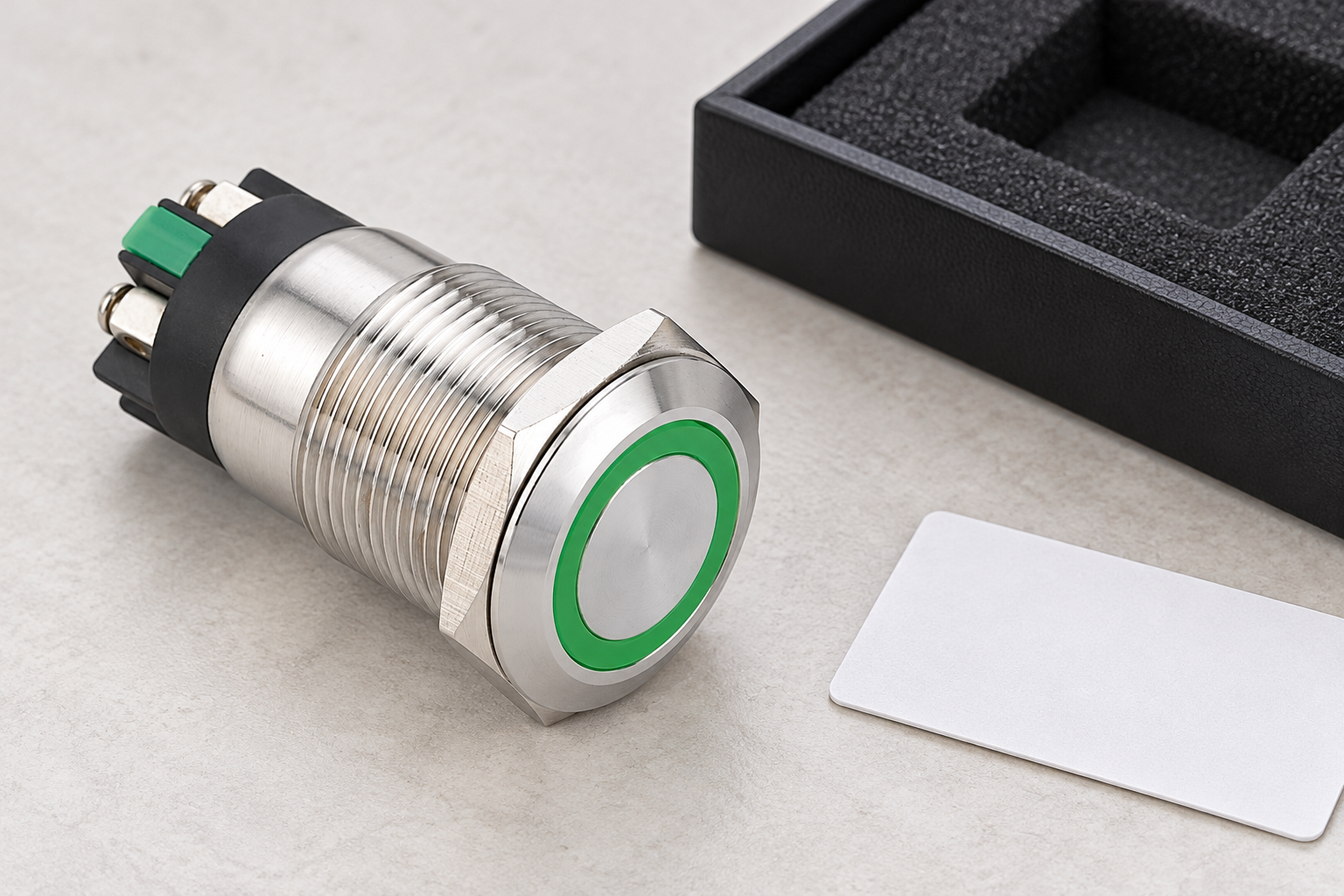
This guide uses the Page produit ONPOW LAS1GQ-11E/L/S as a concrete identification example. Its visible product photograph helps identify the front operator, threaded body and rear terminal arrangement. It does not establish a shock severity, certification or permitted installation. Obtain the applicable drawing, specifications and evidence from the supplier before making an approval decision.
Begin with specimen identity
Record the full order code, drawing revision, contact arrangement, illumination option and terminal configuration. Compare these with the report’s specimen description, photographs and sample labels. If the report uses a family name rather than an exact code, ask for a documented explanation of how the tested sample represents the ordered configuration.
Consider whether any variation changes mass distribution, retention, contact support or the load transmitted through the assembly. A different operator head, terminal module or accessory may matter. Do not decide equivalence from a shared mounting diameter or similar exterior photograph. The supplier or responsible engineer should explain the scope of the evidence.
Also establish whether samples represent production parts, development prototypes or modified laboratory specimens. A prototype report can inform design development without being sufficient for production release. Record any differences explicitly, together with the person authorized to accept them. This keeps purchasing from silently converting a development result into a broader product claim.
Read the input conditions together
A peak acceleration value without pulse duration and pulse shape is incomplete. The report should describe the selected waveform, duration, applied severity, number of shocks and directions. The OpenStax discussion of impulse provides useful background on the relationship between force, time and momentum change; it is not a component qualification method.
For procurement review, the important habit is to preserve all reported conditions as one set. Do not combine a peak from one test with a duration from another and call the result equivalent. Do not translate a shock result directly into a drop height or an impact from a tool without an engineering basis. Different mechanical inputs can produce different responses in the specimen.
Ask whether the report records the input achieved at the specified control location and whether deviations were accepted. If only nominal settings are shown, request clarification about the actual exposure record. A buyer need not redesign the laboratory procedure, but should be able to distinguish the requested test from the documented test.
Compare the mounting and terminal support
The mounting fixture defines how the input reaches the switch. Review the panel representation, fastening method, support points and any accessories used during exposure. A rigid laboratory plate can differ from a thin enclosure door. Neither arrangement is automatically wrong; the question is whether its relationship to the proposed installation has been addressed.
Use the existing panel mounting stack guide to organize the installation details that need confirmation. Record the specified panel and hardware information rather than choosing a generic tightening value from a photograph. A shock report is not permission to change the manufacturer’s installation instructions.
Rear wiring deserves separate attention. A loosely hanging cable can transmit forces differently from a supported harness. Conversely, a laboratory support may remove a load that exists in service. Ask whether terminals were wired, what support was provided, and whether this matches the intended evidence boundary. Do not load terminals mechanically during an improvised workshop check.
A practical report review table
The following table is a document review aid. It contains no universal shock limits; acceptance values must come from the applicable specification and approved test plan.
| Review item | Evidence to request | Decision it supports |
|---|---|---|
| Specimen identity | Order code, revision, photographs and sample labels | Whether the purchased configuration is covered |
| Mechanical input | Pulse shape, severity, duration, count and directions | Whether the recorded exposure matches the requirement |
| Montage | Fixture description, panel representation and fastening details | Whether installation differences need engineering review |
| Electrical state | Powered or unpowered condition, circuit and monitoring description | Which functional claims can be made |
| Results | Before, during and after observations as applicable | Whether the specified acceptance criteria were evaluated |
| Exceptions | Deviations, repairs, retests and authorized disposition | Whether the conclusion has unresolved limitations |

Separate appearance from electrical performance
A switch may look intact after a test while an electrical requirement remains unevaluated. Review which contact functions were checked, when they were checked and under what conditions. For illuminated versions, establish whether the indication function was included. Avoid substituting a general statement such as “no damage” for the specific acceptance criteria required by the application.
If continuity during exposure matters, the report needs a monitoring method appropriate to the specified interruptions. A before-and-after manual operation check cannot demonstrate the absence of short interruptions during the shock. Equally, a report that did not require continuous monitoring should not be described as having failed that requirement unless it was actually part of the agreed test plan.
Keep contact behavior separate from machine safety validation. A component shock report does not demonstrate that a complete machine control system meets its safety requirements. The panel builder remains responsible for evaluating the component within the equipment design and applicable project requirements.
Handle deviations and retests transparently
Read beyond the final pass statement. Look for fixture changes, interrupted runs, damaged samples, replacement hardware and retests. A retest can be technically justified, but its relationship to the initial result should remain visible. Ask which samples were retested, why the test was repeated and what conclusion was authorized.
Do not delete an unfavorable observation from a purchasing summary because a later sample passed. Record the documented disposition and any change to the product, fixture or procedure. If the corrective action changes the ordered configuration, the drawing and order information should identify that change. Otherwise, procurement may approve one version while production receives another.
For a missing page, unreadable graph or ambiguous specimen label, return a precise question rather than rejecting the entire supplier package without explanation. A focused clarification often resolves an administrative gap. An unsubstantiated assertion of equivalence is a different issue and should remain open until the evidence is supplied.
Keep component shock separate from shipping qualification
The test boundary must match the risk being reviewed. A mounted component shock test addresses the defined specimen and fixture. Packaging review addresses the combined protection provided by the package, product support and handling arrangements. One should not replace the other without an approved basis.
For loose switches travelling to an assembly plant, review packaging protection separately from spare switch storage. For received components, use the incoming inspection checklist to identify shipment condition, labeling and visible damage. Neither inspection can recreate an accredited laboratory exposure or prove an unreported rating.
This separation also helps investigate a complaint. A bent terminal on arrival may indicate a packing or handling issue; it is not automatically proof that the installed component failed its mounted shock requirement. Preserve the actual evidence and investigate the relevant boundary first.
Turn the review into a clear purchase decision
Create a short evidence register with the required condition, report reference, covered configuration, open questions and approval owner. Use three clear outcomes: supported for the defined requirement, awaiting clarification, or not supported by the supplied evidence. Avoid a single “shock resistant” checkbox that conceals the conditions behind the claim.
Send the supplier the proposed installation and the required evidence scope before ordering a test. Include the intended mounting, wiring support, functional checks and acceptance criteria. Ask for a quotation that distinguishes existing documentation from new testing. This reduces the risk of paying for a report that does not answer the project’s question.
After approval, retain the reviewed report and configuration references with the purchasing record. If the operator, contact block, material or manufacturing arrangement changes, ask whether the approval needs review. Evidence control is useful only if later deliveries can still be connected to the configuration that was accepted.
Foire aux questions
Does an IEC 60068-2-27 reference prove every version passed?
No. The standard identifies a test method. Coverage depends on the report’s specimen, conditions, results and any documented extension to other configurations. Request the exact evidence rather than assuming a family-wide rating.
Can a mechanical shock result be converted into a drop height?
Not from a peak acceleration alone. Drop behavior depends on the specimen, impact surface, orientation and resulting pulse. Any claimed equivalence needs a defined engineering basis, not a direct label substitution.
Is a visual inspection after shock sufficient?
Only if it satisfies the approved requirement. Electrical operation, illumination or monitoring during exposure may need separate evidence. A visual check cannot demonstrate functions that were never measured.
What should a buyer send with a report request?
Send the full order code, installation description, required exposure, operating state, functional criteria and documentation needs. Ask the supplier to identify existing evidence, limitations and any additional validation required for the application.
Further learning
Khan Academy explains impulse and how stopping time relates to impact force. This is background physics for reading a shock pulse; it is not a component test demonstration or an ONPOW shock qualification.



