

A push button vibration test report should connect a defined switch configuration to a defined vibration exposure and documented acceptance criteria. Check the specimen identity, fixture, frequency range, amplitude, sweep or dwell conditions, directions and functional monitoring before relying on a pass statement. A bare reference to a vibration standard does not prove that every operator, contact arrangement or installation has the same capability. For a panel builder, the useful result is a traceable decision about the proposed component and mounting arrangement, with open differences clearly identified before purchase or equipment release.
Define the vibration evidence you actually need
A switch installed in a machine door experiences vibration through its mounting and attached wiring. Its service environment may differ from that of a packaged switch travelling to a factory or a relay retained in a socket. State which situation the evidence is intended to address before comparing reports.
IEC 60068-2-6 describes a method for sinusoidal vibration at specified severities. Its public scope also distinguishes unpackaged specimens from a product and its packaging considered together. That distinction is important when a purchasing file contains a general vibration report without clearly identifying what was tested.
A sinusoidal report should not be relabeled as random vibration qualification. Similarly, a transportation exposure should not silently become evidence for indefinite operation on a vibrating machine. Different requirements may need different methods, conditions and functional checks. Ask the responsible engineer to define the acceptance requirement before asking the supplier for a matching report.
Trace the tested specimen to the order
Start with the complete part code, revision, terminal arrangement, contact configuration, illumination option and accessories. Compare these with specimen photographs and the report description. If the report covers a series, request the documented basis for including the exact ordered variant.
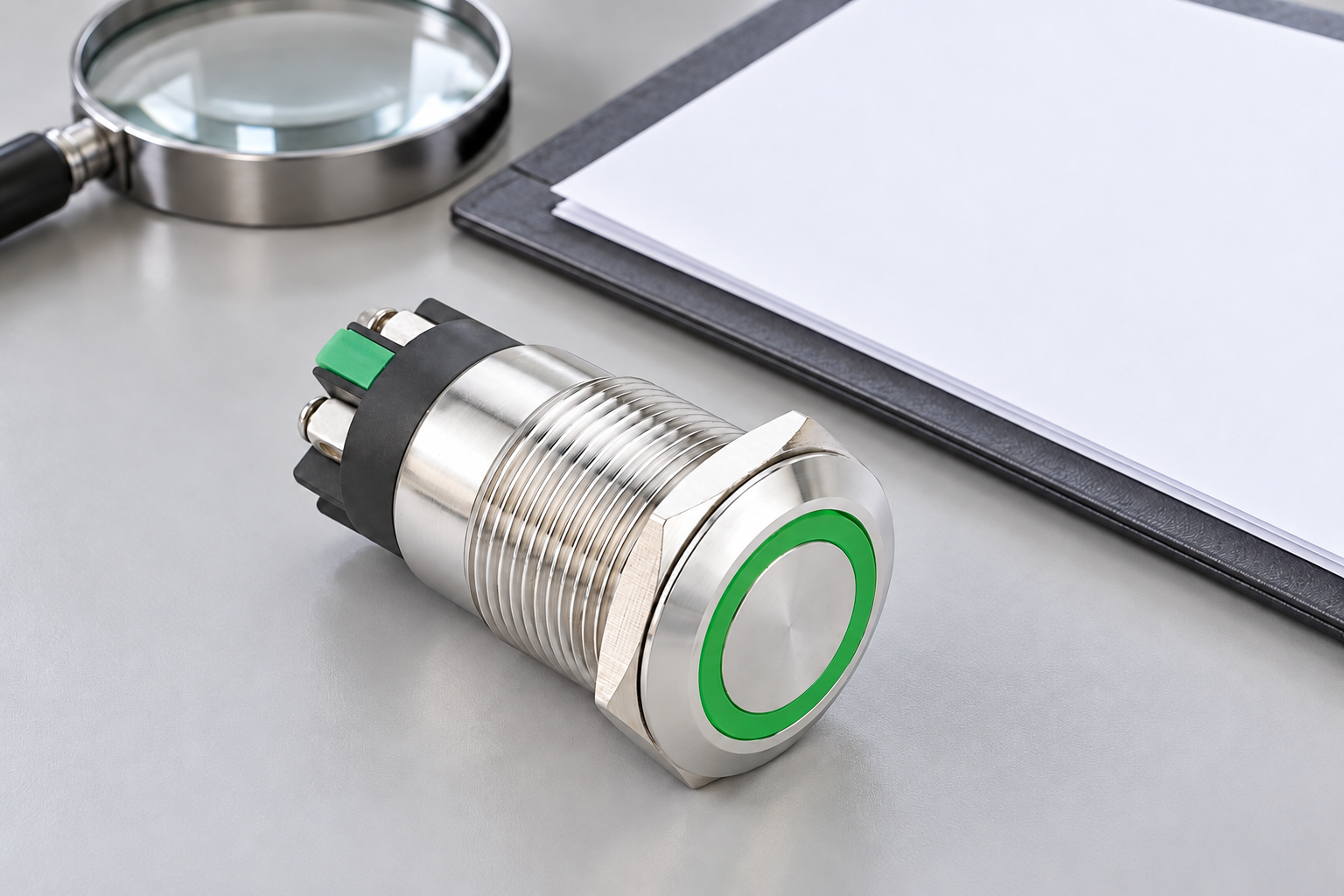
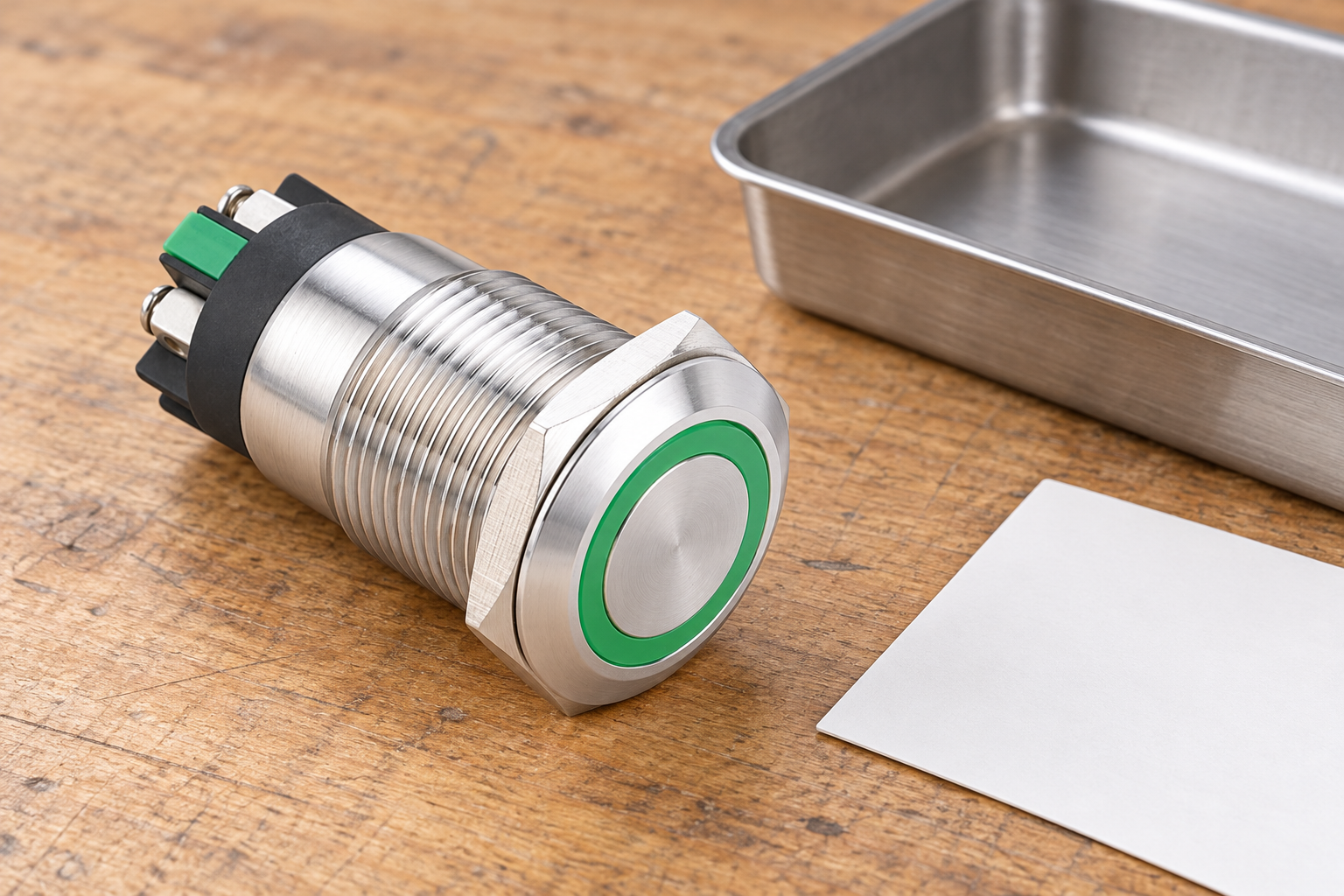
Le ONPOW LAS1GQ-11E/L/S page provides a concrete product reference for this review. The photograph shows a ring operator, threaded body and rear terminal arrangement. It does not prove a vibration rating or establish how the part was mounted during any test. Those claims require appropriate product documentation.
A visually similar head is not enough to establish equivalence. Changes in head size, accessory mass, contact support or terminal configuration can affect the mechanical system. Do not decide that two variants are covered simply because their panel cutouts match. Record the supplier’s explanation and the approval owner for any accepted difference.
Read frequency and amplitude as a complete profile
A vibration report needs more than an acceleration value. Establish the reported frequency range, amplitude description, test duration and exposure directions. Depending on the approved method, the profile may include sweeps, dwell periods or other specified conditions. Preserve the report’s terms rather than compressing them into an unsupported single number.
The educational explanation of simple harmonic motion from OpenStax helps explain why an oscillation has both an amplitude and a frequency. It is background physics, not a substitute for the applicable test procedure. Do not use a classroom spring model to calculate an installation rating for a real switch.
When comparing supplier reports, place the complete profiles side by side. A higher peak value does not automatically mean broader coverage if the frequency range, duration, fixture or monitoring differs. If two reports use different amplitude descriptions, ask a competent reviewer to assess the relationship instead of guessing from the units or marketing headline.
Check the fixture and installation boundary
The fixture is part of the test arrangement. Request photographs or drawings that show the panel representation, support points, fastening arrangement and specimen orientation. The input at a control point is not automatically identical to the motion at every location on the mounted component.
Compare the report arrangement with the intended panel mounting stack. Panel stiffness, reinforcement and accessory arrangement should be described where they are relevant to the evidence review. Use the manufacturer’s approved installation instructions for fastening and hardware; do not invent a universal tightening value for all metal switches.
Document the wiring arrangement as well. A heavy unsupported harness can impose loads that a laboratory arrangement did not include. A support used in the laboratory can also make its boundary different from the field installation. Ask whether the terminals were connected, how cables were supported and which arrangement the result covers.
A report comparison checklist
This table organizes evidence rather than setting a universal vibration severity. Values and pass criteria must come from the applicable specification and approved plan.
| Review area | What to locate in the report | Question for the approval owner |
|---|---|---|
| Product coverage | Part code, revision, configuration and sample identity | Does it represent the ordered switch? |
| Exposure type | Sinusoidal, random or other specified method | Does the method address the required environment? |
| Profile | Frequency range, amplitude, sweep or dwell and duration | Is the complete profile suitable for comparison? |
| Montage | Fixture, panel representation, orientation and wiring support | Are installation differences acceptable? |
| Function | Operating state, monitoring and before/after checks | Were the required functions actually evaluated? |
| Disposition | Deviations, interruptions, failures and retests | Are limitations resolved and recorded? |
Distinguish resonance observations from a broad approval
A component and its support can respond differently across a frequency range. A report may record resonance observations, additional investigations or changes in response. Read these alongside the exposure and acceptance criteria rather than treating their presence or absence as a universal verdict.
If a report identifies a response that prompted further testing, ask what was done and why. Was the fixture revised, the specimen changed, or an additional dwell performed? Was the final conclusion limited to a particular arrangement? Keep those answers attached to the purchasing decision.
Do not infer field service life from a vibration test duration alone. A defined laboratory exposure can provide useful qualification evidence without reproducing every operating condition, installation variability or long-term degradation mechanism. Any life prediction needs its own justified method and assumptions. A procurement summary should preserve that limitation rather than replace it with “lifetime vibration proof.”
Review electrical monitoring separately
Identify which functions were evaluated before, during and after exposure. A switch can remain visually intact while a required electrical behavior has not been demonstrated. Conversely, an unmonitored function should be described as unevaluated, not automatically failed.
For contacts, check the circuit description, operating state and acceptance criteria. If the project requires detecting brief interruptions during vibration, establish whether the monitoring method was appropriate to that requirement. A manual operation check after the test cannot demonstrate uninterrupted continuity throughout the exposure.
For an illuminated operator, determine whether the indicator function was included and whether it was powered during the test. A result for an unilluminated configuration should not be extended to every illumination option without an accepted basis. The aim is precise coverage, not the largest possible product claim.
Keep nearby component problems in their own scope
Vibration concerns can involve different parts of a control assembly. A relay socket retention problem and a panel switch mounting problem should not share an approval conclusion merely because both occur on the same machine. The existing relay retaining clip guide addresses the former boundary and should be reviewed separately where relevant.
Likewise, mechanical condition on delivery belongs in the incoming inspection process. Receiving inspection can identify visible damage, incorrect parts or missing documentation. It does not reproduce a laboratory vibration test and cannot create an unreported qualification.
When a field complaint appears, preserve the installed configuration and operating evidence. Record when the problem occurs, the affected function and any maintenance or installation changes. Avoid an improvised vibration experiment on energized machinery. Investigation should follow the site’s controlled procedure and the responsible engineer’s plan.
Write an evidence request that suppliers can answer
Send the intended order code and installation description with the request. State the required vibration method or project specification, operating state, monitoring expectations and report format. Ask whether existing evidence covers the requirement and which differences need additional assessment.
Separate administrative gaps from technical gaps. A missing specimen photograph may be resolved by retrieving the report attachment. A different terminal configuration may need an engineering explanation. An exposure that omits a required frequency range may need new testing. Treating all three as the same issue wastes time and obscures the actual decision.
For a new test, agree on the specimen, fixture, exposure, functional criteria and deviation process before work starts. Request a clear scope in the quotation so the laboratory activity answers the project’s question. Do not ask a supplier simply to “provide a vibration certificate” and expect every installation detail to be covered.
Maintain the decision after approval
Record the accepted configuration, report number, relevant conditions, limitations and approval owner in a controlled register. Make the purchasing description consistent with that record. A short conditional statement is more useful than a generic “passed” field when the approval depends on a particular arrangement.
Review changes to the operator, contact assembly, materials, terminal support or manufacturing configuration through the agreed process. The existence of an older report does not determine whether a changed part is covered. Ask for documented continuity or a new assessment where necessary.
Before ordering the illustrated ONPOW product for a vibration-sensitive project, request the current drawing, installation instructions and available qualification documentation. Define the environment and required evidence first. This creates a focused supplier discussion and avoids treating a product image or standard title as proof of suitability.
Foire aux questions
Does a sinusoidal vibration report cover random vibration?
Not automatically. These describe different exposures. The relevant specification and competent reviewer must determine what evidence is required and whether any documented relationship is acceptable for the application.
Is the highest acceleration number the best comparison?
No. Compare the complete frequency range, amplitude description, duration, directions, mounting and functional checks. A single peak value can conceal important differences between reports.
Can a post-test contact check prove there were no interruptions?
No. It establishes only the function checked at that time. Demonstrating behavior during vibration requires an appropriate monitoring method and explicit acceptance criteria in the test plan.
What if a supplier report uses only a series name?
Request the sample configuration and a documented explanation of coverage for the exact order code. Keep any limitations visible until the responsible approval owner accepts the evidence.
Further learning
Khan Academy introduces harmonic motion using a mass and spring. This explains frequency and oscillation as background for sinusoidal vibration; it does not establish the response or qualification of the pictured switch.

Introduction to harmonic motion | Oscillatory motion | Physics | Khan Academy — Khan Academy



