

A salt spray report can help a buyer evaluate a stainless steel push button only when the tested specimen, method, exposure conditions and acceptance criteria match the question being asked. A statement such as “passed 500 hours” is incomplete without those details. It does not establish years of outdoor service, prove that the complete switch remains electrically functional or show that every component in the assembly is stainless steel. Start by requesting the actual report and identifying exactly what it demonstrates.
This guide addresses procurement evidence for industrial panel components. It does not claim that the illustrated ONPOW button has passed any salt spray test. It also does not replace marine equipment approval, enclosure ingress testing or the environmental assessment of a complete machine. Those are different decisions, even when they involve the same installation.
Define the service question before asking for hours
Describe the proposed environment in practical terms. Is the panel indoors near a coastal opening, exposed to occasional salt deposits, installed on a vessel or regularly cleaned with chemicals? Identify the expected maintenance and the parts exposed on each side of the panel. These conditions help the responsible engineer decide which evidence is relevant; they are not a recipe for reproducing service in a chamber.
A purchasing team may need to compare finishes, investigate a returned part or qualify a specific assembly. Those objectives can require different specimens and acceptance criteria. A test useful for comparing two surface treatments may not answer whether an installed lamp and contact assembly will continue working. Write the decision first, then ask the laboratory or supplier how the proposed evidence addresses it.
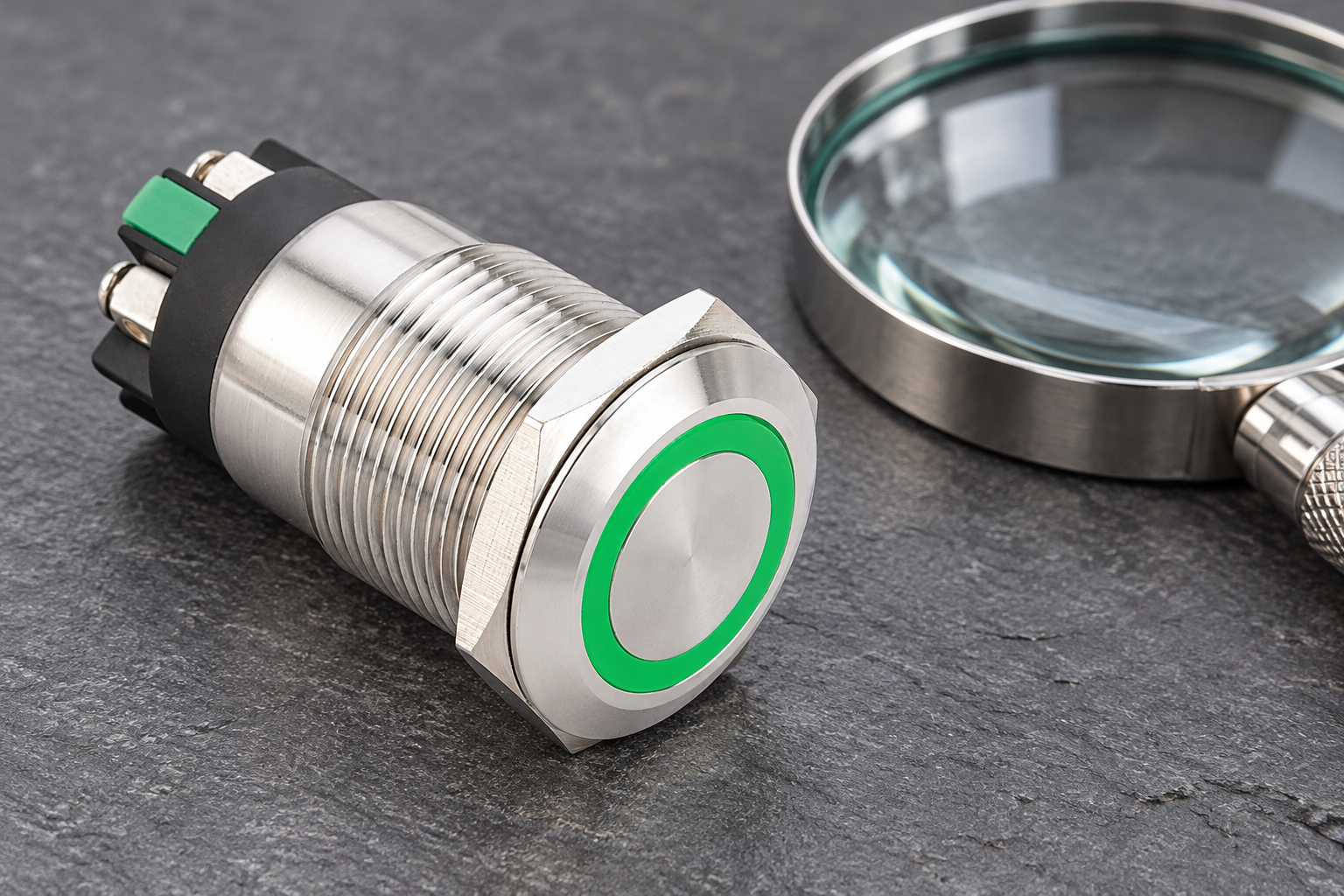
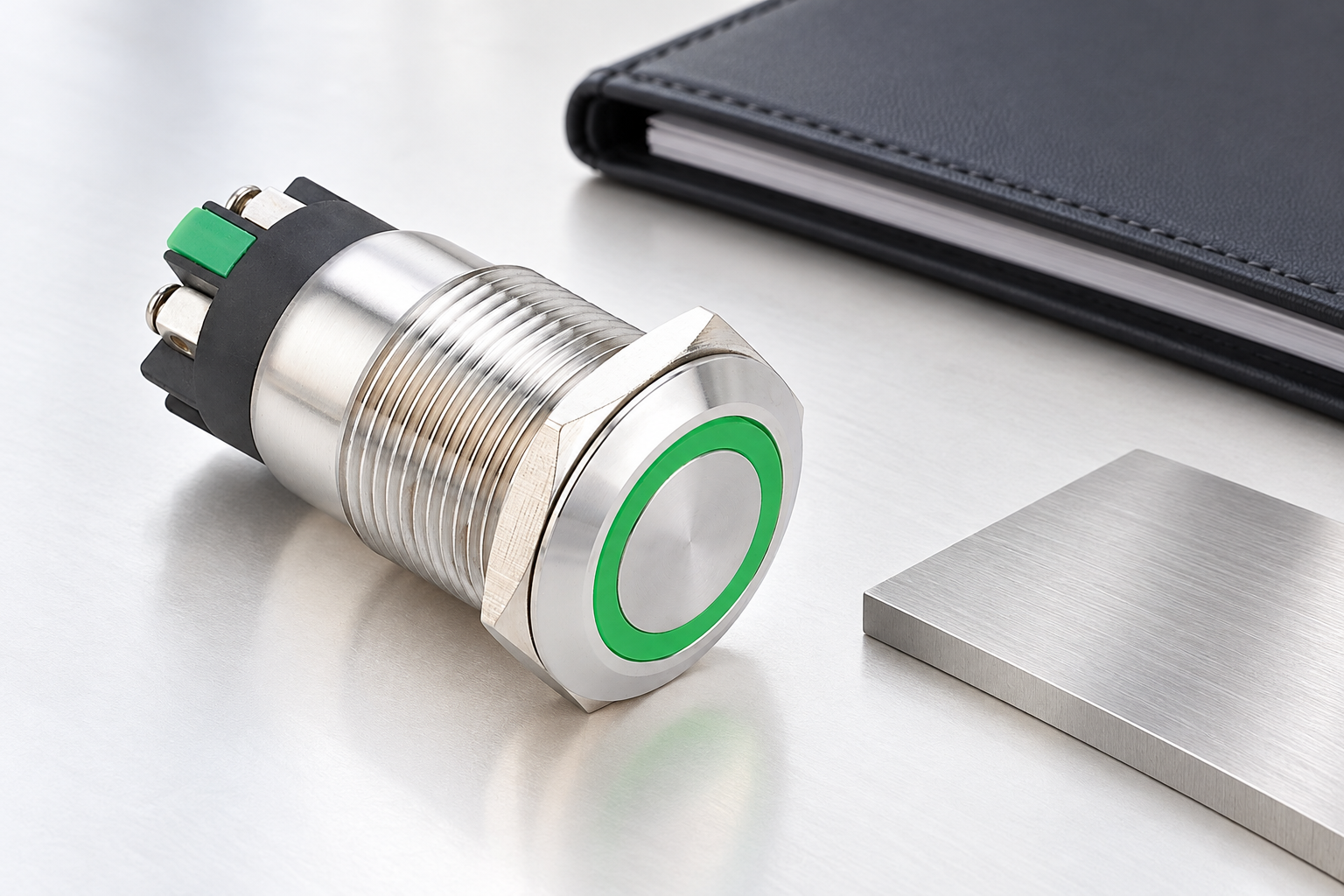
For the ONPOW metal ring-lit product example, the photograph establishes visible product identity and construction. It does not prove a stainless grade, treatment condition, salt resistance or complete assembly performance. Request the exact order code and environmental documentation rather than transferring a result from a similar-looking button.
Match the tested specimen to the purchased component
Find the report’s specimen description, photographs, identifiers and supplied condition. Determine whether it concerns a flat material coupon, a loose metal head, an assembled button or a component mounted through a representative panel. These are materially different test objects. If only the head was exposed, the result does not automatically describe rear terminals, seals, lamp modules or contacts.
Next compare the tested revision with the proposed purchase. Ask about material, finish, manufacturing route and any changes since testing. Do not assume that a family name means every version is covered. A product with a different lens, mounting nut or terminal option may need a separate applicability explanation even when the front view seems unchanged.
Keep the report and the supplier’s applicability statement together. If the report identifies specimens by a laboratory code, ask for the controlled connection between that code and the commercial order code. This is a traceability question, not an accusation. Without it, a technically detailed report can still be impossible to apply to the actual shipment.
Read the method and exposure conditions
Identify the named test method and its edition, then check whether the report records deviations. Different salt mist or corrosion methods should not be treated as interchangeable simply because they use salt. The laboratory should explain the method used and the conditions relevant to interpreting the result. Ask for missing information instead of silently filling gaps from another report.
Look for the exposure duration, specimen preparation, orientation, masking, assembly state and evaluation procedure. Was the specimen cleaned before assessment? Were particular edges or contact areas excluded? Did the test involve a mounted configuration or a free-standing part? These details can affect what the observations mean and whether two suppliers’ reports are comparable.
Le British Stainless Steel Association overview of corrosion testing provides technical background on test selection and interpretation. Use that background to formulate questions for the supplier or laboratory. The applicable method and acceptance requirements still need to be identified for the specific procurement decision; a general technical page is not a product certificate.
Separate observation from acceptance
A report may record staining, corrosion, changes at particular features or other observations. Those descriptions need to be distinguished from the buyer’s acceptance criteria. “No visible red rust” and “operates correctly after exposure” answer different questions. A surface can look acceptable while a separate functional requirement remains untested, or show staining without the report concluding that the assembly failed its defined criteria.
Ask who defined the pass criteria and when they were agreed. A statement of “pass” has limited value if the report never explains what was measured or inspected. If the buyer needs electrical operation, mechanical movement, insulation performance or sealing after exposure, those requirements must be explicitly included in the agreed evaluation plan. Do not infer them from a corrosion photograph.
Le ASTM B117 explanation of significance and use describes limitations of predicting natural-environment performance from salt spray alone. One practical consequence is to avoid a simple conversion from chamber hours to service years. The report is evidence from defined laboratory conditions, not a universal lifetime forecast.
Use a report review table
The checklist below is an original procurement workflow, not a standardised test method. It helps reveal missing evidence before a quotation is accepted. The responsible engineering team should determine which items are required for the intended service and what additional qualification is necessary.
| Report element | Question for the supplier or laboratory | Procurement consequence |
|---|---|---|
| Specimen identity | Which exact order code, revision and assembly were tested? | Prevents transfer from an unrelated part |
| Materials and finish | What controlled construction does the report cover? | Defines the scope of the result |
| Method | Which named method, edition and deviations apply? | Establishes what exposure was actually performed |
| Preparation and mounting | Were parts cleaned, masked or installed through a panel? | Identifies differences from the intended assembly |
| Observations | Where and when were changes recorded? | Separates raw findings from a pass statement |
| Acceptance | Which visual and functional criteria were agreed? | Shows whether the purchasing requirement was evaluated |
| Applicability | What has changed since the tested specimens were made? | Determines whether further evidence is needed |
Assign an owner to every unresolved item. A purchasing decision should not depend on a salesperson’s undocumented interpretation of a laboratory abbreviation. If the team accepts a limited report for a limited purpose, record that purpose and the remaining qualifications. This is more useful than labelling the entire product either “marine grade” or “not suitable” from one incomplete document.
Do not confuse corrosion resistance with ingress protection
Ingress protection concerns a different set of exposure and assessment questions. A button’s specified sealing classification does not establish resistance to salt-related corrosion, while a salt spray report does not establish an ingress classification. Treat each claim as requiring its own applicable evidence and installation conditions.
Le push button panel overview explains the broader assembly context. The panel interface adds another boundary. The head, gasket, panel surface and mounting arrangement form part of the installed condition. A component result cannot automatically be extended to every panel material, cutout or maintenance practice. Use the panel thickness and mounting stack guide when reviewing that mechanical interface, while keeping its separate purpose clear.
For a boat or coastal application, the marine panel selection discussion provides broader questions about the assembly. This article focuses on reading corrosion evidence. It deliberately does not convert a component test into vessel approval, a complete enclosure rating or permission to omit the installation’s environmental review.
Consider the whole assembly and maintenance context
A push button includes more than its visible metal surface. Depending on the construction, the assembly may include polymers, seals, lenses, terminals and internal switching parts. Ask which of those were included in the test and which were evaluated afterward. Avoid describing the entire assembly using a material claim that applies to only one part.
Maintenance assumptions matter as well. A report on a clean specimen does not specify how an installed panel should be cleaned or repaired. Obtain the manufacturer’s cleaning and inspection guidance for the exact component. Do not use abrasive treatment or an unapproved chemical merely because another stainless object tolerated it. The industrial button cleaning guide addresses that separate maintenance decision.
Where the service environment is demanding, agree a staged qualification plan with the responsible team. That may involve document review, sample examination and additional application-specific evaluation. The plan should explain what each stage can establish. More chamber hours alone may not resolve a mismatch between the specimen tested and the actual installation.
Compare suppliers on equivalent evidence
Build a comparison sheet using specimen identity, method, conditions, observations and acceptance criteria. Leave missing fields visibly blank or marked unresolved. Two reports with different specimens or methods cannot be ranked fairly by hours alone. Ask the laboratories or technical owners to explain whether a meaningful comparison is possible.
Also check report completeness. A cover page or cropped screenshot may omit qualifications and observations. Request the relevant complete document through the supplier’s authorised process, respecting any legitimate confidentiality constraints. Retain its identifier, issue date and revision so the accepted evidence can be found during a later audit or repeat order.
A test report is one input to supplier approval. It does not replace shipment identity, incoming inspection or change control. If the purchased construction changes, revisit the applicability of the old result. This keeps a once-valid document from becoming a permanent marketing claim that no longer describes the supplied product.
Send a precise enquiry to ONPOW
Provide the intended environment, exact order code, exposed assembly arrangement and the evidence your project requires. Ask whether a relevant report exists, what specimen it covers and whether functional checks were included. If evidence is unavailable, record the gap and discuss suitable sample qualification instead of requesting an unsupported declaration.
Keep the agreed environmental requirement separate from general appearance. A polished metal face can identify a preferred design, but procurement acceptance needs a documented basis. A useful final decision states the report reviewed, the construction covered, the limitations retained and any further action required before installation. That gives engineering and purchasing the same understanding of what has actually been established.
Foire aux questions
Does 500 hours in salt spray equal a fixed number of outdoor years?
No universal conversion is justified. Laboratory conditions, specimen construction and the real environment differ. Use the report within its stated method and scope rather than turning hours into a service-life guarantee.
Can a material coupon prove the whole button is suitable?
A coupon can provide evidence about the tested material condition. It does not automatically establish the performance of seals, terminals, contacts or the assembled panel component.
Does an ingress rating prove corrosion resistance?
No. Ingress and corrosion assessments address different questions. Obtain the relevant evidence for each claim and confirm the installation conditions to which it applies.
What if a supplier only provides a pass certificate?
Request the specimen identity, method, conditions and acceptance criteria needed for your decision. Until those are available, record the limitation rather than assuming unlisted functional or environmental performance.
Further learning
Introductory corrosion science to support the distinction between material behaviour and an assembly qualification report. Not evidence of ONPOW salt resistance.
Corrosion | Metallurgy | MH Grade 10 | Science | Khan Academy — Khan Academy India – English



