

A push button damp heat test report is useful only when its tested specimen, humidity exposure, operating condition and acceptance criteria match the part and application you are buying. An enclosure rating or an operating temperature range does not answer those questions. Start with the ordered model and the complete report, then review what was exposed, how it was mounted, what was measured and whether the results cover your actual assembly. This guide explains a purchasing review, not a universal test recipe or a claim that a pictured ONPOW button has passed a particular humidity test.
Define the humidity question before requesting a report
A buyer may be concerned about a warm, humid factory, a sealed outdoor cabinet, coastal storage or equipment transported between climates. These are different exposure questions. Record the service environment and the expected operating cycle before asking a supplier for a certificate. Otherwise a genuine laboratory document may answer a different question from the one your equipment presents.
Separate steady humidity exposure from condensation, water jets and immersion. A report addressing one condition cannot simply be relabelled as evidence for all the others. If the immediate problem is water forming inside a panel, use the existing push button condensation guide alongside this document review. The present article focuses on the traceability and limits of damp heat evidence.
Identify the exact specimen and assembly
Record the full order code, contact arrangement, illumination option, terminal style and production revision. A family photograph helps identify appearance; it does not establish that every family member shares the same qualification. Ask whether the report covers the delivered configuration directly or through a documented family assessment.
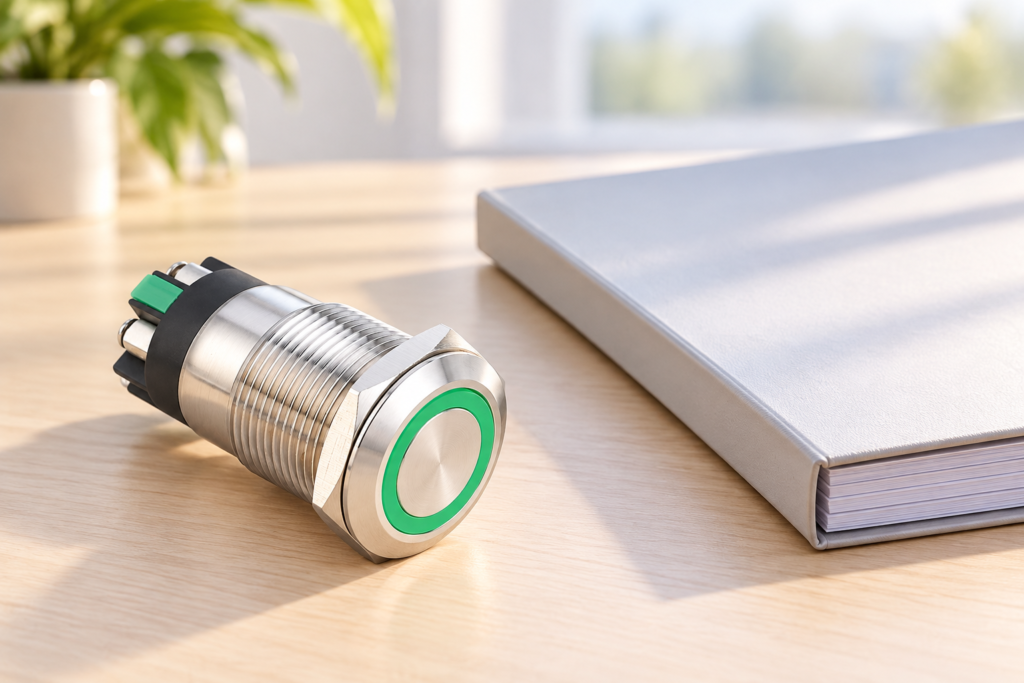
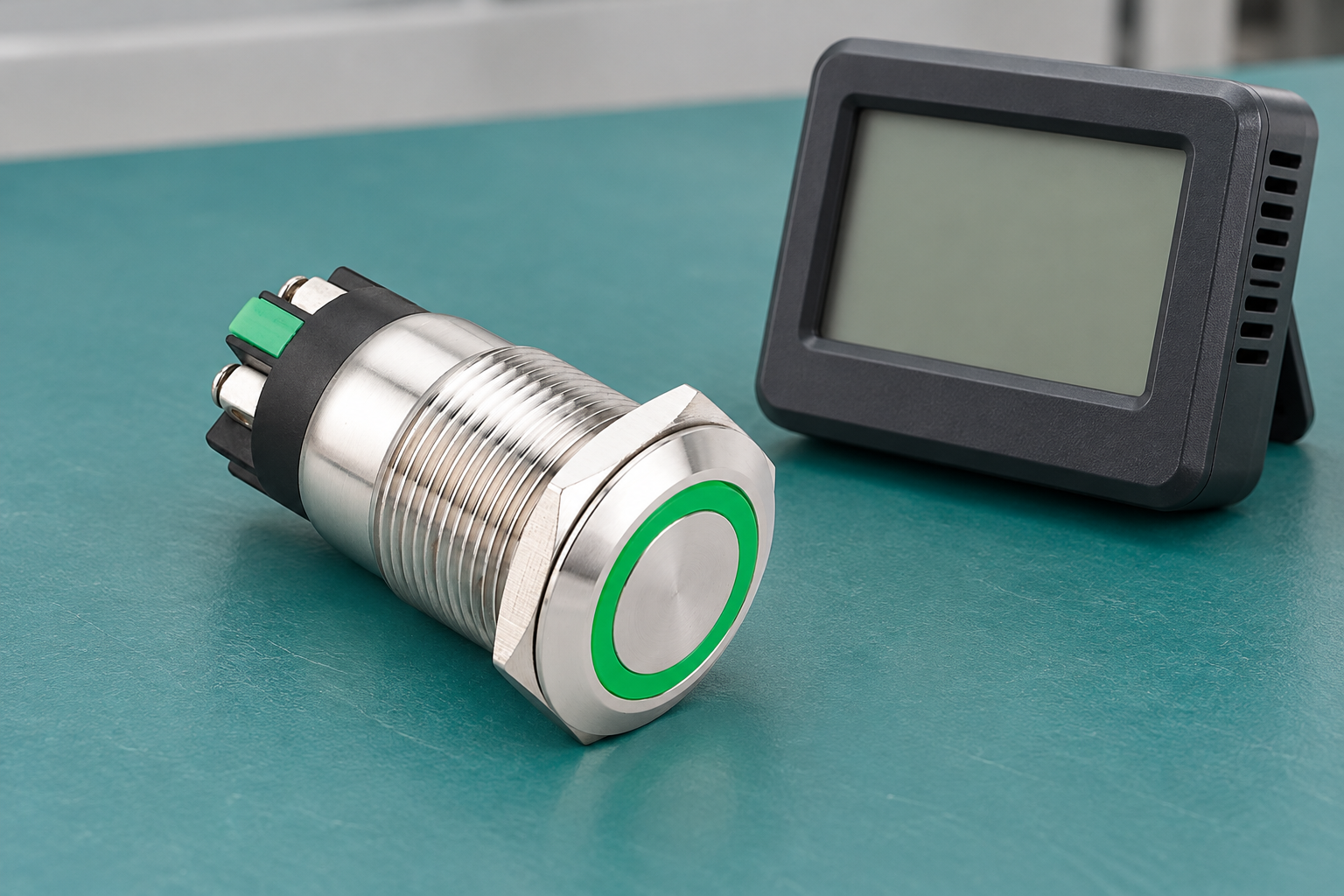
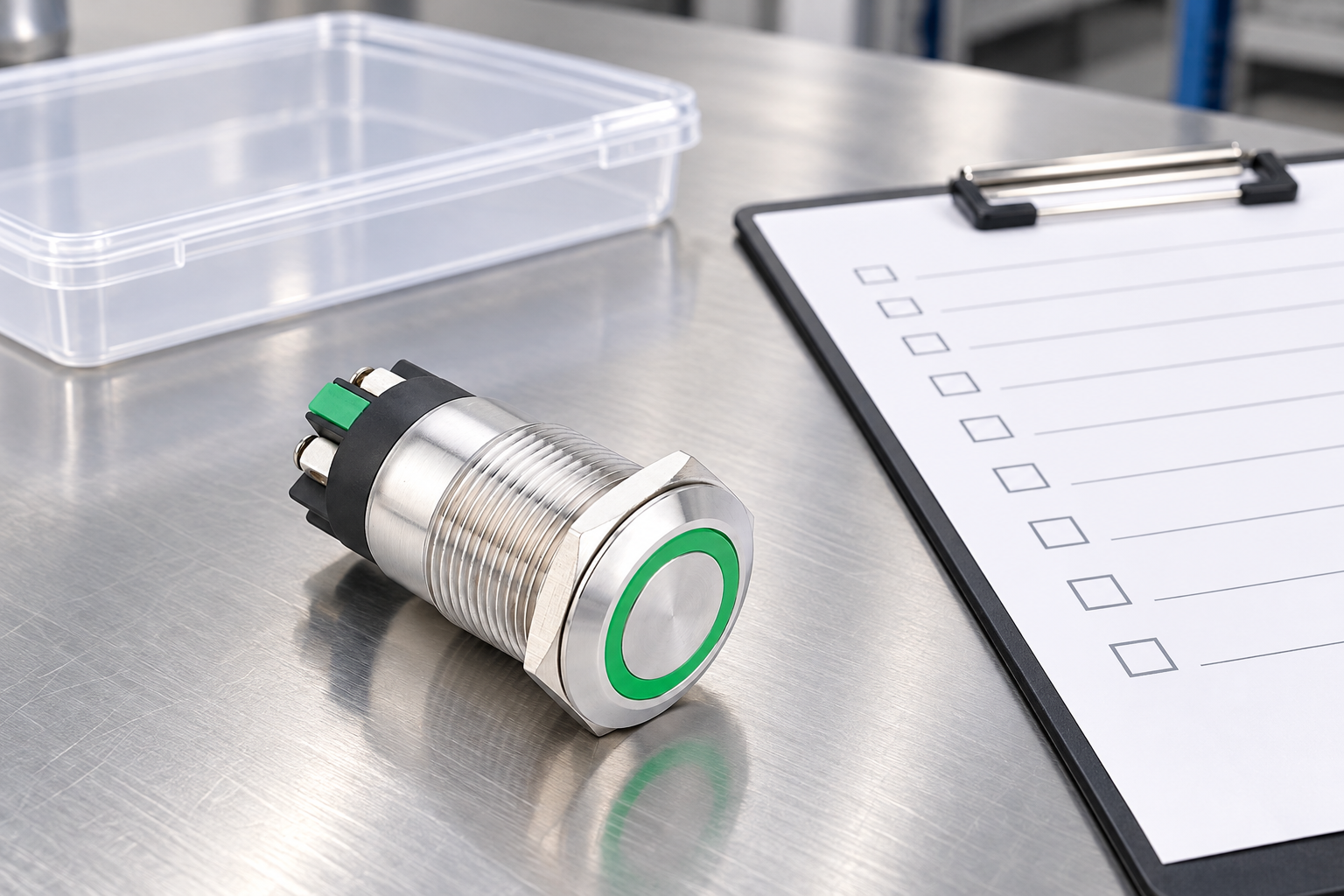
A ONPOW LAS1GQ metal push button example provides a real product reference for this discussion. Obtain its current specification and applicable reports before making an environmental suitability decision. The green ring, metal body and exposed rear connection area are visible features, not proof of humidity resistance or a sealed rear assembly.
Mounting matters. A specimen tested by itself can experience a different environment from a button fitted to a coated panel with a gasket, label plate, cable harness and enclosure. Ask which surfaces were exposed and which interfaces were protected. Keep a photograph or drawing of the laboratory configuration with the report so that later reviewers can reconstruct the boundary.
Distinguish steady damp heat from cyclic exposure
The IEC environmental testing series contains different methods for different stresses. IEC 60068-2-78 concerns steady-state damp heat. Obtain the applicable edition and the actual test specification rather than substituting a brief catalogue description for the laboratory procedure. This article does not reproduce the method or assign a severity to an ONPOW part.
A cyclic programme changes conditions over time, while a steady exposure addresses a sustained environment under its defined conditions. The choice belongs to the relevant product requirements and equipment risk review. A more dramatic sounding test is not automatically the correct evidence. Ask the engineer who specified the exposure to explain why the selected method represents the intended service or qualification requirement.
Storage, operation and recovery conditions also need to be distinguished. A component can be exposed without power and checked afterwards, or evaluated under another specified operating condition. Those reports support different conclusions. Do not write “works continuously in humidity” unless the operating evidence actually supports that statement.
Read the report as a chain of evidence
| Report item | What to request | Why a missing detail matters |
|---|---|---|
| Sample identity | Full model, revision and sample references | A similar-looking variant may have different interfaces |
| Method | Standard reference, edition and any deviations | The test name alone does not define the exposure |
| Severity | Recorded conditions and duration | The buyer cannot compare scope without them |
| Felszerelés | Panel, seals, orientation and exposed surfaces | The laboratory boundary may differ from the equipment |
| Electrical state | Energized or unpowered conditions and circuit details | Post-exposure checks do not prove powered operation |
| Recovery | Conditions before final measurements | Results can depend on the specified recovery stage |
| Acceptance | Pre-agreed requirements and actual results | A pass statement without criteria is hard to interpret |
| Traceability | Laboratory, report number, dates and authorization | A detached summary may not identify the tested samples |
This is a document-review checklist rather than a list of mandatory severities. Requirements come from the selected method, product specification and agreed qualification plan. Keep the complete document; a cropped page containing only “PASS” removes much of the evidence needed to use the result responsibly.
Compare initial and final checks
A useful review asks what was measured before exposure, during exposure where required, and after the specified recovery. Depending on the qualification plan, evidence may address appearance, mechanical operation, contact function or electrical insulation. The presence of a measurement in one report does not make it a universal acceptance test for every switch.
Read actual observations rather than only the final verdict. Corrosion, deposits, changes in actuation or an abnormal electrical result may need engineering interpretation even when a summary is brief. Ask for clarification when the report uses unexplained abbreviations or gives only a tick mark without identifying the requirement.
Compare like with like. Measurements made at different temperatures, using different instruments or after different recovery periods may not support a simple trend calculation. Preserve the stated method and units. If a numerical limit is absent from the supplier document, request it; do not create your own limit from a different product’s datasheet.
Keep environmental evidence separate from panel installation
Damp heat evidence does not remove the need to design the complete installation correctly. Cable routing, terminal protection, drainage strategy and enclosure ventilation affect the equipment environment. Follow the approved equipment design and the exact component instructions rather than adding improvised seals, coatings or heaters because a report appears incomplete.
Használd a push button wiring and installation guide for the wider assembly review. A report for an isolated component does not approve the final panel, and a panel certificate does not necessarily document every optional component configuration. Establish which party is responsible for the final equipment assessment.
Maintenance also changes the boundary. Opening an enclosure, replacing a gasket or moving a cable can alter conditions after commissioning. HSE guidance on equipment maintenance supports planned work, competent personnel and appropriate records. It does not provide a humidity rating for the switch; its role here is to explain why the condition of the maintained assembly belongs in the review.
Review supplier statements without turning them into guarantees
A supplier declaration can be useful when it identifies the product and the supporting evidence clearly. Ask whether it refers to a type test, a production check or another assessment. A type-test report for selected samples should not be described as a humidity test performed on every delivered unit unless that is actually the agreed inspection practice.
Confirm the scope of any laboratory accreditation claim separately from the product result. A laboratory name or logo does not, by itself, explain which method was within its assessed scope at the relevant time. Where accreditation is a contractual requirement, request the appropriate evidence and have the responsible quality team review it.
Avoid making service-life predictions from a single accelerated exposure. Translating laboratory hours into years in a factory requires an appropriate model and application evidence. Without that work, the defensible statement is that specified samples were evaluated under the report’s stated conditions. This narrower statement is more useful than an unsupported lifetime promise.
Build a procurement decision and a follow-up record
Create a short decision record with three possible outcomes: evidence matches the requirement, clarification is required, or additional qualification is required. Identify the reviewer and the unresolved condition. A missing specimen code is a traceability problem; an unsuitable exposure is a scope problem. They call for different follow-up questions.
When the ordered variant changes, revisit the decision. A new terminal arrangement, sealing interface or illuminated construction may need an assessment even when the front face looks identical. Ask the supplier to describe the relationship between the report and the revised configuration instead of assuming that one family document covers every change forever.
Keep transport and storage controls in the purchase package too. The spare push button storage guide covers preservation before installation. Storage instructions and damp heat qualification serve different purposes, but both help prevent a good component from reaching commissioning in an unsuitable condition.
For an enquiry, send the full order code, environment description, mounting sketch, operating condition, required method if already specified, and the documents your quality team needs. Request the applicable product data and report scope from ONPOW. Agree on the remaining review work before using a generic environmental statement as an acceptance condition in a purchase order.
Gyakran ismételt kérdések
Does an IP rating prove damp heat performance?
No. An IP classification and a damp heat evaluation address different exposure questions. Review the applicable enclosure boundary and the actual humidity report rather than treating either label as a replacement for the other.
Can a steady-state report cover repeated condensation cycles?
Do not assume it does. Compare the specified service condition with the method and conditions in the report. Ask the responsible engineer whether cyclic or other additional evidence is needed.
Is a report for one button enough for every terminal option?
Only when there is documented coverage for the ordered variant. Request the sample identity and the supplier’s explanation of any family assessment, especially when construction or exposed interfaces differ.
What should a buyer do when only a pass certificate is supplied?
Request the complete report or sufficient controlled supporting evidence to identify the specimen, method, exposure, acceptance criteria and results. Record any remaining uncertainty before accepting the environmental claim.
Further learning
Humidity and water vapour are useful background for distinguishing a humidity exposure from liquid-water ingress. This educational video does not demonstrate an ONPOW qualification test.
Testreszabás
ONPOW undertakes a variety of custom needs for push-button development. Confirm whether packaging, marking or documentation OEM/ODM applies to Push Button Damp Heat Reports: What Buyers Should Check in the quotation.
A minimális rendelési mennyiséget, a szállítási határidőt és a kereskedelmi feltételeket nem közöljük itt; kérjük, erősítse meg velünk az ügyfélszolgálatban. sales@onpow.com.



