

A push button recycled content claim review should establish exactly what is being claimed, which part of the purchase it covers and what evidence supports that wording. A statement about a shipping box is not a statement about the switch. A statement about one housing material is not automatically a percentage for the complete assembly. Ask for the covered model, material boundary, calculation basis and relevant supply records before repeating a supplier’s claim in a tender or customer document. This guide proposes a buyer’s review method; it does not claim that any illustrated ONPOW product contains recycled material.
Start with the words that will reach the customer
Write down the proposed statement exactly as it would appear in the quotation, product description or procurement response. “Recycled packaging,” “housing made with recycled material” and “switch contains recycled content” refer to different objects. Asking the supplier whether a product is simply “green” does not resolve those differences.
Il FTC’s Green Guides summary explains the need to qualify partial recycled-content claims and distinguish the nature of relevant components. The 2026 US regulatory text on recycled-content claims addresses recovered or diverted material and substantiation, including distinctions between pre-consumer and post-consumer material where those distinctions are claimed. These are useful US references; they do not establish a universal approval for wording in every destination market.
Make the intended audience and destination part of the request. An internal purchasing preference, a contractual minimum and a public environmental claim may need different reviews. Have the appropriate project owner decide what may be stated externally. Purchasing can collect evidence without turning its working notes into approved marketing language.
Separate the switch, its components and the packaging
Use a simple boundary sketch or component list. Identify the complete switch assembly, the particular component named in the claim and any packaging items. Treat replacement contact blocks, mounting accessories and separately supplied cartons according to the actual order rather than assuming everything shares one material statement.
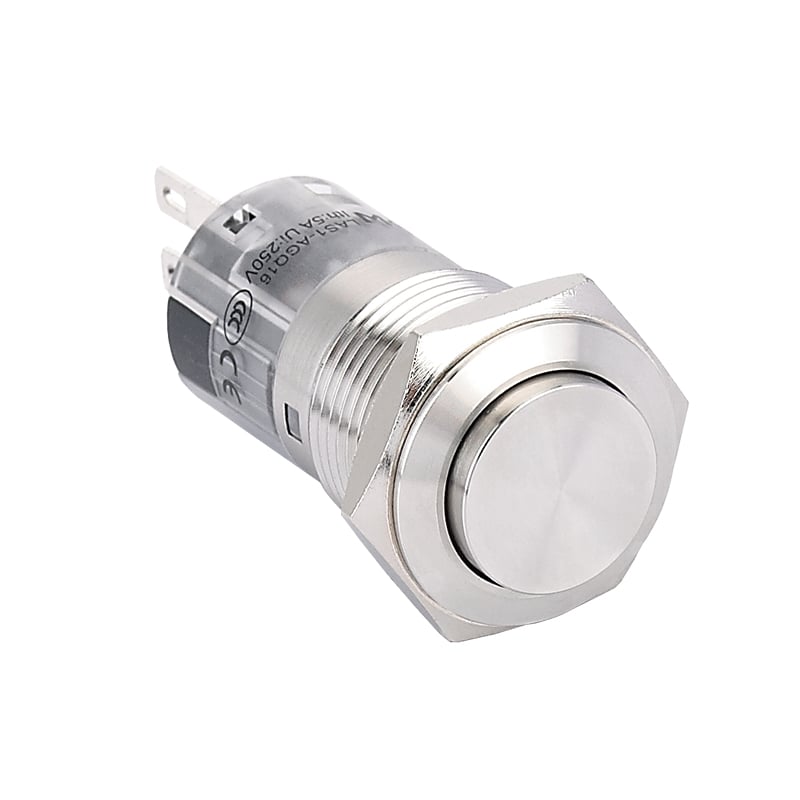
Il Pagina prodotto LAS1-AGQ16H-11E/S provides an example of a specific ONPOW item that can be named in an enquiry. The manufacturer’s photograph is useful for identifying the configuration. It cannot reveal recycled feedstock, the percentage of that feedstock or the history of the material used in a delivered batch.
Record an explicit exclusion wherever useful: the claim may cover a named housing component while excluding electrical contacts, illumination parts, mounting hardware and packaging. A narrow, supported statement is easier to review than a broad statement with assumptions hidden in an attachment. Do not infer excluded components’ composition from their colour, appearance or apparent material.
Define the percentage before comparing offers
Two suppliers may quote the same percentage while using different denominators. One may refer to a particular polymer compound, another to a housing and another to an entire product. Put those statements into separate columns until their boundaries are reconciled. Do not rank the higher number as automatically better.
For a proposed project calculation, identify the claimed recycled mass and the total mass within the same declared boundary. The arithmetic is recycled mass divided by boundary mass, multiplied by 100. This is an explanatory calculation, not a substitute for the selected claim method or proof that all inputs qualify. If the input definition is wrong, accurate arithmetic still produces a misleading answer.
For example, suppose a hypothetical component weighs 20 grams and includes 6 grams of qualifying recycled material. The component-level calculation is 6 divided by 20, or 30%. If the complete hypothetical assembly weighs 50 grams, the same 6 grams would represent 12% of the assembly, assuming no other qualifying recycled inputs. Neither number describes a real ONPOW product, and neither should be used without verified input records and an applicable claim basis.
Use an evidence matrix that exposes uncertainty
Il NSW Government’s 2026 recycled-content procurement guide discusses claim scope, separate packaging reporting and several forms of supporting evidence. The table below is a proposed adaptation for industrial switch purchasing, not a certification checklist or a requirement imposed on every supplier.
| Voce di revisione | Informazioni da acquisire | Question to resolve before acceptance |
|---|---|---|
| Exact wording | Supplier’s statement and proposed customer wording | Are they making the same claim? |
| Identità del prodotto | Complete model list and covered revisions | Does the evidence cover the ordered configuration? |
| Perimetro | Named material, component, product or packaging | What mass is included and excluded? |
| Claimed input | Defined recycled source category and supporting records | What qualifies under the chosen method? |
| Calculation | Input figures, units, denominator and method | Can another reviewer reproduce the result? |
| Coverage in time | Relevant supply period or lot mapping | Does the evidence relate to the delivered goods? |
| Assurance | Declaration, report or certificate with stated scope | Who checked what, and what remains unverified? |
Avoid filling an unknown field with zero. “Not declared” and “verified zero” mean different things. A purchasing system should preserve that distinction so that an empty supplier response does not become a false environmental statement after a spreadsheet is exported.
Ask about pre-consumer and post-consumer wording
If the proposed wording distinguishes pre-consumer and post-consumer content, ask the supplier to define those terms under its selected basis and explain the records behind each value. Preserve the distinction in the review rather than combining categories because the total is easier to display.
Do not assume all factory scrap qualifies merely because it is reused somewhere in production. The US text specifically discusses substantiation for material that would otherwise enter the waste stream. Have the reviewer examine the particular recovery route and the claim method rather than relying on a casual description such as “regrind.”
A supplier might legitimately provide only a total figure without a category breakdown, depending on the applicable method and claim. If a tender specifically requires a post-consumer value, a total figure may leave that tender requirement unresolved. Explain the gap and ask for the needed information; do not silently relabel the total as post-consumer content.
Check what a certificate or declaration actually covers
Read the named organization, site, product scope, material scope, applicable scheme and validity information. A certificate attached to an email might concern an upstream material supplier or an organization’s management system. Ask how it supports the wording proposed for the specific switch purchase.
A supplier declaration can still be useful evidence. Record who issued it, which codes it covers, what method it uses and whether it references supporting supply records. Keep its assurance level visible. Do not rename a self-declaration as independent verification simply because it has a signature or a formal-looking border.
For the broader question of matching supplier documents to ordered configurations, consult laboratory evidence scope. For evidence about restricted substances, the revisione della dichiarazione del materiale REACH addresses a different purpose. Recycled-content information does not establish electrical performance or the absence of restricted substances.
Walk through a realistic purchasing mismatch
Consider a hypothetical supplier quotation saying “30% recycled material,” while the attachment describes a carton supplied by a packaging company. The buyer intends to tell its equipment customer that the switch contains recycled material. The immediate issue is the mismatch between the claimed object and the evidence, not a need to recompute the same percentage.
Return the proposed wording to the supplier and ask whether there is separate switch or component evidence. If only the carton is covered, keep any accepted statement expressly limited to that packaging. If the customer’s tender requires switch content, mark that requirement unresolved rather than presenting the carton statement as equivalent.
A second mismatch can occur after a model substitution. The original evidence may identify one housing design, while the replacement uses another configuration. Even when the electrical function is acceptable, reopen the environmental claim coverage. Purchasing acceptance of a substitute does not automatically approve every statement previously associated with the original part.
Preserve technical suitability as a separate decision
A verified recycled-content statement would not, by itself, establish contact rating, insulation suitability, enclosure protection, mounting compatibility or life in the intended application. Evaluate those requirements against the exact manufacturer’s specifications and project tests. Do not assume either improved or reduced performance from the word “recycled.”
Similarly, “recycled content” does not automatically mean “recyclable at end of life.” Collection, separation and local processing are separate questions. Keep customer wording precise enough that one attribute does not imply an entire environmental lifecycle conclusion. If a broader claim is desired, define the additional evidence needed before approving it.
For shipment continuity, use lot traceability records to connect the accepted documents with the supply being reviewed. Keep material evidence, technical selection and marketing approval as linked but separate decisions. That structure allows one team to resolve a missing document without unintentionally reopening every already-accepted engineering requirement.
Close the review with a usable purchasing note
A useful closeout note states the accepted wording, covered codes, boundary, evidence references, reviewer and unresolved limitations. If no supported claim is available, say that the recycled-content attribute is unverified for the purchase. Do not turn lack of a declaration into a claim that the product contains no recycled material.
For an ONPOW enquiry, provide the exact models, intended quantity, destination and the wording required by your procurement specification. Ask which material or packaging information is available for those configurations. The response should be reviewed on its actual scope; this article and its product photographs do not certify recycled content.
Domande frequenti
Il packaging riciclato può supportare un reclamo di cambio riciclato?
No. Evidence limited to packaging should remain identified as packaging evidence. A claim about the switch or one of its components needs supporting information with the corresponding product boundary.
Is the largest percentage always the best offer?
No. Percentages are comparable only after checking the covered material or product, calculation method, qualifying inputs and relevant evidence. A higher component-level percentage may represent a smaller whole-product contribution.
Does recycled content prove that a switch meets its electrical requirements?
No. Electrical and mechanical suitability require their own configuration-specific specifications and verification. A material sourcing attribute does not substitute for those checks.
What if the supplier cannot provide a percentage?
Record the attribute as undeclared or unverified, explain the missing evidence and follow the project’s purchasing decision process. Do not invent a number, assume zero or repeat a broad environmental claim without support.
Approfondimenti
The European Commission explains misleading environmental claims in this 2023 policy video. It provides background on evidence and clarity; the proposal discussed is not presented here as current law or as a recycled-content certification.

Green Claims – Measures against misleading environmental claims — European Commission



