

A push button plastic volume resistivity report evaluates an insulating material specimen under specified electrical and environmental conditions. To review it, confirm the sampled component, electrode geometry, specimen thickness, applied voltage, measurement time and conditioning. The result can help characterize material behavior or compare controlled batches. It does not establish the insulation resistance, dielectric withstand capability or safety compliance of a complete switch. For purchasing, accept the report only for the property it actually measures, and keep the separate evidence required for the finished component and control equipment.
Define the question before requesting a test
Volume resistivity evidence is most useful when there is a material-level question: whether a supplier dataset is relevant to a proposed insulator, whether a batch comparison was performed consistently, or whether moisture conditioning changes the measured behavior. It should not be ordered as a generic substitute for all electrical documentation.
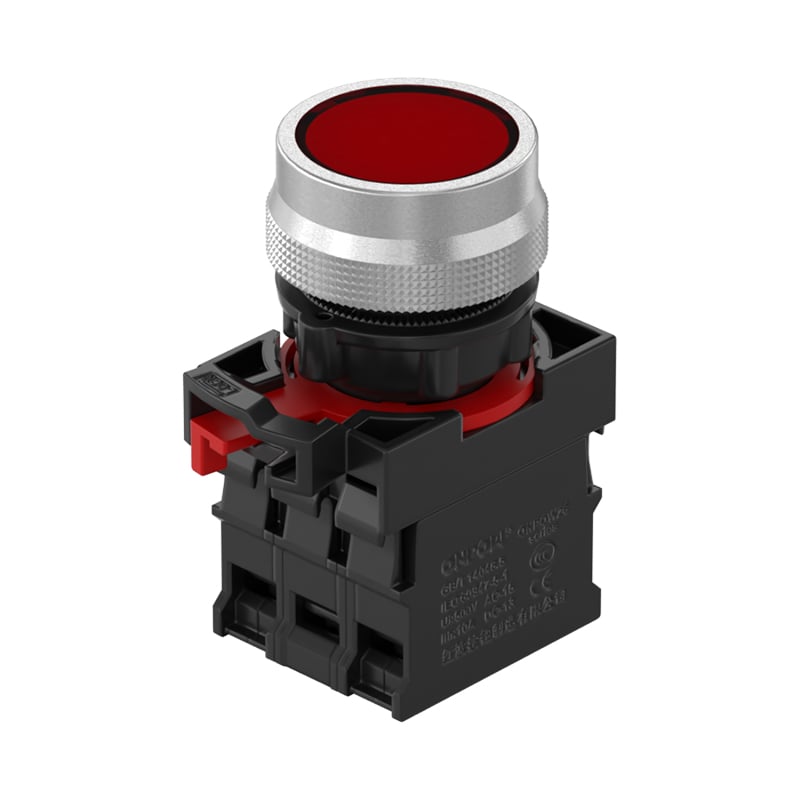
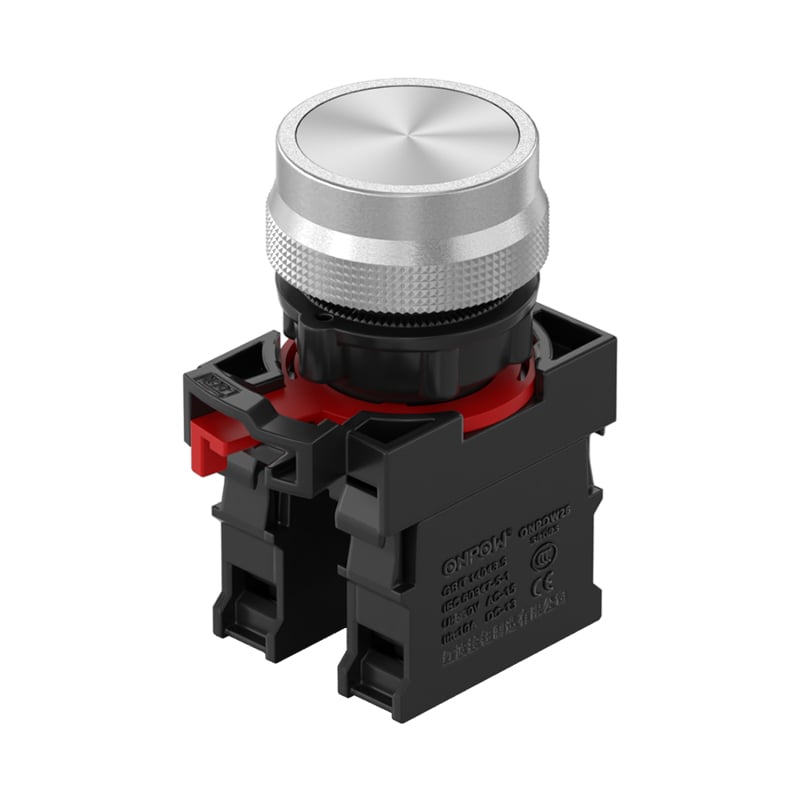
Begin with the component drawing and exact ordered configuration. The ONPOW26 product example identifies a type of industrial panel component, but its photograph does not identify the formulation or electrical properties of every molded piece. Ask which part the material report covers and how the specimen connects to that part.
If the actual concern is leakage between the terminals of an assembled switch, explain that to the responsible engineer or laboratory. The geometry, surfaces, interfaces and assembly condition matter. A report on a separate plaque may be useful background, but it answers a different question from a measurement on the finished assembly.
Separate resistance from resistivity
Resistance is measured in ohms and depends on the measured specimen or assembly geometry. Volume resistivity normalizes an appropriate through-material resistance measurement using dimensional information. It is commonly expressed in Ω·m or Ω·cm. Preserve the unit and the property name together when copying a result into an approval record.
For a simple uniform specimen with a suitable effective electrode area, the relationship is ρv = Rv × A/t. Here ρv is volume resistivity, Rv is through-volume resistance, A is the effective measurement area and t is specimen thickness. The laboratory must define the effective geometry for its electrode system. Do not substitute the visible diameter of a molded part without justification.
A unit example helps catch transcription errors. Suppose an imagined specimen has Rv = 10^12 Ω, effective area 0.001 m2 and thickness 0.002 m. The simplified result is 5 × 10^11 Ω·m, equivalent to 5 × 10^13 Ω·cm. These invented values demonstrate dimensional conversion only; they are not ONPOW data or acceptance limits.
Read the method and its conditions
ASTM D257 addresses DC resistance or conductance of insulating materials and explains the importance of measurement conditions. Use the public scope to identify the kind of evidence being requested, while obtaining the actual procedure and edition from the laboratory. A short web summary cannot supply the full method.
Ask the report to identify the applied voltage and the elapsed time used for the reported reading. An insulating specimen can produce a time-dependent current response, so results obtained under different measurement timing should not be compared casually. The report should also distinguish a stable measured value from a value limited by instrument capability.
Do not energize a component or construct a high resistance test arrangement from a general article. The laboratory should select suitable equipment, procedures and safety controls. A procurement reviewer can assess traceability and completeness without attempting to reproduce a potentially hazardous electrical measurement on a workbench.
Confirm that surface leakage was addressed
A material specimen can support current through its volume and along its surface. A useful volume resistivity report explains the electrode arrangement and how the intended current path was measured. Ask for a diagram or method reference if the geometry is unclear, especially when comparing reports from different laboratories.
UL’s electrical testing overview distinguishes volume and surface resistivity testing. That distinction helps a buyer avoid treating every high resistance result as the same property. Its service examples should not be copied into a purchase specification as universal settings for every plastic or component.
Surface contamination, handling and specimen preparation should be documented where relevant. If a sample was cleaned or dried before measurement, record that treatment. A clean laboratory specimen and a component exposed to the application environment are not automatically equivalent. Ask the equipment team which condition the evidence needs to represent.
Use a material report review table
The following table is an evidence checklist. It does not prescribe a minimum resistivity or replace a product-specific requirement.
| Voce del rapporto | Perché è importante | Cosa richiedere |
|---|---|---|
| Identità del campione | A generic resin label may not map to the component | Material reference, component and batch link |
| Specimen route | Plaques and removed parts have different histories | Preparation description and sampling location |
| Thickness and area | Geometry enters the resistivity calculation | Measured dimensions and effective electrode area |
| Electrode arrangement | Surface and volume current paths differ | Configuration or controlled method reference |
| Conditioning | cURL Too many subrequests by single Worker invocation. To configure this limit, refer to https://developers.cloudflare.com/workers/wrangler/configuration/#limits | cURL Too many subrequests by single Worker invocation. To configure this limit, refer to https://developers.cloudflare.com/workers/wrangler/configuration/#limits |
| cURL Too many subrequests by single Worker invocation. To configure this limit, refer to https://developers.cloudflare.com/workers/wrangler/configuration/#limits | cURL Too many subrequests by single Worker invocation. To configure this limit, refer to https://developers.cloudflare.com/workers/wrangler/configuration/#limits | cURL Too many subrequests by single Worker invocation. To configure this limit, refer to https://developers.cloudflare.com/workers/wrangler/configuration/#limits |
| cURL Too many subrequests by single Worker invocation. To configure this limit, refer to https://developers.cloudflare.com/workers/wrangler/configuration/#limits | cURL Too many subrequests by single Worker invocation. To configure this limit, refer to https://developers.cloudflare.com/workers/wrangler/configuration/#limits | cURL Too many subrequests by single Worker invocation. To configure this limit, refer to https://developers.cloudflare.com/workers/wrangler/configuration/#limits |
| cURL Too many subrequests by single Worker invocation. To configure this limit, refer to https://developers.cloudflare.com/workers/wrangler/configuration/#limits | Ω·m and Ω·cm are different numerical scales | Original units and documented conversion |
| Intended use | Material data do not qualify an entire switch | Explicit scope of the engineering decision |
Compare reports under matched conditions
Place the reports side by side and compare the specimen descriptions before comparing the numbers. Match the property, material designation, preparation route, dimensions, electrode approach and conditioning. Then examine voltage, measurement time and temperature. A large numerical difference may reflect a changed test condition rather than a changed material.
The review should preserve individual results and any averaging method. Ask whether there were repeated specimens, excluded readings or instrument range limits. A report showing “greater than” a value should keep that notation when entered into a spreadsheet; it should not become an exact number suitable for averaging with measured values.
Agree on a project-specific criterion with the responsible engineer. There is no universal number in this article that makes every button suitable for every application. Where the comparison is intended to detect a production change, define the relevant material revision and the decision process before testing. Otherwise, a convenient result can be mistaken for a predetermined requirement.
Keep complete switch insulation evidence separate
Il push button insulation resistance guide addresses a different evidence layer. An assembled switch includes the actual distances, interfaces, conductors, surfaces and configuration. A favorable material resistivity result does not establish the resistance measured between particular terminals or between a circuit and accessible parts.
Likewise, the guida al rapporto di resistenza dielettrica concerns another test purpose. Volume resistivity cannot be converted into a withstand voltage by multiplying by a convenient dimension. The procedure, endpoint and applicable equipment requirements must be evaluated separately.
Do not infer a certification, safety function, protection class or permitted working voltage from a polymer result. Keep the supplier’s current product documentation and any required assembly evaluation in the file. Material evidence can support an engineering assessment, but it cannot remove requirements that apply to the actual component or equipment.
Investigate unexpected results with a clear sequence
If a result appears inconsistent, first verify the copied number, exponent and units. Then check specimen identity and the dimensions used for normalization. A thickness entry in the wrong unit can create a convincing-looking error. Resolve basic record issues before requesting a new material formulation or rejecting a production lot.
Next, ask the laboratory about conditioning, electrode contact, handling, measurement timing and range limitations. Request clarification in writing and retain the original report. A corrected calculation should be issued in a controlled revision, with enough explanation to show which result changed and why.
For questions about laboratory scope, use the laboratory accreditation review. Check the relevant activity and location rather than assuming a general accreditation logo covers every test. Even a suitable laboratory still needs a traceable specimen and a report that answers your specific question.
Create a useful purchasing evidence package
Include the ordered model, drawing revision, component name and material reference in the request. Explain whether the purpose is screening, batch comparison or design input review. Ask for the method edition, conditioning, specimen dimensions, electrode configuration, electrical conditions, complete results and stated limitations. Attach a labeled drawing when component identity could be ambiguous.
Keep material data, complete switch electrical evidence and application approval as separate records with explicit links between them. This allows a future reviewer to see which conclusion each document supports. It also makes a supplier change easier to manage: the team can identify which evidence needs refreshing rather than automatically repeating every test.
For an ONPOW inquiry, send the exact configuration and ask which current documentation is available. If additional material testing is needed, agree on sample selection and intended use before work begins. Describe an unavailable property as unavailable; do not replace it with an estimate based on appearance, a similar product or an unrelated resin datasheet.
Domande frequenti
Is volume resistivity the same as switch insulation resistance?
No. Volume resistivity is a geometry-normalized material property under stated conditions. Insulation resistance of a complete switch concerns a defined measurement on the assembled component.
Can volume resistivity prove dielectric withstand capability?
No. They answer different questions and use different procedures. A resistivity result cannot replace the applicable withstand evidence or equipment assessment.
Why should humidity and measurement time be recorded?
They help define the conditions behind the reported value. Without them, a comparison may confuse different measurement conditions with an actual material difference.
What should I do with a result above the instrument range?
Keep the report’s inequality and limit notation, ask the laboratory how it should be interpreted, and avoid treating it as an exact value for calculations or averages.
Approfondimenti
NPTEL introduces dielectric insulating solids. This is background on insulating materials, not a volume resistivity test or electrical qualification of an ONPOW switch.



