

Cleaning a capacitive touch switch requires two separate checks: the cleaning process must be compatible with the complete assembled surface, and the switch must return to its intended electrical behavior afterward. A clean-looking metal face does not prove that the seal, illuminated ring, markings or cable interface remain suitable. Nor does an IP rating approve a detergent or solvent. Use the exact product manufacturer’s guidance and the finished equipment’s cleaning procedure. This article explains how to qualify that procedure without inventing a universal cleaning chemical, dilution or exposure time.
Define the surface and the cleaning task
Start with the complete product identity and its role in the equipment. Record the switch order code, face material, visible ring or lens, markings, seals, mounting arrangement and nearby panel materials. Keep uncertain materials marked as unknown until the manufacturer confirms them. Do not infer the composition of a seal or lens from its color or appearance.
Define what has to be removed. Dry dust, process residue, fingerprints and contamination controlled by a hygiene procedure are different tasks. A method acceptable for cosmetic wiping may not meet the equipment’s hygiene requirements. Conversely, a facility’s stronger cleaning process may not be compatible with the control assembly.
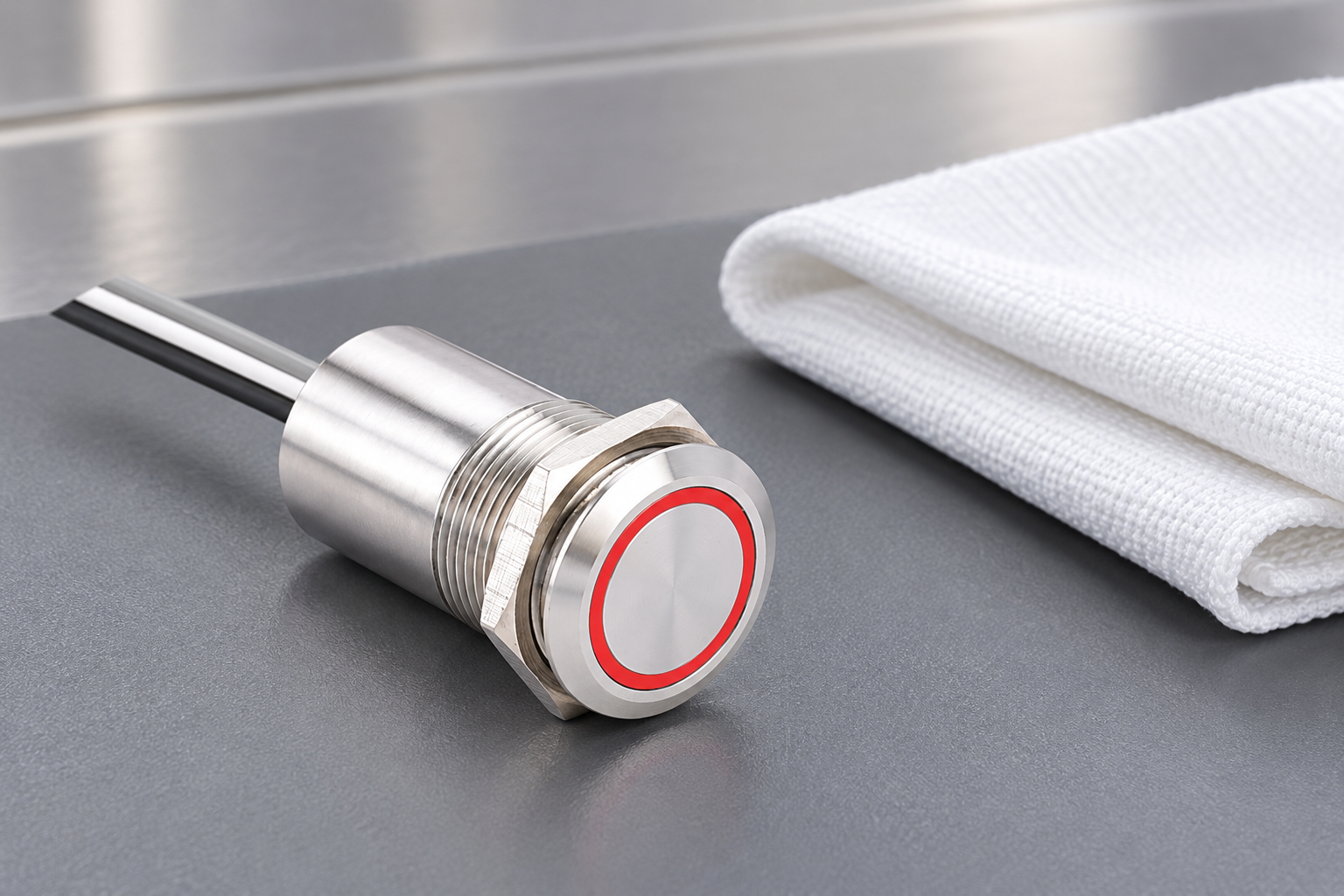
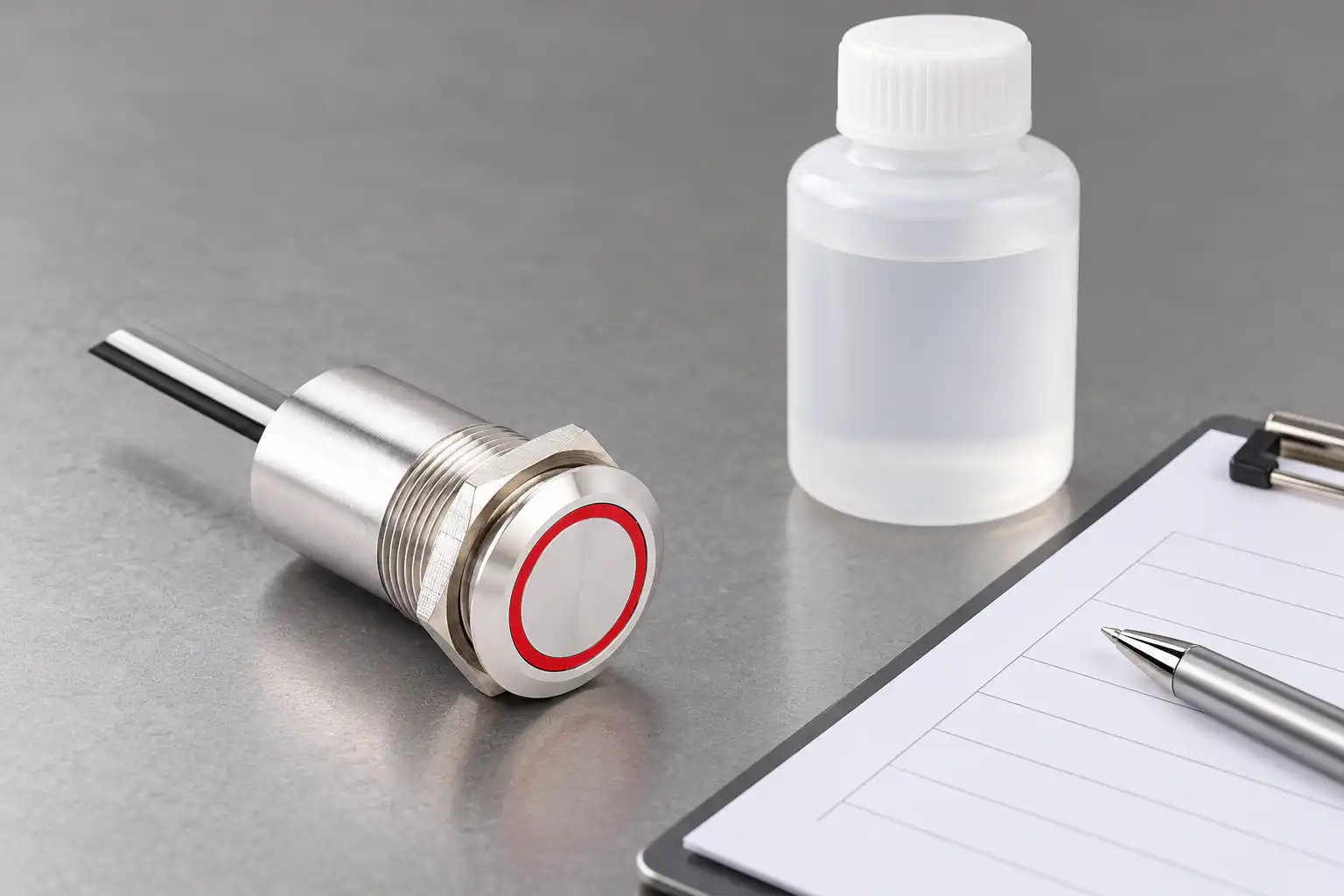
The TS19A10YSS product page illustrates a real ONPOW metal touch switch. The editorial images refer to that product form. They do not approve a cleaning agent or show a model-specific cleaning procedure. Obtain the exact assembled-product guidance before specifying chemical exposure.
Keep cleaning compatibility separate from ingress protection
An ingress protection classification addresses defined enclosure protection tests. It is not a chemical resistance statement and does not automatically describe every exposed part or installation condition. A front face and a rear cable interface may have different requirements. The mounting method and the finished panel can also affect the relevant protection boundary.
Do not turn a successful wipe test into a claim that an assembly tolerates spray, immersion or high-pressure cleaning. These processes introduce different exposure conditions. Likewise, a water-based product may include ingredients that affect a material even when water alone would not cause an obvious problem.
Keep the equipment’s required cleaning performance and the component’s allowed exposure in separate fields. If they conflict, change the design or obtain an approved alternative; do not weaken a hygiene requirement informally or assume that a protective cover solves every compatibility issue.
Describe the process precisely enough to reproduce
Write down the cleaning product identity and the current safety information supplied with it. Record dilution, application method, contact period, rinsing where applicable, drying method and frequency as defined by the approved process. Include whether liquid is applied to a cloth or directly to equipment. These details matter when asking a supplier for compatibility confirmation.
Avoid vague requests such as “Is this switch resistant to cleaning?” A useful request identifies every relevant exposure condition and asks about the complete assembled product. If the supplier has evidence for one material only, keep that limitation visible rather than treating it as approval for the lens, adhesive, seal and cable interface.
| Process item | Information to record | What it establishes |
|---|---|---|
| Product identity | Exact cleaner and current manufacturer information | Which substance or formulation is being evaluated |
| Working preparation | Approved dilution and preparation method | Repeatability of the cleaning process |
| Applicatie | Cloth, spray or another specified method | Exposure route and areas affected |
| Exposure | Contact conditions and cleaning frequency | Relevant service conditions |
| Removal and drying | Approved rinse and drying steps | Condition before return to operation |
| Assembly scope | Face, ring, markings, seals and cable interface | Which parts require compatibility evidence |
| Functional checks | Touch, release, output and indication requirements | Intended behavior after cleaning |
The table is a documentation framework. It deliberately contains no universal concentration or time value because those must come from the actual cleaner, device and equipment requirements.
Plan a controlled compatibility evaluation
Use the manufacturer-approved approach and representative assemblies when qualification is necessary. A loose metal coupon cannot represent the behavior of a finished switch containing multiple materials and interfaces. Include the actual panel mounting condition where it affects exposure or cleaning access.
Define acceptance criteria before starting. Consider visible changes to the face, ring and markings; seal or interface condition; mechanical mounting; and electrical function. Some damage may not be visible immediately, so the qualification plan should address the relevant service pattern rather than only a single cosmetic inspection.
Do not accelerate a test by arbitrarily increasing concentration, temperature or exposure and then claim that it predicts normal service. Such changes can alter the failure mechanism. Any accelerated method needs its own engineering basis and clear limitations. Retain the tested configuration and process revision with the results.
Control unexpected operation during cleaning
A capacitive control responds to changes in its sensing environment. A cleaning cloth, moisture or residue can affect that environment, depending on the device and installation. The equipment must therefore be placed in a safe cleaning state before the operator touches or wets the control surface.
Do not rely on a front indicator or an assumed software lockout as the sole protection against hazardous motion. Use the equipment’s established procedure, including isolation where required. The cleaning team should know which controls remain active and who authorizes return to operation.
The separate capacitive false-triggering guide addresses unexpected output changes. Here the goal is to include that possibility in a documented cleaning process rather than adjusting sensitivity or modifying the circuit without product-specific authority.
Inspect the surface after the approved drying step
Check for residue, discoloration, clouding, damaged markings or visible deterioration around interfaces. Compare with a documented baseline rather than memory. Confirm that the procedure has not left liquid where the equipment instructions prohibit it, including around adjacent panel joints and cable entries.
If the switch has an illuminated ring or symbol, inspect its readability under the relevant viewing conditions. A lens can appear acceptable under a service light yet become harder to read in normal operation. Record any change separately from the touch response: successful sensing does not prove that indication remains suitable.
Do not polish, scrape or apply an additional chemical to hide an unexpected result. Preserve the evidence and obtain the manufacturer’s guidance. Repeated cleaning-related changes should trigger a review of material compatibility and equipment design rather than a routine replacement cycle with no cause investigation.
Verify the output and the control response separately
Plan a safe functional check that reflects the intended touch action, release behavior and indication. Confirm the device output and the equipment input using the approved method. Do not judge function only by whether a light comes on or a machine performs one requested action.
Check the complete installed configuration after the approved return-to-service conditions are met. A device tested loose on a bench may behave differently once mounted, grounded and connected in the enclosure. Changes to wiring or grounding during the cleaning investigation need to be recorded rather than introduced as invisible adjustments.
Where gloves are part of normal work, use the defined operating conditions in the acceptance plan. Do not claim universal glove compatibility from a successful test with one glove. The touch switch glove guide explains why the glove and the installed sensing system must be evaluated together.
Freeze the approved process and manage changes
Once the process is accepted, keep the cleaner identity, dilution, method, assembly configuration and functional checks in a controlled record. Train the people who perform the cleaning. A switch can remain unchanged while a replacement cleaning product introduces a materially different exposure.
Review proposed changes before use. These include another supplier’s cleaner, a new wipe, revised drying conditions, additional labels on the face or a replacement switch with different materials. “Equivalent” should be supported by evidence relevant to the actual change, not by similar packaging or a common marketing description.
Ask ONPOW for compatibility guidance using the full switch code and a precise process description. When component limits cannot meet the equipment’s cleaning requirement, review the control location, protective design or product selection. The piezo washdown discussion provides related design questions but does not establish chemical resistance for a capacitive model.
Frequently asked questions
Can I use any cleaner on a stainless-steel touch switch?
No. The complete assembly can include other metals, plastics, seals, markings and interfaces. Obtain approval for the exact product and cleaning conditions rather than relying on the face material alone.
Does a waterproof rating approve a disinfectant?
No. Ingress protection and chemical compatibility address different questions. Check the stated protection boundary and obtain the manufacturer’s chemical exposure guidance for the assembled device.
Why can a touch switch activate during wiping?
The cloth, moisture or residue may alter the sensing conditions. The equipment must have an approved safe cleaning state. Investigate unexpected output behavior using the exact device guidance rather than changing sensitivity at random.
Is visual inspection enough after cleaning?
No. Visual condition, indication, touch response, release behavior and equipment response are separate checks. Use the approved qualification and return-to-service procedure for the actual installation.
References and scope
HSE electrical maintenance safety and HSE equipment maintenance guidance provide the safe-working framework. IEC 60529’s publication information identifies the enclosure ingress-protection standard; it is not a chemical compatibility certificate. Cleaner-specific safety information and exact product instructions remain necessary.
Further learning
University background on capacitance-based sensing, explaining why a changed surface environment can influence a sensor. It does not approve a cleaner or establish the parameters of an ONPOW touch switch.

Lec 11: Principle of Sensing – Capacitance — NPTEL IIT Guwahati



