Push button conflict minerals supplier records should connect the customer’s request to the supplier’s declared product scope and the evidence it has collected. A completed questionnaire is a starting point for review, not proof of the origin of every metal in every switch. Check the reporting period, covered references, declaration scope and unresolved upstream information before using a response in an equipment sourcing file. This guide explains a practical review for industrial control buyers without assuming that any particular ONPOW model contains a specified mineral or that a supplier has obtained an independently verified sourcing status.
Establish the purpose of the request
A customer may ask for a Conflict Minerals Reporting Template, commonly called a CMRT, a company sourcing policy or a response to its own questionnaire. Ask which output is required and why. Record the customer’s requested reporting period, product coverage and template instructions. A broad company policy and a completed reporting template have different purposes and should not be filed as interchangeable answers.
De Responsible Minerals Initiative CMRT page explains that the template transfers information about mineral origin and smelters or refiners through a supply chain. Obtain the appropriate template and instructions from the responsible source when conducting the review. Do not assume that a supplier’s earlier spreadsheet is still the requested format, or that a file name establishes its actual reporting scope.
Identify the switch and the supplying entity
List the exact ordered references, options and separately supplied accessories. Identify the company providing the response and its relationship to the manufacturer. A distributor may pass on upstream information, but the buyer still needs to understand which products and reporting entity the declaration covers. Keep the quotation, purchase record and supplier correspondence together so that a later reviewer can follow the connection.
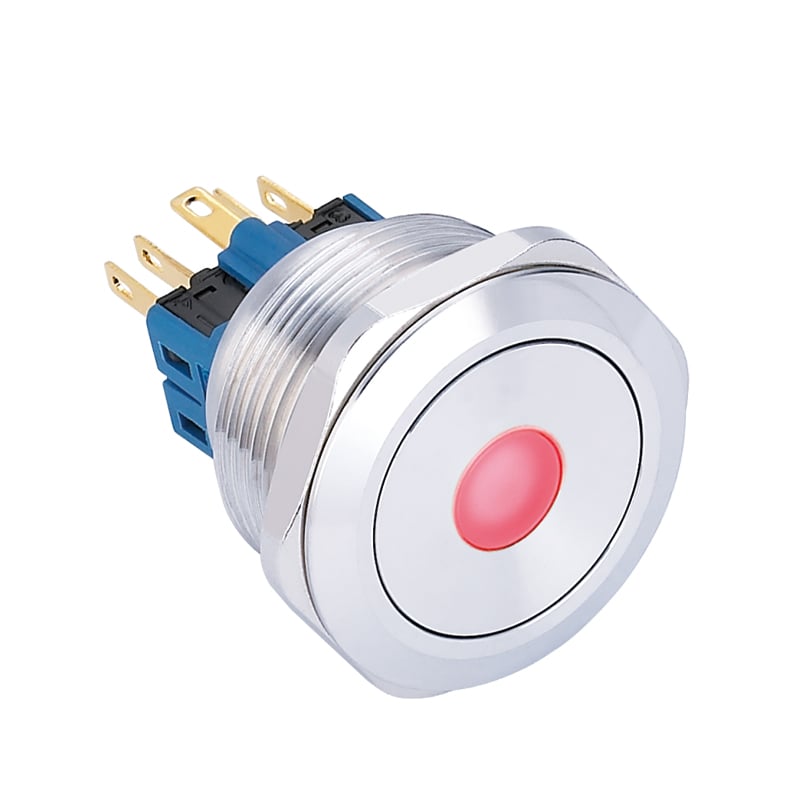
De ONPOW productreferentie helps identify the switch family for a document request. A visible metal part does not establish its complete composition or mineral origin. Product photographs in this article are identification examples only. They are not evidence that tin, tantalum, tungsten, gold or any other named mineral is present, absent or sourced from a particular region in the illustrated configuration.
Read the declaration scope before the answers
A reporting template may describe an entire company, a defined set of products or another stated scope. Read that scope first. A company-wide response can contain facilities connected to products outside the buyer’s order. Conversely, a narrowly scoped response may omit other items purchased from the same supplier. The task is to understand the relationship, not to force every response into one preferred scope without discussion.
Ask for a controlled list when the declared product scope is not self-explanatory. Save the supplier’s explanation of how the listed references relate to the order. If the answer is company-wide, record that limitation rather than relabel the file as product-specific. This distinction is especially important when a customer requests evidence for a particular equipment bill of materials.
Use a supplier-record review table
This table is an original procurement workflow. It does not prescribe legal obligations for every buyer and does not certify a mineral supply chain. Use it to identify what can be reviewed from the available response and what needs a follow-up question.
| Beoordelingsitem | Information to establish | Common mismatch | Useful next action |
|---|---|---|---|
| Reporting entity | Company and responsible contact | Distributor file has no clear upstream relationship | Request the source and coverage explanation |
| Reporting period | Period requested by the customer | Current order relies on an unexplained older response | Ask whether the evidence remains applicable |
| Declaration scope | Company, product list or stated boundary | Company-wide data labelled as part-specific | Preserve the scope and ask for mapping |
| Mineral answers | Qualified answers under the template instructions | Unknown or incomplete interpreted as no | Retain the actual answer and seek clarification |
| Facility information | Identified smelters or refiners and supporting context | Facility name confused with a mine or an entire product | Ask how the facility data relates to the declared scope |
| Follow-up | Open issues, owner and response date | A received file marked fully approved | Track review completion separately from file receipt |
Review the template instructions alongside this checklist. If the supplier leaves a field blank, ask what the blank means. A buyer should not silently replace an incomplete response with a favourable interpretation merely to close a customer questionnaire.
Distinguish information collection from due diligence
De OECD mineral supply-chain guidance site describes an ongoing approach involving management systems, risk assessment, responses to risk, audits at relevant control points and communication. Receiving a spreadsheet is only one information-gathering activity within a wider process. A file can support review while still leaving questions about implementation or coverage unresolved.
Apply follow-up proportionately to the evidence and the buyer’s role. A downstream equipment purchaser is usually several steps removed from extraction. It needs a clear way to engage suppliers and escalate concerns, rather than pretend to possess mine-level knowledge. Keep the supplier’s stated information separate from the buyer’s assessment. The existence of a template, a company policy or a facility list should not be described as proof that every risk has been eliminated.
Handle smelter and refiner information carefully
A facility name can be incomplete, misspelled or unrelated to the scope requested by the buyer. Ask the supplier to clarify uncertain entries using the reporting instructions and the appropriate reference information. Record any verification date and the source used. Do not invent a facility identifier or infer a mine of origin from a company’s country of registration.
Where a supplier refers to an assessment programme, determine exactly what was assessed and when. An assessment associated with one facility should not be extended to every upstream actor or every product of the responding company. Programme information and supplier mapping both matter. Avoid publishing a sourcing label on a product page merely because a facility appears in a received spreadsheet; the relationship to that product must first be established.
Work through a scope mismatch
Imagine a hypothetical panel builder ordering several switch references from one supplier. The customer requests a product-level response, while the supplier returns a company-level CMRT. The correct first step is to document the difference and request a coverage explanation or an appropriate product mapping. Automatically rejecting all company-level information can discard useful evidence; automatically treating it as product-specific creates a different error.
If the supplier cannot narrow the response, ask what information it can reliably provide and refer the remaining issue to the customer or designated sourcing reviewer. Preserve the original file, the explanation and the decision. This example is a review scenario, not a statement about ONPOW’s supply chain. No particular mineral content, facility relationship or sourcing outcome should be inferred from it.
Keep chemical declarations and lot records in their own roles
A conflict minerals response is not a substitute for a chemical substance declaration. The REACH material declaration guide addresses a different materials-information question. The RoHS scope review likewise concerns a separate assessment. A supplier can provide multiple documents, but each must answer its own customer requirement.
Gebruik de gids voor traceerbaarheid van partijen when linking deliveries to procurement and production records. A lot number may help associate a shipment with documentation; it does not independently identify mineral origin. Keep these evidence routes connected without collapsing them into one claim. Electrical ratings, environmental protection and application suitability also remain separate engineering questions that a sourcing template cannot settle.
Track incomplete responses without hiding uncertainty
Maintain distinct states for requested, received, under review and accepted under the customer’s requirements. Record the specific missing information and the person responsible for follow-up. If a supplier reports that upstream information is incomplete, preserve the qualification. Do not convert it into either a claim of absence or a definitive finding of problematic sourcing without additional evidence.
Escalate material inconsistencies through the buyer’s responsible sourcing process. The OECD framework supports identifying and managing risks rather than treating a questionnaire as a one-time guarantee. The appropriate action depends on the actual circumstances and the relevant requirements. Procurement should collect and communicate facts clearly, while the authorised reviewer decides how unresolved issues affect the purchase or customer response.
Retain a usable record and define review triggers
Save the original template, supporting correspondence, product mapping and review decision under a controlled supplier or part record. Identify the reporting period and the customer request it answers. Retain earlier versions according to the organisation’s document policy so that a later update does not erase the evidence behind an earlier decision. Avoid copying an editable spreadsheet into an unrelated order without checking its scope.
Reopen the review when the supplied configuration, reporting entity, customer instruction or relevant supplier information changes. Assign an owner for periodic follow-up where the customer’s process requires it. A supplier response should remain connected to the decision it supported; it should not become a permanent product badge detached from its date and qualifications. The file is useful because another person can understand it, not because every field is coloured green.
Prepare an answerable ONPOW information request
Send the exact references and options, the reporting period and the requested template or questionnaire. Explain whether the request covers only those switches or other supplied items. Ask for the responding entity, declaration scope and the contact who can clarify product coverage. If the customer requires product-level information, state that before the supplier completes the response.
Neem contact op met ONPOW for available supplier documentation tied to the requested references. Keep any requested electrical specifications in a separate section. The practical objective is a traceable sourcing-information package with clear limits and follow-up responsibilities. Neither a catalogue image nor an unreviewed spreadsheet can establish the mineral content or origin of a specific finished switch.
Veelgestelde vragen
Does a completed CMRT certify a push button as conflict-free?
Nee. Een CMRT communiceert informatie over de toeleveringsketen binnen een verklaarde reikwijdte. Beoordeel de antwoorden, dekking, ondersteunende informatie en relevante vervolgacties voordat u een inkoopverklaring doet.
Does a company-wide response necessarily describe my ordered model?
Het kan een breder scala aan producten en faciliteiten omvatten. Vraag hoe de bestelde referenties worden gedekt en behoud de bedrijf brede reikwijdte in plaats van het als product specifieke bewijs te herlabelen.
Can a product photograph show which conflict minerals are present?
No. Visible metal features do not disclose a complete material composition or mineral origin. Obtain supplier information appropriate to the requested product and reporting scope.
Is a lot number enough to establish mine or smelter origin?
No. A lot record supports delivery traceability within its own system. Mineral-origin information requires a separate supply-chain evidence route and a clear connection to the declared product scope.
Meer leren
OECD presents its study of company reporting on mineral supply-chain due diligence. The 2022 recording illustrates why disclosure and implementation need separate review; it does not assess an ONPOW supplier or product.