

A push button product carbon footprint boundary determines which processes a reported emissions figure actually includes. Before using a supplier’s number, confirm the exact configuration, reporting unit, life-cycle stages, exclusions, data period and assumptions. A cradle-to-gate result should not be presented as a complete lifetime footprint, and a company emissions total is not a product result. This guide helps switch buyers request usable information and route unresolved questions to an environmental practitioner. It does not calculate an ONPOW footprint, certify a product or assign emissions to any model shown in the photographs.
Why the boundary matters more than the headline number
A purchasing spreadsheet may have a single field for carbon emissions per item. The supporting report is rarely that simple. One supplier may include materials and manufacturing, while another also includes delivery, operation and disposal. Copying both figures into the same column without their boundaries can create a misleading comparison even when both reports are internally valid.
The boundary tells the reader where the accounting starts and ends. It also identifies the processes attributed to the product and explains exclusions. Treat the result and its boundary as an inseparable pair. If the number travels to another spreadsheet or customer portal, the scope information needs to travel with it.
Begin by identifying the intended use of the data. Early design estimation, customer reporting and comparative purchasing decisions need different levels of detail. An imperfect but clearly described input may serve an agreed preliminary estimate. The same input should not automatically support a public claim that one switch has lower emissions than another.
Separate product accounting from company accounting
De GHG Protocol Product Standard addresses emissions associated with an individual product’s life cycle. Its guidance distinguishes that perspective from corporate value-chain accounting. A manufacturer’s annual emissions report can provide useful context, but it does not by itself supply the footprint of a particular ordered push button.
For example, dividing a company’s annual emissions by its annual production count is not a substitute for the required product accounting model. Products may use different materials and production routes, and the organizational inventory may have a different boundary. A simple division can hide those differences and should not be represented as a validated product footprint.
Ask the supplier for the report supporting the actual product figure, not only a sustainability brochure. The WRI publication page for the Product Standard describes the product-level purpose of the framework. A company target, an offset purchase and an assessed product inventory are separate forms of information.
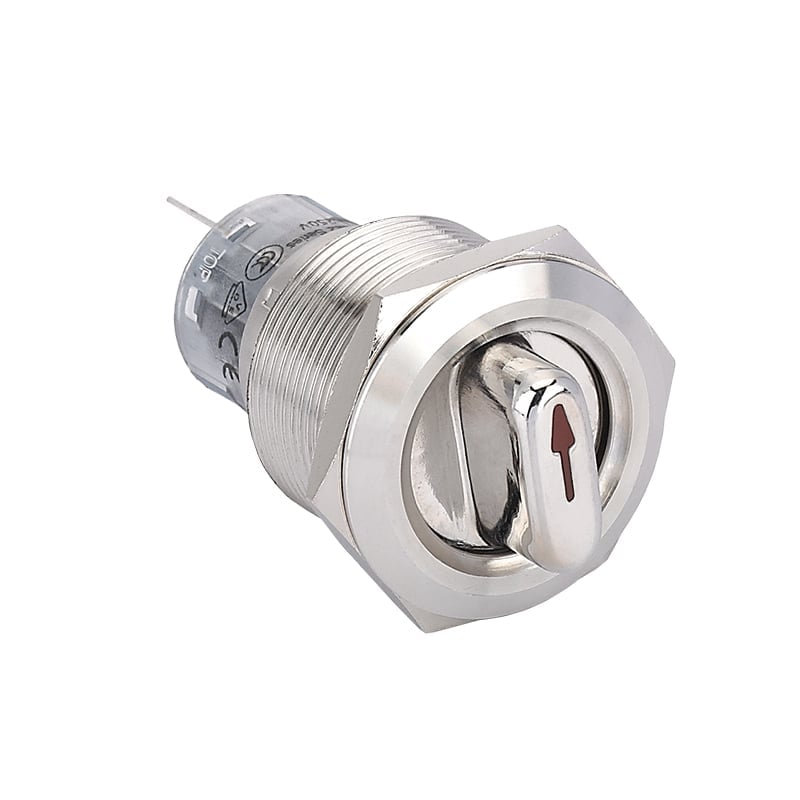
Define the supplied switch before requesting data
State the full order code and what arrives in the box. Does the supply include the operator, contact blocks, an illumination module, a connector or mounting accessories? If the report covers an operator only, the buyer must not assume that the rest of the installed assembly is included. Make the included-component list part of the data request.
De LAS1-AGQ22-11TSB catalog page provides a concrete identity reference for a supplier discussion. Other LAS1-AGQ22 configurations need their own identification. The photographs illustrate catalog differences only; they provide no evidence of measured emissions, manufacturing energy or environmental certification.
Also identify the purchase quantity and reporting unit. Per item, per mass and per defined service are different bases. If a supplier reports a grouped or representative model, request the explanation connecting it to the ordered configuration. Keep that qualification visible rather than renaming the representative figure as a model-specific result.
Map the included stages and missing information
Use a process map or a written stage list to understand what the result covers. The following table is a review aid, not a claim that every listed process must be treated identically under every accounting framework.
| Boundary question | Op te vragen bewijsmateriaal | Purchasing interpretation |
|---|---|---|
| What product is assessed? | Order-code and included-component description | Relate the figure to the actual supply |
| What happens upstream? | Material and component process coverage | Identify included purchased inputs and exclusions |
| What manufacturing is covered? | Production route, location coverage and data period | Check relevance to the supplied configuration |
| Where does delivery end? | Transport and distribution assumptions | Avoid assuming the customer’s route is represented |
| Is operation included? | Use scenario, service period and energy assumptions | Keep an excluded use stage distinct from zero emissions |
| Is end of life included? | Treatment scenario and allocation explanation | Do not equate assumed recycling with demonstrated recovery |
| Which processes are excluded? | Documented exclusions and reasons | Assess whether the data fit the customer’s purpose |
| What is the result unit? | Quantity basis and climate indicator description | Prevent incompatible values entering one comparison |
For methodological detail, the GHG Protocol Product Life Cycle Accounting and Reporting Standard contains dedicated guidance on boundary setting and disclosure. Have a qualified practitioner interpret requirements for the intended study rather than inventing a boundary from the table alone.
Understand partial footprints without treating them as failures
A partial footprint can be useful when its purpose and limits are clear. A component supplier may have production-stage data while the panel builder or machine manufacturer controls the later use scenario. The buyer should establish where one dataset ends and the customer’s assessment begins. This handoff prevents missing processes and accidental double counting.
De public scope of ISO 14067:2018 includes product and partial product carbon-footprint quantification. It addresses climate change rather than every environmental impact, and its scope does not cover carbon offsetting. The public abstract is a scope reference, not the complete standard or evidence that an ONPOW model has been assessed against it.
Label partial data explicitly in the project record. If a report stops at the factory gate, state that limit next to the value. Do not add a statement such as “lifetime footprint” merely because the downstream team would prefer a complete number. Ask what further data are needed and who is responsible for supplying them.

Review use-stage assumptions for illuminated controls
An illuminated operator introduces questions about operation that may not arise in the same way for an unilluminated configuration. Ask whether the assessed scenario includes the light source and related operating energy. Then ask how the operating pattern was chosen. A continuously energized indicator and an intermittently used control may have different scenarios even within the same installation.
Do not estimate use-stage emissions from a photograph, mounting size or nominal voltage. A voltage description alone does not establish power consumption. Obtain the correct electrical information and an agreed operating scenario. The practitioner also needs an appropriate electricity dataset and any assumptions about changes over the assessment period.
Separate engineering reliability from environmental service-life assumptions. A cycle rating, where supported by an applicable specification, does not automatically establish the number of years used in a footprint study. The customer’s duty and maintenance plan matter. If the report uses an assumed lifetime, preserve that description instead of turning it into a product warranty.
Compare methods and data quality before comparing suppliers
The smallest displayed number is not necessarily the best-supported result. Review the reporting period, geography, data sources and treatment of important processes. Ask which information is measured for the supplier and which uses secondary datasets. A short result sheet may require a supporting report before those questions can be answered.
When two footprints use different boundaries, do not casually subtract or scale individual stages to make them appear comparable. Changes may affect allocation, cut-offs or other study assumptions. Give both reports to the responsible practitioner and ask whether a common comparison can be built from the available information.
Sensitivity analysis can be more informative than an unsupported ranking. If an uncertain operating pattern changes the conclusion, that uncertainty belongs in the decision. Procurement can help by collecting realistic usage and supply information. It should not replace uncertain inputs with precise-looking guesses to complete a customer form.
Keep carbon information separate from other supplier claims
A carbon-footprint result does not establish restricted-substance compliance or recycled content. Those requests have their own scope and evidence. The materiaalverklaringsgegevensgids explains how structured substance information serves a different purpose from climate accounting.
Likewise, the conflict-minerals supplier records guide concerns supply-chain sourcing information. Those records may be part of a wider purchasing file, but they do not calculate climate impact. Keep the underlying evidence connected without changing its meaning.
A useful common starting point is the supplier evidence review: identify what a record covers, its source and its limitations. The environmental practitioner must then decide how that information can be used in the chosen accounting framework.
Prepare a request that the supplier can answer
Send a structured request containing the exact product configuration, the customer’s intended use of the result, the required unit and the desired life-cycle coverage. Ask for the report date, represented production period, assessment method and available verification statement. Request explicit exclusions and any restrictions on comparison or external communication.
Offer clear response categories: applicable report available, related report requiring mapping, partial dataset available, or no usable data currently available. That gives the supplier a truthful way to report limitations. If no footprint exists, do not pressure the supplier to invent a figure from product mass or a company emissions total.
Save the received report and the review conclusion together. Record outstanding questions, agreed assumptions and who approved the dataset for its intended use. Revisit the file when the product configuration, represented production route or accounting method changes. A documented boundary makes the information useful across teams and reduces the chance that a qualified number becomes an unqualified marketing claim.
Veelgestelde vragen
Is een fabriekspoortcijfer een volledige levensduurvoetafdruk?
No. A factory-gate boundary excludes later processes unless the report explicitly states otherwise. Preserve the boundary label and ask the responsible practitioner what additional information is required for the customer’s intended assessment.
Can I use the manufacturer’s annual emissions as a switch footprint?
Not without a suitable product accounting study. Corporate and product inventories answer different questions and may cover different activities. An annual total divided by production quantity should not be presented as a validated model-specific result.
Dekt een koolstofvoetafdruk alle milieueffecten?
No. A product carbon footprint addresses climate-related impact within its defined scope. It does not by itself assess all resource, toxicity, water or other environmental issues. Broader conclusions require the appropriate evidence and assessment method.
Kunnen twee gerapporteerde voetafdrukken direct met elkaar worden vergeleken?
Only after their function, configuration, unit, boundaries, methods and relevant assumptions have been assessed for compatibility. Ask a qualified practitioner to determine whether the available reports support the proposed comparison and intended communication.
Meer leren
WRI introduces the GHG Protocol and the distinction between business accounting frameworks. This historical overview provides context, not a calculation method or verification of any switch footprint.

WRI/WBCSD Greenhouse Gas Protocol (GHGP) — World Resources Institute



