

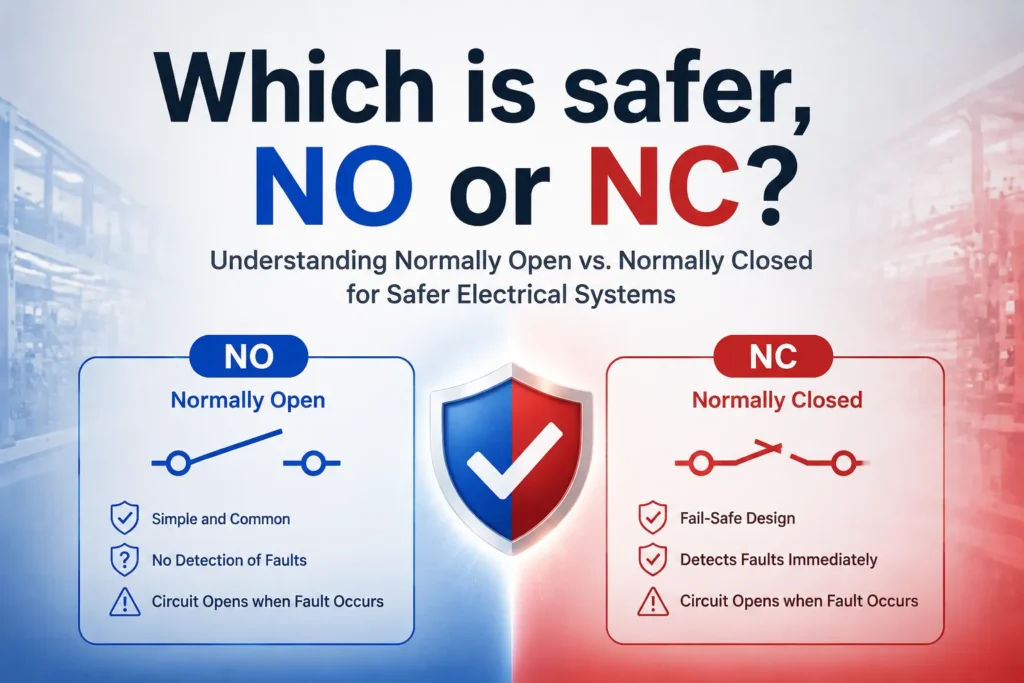
When choosing a push button switch, limit switch, sensor, or safety control device, many buyers ask the same question:
Which is safer, a normally open switch or a normally closed switch?
The short answer is:
A normally closed (NC) switch is generally safer for safety-critical circuits because it can provide fail-safe monitoring. However, the safest choice always depends on the function of the circuit and the application.
To make the right decision, you first need to understand how normally open switches and normally closed switches work.
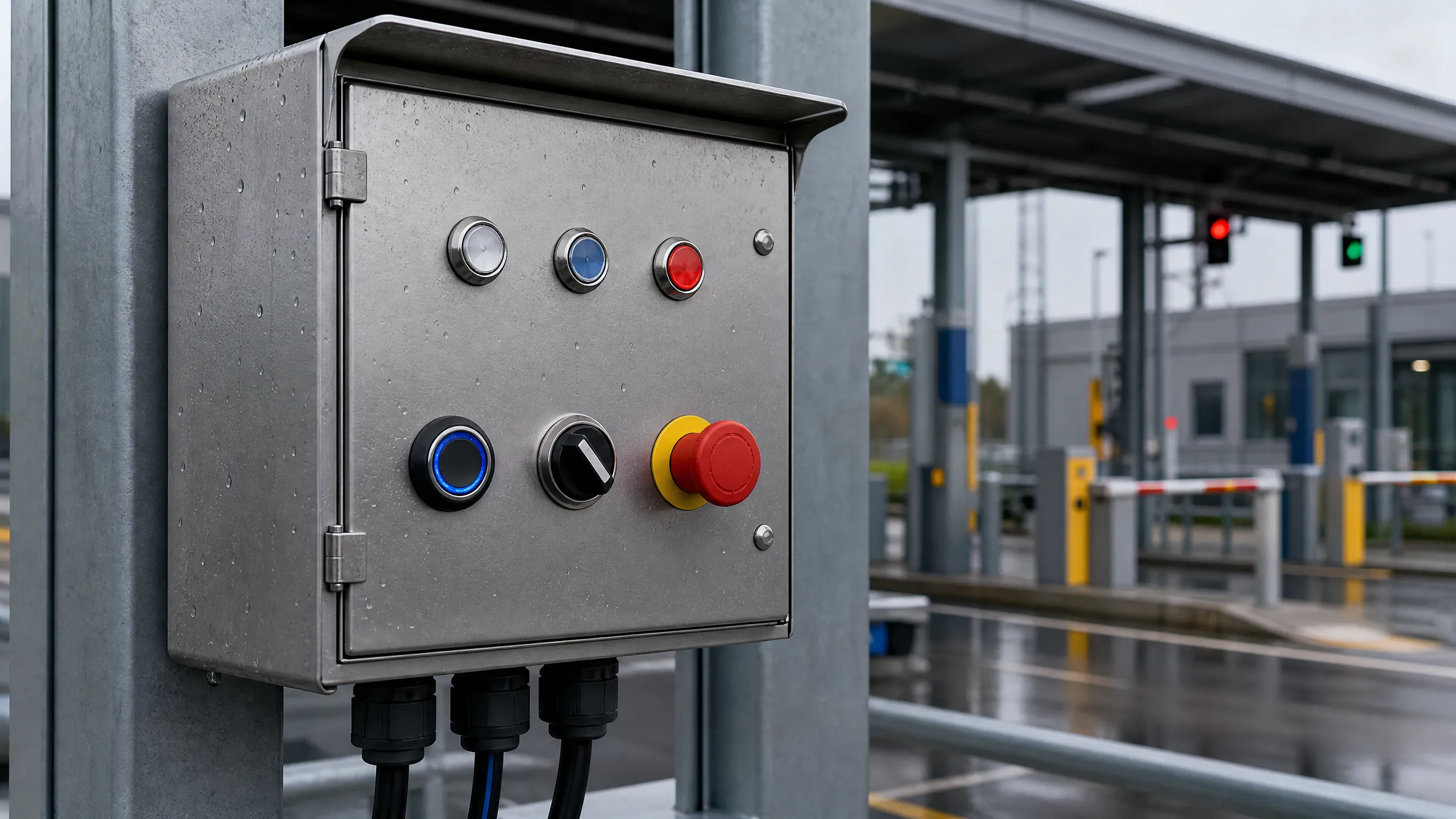
What Is a Normally Open Switch?
A normally open switch (NO switch) has an open circuit when it is in its normal, unactivated state.
Because the circuit is open, electrical current cannot flow. When the switch is pressed, activated, or triggered, the contacts close and allow current to pass.
In simple terms:
- Normal state: Circuit open
- Switch activated: Circuit closed
- Current flow: Only when activated
A normally open switch is commonly used when an action should begin after the switch is pressed.
Typical applications include:
- Start buttons
- Machine activation controls
- Doorbells
- Signal triggers
- Control panel buttons
- Momentary push button switches
For example, when an operator presses a machine start button, the NO contacts close and send a signal to start the machine.
What Is a Normally Closed Switch?
A normally closed switch (NC switch) has a closed circuit when it is in its normal, unactivated state.
Because the circuit is closed, electrical current can flow continuously. When the switch is pressed, activated, or triggered, the contacts open and interrupt the circuit.
In simple terms:
- Normal state: Circuit closed
- Switch activated: Circuit open
- Current flow: Until the switch is activated
A normally closed switch is often used where the system needs to monitor whether the electrical circuit remains complete.
Typical applications include:
- Emergency stop circuits
- Safety interlock systems
- Machine safety controls
- Protective guards
- Alarm systems
- Fault monitoring circuits
For example, an emergency stop button may use NC contacts. Under normal operating conditions, the safety circuit remains closed. When the emergency stop button is pressed, the contacts open and interrupt the circuit.
Which Is Safer: NO or NC?
For most safety-related applications, an NC switch is generally considered safer.
The main reason is that an NC circuit can help detect certain faults that might otherwise remain hidden.
For example, imagine that a wire becomes disconnected in a safety circuit:
- In an NC circuit, the broken wire opens the circuit and can trigger a stop or fault response.
- In an NO circuit, the circuit is already open during normal operation, so a broken wire may not be detected immediately.
This is why NC contacts are commonly used in emergency stop circuits and other safety-related control systems.
However, this does not mean that every NC switch is automatically safe or that NO switches are unsafe.
The safety of a system depends on several factors, including:
- The function of the circuit
- The control system design
- The required safety level
- The wiring method
- The type of switch
- The operating environment
- The relevant safety standards
The contact type is only one part of the overall safety design.
Why Are NC Contacts Often Used in Emergency Stop Circuits?
Emergency stop systems are designed to stop a machine or reduce hazardous movement when an emergency occurs.
An NC contact is useful because the safety circuit remains closed during normal operation. If the emergency stop button is pressed, the contact opens and interrupts the circuit.
An NC design may also respond to certain wiring problems.
For example, if a wire becomes loose or breaks:
- The circuit opens.
- The control system detects the interruption.
- The machine may stop or enter a safe condition.
This principle is often called fail-safe operation.
A fail-safe design aims to move the system toward a safer condition when a fault occurs rather than allowing the machine to continue operating without detecting the problem.
However, the exact behaviour depends on the control system and how the safety circuit is designed.
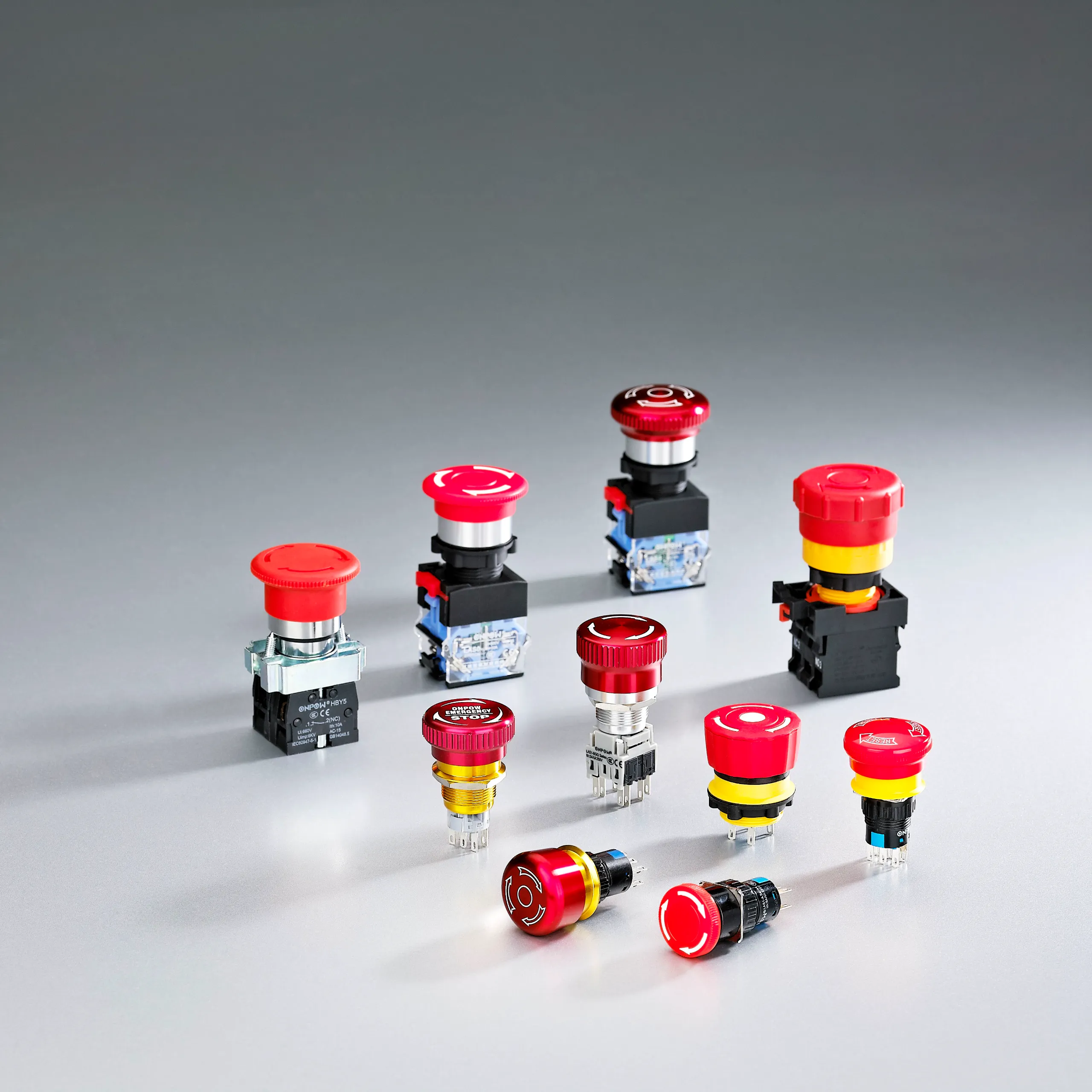
When Should You Choose a Normally Open Switch?
Choose a normally open switch when you want an action or signal to occur only after the switch is activated.
An NO contact may be suitable for:
Machine Start Buttons
A machine usually should not start automatically after power is restored. An NO start button requires a deliberate action from the operator.
Signal and Control Inputs
An NO switch can send a signal when pressed, such as turning on a light, activating a relay, or starting a process.
Momentary Push Button Controls
Many momentary push buttons use NO contacts because the circuit closes only while the button is pressed.
User-Initiated Actions
If the purpose is to start, enable, activate, or trigger a function, an NO contact is often the logical choice.
When Should You Choose a Normally Closed Switch?
Choose a normally closed switch when the circuit needs to remain active during normal operation and open when a safety action or fault occurs.
An NC contact may be suitable for:
Emergency Stop Buttons
NC contacts are widely used in emergency stop control circuits because pressing the button opens the circuit.
Safety Guards and Interlocks
An NC circuit can monitor whether a protective door or machine guard remains in the correct position.
Fault Detection
If a wire is disconnected, the circuit may open and allow the system to detect a possible fault.
Stop Functions
Many stop buttons use NC contacts because pressing the button interrupts the control circuit.
NO vs. NC: Quick Comparison
| Feature | Normally Open (NO) | Normally Closed (NC) |
|---|---|---|
| Normal circuit state | Open | Closed |
| Current flows normally | No | Yes |
| Contact changes when activated | Closes | Opens |
| Common function | Start or activate | Stop or monitor |
| Typical application | Start button | Emergency stop button |
| Can help detect broken wiring | Usually limited | Often more effective |
| Common use in safety circuits | Application-dependent | Frequently used |
Can a Switch Have Both NO and NC Contacts?
Yes. Many industrial push button switches are available with both NO and NC contact configurations.
A switch may have:
- 1NO
- 1NC
- 1NO + 1NC
- 2NO
- 2NC
- Multiple contact combinations
A combined 1NO + 1NC switch can perform different functions within the same control system.
For example:
- The NO contact can send a start or control signal.
- The NC contact can interrupt another circuit or provide status monitoring.
This can simplify control panel design and provide more flexibility.
Before purchasing, check the switch specifications carefully because the available contact configurations may vary by model.
Is NC Always Safer Than NO?
No. NC is not automatically safer in every situation.
An NC contact is often preferred for safety monitoring because an open circuit can indicate that a button has been pressed or that a connection may have failed. However, safety depends on the complete system design.
For example, an NO switch may be the safer choice for a machine start function because the machine should require a deliberate action before starting.
The better question is:
What should happen when the switch is activated, disconnected, or damaged?
If the system should stop or enter a safe state when the circuit is interrupted, an NC contact may be appropriate.
If the system should operate only after a deliberate action closes the circuit, an NO contact may be more suitable.
How to Choose the Right NO or NC Switch
Before selecting a switch, consider the following questions.
1. What Is the Switch Required to Do?
Is the switch intended to:
- Start a machine?
- Stop a machine?
- Trigger a signal?
- Activate a relay?
- Monitor a safety guard?
- Interrupt a control circuit?
The required function is usually the first factor to consider.
2. What Should Happen If a Wire Breaks?
For safety-related circuits, consider how the system should respond to a disconnected or damaged wire.
If the system should stop when the circuit is interrupted, an NC configuration may provide a more suitable design.
3. Is the Application Safety-Critical?
Emergency stop systems, machine guards, and protective interlocks may require additional safety components and specialised control systems.
Do not select a switch based only on whether it is NO or NC. Check the relevant safety requirements for the complete application.
4. What Electrical Rating Is Required?
Check the switch specifications, including:
- Rated voltage
- Rated current
- Contact rating
- AC or DC compatibility
- Load type
- Electrical life
A switch with the correct contact type may still be unsuitable if its electrical rating does not match the application.
5. What Operating Environment Will the Switch Face?
Consider:
- Water exposure
- Dust
- Oil
- Vibration
- High or low temperatures
- Outdoor installation
For demanding industrial environments, an appropriate protection rating may be important.
Choosing ONPOW Normally Open and Normally Closed Switches
ONPOW offers industrial push button switches with a range of normally open switch and normally closed switch contact options.
Depending on the product series, buyers can select different configurations to support functions such as:
- Machine start and stop control
- Emergency stop operation
- Industrial control panels
- Equipment monitoring
- Automation systems
- Custom control applications
ONPOW push button switches are available in different mounting sizes, materials, actuator styles, illumination options, and protection levels. This allows buyers to choose a switch based on both electrical requirements and installation conditions.
When selecting an ONPOW switch, check the product specifications to confirm the available NO and NC contact configurations for the chosen model.
Frequently Asked Questions
Is normally closed safer than normally open?
For many safety circuits, an NC switch is considered more suitable because a broken wire or disconnected connection may open the circuit and trigger a fault or stop response. However, safety depends on the complete system design.
Is an emergency stop button normally open or normally closed?
Emergency stop buttons commonly use normally closed contacts. Pressing the button opens the safety circuit and sends a stop signal.
Is a start button normally open or normally closed?
A machine start button commonly uses a normally open contact. Pressing the button closes the circuit and sends a start command.
What does 1NO and 1NC mean?
1NO means one normally open contact. 1NC means one normally closed contact.
A 1NO + 1NC configuration includes one normally open contact and one normally closed contact.
Can I use an NO switch as a stop button?
An NO contact can be used in some control designs, but it may not provide the same fault-monitoring behaviour as an NC stop circuit. The correct configuration depends on the control system and safety requirements.
Can I use an NC switch as a start button?
An NC switch can be used for certain control functions, but it is generally not the typical choice for a standard machine start command. A normally open contact is often more suitable because the operator must actively close the circuit to start the machine.
Final Thoughts
When comparing a normally open switch with a normally closed switch, neither contact type is universally best.
A normally open switch is commonly used to start, activate, or trigger a function. A normally closed switch is often preferred for stop functions, safety monitoring, and applications where an interrupted circuit should produce a safe response.
For many safety-related circuits, NC contacts provide an important fail-safe advantage. However, the final choice should always be based on the application, electrical requirements, control system, and relevant safety standards.
Before purchasing, confirm the required contact configuration and review the switch specifications carefully. Choosing the correct NO or NC contact can improve system reliability, simplify control design, and support safer equipment operation.
Customization
ONPOW undertakes a variety of custom needs for push-button development. Confirm whether packaging, marking or documentation OEM/ODM applies to Which Is Safer, NO or NC? in the quotation.
Minimum order quantity, lead time and trade terms are not published here; confirm them with sales at sales@onpow.com.



