

A 20A push button switch should not be selected for direct load switching from the “20A” label alone. The label must be tied to the exact model, the meaning of the published current field, and the actual load duty. When the necessary operational-duty evidence is not available, use the button as a control input to a properly selected contactor rather than treating it as the power switch.
Part 1. What does 20A mean on a push button switch?
“20A” is not a complete sentence in an electrical specification. It can refer to a named current field under a stated standard, temperature, enclosure condition, or duty. A sourcing decision needs the full field name, the model number, and the application conditions before it can determine whether a device is intended to make and break the proposed load.
For the ONPOW GQ30-L-11/S page, the listed fields include Ui 250V and Ith 20A. Ui is an insulation-voltage field; Ith is a conventional thermal-current field. Neither label alone states a validated load type, operational utilization category, switching frequency, inrush capability, or a direct motor-control recommendation.
The search phrase can therefore hide different buyer needs. One buyer may need a maintained local isolating action, another a momentary command for a contactor coil, and another a resistive load switch. The right answer begins with the load and circuit, not with a current headline.
| Specification field | What it tells you | What it does not establish |
|---|---|---|
| Interfejs użytkownika | Insulation-voltage context | Direct switching duty |
| Ith | Conventional thermal-current test context | A validated make/break rating for every load |
| Contact arrangement | Available circuit paths | Motor or inductive duty without other data |
| IP field | Stated ingress boundary | Electrical load suitability |
For the wider panel-control context, see the 22mm push button switch guide. Hole size and housing style remain separate from the electrical-duty decision.
Part 2. Why is Ith not a switched-load rating?
Ten Eaton IEC application guide defines conventional free-air thermal current, Ith, as the maximum test current used for temperature-rise tests of unenclosed equipment in free air. It further distinguishes this test concept from rated operational current.
In practice, the distinction changes the selection process. Carrying a defined current under temperature-rise test conditions does not, by itself, demonstrate how contacts perform while repeatedly closing and opening an inductive load, managing inrush, or interrupting an arc. Enclosure temperature, switching frequency, conductor choice, protective devices, and the load’s electrical behavior also affect the selection.
Ważne: Do not write “directly switches 20A” where the available product evidence only lists
Ith 20A. The Eaton application guide is the source for the thermal-current distinction.
A thermal-current field can still be important for thermal design and comparison. It simply cannot replace a documented operational switching category and its application conditions. That is why comparable contactors show separate conventional thermal and application-duty information in their documentation.
Part 3. When can direct switching be evaluated?
Direct switching can be evaluated only after the buyer identifies the load and obtains model-specific operational switching evidence that covers the use case. “Load is under 20A” is not enough information. The selected product documentation must relate to the actual voltage, current, load type, operating frequency, circuit protection, and environmental conditions.
Start with the questions below. If any answer is unknown, the safer engineering path is to collect the data or use a contactor architecture that separates local control from power switching.
| Direct-switching input | Why it changes the decision | Evidence to request |
|---|---|---|
| Supply voltage and AC/DC | Contact interruption differs by circuit | Exact operational rating at voltage |
| Load type | Resistive, inductive, capacitive, and motor loads behave differently | Applicable utilization/duty category |
| Inrush and starting behavior | Peak current can exceed steady current | Load or motor data |
| Switching frequency | Contact wear depends on operations | Electrical endurance under stated duty |
| Protection and enclosure | Fault and temperature conditions matter | Coordination and derating information |
This is not a claim that a contactor is always required. It is a decision boundary: direct switching needs evidence for the intended duty, while an incomplete current label is insufficient evidence.
Part 4. When is a contactor the better circuit choice?
When a load needs a device selected for its power duty, a push button can command the contactor coil instead of carrying the load path. Control.com’s motor-starter article explains a common arrangement: an NO Start contact momentarily energizes a coil, an auxiliary contact seals in the command, and an NC Stop contact opens the coil circuit.
This separates responsibilities. The push button is chosen for the operator interface and control circuit.
The contactor, overload protection, and other protective components are selected for the load and machine requirements. The architecture also gives the designer a clear place to define stop behavior, loss-of-control-power behavior, and additional interlocks.
Z pola: One engineer described the conventional answer as “add a contactor with a couple of no/nc push buttons.” The value of that wording is the buyer concern—operation count and control location—not a substitute for a project design review. — Electronics Stack Exchange discussion
For installation-oriented reading, link the drawing package to the push button switch wiring and installation guide. The final circuit must still be designed and reviewed for the equipment in question.
Part 5. Which load details change the answer?
Inductive loads, motors, solenoids, transformers, and switched power supplies can impose conditions that a simple steady-current number does not describe. Likewise, a resistive heater may have different switching behavior from a motor even when their running currents look similar.
The decision is affected by:
- load type and starting/inrush behavior;
- circuit voltage and whether it is AC or DC;
- operating frequency and expected electrical endurance;
- ambient and enclosure temperature;
- upstream protection and prospective fault conditions;
- required stop, restart, and interlock behavior.
Do not turn these questions into a generic compliance claim. They are the input set needed to match the device documentation with the application. A current number without those inputs is not a complete load specification.
Fit Boundary: This guide fits a buyer choosing the control architecture with documented load data. It does not fit a request to certify that a particular button will directly switch an unspecified 20A load, provide a safety function, or meet an unstated regional requirement.
Part 6. Where does GQ30-L-11/S fit the documented evidence?
Ten GQ30-L-11/S 30mm screw-terminal push button is a candidate when the buyer needs its physical interface and can match the application to the page’s published model fields. The page lists Ui 250V, Ith 20A, screw terminals, front IP65 with IP67 made to order, and IK09. It also lists stainless steel for the button and body, plus silver-alloy contacts and a PA base.
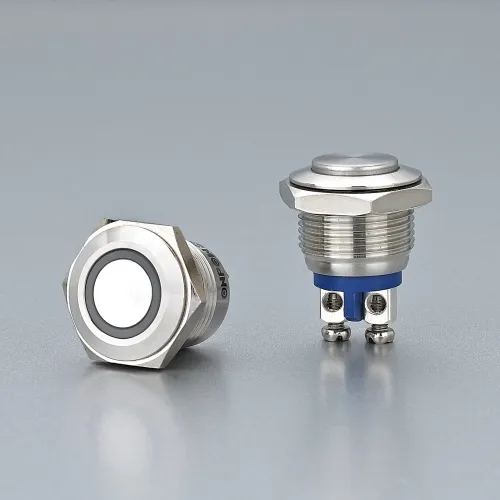
Its listed Ith is useful to record accurately: GQ30-L-11/S lists Ith 20A. That sentence must not become “the model switches a 20A load.” The page does not provide the operational-duty validation needed for that conclusion. It also does not support claims about safety certification, motor duty, or suitability for a particular equipment type.
Choose another documented product or a contactor-based circuit when the project needs a stated utilization category, direct-load evidence, a different panel size, or a safety function. The metal vs plastic push buttons article can help with enclosure-material questions, but it cannot resolve the load-duty evidence.
Part 7. What should the RFQ include?
An RFQ should allow a supplier or controls engineer to assess the actual circuit—not guess from “20A.” Supply the fields below together with the requested model or desired panel size.
| Buyer should provide | Dlaczego to ma znaczenie | Common mistake |
|---|---|---|
| Exact load type and voltage | Identifies relevant duty | Stating only amperes |
| Running current, inrush, and start data | Tests direct-switching suitability | Using steady current alone |
| AC/DC and switching frequency | Affects contact duty and endurance | Omitting operation rate |
| Circuit diagram or architecture | Shows button, coil, and load paths | Assuming a button must carry power |
| Required panel interface and front exposure | Confirms 30mm fit and stated IP need | Treating IP as a load rating |
| Protection and documentation requirements | Enables a complete review | Inferring certification from a series name |
To discuss a documented configuration, contact ONPOW with load and control details. Include the application information above so the enquiry can be assessed against exact model documentation.
Często zadawane pytania
What does 20A mean on a push button switch?
It identifies a current field only when read with the exact model documentation. For GQ30-L-11/S, the page lists Ith 20A.
Is Ith the same as a switched-load rating?
No. Ith is a conventional thermal-current concept for temperature-rise testing; it does not automatically establish make/break performance for a proposed load.
Can a 20A push button switch a motor directly?
Only model-specific operational-duty evidence and the complete circuit conditions can answer that. Do not infer it from Ith.
When should a contactor be used instead?
Use a contactor architecture when the load needs a purpose-selected power-switching device or when direct-load evidence for the button is incomplete.
Does a higher current number cover inductive loads?
No. Inductive-duty behavior must be covered by the relevant operational data, including voltage and use conditions.
What must be checked for a direct-load design?
Check load type, voltage, current, inrush, switching frequency, duty category, endurance, protection, temperature, and installation conditions.
What should an RFQ say for a 20A push button?
State the model or panel interface, complete load and circuit data, environmental conditions, quantity, and documentation requirements.



