

Przy wyborze switch button push for industrial equipment, outdoor machinery, marine systems, or medical devices, waterproof performance is often one of the first specifications buyers look at. But what does a waterproof rating really mean? More importantly, how do manufacturers verify that a switch can survive water exposure in real-world conditions?
This guide explains how wodoodporne przyciski are tested, what the different IP ratings represent, and what buyers should check before making a purchase.
Why Waterproof Testing Matters
A switch button push may operate perfectly in a clean laboratory, but actual working environments are rarely ideal. Rain, cleaning fluids, dust, humidity, and accidental splashes can all shorten the lifespan of an electrical switch if it is not properly protected.
Reliable waterproof testing helps ensure that a switch can:
- Prevent water from entering the housing
- Maintain stable electrical performance
- Resist corrosion over time
- Continue operating after repeated exposure to moisture
- Reduce maintenance and equipment downtime
For industries where equipment reliability is essential, waterproof testing is not just a quality check—it is a critical safety requirement.
Understanding IP Ratings
The most common waterproof standard for przyciski is the Ingress Protection (IP) rating defined by IEC 60529.
The first digit represents protection against solid particles such as dust.
The second digit indicates resistance to water.
Some common ratings include:
| Stopień ochrony IP | Water Protection | Typical Applications |
| IP65 | Protection against water jets | Maszyny przemysłowe |
| IP66 | Strong water jets | Outdoor control panels |
| IP67 | Temporary immersion up to 1 meter | Marine equipment, automation |
| IP68 | Continuous immersion under specified conditions | Underwater or harsh environments |
| IP69K | High-pressure, high-temperature water jets | Food processing and sanitation equipment |
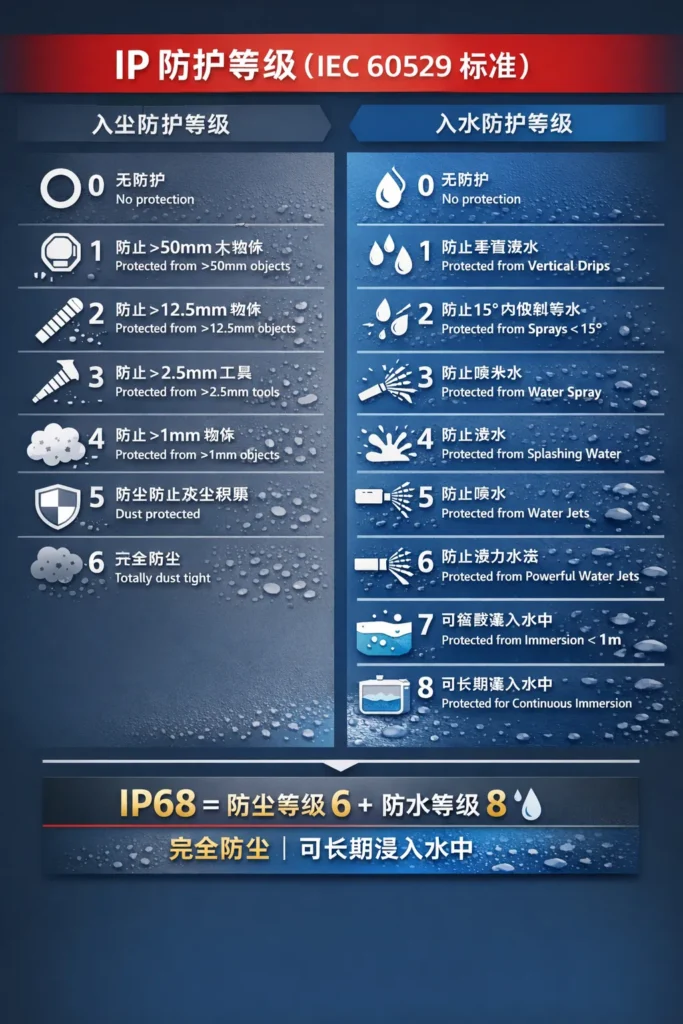
Higher numbers do not always mean “better.” The right rating depends on the actual operating environment.
How Waterproof Switches Are Tested
Manufacturers perform several standardized tests before certifying a switch button push with a specific IP rating.
1.Water Jet Test (IP65/IP66)
The switch is mounted in its normal installation position and sprayed with water from multiple directions using calibrated nozzles.
Engineers then inspect the switch for:
- Water penetration
- Electrical failures
- Mechanical damage
- Seal integrity
A qualified switch should continue operating normally after testing.
2.Immersion Test (IP67)
For IP67 push button switches, the switch is submerged in clean water at a specified depth—typically 1 meter—for approximately 30 minutes.
After removal, inspectors verify that:
- No water has entered the enclosure
- Electrical contacts function correctly
- LEDs remain operational
- Buttons move smoothly without sticking
This test simulates accidental flooding or temporary immersion.
3.Extended Immersion Test (IP68)
Unlike IP67, IP68 waterproof switches undergo longer or deeper immersion according to manufacturer-defined conditions.
Testing may include:
- Greater water depth
- Longer immersion periods
- Multiple immersion cycles
- Performance verification after testing
This level of protection is commonly required for marine equipment, underwater devices, and harsh industrial applications.
4.High-Pressure Wash Test (IP69K)
Industries such as food processing and pharmaceutical manufacturing frequently clean equipment using high-pressure hot water.
During an IP69K test, the switch is exposed to:
- High-pressure water jets
- Elevated water temperatures
- Multiple spray angles
- Rotating exposure
The switch must remain sealed and fully functional after the cleaning cycle.
5.Seal Integrity Inspection
Waterproof performance depends heavily on sealing components.
Manufacturers carefully inspect:
- Rubber O-rings
- Silicone gaskets
- Housing interfaces
- Panel mounting seals
- Threaded connections
Even a high-quality switch can fail if the sealing system is poorly designed.
6.Operational Life Testing
Waterproof testing is often combined with durability testing.
A przycisk may undergo tens of thousands—or even millions—of operating cycles before and after waterproof testing to ensure consistent performance.
Engineers evaluate:
- Rezystancja styku
- Actuation force
- Zwrot towaru
- Electrical continuity
- LED illumination stability (for illuminated models)
This confirms that waterproof performance lasts throughout the switch’s service life.
Environmental Tests Beyond Water
Professional manufacturers typically perform additional environmental testing to simulate harsh operating conditions.
These tests may include:
- Dust resistance
- Salt spray corrosion testing
- High and low temperature cycling
- Humidity testing
- Mechanical shock testing
- Vibration testing
Together, these evaluations provide a more complete picture of long-term reliability.
How Buyers Can Verify Waterproof Performance
Not every product advertised as “waterproof” has been independently tested.
Before purchasing a switch button push, ask suppliers the following questions:
- What IP rating has been certified?
- Which testing standard was used?
- Is the rating valid after panel installation?
- Can test reports or certifications be provided?
- Does the rating apply to the front panel only or the complete assembly?
- What materials are used for the housing and seals?
Reliable manufacturers are usually willing to provide technical documentation and test data.
Choosing the Right Waterproof Push Button Switch
The best waterproof switch depends on your application.
Na przykład:
- IP65 is suitable for general industrial machinery.
- IP67 works well for outdoor equipment exposed to rain or occasional flooding.
- IP68 is recommended for equipment operating in continuously wet environments.
- IP69K is ideal for equipment requiring frequent high-pressure washdowns.
Selecting a higher rating than necessary may increase cost without providing additional practical benefits.
Why Manufacturing Quality Matters
A waterproof rating is only as reliable as the manufacturing process behind it. Precision machining, high-quality sealing materials, and strict quality control all contribute to consistent waterproof performance.
ONPOW manufactures a wide range of przyciski designed for demanding industrial applications. Many models feature IP67 or higher protection, durable stainless steel housings, long mechanical life, and multiple illumination options, making them suitable for automation equipment, transportation systems, outdoor control panels, and other challenging environments.
Najczęściej zadawane pytania
Q:Can a waterproof switch still fail?
A:Yes. Improper installation, damaged seals, incorrect panel thickness, or physical impact can compromise waterproof performance even if the switch itself meets IP standards.
Q:Does IP67 mean the switch is waterproof forever?
A:No. IP67 indicates that the switch passed a standardized immersion test under specific conditions. Long-term reliability also depends on installation quality, maintenance, and the operating environment.
Q:Is IP68 always better than IP67?
A:Not necessarily. If your equipment is only exposed to rain or occasional splashes, IP67 is often sufficient. IP68 is mainly intended for applications involving prolonged or repeated immersion.
Q:Should I request certification from the supplier?
A:Absolutely. Reputable manufacturers should be able to provide relevant test reports or certification documents that support their waterproof claims.
Wniosek
Zrozumienie, jak switch button push is tested helps buyers make more informed purchasing decisions. Waterproof testing goes far beyond simply spraying a switch with water—it involves standardized evaluations for immersion, water jets, sealing performance, durability, and environmental resistance.
Przy wyborze wodoodporny włącznik przyciskowy, look beyond the advertised IP rating. Consider the testing methods, manufacturing quality, installation requirements, and the actual conditions your equipment will face. Choosing a well-tested switch from a trusted manufacturer can significantly improve system reliability, reduce maintenance costs, and ensure dependable operation for years to come.



