

A tamper-proof push button switch is specified by how the panel controls access to the operator, fasteners, and service points—not by the phrase “tamper-proof” alone. For a public-facing panel, define the fastening method, panel thickness, rear access, cleaning exposure, and evidence required for any IP or IK statement.
Part 1. What tamper-proof means for a public panel
“Tamper-proof” is a design objective, not a universal product certification. The panel is harder to alter when the operator, retaining hardware, legends, and service access are considered together.
| Design question | Dlaczego to ma znaczenie | Evidence to request |
|---|---|---|
| Can a passer-by reach the retaining nut? | Front access can allow removal or rotation | Mounting drawing and tool-access note |
| Can the rear body be reached? | Rear access changes replacement and bypass risk | Enclosure service drawing |
| Is a key required to change state? | A key selector adds a separate access mechanism | Keying and position documentation |
| Is the face exposed to cleaning or impact? | Environment and mechanical evidence are separate claims | Exact model IP/IK or test document |
Tamper resistance should therefore be written as a set of verifiable controls, not as a promise that the system cannot be altered.
Part 2. How fastening and rear access change the design
Public-panel design starts at the interface between the operator and the enclosure. Lock the panel thickness, cutout, retaining method, bezel access, and the replacement path before choosing the head finish.
Check these items on the drawing:
- front nut, clip, or bezel access and the tool needed;
- panel thickness range and any gasket or washer stack;
- rear body clearance for wiring and service tools;
- anti-rotation feature and operator orientation;
- label or legend area that remains readable after cleaning;
- replacement procedure that does not require uncontrolled access to adjacent circuits.
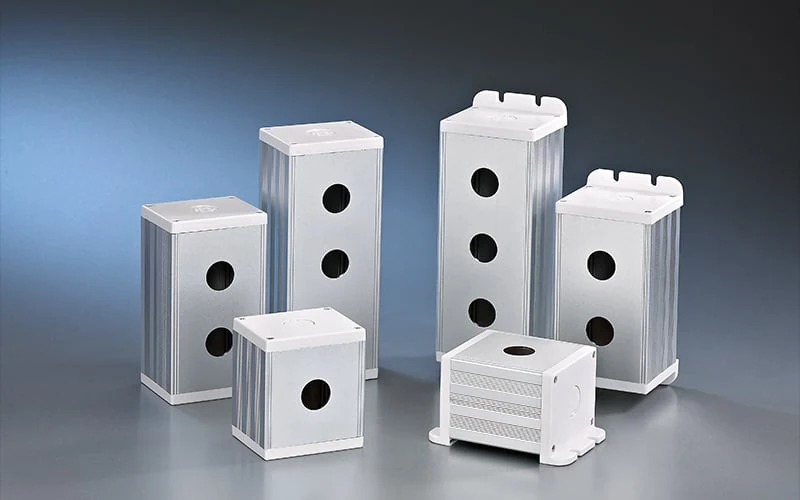
Wskazówka: Put the mounting drawing and a rear-service sketch in the RFQ. A front photograph cannot prove that the retaining hardware is inaccessible after installation (aparatura obwodów sterowniczych IEC 60947-5-1).
Part 3. How to separate environmental evidence from tamper claims
IP and IK describe specific protection tests and should not be used as synonyms for tamper resistance. IEC 60529 addresses ingress protection; a buyer still needs model-specific evidence for the installed interface and environment.
| Wymaganie | Ask for | Nie wyciągaj wniosków |
|---|---|---|
| Dust or water exposure | Exact IP evidence for the model and installed interface | “Tamper-proof” means waterproof |
| Impact exposure | Exact IK evidence if relevant | Metal automatically means a verified IK level |
| Cleaning agents | Material and test compatibility | A stainless finish proves chemical resistance |
| Public access | Fastening, guard, keying, and service method | IP/IK equals access control |
Ważne: Do not publish an IP, IK, or security rating from a family name or a product photograph. Confirm the exact model and evidence before the public panel is approved (IEC 60529 IP code).
Part 4. When a key-lock or guarded operator is the better architecture
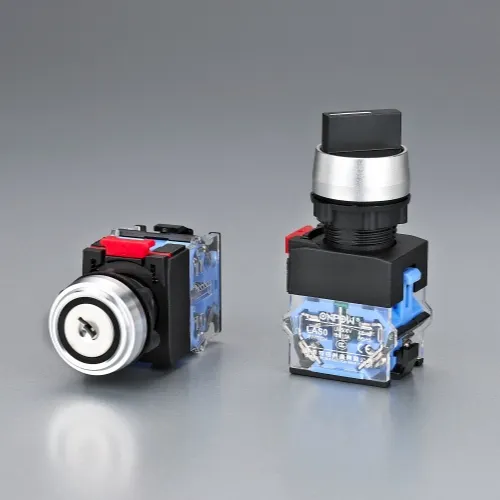
Sometimes the requirement is not resistance to removal; it is restriction of who may change the state. A key-operated selector switch may be more appropriate when the operation itself must be limited to authorized personnel.
Use a key-lock or guard when:
- the control state must remain unavailable to casual users;
- a maintenance mode requires a deliberate authorization step;
- the panel owner can manage keying, spare keys, and service access;
- the risk assessment calls for a separate access-control mechanism.
Use a standard push button with controlled fastening when the public may operate the function but must not remove or rotate the hardware. These are different requirements and should not be collapsed into one adjective.
Part 5. How to use the ONPOW metal line as a candidate path
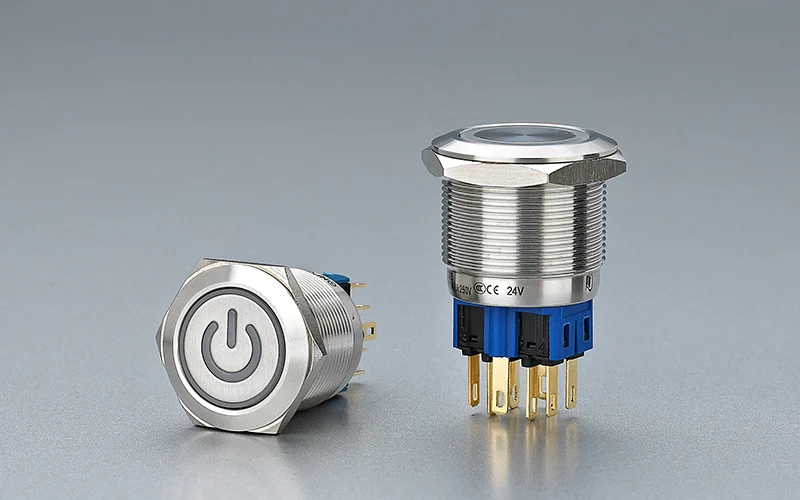
Ten ONPOW metal push-button switch line is a candidate route for public-facing panel operators because the site provides a metal product family and panel-integration context. The GQ22 metal push button category is a practical starting point when the required cutout, contact arrangement, actuation, and front-environment evidence match the selected model.
Before approving a candidate, confirm:
- panel cutout, thickness, and anti-rotation detail;
- retaining hardware access after installation;
- contact arrangement and momentary/maintained action;
- exact IP/IK or material evidence requested by the environment;
- label, finish, and cleaning compatibility;
- replacement method and spare-part identification.
If the requirement is authorization rather than hardware retention, route the project to the key-selector family instead of forcing a push-button solution.
Part 6. What to send in a public-panel RFQ
Send the following through skontaktuj się z nami:
- panel drawing with cutout and thickness;
- retaining hardware, anti-rotation, and tool-access requirement;
- public-use action and whether state restriction is required;
- contact function and circuit duty;
- cleaning, impact, dust, water, and temperature exposure;
- exact IP/IK or material documents required;
- legend, finish, illumination, and color requirements;
- quantity, sample, replacement, and documentation needs.
Stop and request engineering confirmation if the brief uses “tamper-proof” as a substitute for access control, safety approval, hazardous-area certification, or a model-specific IP/IK claim.
Najczęściej zadawane pytania
What makes a push button tamper-proof?
The installed combination of inaccessible or controlled fastening, anti-rotation, service access, and an appropriate operating architecture. The phrase alone is not a universal certification.
Is tamper-proof the same as vandal-resistant?
No. They may describe related design goals, but the buyer should ask for the exact construction, test, or rating evidence used for the selected model.
Does tamper-proof imply IP or IK certification?
No. IP and IK are separate protection classifications. Confirm the exact model evidence and installed-interface conditions.
Should a key lock be used instead?
Use a key selector when the requirement is to restrict who may change the state. Use controlled fastening when the public may operate the button but should not remove the hardware.
What panel thickness must be specified?
The drawing should state the panel thickness range, washer or gasket stack, retaining method, and rear clearance for the exact model.
How do public panels handle replacement?
Define a service procedure that identifies the spare model, controls rear access, and preserves the contact and environmental requirements after replacement.
What should an RFQ include for a public-access button?
Send the panel drawing, fastening and access requirement, contact duty, environment, evidence documents, legend/finish, quantity, and service expectations.



