

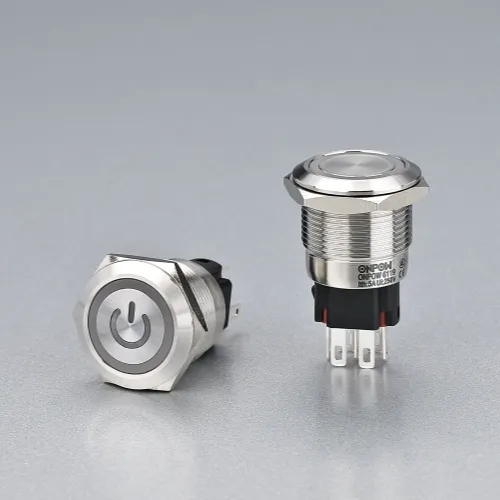
A 110V push button switch with illumination must be specified from the AC lamp supply first, not from the contact rating on the datasheet. The visible 110V or 220V LED option identifies the documented mains lamp circuit for that SKU. Match that variant to the panel’s actual control or indication supply, confirm the terminal diagram for the exact part number, and keep the lamp circuit separate from the switching contacts. For 12V or 24V DC lamp topics, use the 12V vs 24V illuminated push button guide instead of treating this page as a low-voltage reference.
Part 1. What changes between a 110V and 220V push button LED circuit?
At 110V or 220V, the procurement decision is which AC lamp-supply variant the manufacturer documents for the SKU — not whether the contact rating happens to mention a similar number. Illuminated operators pair a switching mechanism with a lamp assembly rated for a stated mains lamp circuit; the schematic must show both circuits before terminals are assigned.
At mains-related lamp voltages, the selected LED option is usually tied to a specific internal lamp assembly and any required current-limiting arrangement documented for that model. ONPOW’s страница продукции GQ lists LED voltage options including 110V and 220V and notes that 110–220V versions use external resistance. That note applies to the GQ family and does not prove the construction of an unlisted SKU.
| Параметр | 110V LED option | 220V LED option | Влияние на закупку |
|---|---|---|---|
| Напряжение питания подсветки, подлежащее документальному подтверждению | 110V AC as specified on the drawing | 220V AC as specified on the drawing | Сопоставьте код заказа с фактической схемой подключения лампы |
| Контактная цепь | Отдельная спецификация | Отдельная спецификация | Указывайте напряжение, ток и тип нагрузки отдельно |
| Current limiting | Per selected model documentation | Per selected model documentation | Do not assume the lamp assembly is interchangeable across voltages |
| Безопасное упрощённое правило | Нет | Нет | Количество клемм — это не схема подключения |
Regional panel standards often use nominal values such as 120V or 230V on drawings. Those names do not replace the manufacturer LED voltage option on the order code. Record the documented supply, then confirm whether the project requires the 110V or 220V lamp variant shown for the selected series.
Часть 2. Какая цепь отвечает за подсветку, а какая — за коммутацию нагрузки?
On most industrial illuminated operators, the switching contacts и lamp terminals answer different questions. Contacts start or stop a command path; the lamp path shows power present, machine state, or operator feedback — verify both on the wiring diagram for the exact part number.
Земля Руководство NKK по кнопочным выключателям с подсветкой explains why higher lamp voltages may need documented current limiting. Use that as background context, then apply only the terminal markings and datasheet for the ONPOW SKU on your BOM.
Важно: Never infer a lamp-terminal connection from the contact rating or from a keyword such as “110V push button switch.” The публикация IEC 60947-5-1 распространяется на устройства цепей управления, но не заменяет схему подключения конкретной модели.
Ui and Ith fields on a series page describe contact-related data for that family. They are not an instruction to feed the LED from the same terminals that switch the load. If a drawing shows a 110V indication supply and a separate control circuit, both must appear on the BOM and wiring review.
Part 3. How should an LED be wired for power, status, or actuation on AC mains?
For a power-present indication, the LED circuit is connected across the appropriate AC control or indication supply so the actuator is lit whenever that supply is available. For state indication, the lamp circuit is driven from a proven auxiliary contact, relay output, or logic interface that represents the desired state rather than merely a button press.
Press-feedback wiring energizes the lamp only while the intended command path is active. That still requires the correct 110V or 220V lamp option, any external resistance noted on the page, and the panel’s isolation or suppression rules.
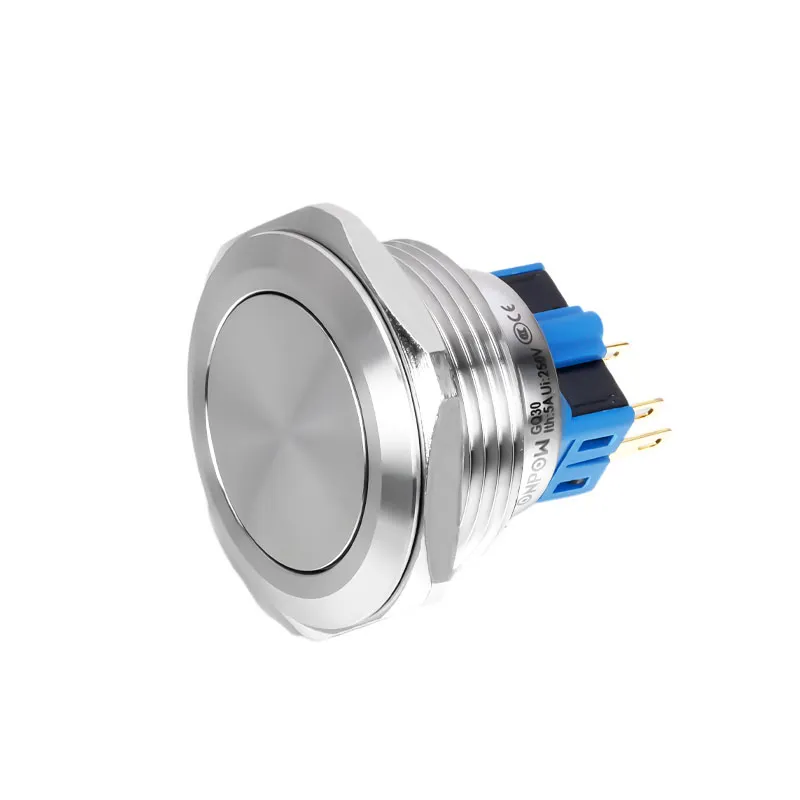
| Требуемая индикация | Выбор схемы | Что должно быть показано на чертеже |
|---|---|---|
| Доступное питание | Lamp across the documented AC supply | 110V or 220V LED option and lamp terminals |
| Команда активна | Лампа, управляемая проверенным сигналом состояния | Source of the state signal and reference conductor |
| Подтверждение нажатия | Лампа, включаемая через предусмотренную логику контактов | Whether the action is momentary or latching |
| Remote or PLC-driven state | Lamp driven by approved interface hardware | AC/DC requirement, limiting parts, and failure behavior |
When the schematic is still open, use the руководством по подключению и установке кнопочного выключателя to read terminal labels before energizing either circuit.
Part 4. When do external resistance, AC marking, and neutral reference change the design?
At 110V and 220V lamp ratings, current limiting is part of the product documentation rather than an optional field guess. ONPOW’s GQ page states that 110–220V versions use external resistance. Treat that as a GQ-family note and verify the exact BOM for the selected configuration.
AC lamp circuits also require a clear reference on the drawing. Some panels use a documented line-to-neutral indication supply; others use line-to-line control transformers. The acceptable reference depends on the machine standard and the selected model. Do not assume a lamp marked for AC operation can be placed on any two conductors that measure the correct voltage under load.
If a datasheet marks LED terminals with polarity, maintain the stated connection even when the supply is AC. ONPOW’s GQ page describes an AC/DC LED lamp with no anode/cathode terminal difference for certain GQ configurations; that published note should be used only for the relevant GQ configuration, not as a universal rule across every illuminated switch.
Eaton’s pushbutton selection overview reinforces that pilot devices are chosen from circuit function and mounting data. Use that framing when reviewing whether the lamp circuit belongs on a dedicated indication supply rather than on an improvised tap from the power circuit.
Part 5. Which AC lamp-supply mistakes should stop a panel build?
Подключение лампы на 12 В непосредственно к источнику питания 24 В недопустимо, если только документация выбранной модели прямо не подтверждает возможность такой схемы. Вариант на 24 В при питании от 12 В также нельзя считать допустимым решением без проверки характеристик: нельзя исходить из предположений относительно яркости и режима работы.
Avoid these recurring errors on AC panels:
- ordering by contact voltage while omitting LED voltage;
- using a mains lamp variant where the drawing actually specifies 12V or 24V DC;
- omitting or guessing external resistance when the datasheet requires it;
- – подключение индикаторной лампы к контакту, который не отражает фактическое состояние оборудования;
- treating Ui 250V or Ith 5A as proof that the lamp may share the load terminals; and
- assuming every illuminated device is polarity-free or internally limited.
When the panel uses low-voltage DC indication instead, stop and route the specification to the 12V vs 24V illuminated push button guide. Mixing AC mains and DC lamp guidance on one BOM line creates repeatable commissioning failures.
Part 6. Which ONPOW illuminated families fit a documented 110V or 220V specification?
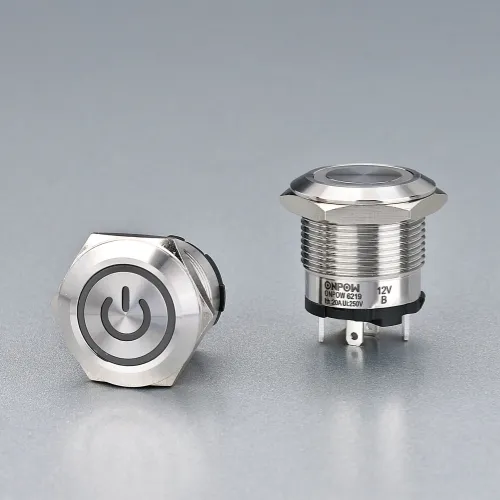
Для проекта, в котором схема подключения лампы уже документирована, семейство продукции ONPOW GQ is a relevant starting point because the page publishes LED options through 110V and 220V and notes external resistance for that range. Narrow the choice by cutout, operation, terminal type, protection need, LED color, and the exact lamp-circuit note.
Земля Серия ONPOW61 lists 16 mm, 19 mm and 22 mm installation diameters, 1NO1NC or 2NO2NC contact structures, and AC/DC 6V/12V/24V/110V/220V LED options. Its published Ui 250V and Ith 5A are series facts for contact-related review, not an instruction to use a contact circuit as the LED supply.
Используйте металлических кнопочных переключателей only to browse related diameters and styles before returning to the exact series page for lamp-voltage evidence.
Part 7. What should buyers place in a mains-voltage illuminated push-button RFQ?
Запрос коммерческого предложения (RFQ) становится сопоставимым, если в нём отдельно указаны цепь питания лампы и параметры коммутационной нагрузки. Укажите точный диаметр монтажного отверстия панели, номер детали (если известен), режим работы (с фиксацией или без фиксации), конфигурацию контактов, контактную нагрузку и её тип, напряжение питания лампы, цвет светодиода, требуемое поведение индикации, предпочтительный тип клемм, требуемую степень защиты, количество и требования к документации для целевого рынка.
Границы применимости сравнения: Use this guide when the drawing documents an AC lamp supply (110V or 220V context) and the desired indication behavior. It does not replace field verification on unknown terminals, undocumented supply values, or unfinished lamp logic. For 12V/24V DC lamp work, use the 12V vs 24V illuminated push button guide. Send completed inputs through свяжитесь с ONPOW и предоставьте характеристики панели or browse Руководства в блоге ONPOW for related panel topics.
Часто задаваемые вопросы
What is the difference between a 110V and 220V illuminated push button?
A 110V or 220V label usually identifies the specified AC lamp supply option for that SKU. Select it from the actual LED circuit on the drawing and confirm the exact model’s terminal and resistance information.
Can I connect a 110V LED option to a 220V lamp supply?
Не следует делать это напрямую без проверки. Обязательно изучите документацию производителя для выбранной схемы подключения лампы. Несоответствие напряжения может потребовать предусмотренного документацией решения для ограничения тока или использования модели с подходящим номинальным напряжением.
Отделены ли клеммы светодиода от контактов переключателя?
Часто да, но расположение клемм зависит от конкретной модели. Используйте точную электрическую схему подключения, а не ориентируйтесь только на количество контактов или модели другой серии.
Does a 110V push button switch mean the contacts switch 110V loads directly?
No. The keyword often reflects search language for illuminated operators on AC panels. Contact duty, utilization category, and any required interface hardware must be documented separately from the lamp supply.
Why do some illuminated switches need external resistance at 110V or 220V?
Higher lamp voltages typically require current limiting defined by the manufacturer. ONPOW’s GQ page notes external resistance for 110–220V options. Confirm the selected SKU rather than adding or omitting parts from appearance alone.
Should I order 110V or 220V for a 120V or 230V panel?
Record the documented supply and nominal standard first, then match the manufacturer LED voltage option listed for the selected series. Do not treat nominal regional names as proof that any nearby lamp variant is acceptable.
What must an RFQ state for a mains-voltage illuminated push button?
Укажите отдельно параметры коммутационной нагрузки и цепи лампы, а также размер монтажного отверстия, тип действия, конфигурацию контактов, напряжение и цвет светодиода, требуемый режим индикации, тип клемм, необходимость защиты, количество и требования к документации.
Where should low-voltage 12V or 24V LED options be documented instead?
Используйте 12V vs 24V illuminated push button guide for DC control-circuit lamp supplies. That article covers internal resistance and polarity topics for low-voltage options rather than mains lamp specification.
Ссылки
- Устройства управления и коммутационные элементы цепей управления согласно IEC 60947-5-1
- Техническое руководство NKK по кнопочным переключателям с подсветкой
- Обзор выбора кнопок Eaton
- Обсуждение на Electronics Stack Exchange вариантов напряжения светодиода кнопочного переключателя
- All About Circuits forum thread on illuminated push button supply voltage



