

A push button dry heat test report is useful only when its specimen, operating state and acceptance checks match the component you intend to buy. Start by separating powered operation from unpowered storage, then confirm the exact order code, mounting arrangement and recorded observations. A high chamber temperature printed on a report is not, by itself, a continuous operating rating for an illuminated switch. This guide gives control-panel buyers a document-review workflow. It does not prescribe a test temperature or claim that a particular ONPOW product has completed environmental qualification.
Define the decision before requesting a report
A buyer considering a button for a warm enclosure needs an answer about the intended installed assembly. A warehouse manager concerned about a spare part during transport needs an answer about a packaged, unpowered item. Both may receive a document called a heat test report, but the evidence addresses different conditions. Write down which decision the report must support before comparing suppliers.
Use a short application description: the equipment location, whether the indicator operates continuously, the expected service state and the document that defines the required conditions. Give engineering responsibility to a named reviewer. Purchasing can collect the evidence without independently turning a laboratory observation into a product rating.
The public scope of IEC 60068-2-2:2025 covers dry heat evaluation of heat-dissipating and non-heat-dissipating specimens, including energized and non-energized conditions after temperature stability. It distinguishes packed transport or storage from unpacked use and excludes evaluation of temperature changes. The practical review questions below apply that distinction to purchasing; they are not a substitute for the standard or the laboratory’s approved procedure.
Identify the entire specimen configuration
Record the complete model designation and the revision of the specification that accompanied the sample. A family photograph cannot resolve optional illumination, contact arrangement or termination. If a report lists a short family name, request a controlled statement connecting the tested specimen to the proposed order code. Keep that statement with the report rather than relying on a salesperson’s recollection.
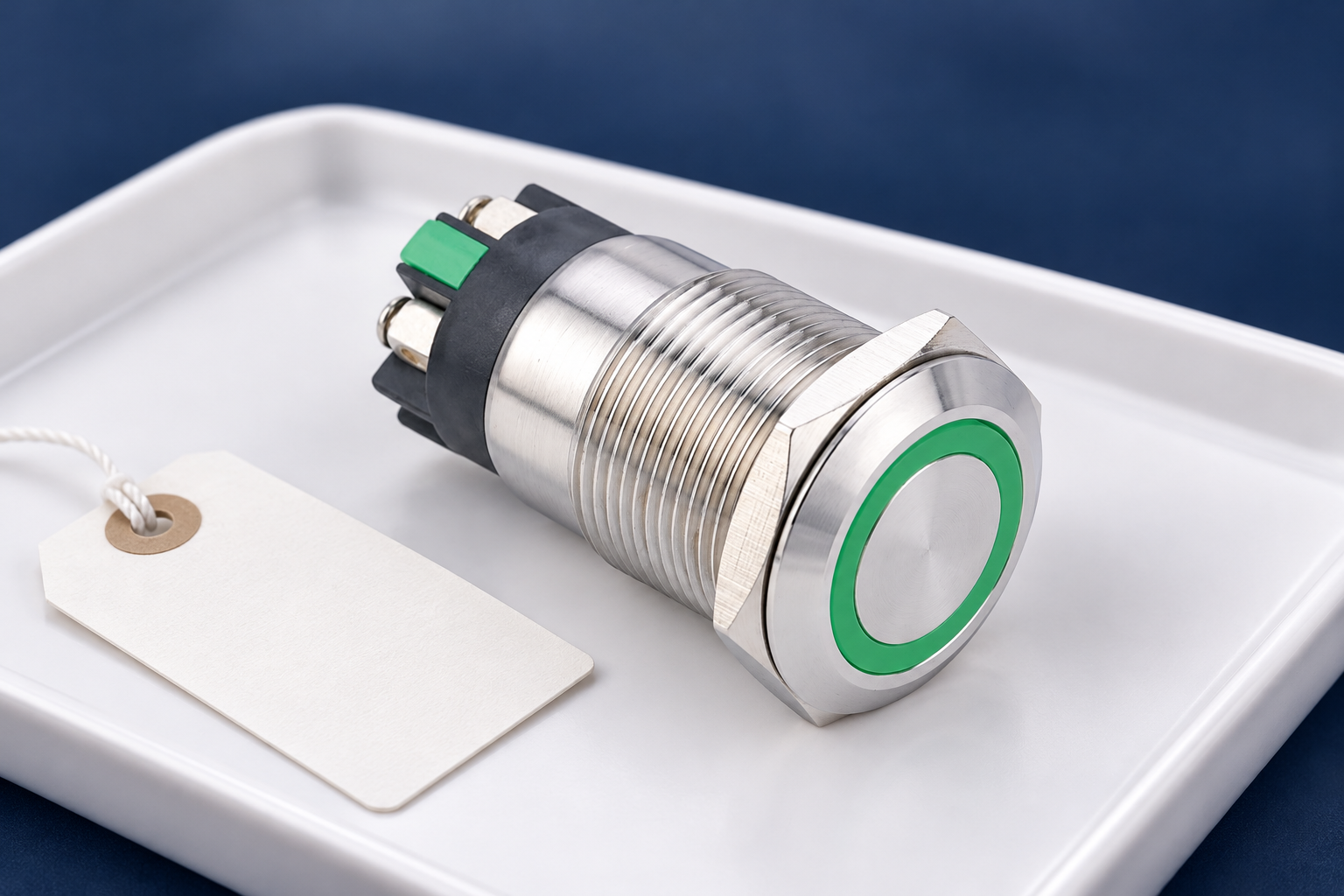
Земля ONPOW LAS1GQ-11E/L/S product reference provides a concrete starting point for a supplier discussion. Confirm the ordered configuration and relevant documentation directly. Its visible metal body, green ring and rear terminals establish appearance, not the temperature capability of internal parts or the assembly.
Ask whether the sample included the installed accessories, connector and mounting hardware relevant to your application. If an accessory was absent, show that absence in the comparison. A separate lamp module or different terminal connection can make two otherwise similar specimen descriptions materially different for the decision being reviewed.
Separate operating, storage and transport evidence
Use a simple evidence matrix to stop similar-looking report headings from merging into one approval. This is a suggested purchasing record. It contains no universal severity levels or pass criteria; those belong to the applicable specification and approved test plan.
| Вопрос для обзора | Evidence to request | Reason to hold the decision |
|---|---|---|
| What state was evaluated? | Powered operation, unpowered exposure, packaged transport or storage | Report state does not match the application |
| Which item was exposed? | Full order code, sample identity, configuration and revision | Only a broad series name is available |
| What was mounted around it? | Fixture, panel representation and accessory description | Installed condition cannot be compared |
| How was illumination treated? | Supply condition and monitoring description if relevant | Lamp was absent or its state was unspecified |
| When was function checked? | Before exposure, during exposure where required, and after recovery | A final visual check is the only result |
| Who accepted the result? | Referenced criteria, recorded results and reviewer disposition | A pass label has no traceable acceptance basis |
Keep application conditions and test conditions in separate columns in your own record. When they differ, describe the difference in words. A blank cell invites an assumption that the two were identical, especially when the document later travels from purchasing to a maintenance team.
Review temperature stability and specimen heating
The report should make clear what was measured and how the intended exposure condition was established. Distinguish a chamber control reading from a measurement associated with the specimen. For an illuminated assembly, ask how the operating state and any resulting heat were represented. Do not infer the internal condition from the metal surface shown in a product photograph.
Avoid demanding a convenient sensor location merely because it is easy to photograph. Ask the laboratory or responsible engineer to explain the measurement arrangement under the selected method. The buyer’s task is to retain enough information to understand the result, not to improvise a competing test procedure.
For background, heat can move through contact, moving air and radiation. These mechanisms help explain why mounting and airflow descriptions matter. A switch standing alone in a spacious fixture is not automatically equivalent to the same switch surrounded by other components inside equipment. The report-to-application comparison should name the differences and identify who evaluated them.
Check the electrical state without inventing a load
A phrase such as “powered during test” needs an accompanying description of what was powered. The illumination circuit and switching contacts serve different functions. Ask whether the indicator was energized, whether the contacts were operated and which functional observations were recorded. Preserve the actual test description instead of filling missing fields with the normal supply used in your workshop.
If the application uses a different illumination option, flag the mismatch. Do not apply an unpowered storage result as evidence of continuous illuminated operation. Equally, do not assume that a powered sample establishes every possible switching duty. The report’s scope should remain visible when engineers decide whether additional evidence is needed.
General installation considerations belong in the push button wiring and installation guide. This report review does not authorize testing energized equipment or changing wiring. Electrical work and laboratory tests require the appropriate competent personnel and controlled arrangements.

Read the observations behind the conclusion
Look for the actual observation sequence. A useful record distinguishes initial condition, the defined exposure, any required observations during exposure and the condition after recovery. Ask what each functional check meant. “Works normally” may be too broad if the purchasing concern is a sticky actuator, loss of indication or a change in an electrical characteristic.
Compare the stated acceptance criteria with the recorded results. If the criterion requires a particular function, confirm that the function was actually assessed. If only appearance was evaluated, preserve that narrower conclusion. Request clarification when a summary says pass but the detailed sheet records an exception.
A report can be valid and still be insufficient for your decision. For example, an unpowered spare may show no visible change after a defined exposure, while the intended application needs evidence about illumination during operation. Mark the first result as relevant to storage only. This avoids unfairly dismissing useful evidence while preventing it from being extended beyond its recorded scope.
Compare dry heat with neighboring environmental questions
Constant-temperature exposure and repeated changes in temperature answer different questions. Use the temperature change report review when the concern is transitions and cycling. Keep the two document requests separate so a supplier can answer each accurately.
Humidity is another independent dimension. A dry heat result does not establish performance in a warm, humid enclosure. If moisture is part of the actual environment, collect the relevant evidence rather than adding humidity language to an unrelated report. Similarly, an environmental report does not establish enclosure sealing, resistance to cleaning chemicals or a universal service life.
For spare stock, the push button storage guide addresses practical handling before installation. The report review here concerns what a particular exposure document can support. Keep warehouse controls and qualification evidence linked, but do not treat one as proof that the other was completed.
Resolve an incomplete report with a precise supplier request
Send questions that can be answered with an attachment or a controlled statement. Ask for the complete specimen designation, the operating state, the relevant specification revision, the exposure record and the functional results. Identify each missing item by report page or section. A focused request is easier to resolve than asking for a stronger certificate without explaining the actual gap.
When a full report cannot be shared, ask whether a controlled extract and a scope statement can support your review. The responsible engineer must decide whether that evidence is sufficient. Do not edit an extract to remove exceptions or present a limited summary as the complete laboratory record.
Keep an open-issue list with an owner and a required response. Separate missing evidence from a confirmed incompatibility. A supplier may need time to find an archived configuration record; that is different from confirming that a tested option was not the quoted option. Your purchasing decision should reflect the evidence that has actually arrived.
Keep approval tied to future substitutions
Record the reviewed model, document references, accepted application boundary and approval date in the purchase record. A later substitution should trigger comparison with that record. Changing an illumination option, accessory or specification revision should not silently inherit an earlier approval merely because the front face looks familiar.
Retain the original report and clarification trail with the approved configuration. The HSE maintenance guidance provides broader context for maintaining work equipment safely. The document-control workflow proposed here helps maintenance teams find the basis for a replacement decision; it does not replace equipment-specific instructions.
To discuss an ONPOW application, send the full order code, operating and storage requirements, installation context and the evidence your project requires. Ask for confirmed documentation before approving a temperature claim. A clear scope question helps both parties avoid a technically impressive report that answers the wrong purchasing question.
Часто задаваемые вопросы
Does the highest temperature on a report become the operating rating?
No. A test condition belongs to the specimen, state, duration and acceptance criteria recorded in that report. Use the manufacturer’s confirmed rating and the application’s approved requirements for the purchasing decision.
Can an unpowered dry heat report support an illuminated operating application?
It may provide limited storage or exposure evidence, but it does not establish the powered operating condition. Ask for the relevant configuration and operating evidence before extending the conclusion.
Is a temperature change report interchangeable with dry heat evidence?
No. Stable high-temperature exposure and temperature transitions have different scopes. Identify which question the application needs answered and request the appropriate report.
What should a buyer do when the report names only a product family?
Request a controlled mapping from the tested specimen to the complete proposed order code. Keep the mapping, report and any exceptions together for engineering review.
Further learning
Khan Academy explains temperature, thermal energy and heat transfer. This provides background for understanding why specimen state and mounting matter when reading a dry heat report; it does not demonstrate an ONPOW qualification test.
Thermal energy, temperature, and heat | Khan Academy — Khan Academy



