

Outdoor push button UV qualification starts with evidence for the exposed materials and the finished switch configuration. A stainless steel head does not establish that its illuminated ring, seals, legends or plastic parts will tolerate the proposed outdoor exposure. Ask for the tested part identity, exposure method, operating conditions and the properties checked afterward. Treat an accelerated weathering report as a defined comparison, not a promise of a fixed number of years outside. This guide explains how a buyer can review that evidence before approving a panel control for an outdoor project.
Define the actual exposure before requesting a certificate
An outdoor panel in permanent shade and a sun-facing enclosure can create different purchasing requirements. Describe the site, mounting orientation, expected sunlight, nearby reflective surfaces and whether a transparent cover stands between the sun and the control. Note whether the button will be operated frequently or remain idle for long periods. These observations define the question the supplier and laboratory need to answer; they do not independently establish a test cycle.
List the exposed surfaces rather than writing only “metal switch.” A metal operator can include a translucent ring, a moving seal and a marked front surface. Each may have a different failure concern. The outside face may look acceptable while the legend loses readability or the operator becomes difficult to move. Conversely, a change in appearance need not prove that the electrical contacts have failed. Define cosmetic and functional requirements separately so that the final review can distinguish them.
Keep UV evidence separate from water and corrosion evidence
A water-ingress rating addresses a defined enclosure protection assessment. It is not a substitute for evidence about sunlight exposure. A corrosion report answers another question again. The ONPOW outdoor push button overview is a useful starting point for the broader environment review, while this article concentrates on weathering evidence and its purchasing limits.
The ASTM G154 scope describes fluorescent ultraviolet apparatus for exposing materials and explicitly separates its use from bare-metal corrosion testing. That distinction matters when a buyer receives a material report for a steel housing and assumes it also covers a polymer ring. Ask which component and which property each document addresses. File the water, corrosion and sunlight evidence as related records with separate conclusions.
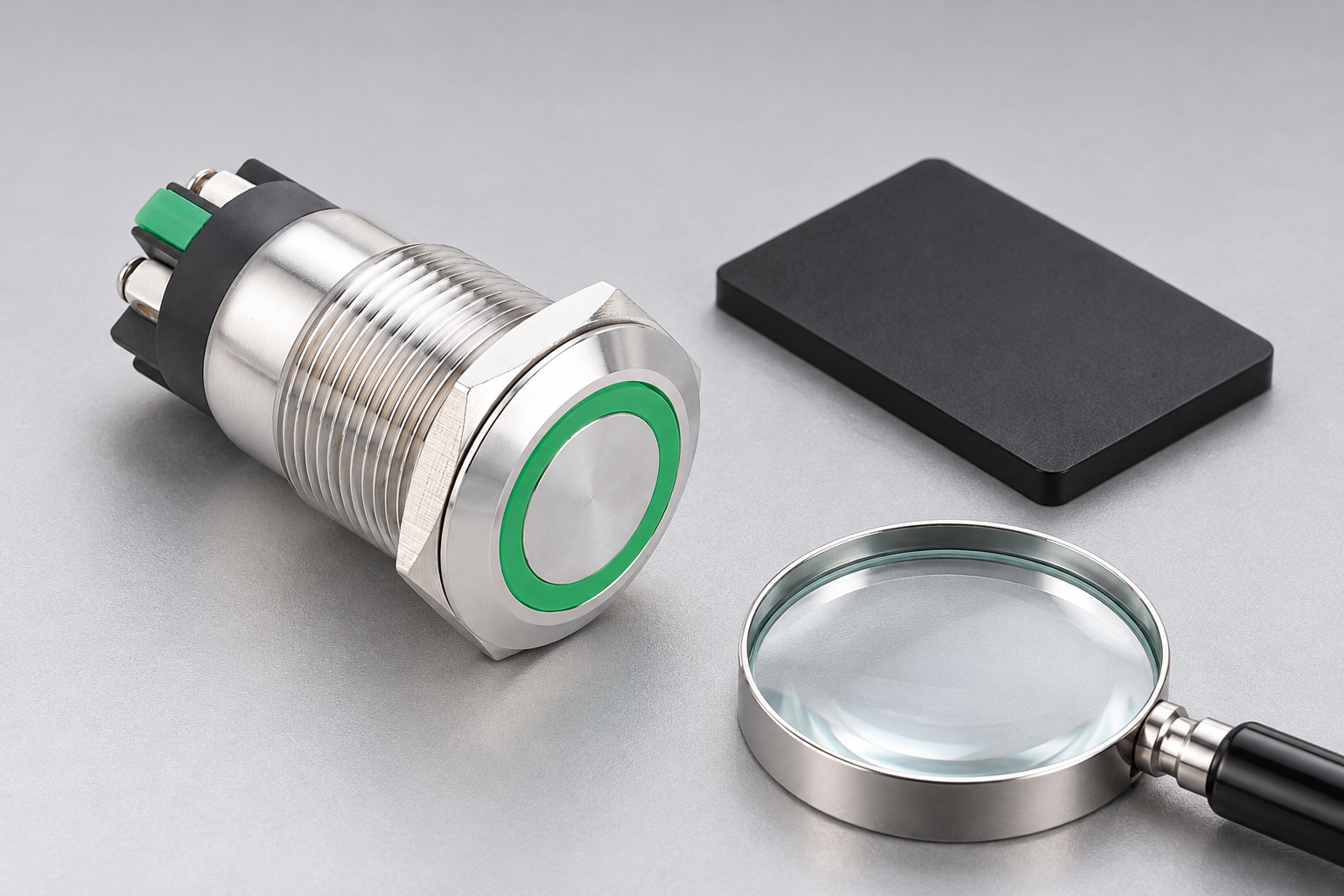
Establish exactly what was tested
Begin with the report number, issuing laboratory, report date and sample description. Match the manufacturer, part code and relevant configuration to the proposed order. Request photographs or drawings if the description is too broad. A generic statement such as “plastic switch part” is insufficient to connect a result to a particular colour, resin, seal or assembly revision. Avoid filling these gaps from a catalogue photograph.
Next identify whether the specimen was a flat material coupon, a finished ring, a front assembly or a complete switch. Coupons can support material comparison, but they cannot reproduce every feature of an assembled operator. Joints, shadowing, surface geometry and mechanical interfaces can alter the engineering question. Ask the supplier to explain the relationship between the specimen and the delivered part, and record any remaining difference as a qualification gap rather than silently accepting equivalence.
Read the exposure conditions as one complete record
A duration alone does not define an accelerated exposure. The light source, exposure sequence, temperature conditions, moisture stages and specimen arrangement all affect interpretation. Ask for the method designation and edition together with the operating details actually used. If a report omits a field needed for comparison, request clarification from the laboratory instead of selecting a familiar value from another report.
The report should also identify how exposure was monitored and whether there were interruptions or departures from the agreed method. These details become particularly important when comparing two suppliers. A longer test under a different arrangement is not automatically a stronger result. Compare like conditions where possible and ask a qualified reviewer to explain differences where a direct comparison cannot be made. Do not rank reports by their largest printed hour figure.
Use a report review table before approval
The following table is a procurement checklist, not a list of universal pass limits. Its purpose is to turn missing evidence into explicit questions. Method details should be checked against the actual standard and laboratory report; the IEC catalogue for solar-radiation testing provides a separate standards reference when that approach is specified for the project.
| Review item | Evidence to request | Decision supported |
|---|---|---|
| Product identity | Part code, revision, colour and specimen photographs | Whether the report belongs to the proposed configuration |
| Exposed material | Identification of ring, marking and sealing components in scope | Which visible parts have evidence and which remain open |
| Exposure conditions | Method edition, light source and full operating sequence | Whether two reports can be compared meaningfully |
| Assessment baseline | Pre-exposure appearance and functional measurements | Whether a change after exposure can be evaluated |
| Acceptance criteria | Project-agreed cosmetic and functional limits | Whether the result meets the defined purchasing requirement |
| Report deviations | Interruptions, substitutions and omitted assessments | Whether additional evaluation is necessary |
| Change control | Rules for notifying material or process changes | Whether later deliveries remain connected to the evidence |
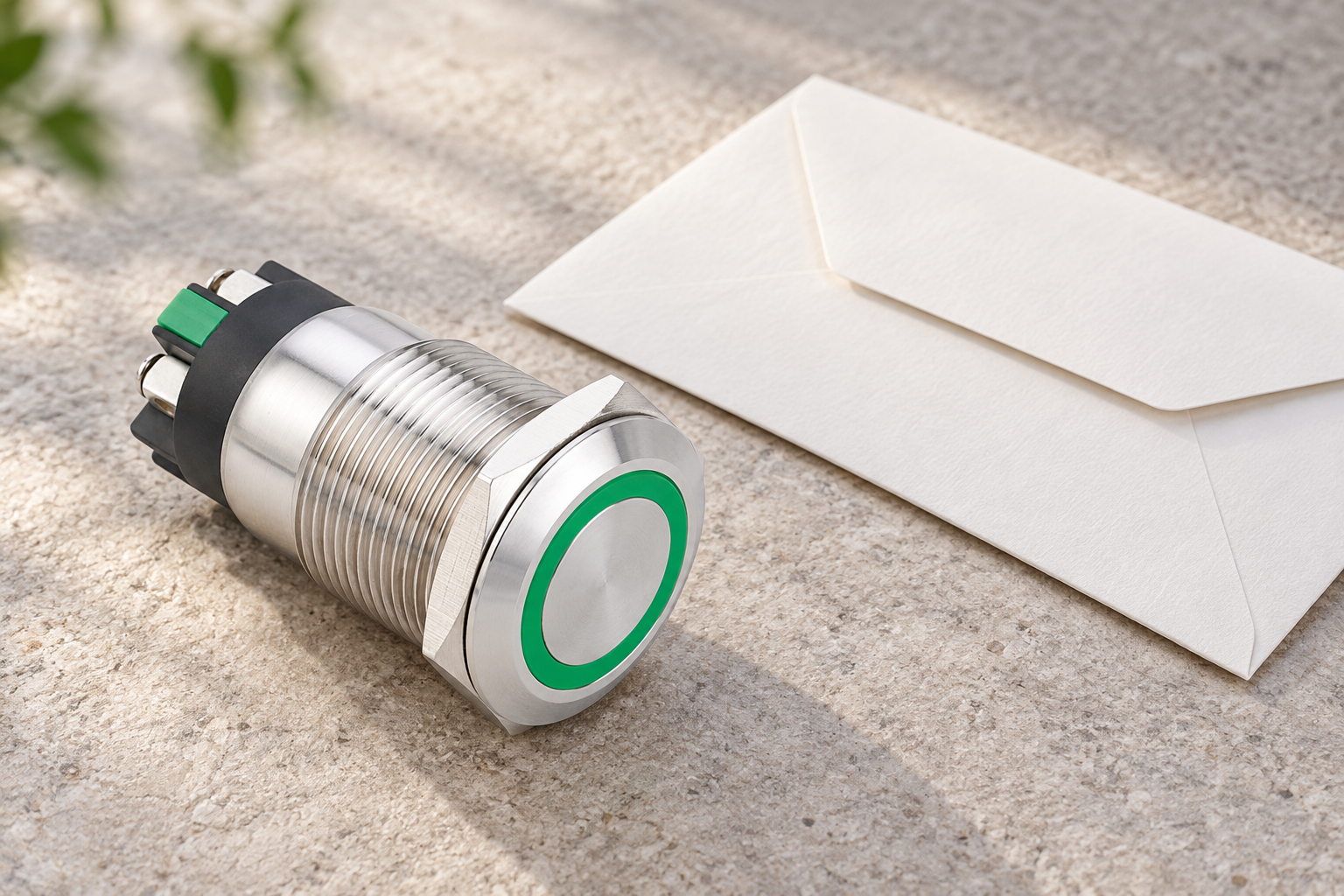
Decide what should be checked after exposure
Define the assessment before testing. Depending on the application, it may include colour change, cracking, loss of marking, condition of exposed seals and the ability to operate and return normally. An illuminated control may also require an agreed check of indication visibility. Each check needs an appropriate method and a defined baseline. A casual photograph cannot establish contact performance, sealing performance or a quantified change in actuation force.
If electrical or ingress tests are required after weathering, state them in the project plan and have the responsible engineer and laboratory define the sequence. Do not assume they were performed because the report ends with the word “passed.” Ask what passed, against which criterion, and on which samples. Retain the original results, including any failure or conditional result, so that the purchasing decision remains traceable.
Avoid converting laboratory hours into outdoor years
Accelerated tests can help compare materials under specified conditions. Converting exposure hours into a service-life promise requires evidence that relates the test to the actual environment and failure mechanism. Without that relationship, a simple multiplier creates false precision. A buyer should request the basis of any lifetime claim rather than repeating it in a specification or customer quotation.
A material weathering report needs to be interpreted within its stated exposure and assessment limits. It should not be treated as an industrial switch approval document when the finished assembly was outside its scope. The useful purchasing lesson is to ask what exposure and what change a document actually describes. Site observations and maintenance records can complement a laboratory comparison, but neither should be presented as a universal prediction for every climate or installation.
Apply the review to a real ONPOW product
The LAS1GQ stainless steel ring-lit push button product page identifies a real product family and its visible construction. Use the exact ordered code as the starting point for a document request. The photograph establishes appearance; it does not establish UV resistance, outdoor life or a particular weathering qualification. Ask ONPOW which reports are available for the proposed configuration and identify any requirement that still needs project testing.
For the visibility of a sun-facing operator, use the separate panel indicator brightness guide. For enclosure protection boundaries, consult the IP65 and IP67 sealing review. These are complementary decisions. Passing one evaluation should not erase an unresolved requirement in another part of the environmental assessment.
Write a quotation request that can be answered
Include the intended location, orientation, expected exposure and exact product configuration. State whether you need existing material evidence, an assembly report or a new qualification programme. Attach your acceptance criteria and ask the supplier to identify what is covered by existing records. Request a clear list of exclusions. This makes an honest “not yet tested” response more useful than an unsupported yes-or-no claim.
For repeat orders, retain the accepted report and the configuration it supported. Ask how changes in polymer, colourant, marking, seal or supplier will be communicated. A subsequent delivery should not be assumed equivalent merely because its sales name remains familiar. When the use changes from a sheltered cabinet to an exposed outdoor station, reopen the environmental review. Contact ONPOW with the part code and application details to request the available supporting documents before committing to production.
Sıkça Sorulan Sorular
Does a stainless steel head prove outdoor UV resistance?
No. It identifies a housing material or appearance, while other exposed parts may include polymers, markings and seals. Request evidence for the relevant components and configuration rather than extending a metal description to the whole assembly.
Is an IP rating enough for a sun-facing panel?
An ingress rating and sunlight weathering evidence address different requirements. Review the exact ingress scope and the environmental evidence separately, then confirm that the complete installation meets the project requirements.
Can two reports be compared using exposure hours alone?
No. Compare specimen identity, method, operating conditions, assessments and acceptance criteria. A duration has meaning only within that full record. Ask the laboratory to explain any differences that prevent a direct comparison.
What should be done when no assembly weathering report exists?
Record the gap, request the available material evidence and agree whether a project-specific evaluation is needed. Do not invent a qualification or convert a material result into approval of an untested complete switch.
Further learning
Khan Academy explains how light interacts with molecules, including ultraviolet light. This supports the material-exposure discussion; it is not a weathering test or an ONPOW qualification.



