

A push button UL 94 report should connect a specific plastic material, its recognized conditions and the molded part used in the ordered switch. A material flammability rating does not by itself certify the complete button, the control panel or the machine. Buyers should verify material identity, thickness coverage, color restrictions and the relationship between the tested material and the supplied construction. This guide explains that document review and the questions to resolve when a supplier offers only a generic “flame-retardant plastic” statement.
Start with the part that actually needs evidence
A metal-faced push button can contain several nonmetallic parts. A rear housing, insulating support, light-transmitting ring and internal separator may perform different functions and use different materials. Do not assume that a rating associated with one item covers every plastic part in the assembly.
Ask the supplier to identify the part to which the evidence applies on a controlled drawing or parts list. A useful answer connects the component identifier to a material specification without requiring disclosure of unrelated proprietary design information. If only a general resin-family name is supplied, record that the material grade remains unverified.
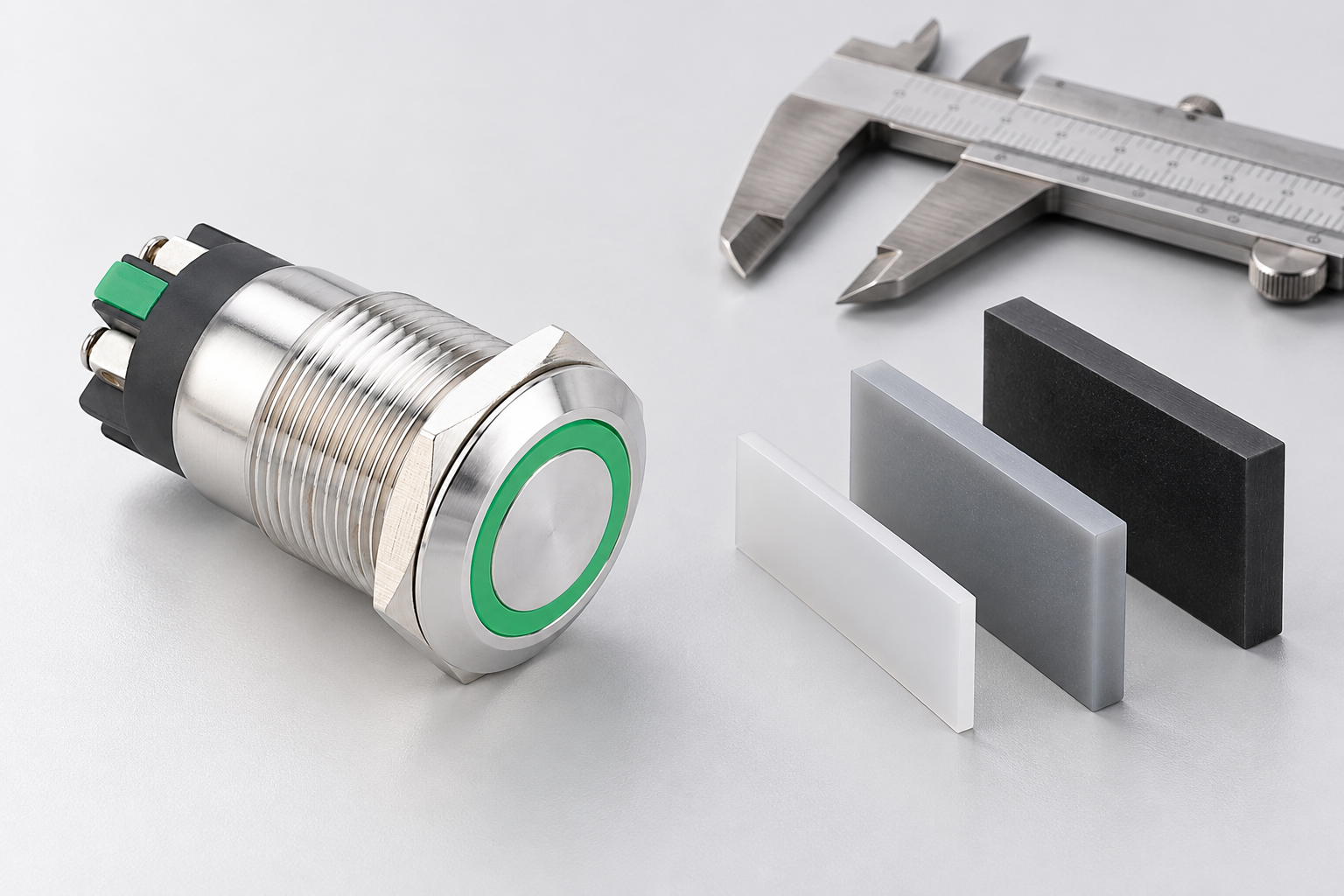
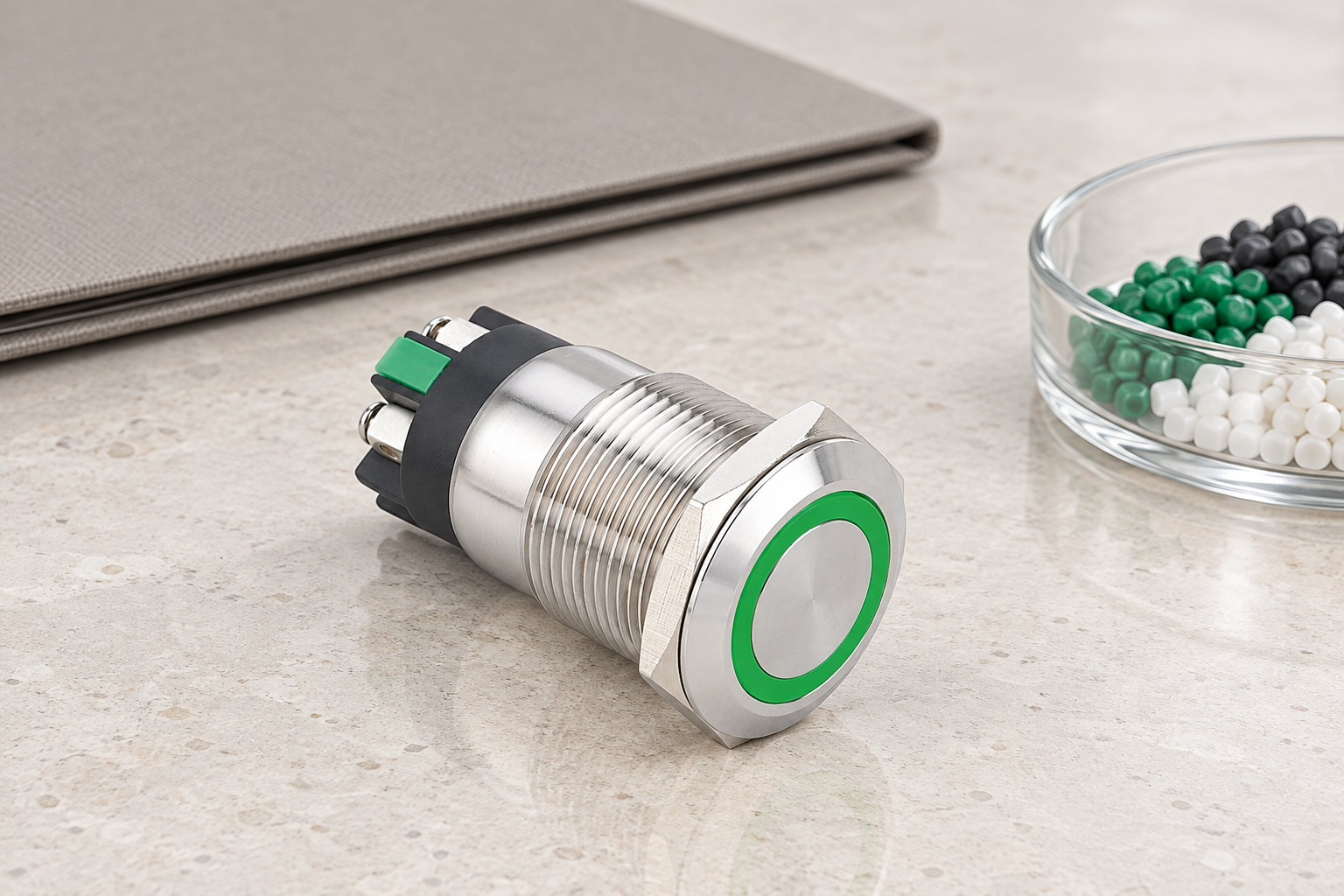
El Página del producto LAS1GQ-11E/L/S offers a real ONPOW product reference for this discussion. The photograph identifies visible construction; it cannot establish the chemical composition or fire behavior of hidden or visible polymer parts. Request product-specific evidence for the exact order rather than assigning a rating from appearance.
What a material flammability classification establishes
UL Solutions explains that UL 94 uses controlled small-scale tests to distinguish burning behavior. Test arrangement and specimen characteristics matter. A classification describes performance within that evaluation, rather than a promise that a finished device cannot catch fire.
Keep horizontal, vertical, thin-material and other classifications in their proper test groups. Do not treat similar-looking letter and number combinations as interchangeable. Where an engineering requirement names a particular classification, ask the responsible designer to confirm that the submitted evidence meets that requirement.
This article is a purchasing review guide. It does not prescribe flame application times, specimen preparation or pass/fail calculations, and it does not replace an applicable end-product standard. Qualification testing belongs with competent laboratories using the relevant controlled documents.
Review the evidence in a consistent table
The table below is a recommended document checklist. It contains no universal rating requirement for ONPOW switches or industrial panels.
| Document field | What a buyer should establish | What remains unresolved if missing |
|---|---|---|
| Material manufacturer and grade | Exact identity of the rated material | Generic polymer name cannot identify the evaluated formulation |
| Part mapping | Which switch part uses that material | Rating cannot be assigned to a rear housing or insulator |
| Thickness coverage | Applicable recognized thickness or range | Thin sections may fall outside the submitted evidence |
| Color coverage | Whether the supplied color is included | A different color cannot be assumed equivalent |
| Classification and method | Exact rating and relevant test grouping | Similar rating names may be confused |
| Document status | Identifiable record and current applicability | An old screenshot may omit restrictions or changes |
| Production traceability | Link between the accepted material specification and supplied parts | Tested resin may not be the material actually molded |
Use separate rows for different parts and materials. This prevents a single approved resin entry from becoming a blanket statement for the whole product. Record the reviewer and the evidence date so a later material change can be evaluated against a clear baseline.
Read thickness coverage before comparing ratings
Plastic parts are not uniformly thick. A substantial rear body can include thin walls near a terminal, ribs, recesses or an insulating barrier. Ask which relevant section dimensions the supplier used when checking the material evidence. An overall housing dimension does not answer the wall-thickness question.
For example, suppose a report identifies a material at a stated thickness while the controlled drawing shows a thinner relevant section. The buyer should flag a coverage question and request an engineering assessment. Do not simply accept the report because the plastic trade name matches, and do not declare the part unsafe without the missing assessment.
Avoid extrapolating a rating in either direction unless the recognized conditions and applicable evaluation permit it. A thickness limit is part of the evidence, not a marketing detail to remove from the purchasing specification.
Keep color and formulation under control
Color can be part of the recognized material conditions. Ask whether the specific supplied color or an applicable color designation is covered. Do not assume a transparent light guide, a green ring and a black rear block use the same grade or share a rating simply because they are supplied together.
When alternate colors are offered, request the coverage statement before approving the alternate. Purchasing should retain enough information to distinguish a cosmetic color choice from a material specification change. The review can be concise: identify the accepted variant, the supporting record and any restriction communicated by the supplier.
UL’s plastics recognition webinar overview highlights thickness recognition, color coverage and material records as practical topics in plastics evaluation. Use those distinctions to frame supplier questions, rather than copying a rating from an unrelated resin datasheet.
Trace the material record to the delivered assembly
A valid material record can still be unrelated to the switch being purchased. Ask how the supplier links the molded part to the stated resin grade and how substitutions are controlled. Appropriate evidence may include a controlled material specification and a supplier declaration tied to a part revision, with further records supplied as required by the purchase agreement.
Do not demand that every shipment repeat all original qualification testing unless the contract requires it. Distinguish qualification evidence from routine production control. The first establishes the evaluated material conditions; the second provides confidence that production remains within the accepted specification.
If a supplier changes resin source, molding subcontractor or color system, ask whether the accepted evidence remains applicable. Record the decision before approving the change. A familiar part number should not make an undocumented material substitution invisible.
Separate material rating from complete product approval
A control device has electrical, mechanical and thermal responsibilities beyond the behavior of a small plastic specimen. A material rating does not establish contact performance, insulation coordination, mounting integrity or the suitability of a panel installation. These questions need their own applicable evidence.
UL’s explanation of UL 94 certification limits specifically describes the small-scale nature and restricted scope of these material tests. A buyer should therefore avoid converting a resin classification into a statement that an entire machine is fireproof or approved for any environment.
For the overall installation context, consult the guía de cableado e instalación de pulsadores. Keep the material review attached to the broader design evaluation, with each conclusion limited to the evidence that supports it.
Distinguish burning from other material properties
Resistance to burning, deformation under heat and surface electrical tracking are different questions. Evidence about one property cannot fill a missing result for another. When a purchasing specification uses the broad phrase “heat resistant,” ask the designer which behavior actually matters to the application.
El insulation resistance review guide concerns electrical measurement boundaries. The dry heat report guide concerns temperature exposure and functional evidence. Neither establishes small-flame burning behavior. Keep electrical tracking and heat-deformation evidence separate as well, while using the same controlled part identity to connect the records.
This distinction also helps when investigating a failure. A softened support, a carbonized surface path and a burning specimen are not interchangeable observations. Preserve the actual evidence and let the responsible investigation identify the relevant mechanism.
Resolve incomplete or contradictory submissions
When a quotation says “V-0” but the supporting document lists a different classification or material, return a precise query. Identify the quotation line, the conflicting record and the required clarification. Ask for corrected evidence or a revised claim, rather than silently choosing the more favorable statement.
Treat cropped screenshots cautiously. Request the complete identifiable record needed to see grade, restrictions and conditions. A clear document reference is more useful than a high-resolution image containing only the largest rating text. Save the accepted version with the purchase record so later reviewers can reconstruct the decision.
If the supplier cannot provide the requested evidence, keep that requirement open. The engineering owner can decide whether an alternative construction, additional evaluation or a revised requirement is appropriate. Purchasing should not solve the gap by relabeling a generic plastic statement as verified qualification.
Put the right questions into the inquiry
Provide the complete button order code, any required material classification, the applicable equipment requirements and the intended configuration. Ask ONPOW which parts and options can be supported by current material evidence. Request confirmation of thickness and color applicability where these are relevant to the design.
State whether material substitution requires notification or approval. Make the accepted part revision and document references visible in the purchase specification. This gives receiving and future procurement teams a usable comparison point when packaging, color or supplier documentation changes.
The result should be a bounded conclusion: identified material evidence applies to identified parts under stated conditions. That conclusion is more useful than a broad fire-safety promise that no one can connect to the delivered switch.
Preguntas frecuentes
¿Una clasificación UL 94 hace que un pulsador sea ignífugo?
No. It describes material behavior within a defined small-scale evaluation. It does not guarantee that the complete switch, panel or machine cannot ignite or establish suitability for every real fire condition.
Can I apply the rear housing rating to the illuminated ring?
Only if evidence identifies the ring’s material and applicable coverage. Different parts may use different grades, colors and thicknesses. A statement about one housing should not be extended to another part without a documented relationship.
Is the resin name alone enough for purchasing approval?
Usually it leaves important questions unanswered. Ask for the exact grade, relevant recognized conditions and a link to the molded part used in the ordered switch. The required evidence should match the purchasing and engineering requirements.
Does ONPOW’s product photograph prove a flammability rating?
No. A photograph supports visual identification only. Send ONPOW the complete order code and material requirements, and request the available current evidence for the specific construction before recording a rating as verified.
Información adicional
Khan Academy India introduces combustion and the conditions under which burning occurs. Use this foundation to understand why material burning behavior is a separate question from heat deformation; the lesson does not demonstrate UL 94 or certify any ONPOW material.

Types of Combustion Part 1 | Middle School Science | Khan Academy — Khan Academy India – English



