

Industrial buzzer frequency describes the tone’s oscillation rate, while sound level describes a different property of the acoustic signal. A higher-pitched or louder buzzer is not automatically easier to recognize in a noisy workplace. Choose an audible alarm frequency by reviewing the exact sounder output, background noise, listener positions, hearing protection, required response, and the applicable equipment requirements. Then verify the installed signal under controlled conditions. This guide addresses general industrial panel signaling and procurement. It does not prescribe one universal alarm frequency, certify an ONPOW model for a protective function, or replace the machine’s alarm and safety assessment.
Separate tone frequency, loudness, and alarm repetition
Tone frequency is measured in hertz, meaning cycles per second. It contributes to perceived pitch. Sound level concerns the acoustic pressure or a specified measurement of it. An alarm pattern describes how the sound starts, stops, repeats, or changes. These are separate specifications even when a single catalog description calls all of them buzzer frequency.
A hypothetical sounder can produce a tone in the kilohertz range while sounding twice per second. The twice-per-second timing describes the pulse pattern, not the acoustic tone frequency. A controller’s switching or PWM rate is yet another electrical quantity and must not be assumed to become the emitted tone frequency for every buzzer circuit.
その MIT OpenCourseWare sound-waves lecture provides general physics background. It does not specify an industrial alarm. When requesting a sounder, state separately the desired acoustic tone or spectrum, output pattern, electrical interface, and the conditions used for any sound-level measurement.
Identify the sounder circuit before changing its drive
Some buzzers contain circuitry that generates their own sound when supplied as specified. Others require an external drive waveform. The exact product documentation determines which arrangement is present. Do not identify that interface from case size, a speaker-like grille, or a marketing name alone.
For a self-contained sounder, changing the controller’s on/off timing can change the alarm pattern without giving the designer arbitrary control of the internal acoustic tone. A different supplied version may have different behavior. Conversely, a transducer requiring a drive waveform needs an interface designed for that transducer and operating conditions.
Do not apply an arbitrary PWM signal or a different voltage to an active buzzer in an attempt to tune its pitch. Request the permissible input and output behavior, and use the manufacturer’s approved control method. Circuit changes can affect current, heating, output, or reliability even when the sound initially seems acceptable.
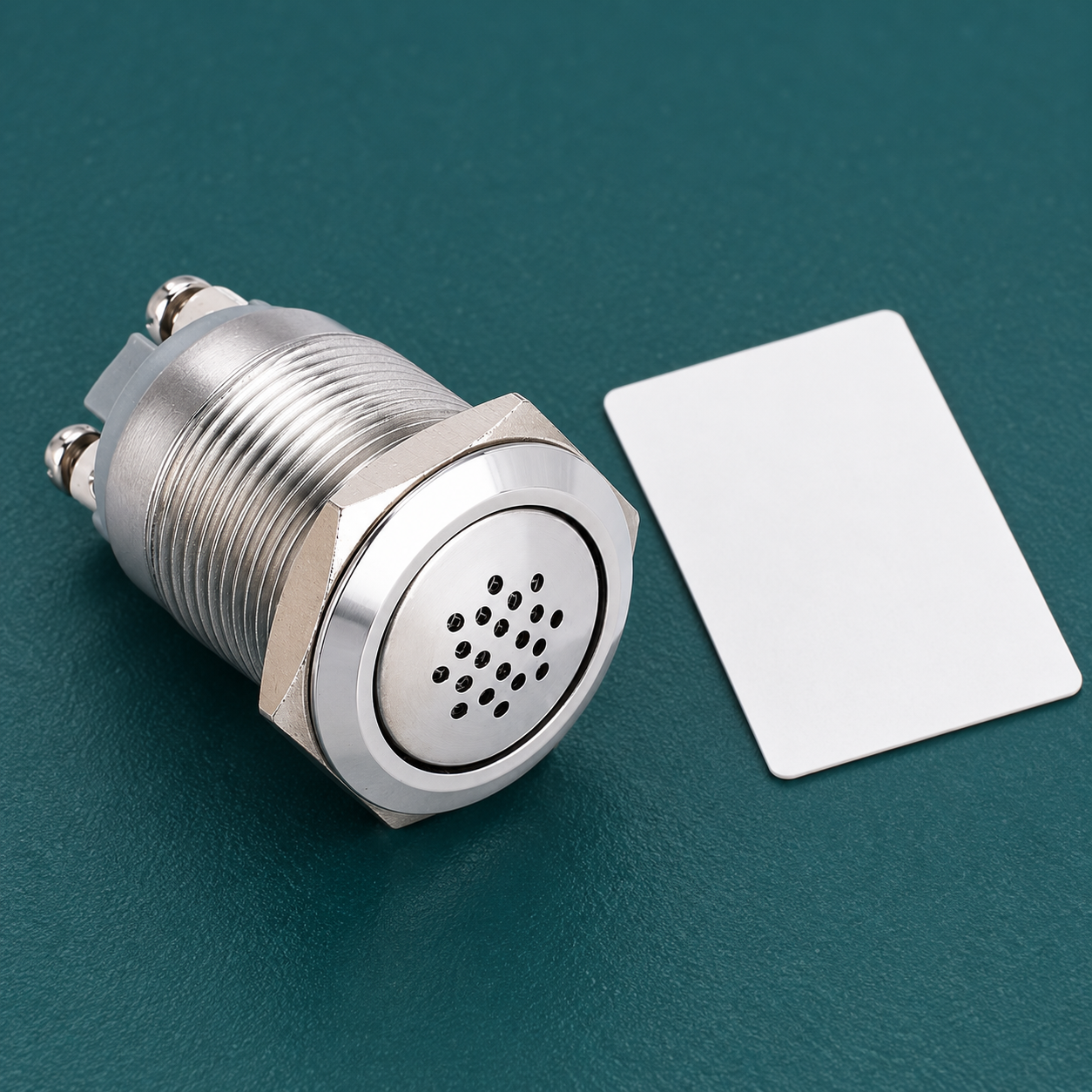
Ask which frequencies compete with the warning
A workplace contains several possible masking sounds: machine operation, ventilation, tooling, other alarms, and nearby processes. Their effect is not described fully by one overall noise number. A tone that is obvious in a quiet office can be difficult to recognize next to a machine with strong sound in a similar frequency region.
Survey the actual listener positions and operating conditions. Include the normal equipment cycle, doors or covers in their normal positions, and relevant simultaneous machinery. If hearing protection is required, include its use in the approved assessment rather than evaluating the alarm with unprotected ears in a quiet room.
NIOSH’s guide to understanding occupational noise exposure discusses workplace noise and hearing-loss context. It is not a buzzer tuning rule. Use suitable acoustic assessment and qualified review to determine whether the intended signal can be detected and recognized without treating louder output as the only remedy.
Use a practical tone-selection checklist
The following table defines evidence to gather. It contains no claimed optimum frequency or guaranteed audibility level for an ONPOW sounder.
| 選択問題 | Evidence to obtain | What to avoid | Installed check |
|---|---|---|---|
| What does the sounder emit? | Exact model’s tone or spectral data and sound pattern | Inferring tone frequency from voltage or case diameter | Confirm the supplied version and its actual output |
| What masks the signal? | Representative background-noise assessment at listener positions | Approving a bench demonstration in a quiet room | Assess the normal machine cycle and relevant nearby equipment |
| Who must recognize it? | Listener locations, tasks, hearing protection, and required response | Assuming one person’s hearing represents the whole application | Verify recognition under the approved operating conditions |
| How is it controlled? | Documented supply, input interface, and permitted switching pattern | Using an arbitrary electrical frequency to tune an unknown circuit | Confirm the controller command and sounder behavior separately |
| What other cues are needed? | Alarm priorities, labels, and any complementary indication | Adding several indistinguishable sounds for different conditions | Confirm users understand the required action for each signal |
This checklist supports a repeatable decision: define the emitted signal, evaluate its environment, and verify its meaning. It is more useful than selecting the largest frequency or sound-level number in a catalog without the associated conditions.
Frequency calculations need an actual acoustic signal
For a periodic signal, frequency equals the number of complete cycles divided by elapsed time: f = N / t. N is the counted cycles and t is time in seconds. For an illustrative recorded tone with 1,200 complete acoustic cycles in 0.5 seconds, the calculated frequency is 2,400 Hz. This is an arithmetic example, not a measured value or recommendation for an ONPOW product.
The calculation assumes a sufficiently periodic acoustic signal and a valid time measurement. It cannot use a zero time interval, count controller on/off commands as acoustic cycles, or infer a complex spectrum from a rough sound recording. A multitone or changing signal may require spectral analysis rather than one cycle count.
Use equipment and methods appropriate to the intended assessment. A recording or phone display can support informal investigation, but it should not be presented as calibrated acceptance evidence without the required validation. Record the instrument, settings, conditions, and limitations alongside the result instead of reporting an isolated frequency number.
Distinguish an audible tone from a recognizable alarm
An operator can hear a sound without knowing what it means or what to do next. Define the condition associated with the buzzer, the expected response, its priority, and how it differs from other signals in the area. Avoid assigning several unrelated conditions to the same tone unless the complete indication makes them clear.
A pulse pattern, a separate visual indication, a controller message, or an appropriate label can help distinguish conditions where the equipment design supports those cues. None of those additions automatically proves that a protective alarm has the required performance. The machine’s risk and alarm assessment determine the necessary architecture and validation.
A buzzer is also not a substitute for an appropriately designed stopping or safeguarding function. General panel signaling does not establish suitability for fire, evacuation, medical, or personnel-protection duty. Obtain the evidence relevant to the actual equipment and destination requirements before selecting a sounder for such a role.
What the GQ16B-M page does and does not specify
ONPOW GQ16B-M product page lists a 16 mm diameter, DC 12 V or DC 24 V versions, continuous and intermittent sound-type options, and sound-intensity entries at stated distances. Confirm the exact order code and current documentation for the supplied version.
The page does not publish a tone-frequency or complete spectral specification in its parameter list. Do not fill that gap with a typical buzzer frequency from another manufacturer’s catalog. Ask ONPOW for the actual tone or frequency data, tolerances where applicable, output pattern, and measurement conditions for the version being ordered.
The published sound-intensity figures also should not be treated as a guarantee that the installed alarm can be heard throughout a noisy facility. Distance, enclosure, obstructions, operating environment, measurement settings, and human recognition all matter. The page lists IP40 and IK04; that information does not, by itself, establish outdoor or washdown suitability for a completed panel.
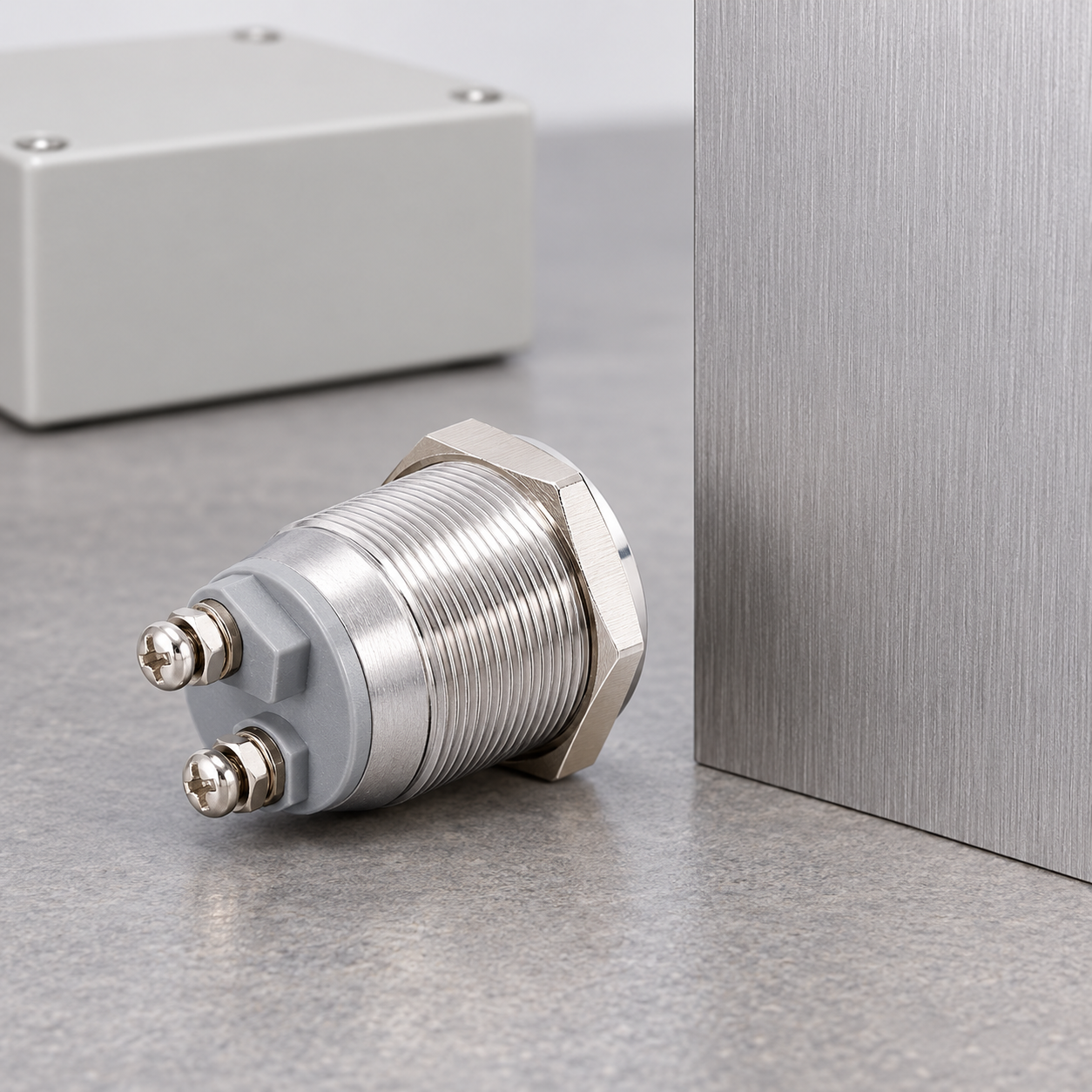
Test with the panel and listener positions represented
Mounting can change the practical acoustic path. A grille can be obstructed, an enclosure can restrict the output, and a listener can be on the opposite side of the machine from the sounder. Verify the manufacturer’s mounting instructions and the final panel arrangement instead of testing only a loose component close to the listener.
Check the sounder command and the emitted signal separately. A correct controller output does not prove a recognizable acoustic alarm, while a weak or intermittent sound can arise from an unsuitable supply or interface rather than from tone choice. The industrial buzzer wiring guide covers the electrical review.
Use the site’s controlled commissioning process and relevant qualifications. Avoid exposing personnel to unnecessary sound levels merely to compare several products. NIOSH’s occupational hearing-loss prevention information provides context for managing workplace noise; the approved assessment must address the actual installation.
Keep the acceptance conditions with the purchase record
A useful sounder inquiry includes the exact supply, permitted input interface, requested output pattern, tone or spectral requirements, listener positions, representative noise environment, mounting arrangement, environmental conditions, and applicable equipment requirements. Request a documented sample or evaluation method where the signal must be assessed before the production order.
Retain the supplied model, verified electrical behavior, acoustic assessment conditions, alarm-state mapping, and commissioning results. A replacement with the same diameter and voltage may still have a different tone or pattern. Recheck the characteristics that determine recognition rather than accepting mechanical fit alone.
Start with the broader industrial buzzer selection guide. If a fitted sounder does not behave as expected, use the buzzer troubleshooting guide. For unpublished tone data, send ONPOW the actual application instead of specifying a guessed frequency.
教育ビデオ

11. Sound Waves by MIT OpenCourseWare. General sound-wave physics from MIT. This lecture does not prescribe an industrial alarm frequency or approve a sounder installation. Open the video on YouTube.
よくある質問
Is buzzer frequency the same as its on/off repetition rate?
No. Acoustic tone frequency, alarm pulse timing, and electrical switching frequency describe different quantities. State each one separately.
Is a higher-frequency buzzer always easier to hear?
No. Recognition depends on the emitted signal, background noise, listener conditions, mounting, and required response. Verify the actual installation.
Can I infer tone frequency from a 12 V or 24 V label?
No. Supply voltage does not provide a tone-frequency specification. Obtain the exact model’s acoustic information.
Can I tune any active buzzer with PWM?
Do not assume that interface is permitted. Follow the exact product documentation and approved drive arrangement before changing the input.
What if the product page lacks frequency data?
Request the actual tone or spectrum, output pattern, and measurement conditions for the supplied version. Do not substitute another product’s typical value.



