

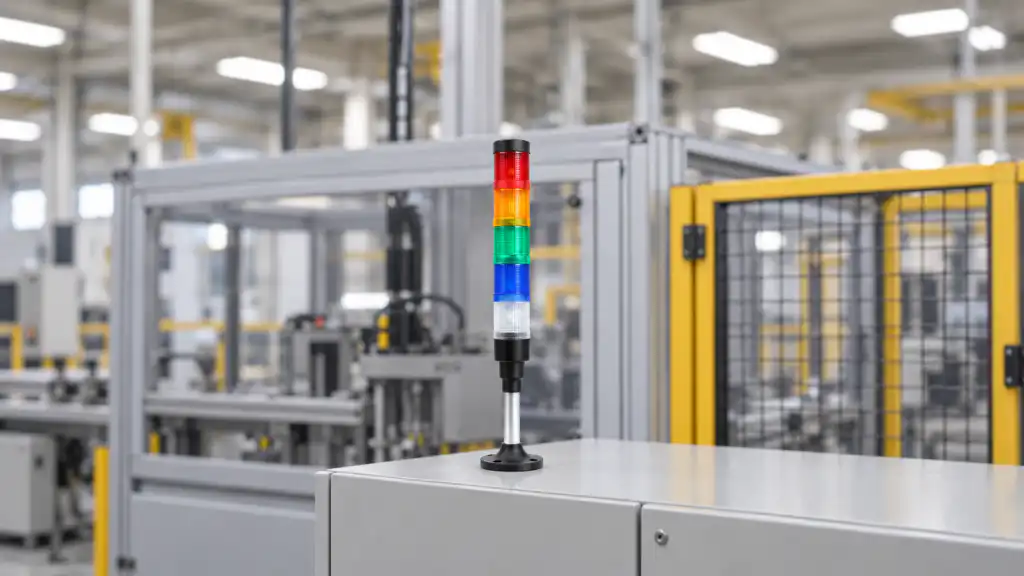
モジュラータワーライトは、オペレーターが識別する必要のある機械の状態を表示できる十分な段数を備え、かつ工程上明確に定義できる範囲を超えないようにする必要があります。段数は、文書化された状態一覧、必要なオペレーターの対応、利用可能な制御出力、視認条件、および正確な製品構成に基づいて選定してください。5段式のタワーライトが3段式より必ず優れているわけではありません。使用しない色を追加すると、配線や判断の負担が増える一方、段数が少なすぎると重要な状態を適切に伝えられなくなる可能性があります。.
これは計画立案のためのガイドであり、あらゆる用途に共通する色分け規則ではありません。ONPOWの 多段式警告灯シリーズ には、段数や構成が異なる製品が含まれています。5段式モデルの例については、 HBJD-55A/D/5/RYGBW/Aの製品ページ; をご覧ください。仕様を決定する前に、製品ドキュメントで最新の注文コード、利用可能なモジュール、電気的仕様、および取り付けオプションを確認してください。.
タワーライトの製品カタログではなく、機械の状態から検討を始める
オペレーターが通常作業する位置から確認する必要のあるすべての状態を書き出してください。「赤」「黄」「緑」から考え始めるのではなく、「サイクル運転中」「材料補充が必要」「異常確認済み」など、工程で使用する具体的な表現で状態を定義します。それぞれの状態について、誰がその表示に気づく必要があるのか、どのような対応が求められるのかを記録してください。2つの状態に対して必要な対応が同じであり、区別する必要もない場合は、別々の表示段を設ける必要がない可能性があります。.
タワーライトは、モデルや制御設計に応じて、単一の状態、複数の同時発生状態、または状態の順序を表示できます。まず、機械に必要な表示方式を決定してください。複数の状態が同時に成立する可能性がある場合は、段を積み重ねた状態表示が役立ちます。一方、状態が相互排他的であれば、必要な出力数を少なくできる場合があります。選定したモデルのドキュメントに明記されていない限り、タワーライトが同時に入力された指令を内部で自動調整したり、特定の点滅パターンを生成したりすると想定しないでください。.
実用的な段数選定の判断表
| 設計上の検討事項 | 定義すべき内容 | 段数への影響 |
|---|---|---|
| オペレーターに表示すべき個別の状態 | 異なる認識や操作が必要となる条件 | 同時に視覚的に区別する必要がある状態のみを数える |
| 同時に発生する状態 | 機械の状態が重複するのか、互いに切り替わるのか | 状態が重複する場合は、別々に点灯する段数を設けるか、別の表示方法を採用する必要がある |
| 制御出力 | 利用可能なPLC出力、リレー接点、または承認済みのインターフェースチャンネル | 選定した製品に必要な制御入力が備わっていることを確認する |
| 視認距離 | オペレーターの位置、視角、障害物、および周囲の明るさ | 積層段数を増やしても、視認性の高い適切な位置に設置された信号の代わりにはならない |
| 状態の管理主体 | 表示灯がどの設備または工程ユニットを示すのか | 1台の表示灯で、関連性のない複数の機械を曖昧にまとめて表示しない |
| 将来的な変更 | 承認済みの拡張ニーズと想定されるプロセス変更 | 将来の明確な運用状態によって配線や凡例の追加が正当化される場合に限り、予備の段を追加してください。 |
この表は設計を検討するための参考資料であり、製品仕様書ではありません。利用可能な段数、色の選択肢、電圧、ブザー、入力の構成は、選択したモデルによって異なります。 ONPOWの製品ラインナップ については、最新の図面および各モデルの詳細と併せて確認してください。.
各段を明確に定義された状態に対応させる
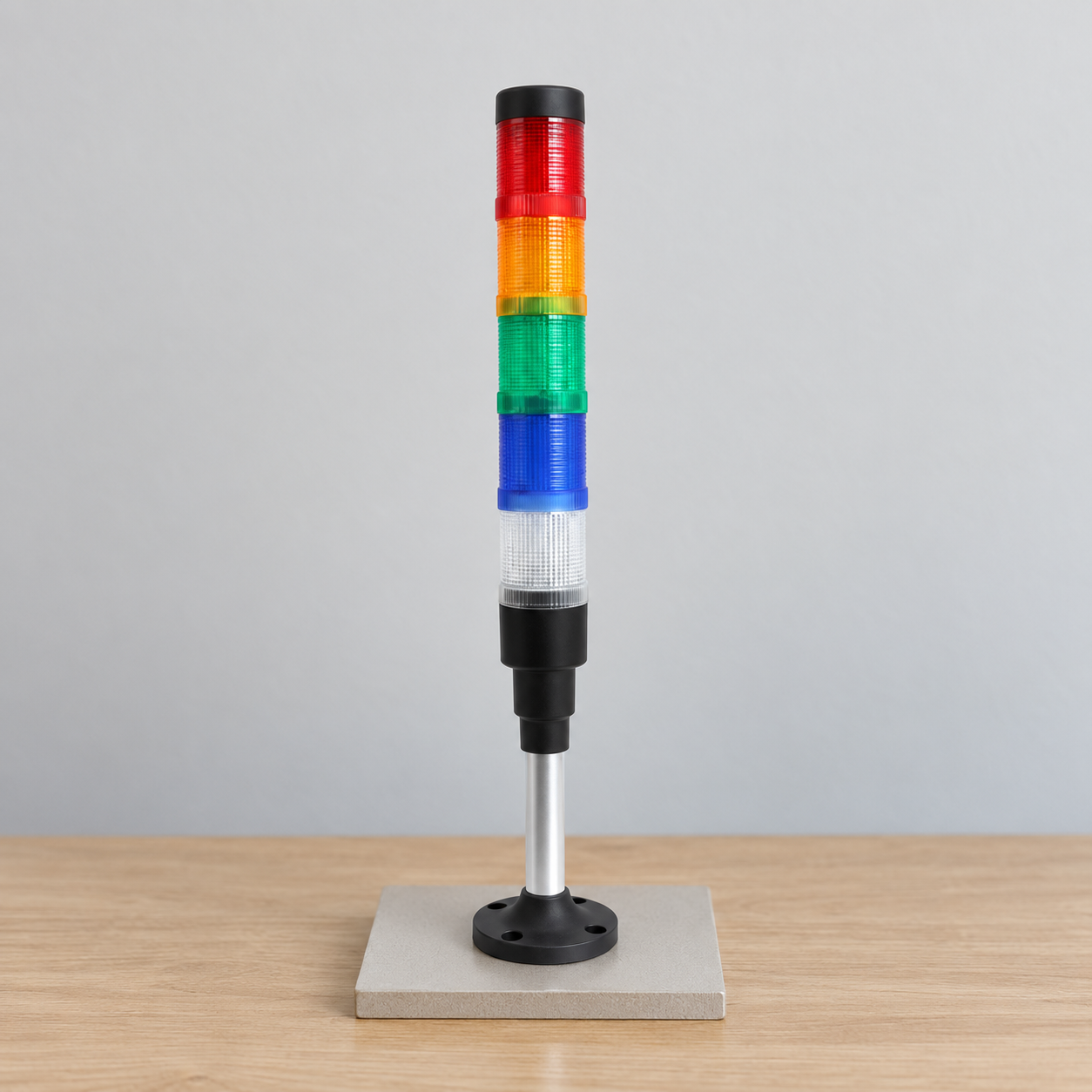
重要な状態の数を見積もった後、状態と表示段数の対応表を作成してください。機械の状態、それを表す段または組み合わせ、オペレーターの対応、および制御出力を記録します。起動、停止、故障、リセット、停電時の動作も含めてください。これにより、部品を発注する前に、未定義の色や矛盾する組み合わせを発見できます。.
| 状態の例 | オペレーターへのメッセージ | 設計上の確認事項 |
|---|---|---|
| 待機中または準備完了 | 機械は使用可能な状態ですが、サイクル運転は行っていません | Decide whether this state needs a continuously visible tier or is the default with all tiers off |
| Running | The automatic or manual cycle is active | Confirm the signal starts and ends at the correct process transitions |
| Attention required | An operator action or replenishment is needed | Define the action and whether it can coexist with “running” |
| Fault | A defined fault state needs attention | Coordinate the tower with the machine alarm strategy and fault display |
| Service or special mode | A separate mode must be visible to the people nearby | Decide if this deserves a tier, a keyed control/label, or another interface |
These are example labels only; they do not assign a standard meaning to any color. IEC 60073 provides coding principles for indicators and actuators, while IEC 61310-1 addresses visual, acoustic, and tactile signals for machinery. Consult the applicable standard and machine requirements for the actual application. ONPOW’s tower-light color guide discusses color meaning; this article focuses on the number of signals and the design decision, not a replacement color code.
各状態が排他的か、同時に発生する可能性があるかを判断する
The most important count question is often not “How many states exist?” but “How many must be seen at once?” If a machine can only be idle, running, or in fault—one state at a time—a defined selection scheme may use fewer independently illuminated tiers. If “running” and “material low” can occur together, a design that displays only the highest-priority condition may hide useful information. A stack that allows multiple modules to remain lit may make those conditions visible, but only if the product and control system support that behavior.
Write down the priority rule when states conflict. For example, a fault might override normal-running indication, or an attention request may remain visible while the machine continues to run. Confirm how the electrical outputs implement that rule and how the operator understands it. The visual display must agree with the HMI, alarm logic, and operating procedure; otherwise adding tiers can make the panel less clear rather than more informative.
製品構成と出力容量を確認する
The number of colored lenses visible in a photograph does not prove how many separate input wires or independent channels the product provides. Verify the exact part number, supply version, included modules, wiring diagram, and any sound or flashing function. The ONPOW HBJD-55 family product page illustrates a multilevel tower family, but the selected variant and its diagram govern the actual connection.
Compare the wiring diagram with the control hardware. Count the outputs required for the selected operating mode, check the controller’s sourcing or sinking arrangement, supply voltage, channel and group limits, and decide whether an approved relay or driver is needed. Do not assume a controller output can drive every tier directly. Do not infer electrical assignments from insulation colors in an image. If the selected stack includes a sounder, separately define its audience and alarm pattern; ONPOW’s industrial buzzer selection guide covers those considerations.
視認性とオペレーターの作業環境を考慮する
Tier count does not determine whether the tower can be recognized. Select a mounting position where the intended people can see it without obstruction, including from normal working positions. Consider viewing distance, angle, ambient light, reflections, machine guarding, nearby equipment, and whether more than one tower may be visible at once. A signal that can only be seen from one aisle may not serve operators on the other side.
Use labels, an HMI message, or written operating instructions where color alone is not enough. Keep the tower associated with a specific machine or zone, and make the state legend consistent across similar equipment. If color discrimination is a concern, include position, text, sound, or another appropriate cue as part of the design. A larger stack does not fix a poor location or an ambiguous legend.
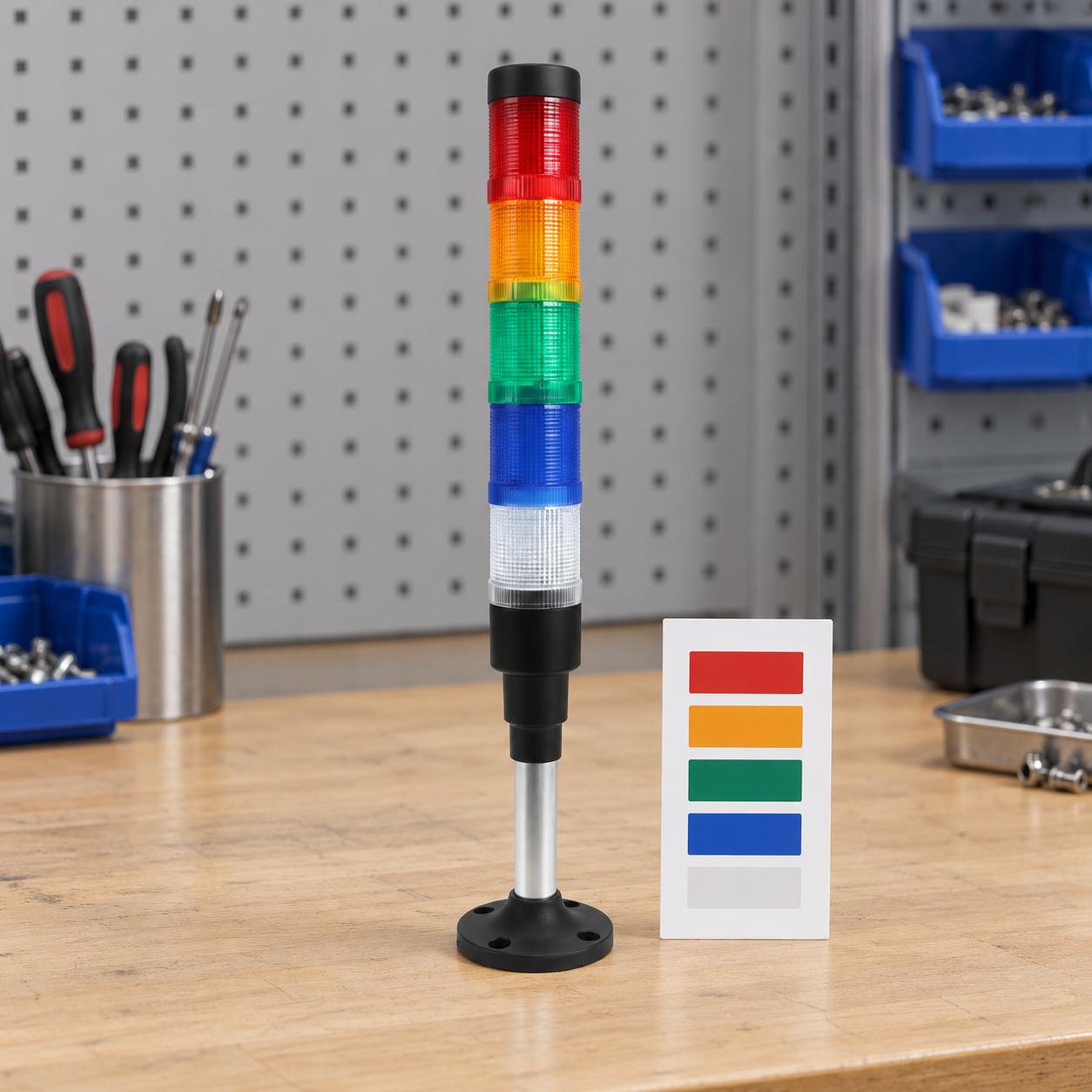
「念のため」という理由だけで段数を増やさない“
A spare tier can be useful when an approved expansion is already defined. Otherwise it can create an unused signal, an unwired input, or a future color convention that no one documents. More tiers also mean more choices to name, wire, program, test, explain, and maintain. Add one only when the state list or approved expansion plan identifies what it will represent and who will respond to it.
If a product has more physical modules than the first application needs, mark unused channels in the drawing and commissioning record. Make sure unassigned modules cannot turn on unexpectedly because of floating inputs or an incorrect common connection. If a later process change uses the spare tier, update the PLC logic, wiring diagram, operator legend, maintenance documentation, and training together.
すべての状態マトリクスを用いて試運転・動作確認を行う
Before handover, test every defined state and transition at the machine. Verify that each commanded condition illuminates the intended module, that simultaneous conditions behave as designed, and that startup, reset, power restoration, and communication or output faults produce understandable indications. Test from the operator’s actual viewing positions and confirm the legend matches the observed signal.
Keep the test record tied to the full product code and wiring drawing. The IEC 61310-1 scope provides a framework for considering visual and other signals at the machine interface; the machine’s applicable standards, risk assessment, and approved procedures determine the required verification. A stack-light test is not, by itself, proof that a safety function is adequate.
教育ビデオ
This ACC Automation tutorial shows a generic stack-light and PLC wiring example. It can help visualize a controls connection, but it does not determine the correct tier count or replace ONPOW’s exact wiring diagram.
Watch the generic stack-light and PLC wiring tutorial.
よくある質問
産業用タワーライトには何段必要ですか?
Choose enough tiers for machine states that operators must distinguish, especially when conditions can occur together. Confirm the product’s actual input arrangement and output capacity before setting the count.
各段階に専用のPLC出力が必要ですか?
必ずしもそうとは限りません。必要な出力数は、選択したタワーライト、その内部機能、および希望する制御動作によって異なります。目視できるレンズ1つにつき出力が1つ必要だと決めつけず、正確な配線図とコントローラーの技術資料を参照してください。.
将来の使用に備えて、予備の段を追加で設置する必要がありますか?
承認済みの将来の運用状態が定義されている場合に限ります。未使用の入力を文書化し、意図せず作動しないことを確認してください。また、その段階を正式に導入する際には、制御ロジックとオペレーター向け凡例を更新してください。.
タワーライトの色には、世界共通の意味があるのでしょうか?
一般的なオンラインリストに記載された意味が、すべての機械に当てはまると考えてはいけません。適用される規格や機械の要件に従い、設備およびオペレーター向けに一貫した状態表示の凡例を定め、文書化してください。.
段数を増やすと、機械の状態をより理解しやすくなりますか?
各階層に明確な意味があり、ハードウェアが意図どおりに表示できるのであれば、より多くの異なる状態を示すことができます。使用されていない信号や競合する信号は複雑さを増すため、設計を確定する前に、オペレーターとともに状態マトリクスを検証してください。.
参考文献
- IEC 60073: Basic and safety principles for man-machine interface, marking and identification — Coding principles for indicators and actuators
- IEC 61310-1: Safety of machinery — Indication, marking and actuation — Part 1: Requirements for visual, acoustic and tactile signals
- National Instruments: Choosing an industrial digital I/O module
ONPOWの関連ページ
- Multilevel warning-light product range
- HBJD-55A/D/5/RYGBW/A five-tier product example
- Tower-light color meanings
- Industrial buzzer selection guide
カスタマイズ
ONPOW undertakes a variety of custom needs for push-button development. Confirm whether packaging, marking or documentation OEM/ODM applies to Modular Tower Lights: Choosing the Number of Signal Tiers in the quotation.
最小注文数量、リードタイム、および取引条件はここに掲載されていません。販売担当者に確認してください。 sales@onpow.com.



