

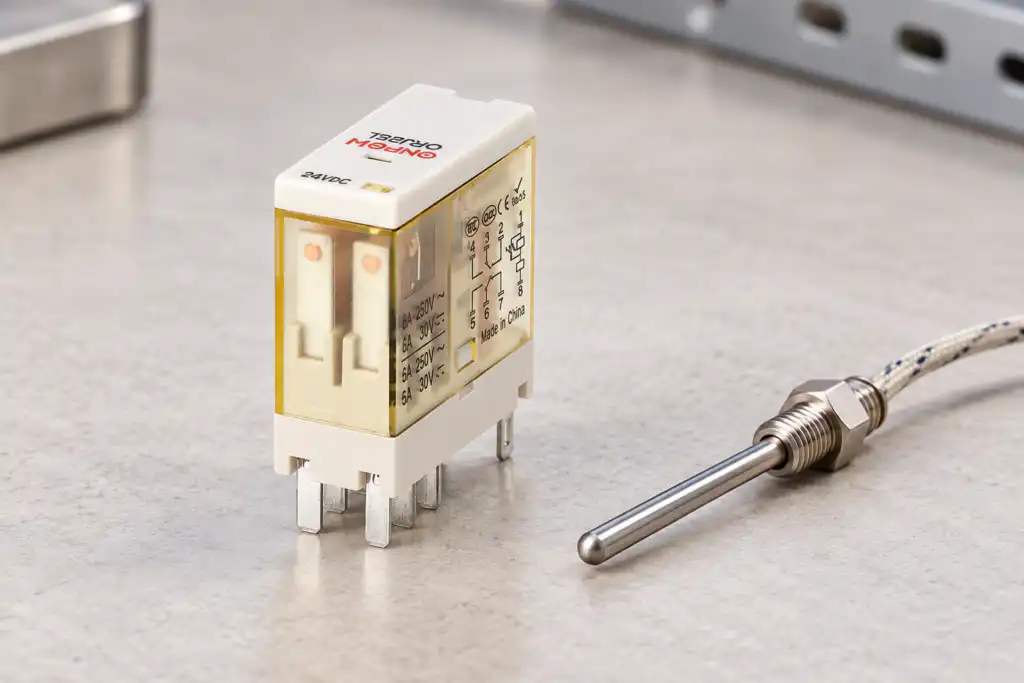
Relay coil heating is expected when an energized coil converts electrical energy into heat, but a warm relay is not automatically healthy or faulty. A useful inspection separates coil heating, contact and socket heating, local cabinet temperature and abnormal supply conditions. Compare recorded measurements with the exact relay’s data and the equipment’s approved limits. Do not use a hand-touch judgement or a generic temperature number as an acceptance test. This guide explains how maintenance and purchasing teams can collect useful evidence without confusing a surface observation with an internal winding temperature.
Start with the symptom and the operating context
Write down what changed: a new smell, discoloration, intermittent pickup, a cabinet alarm or a temperature trend. Record the machine step, duration of energization and surrounding operating conditions. A relay that feels warmer after continuous operation than after a brief cycle may simply have reached a different thermal condition. That observation still needs comparison with its specified application.
Separate normal observation from an immediate equipment concern. Smoke, damage or another abnormal condition calls for the site’s approved response and competent assessment. Do not repeatedly energize a suspect relay to see whether it fails again. Preserve the failed part and its operating history when the investigation requires them.
その electromechanical relay selection guide addresses specification. This article focuses on temperature evidence after a relay is selected or installed. For a broader fault classification, refer to relay failure modes. Keeping those scopes separate helps the maintenance team ask a precise question.
Confirm the complete coil variant
Record the exact model and coil option, including AC or DC, rated supply and any indicator or suppression arrangement. Similar cases can contain different coils. A photograph of the front label should be paired with the order record and circuit documentation, especially after a spare has been fitted.
その ONPOW ORJ2SL product example illustrates a plug-in relay construction. Use the current documentation for the particular version being purchased. The reference photograph identifies the visible product form; it does not establish a continuous operating temperature, an internal winding temperature or a permission to substitute a different coil version.
Check the socket and retention arrangement too. A mechanically fitting relay is not sufficient evidence of electrical compatibility. Terminal assignment, supply option and any accessories must match the approved assembly. If the replacement history is uncertain, resolve identity before interpreting temperature readings. Otherwise the team may spend time diagnosing a relay that was never the intended variant.
Understand where the heat can originate
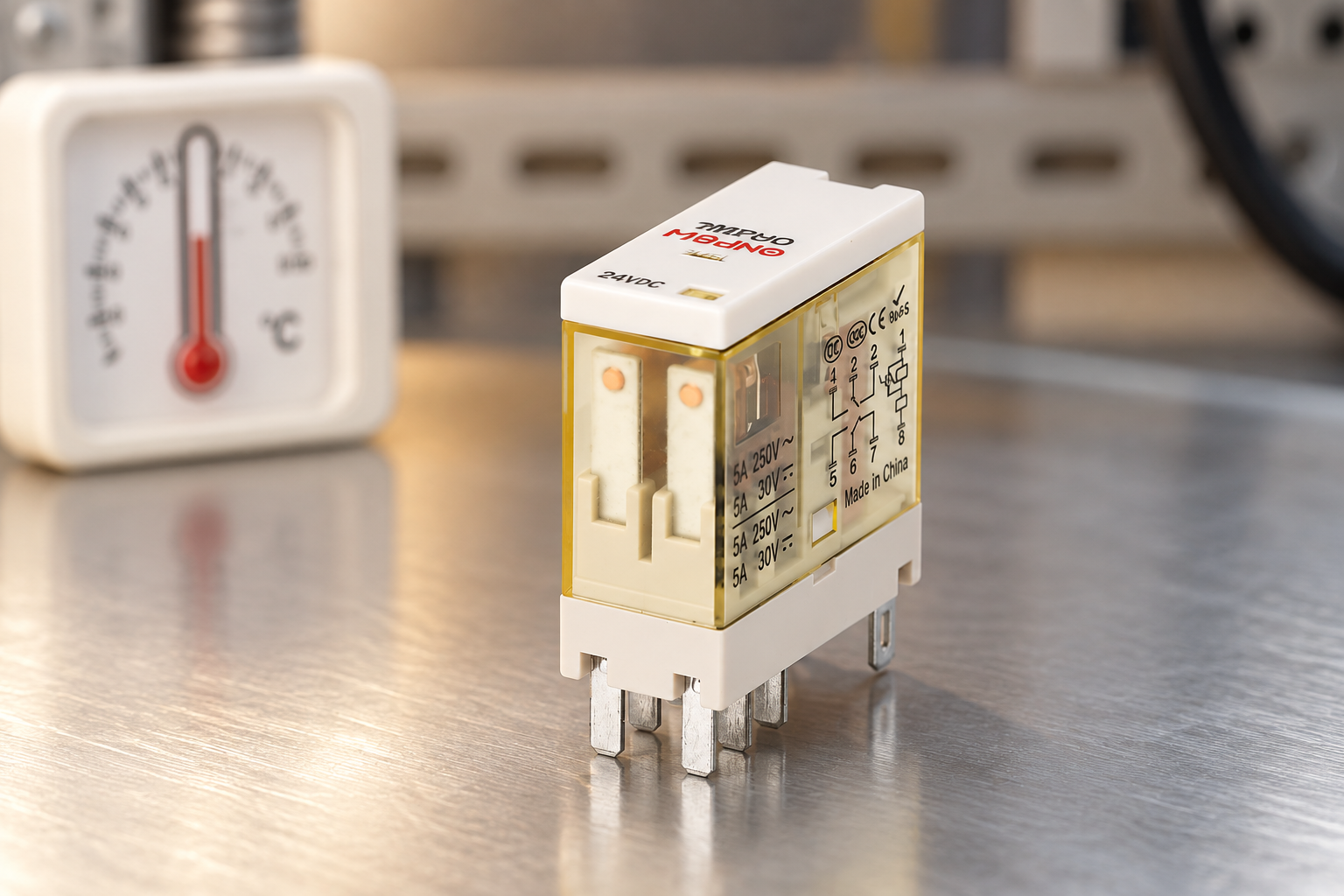
The energized winding dissipates power. Contacts carrying load and connections with resistance can also generate heat. Nearby power supplies, drives or other relays can raise the surrounding air temperature. These sources can overlap, so a warm case alone does not identify the dominant cause.
For a simple steady DC resistance model, power can be expressed as P = V × I, or P = I²R when the quantities describe the same operating condition. That model is not a complete prediction of relay temperature. Heat transfer, winding resistance changes, duty cycle and construction all matter. AC coils also involve impedance and magnetic behaviour; do not use a cold DC resistance calculation as their operating power model.
An inspection should therefore map locations and conditions, not only collect one hottest number. Note whether the warm region is associated with the coil area, a socket terminal or another nearby component. A thermal pattern can guide further investigation, but it does not establish an electrical diagnosis without the corresponding circuit and component evidence.
Separate absolute temperature from temperature rise
Temperature rise compares a defined measured location with the specified reference environment. If a surface is measured at 52 °C and the relevant local air measurement is 32 °C under a defined procedure, the difference is 20 K. This is an arithmetic example, not an ONPOW limit or a statement that either temperature is acceptable for your relay.
その NIST explanation of temperature units helps distinguish Celsius readings and kelvin temperature differences. Record the instrument’s units consistently. A cabinet room sensor may not represent the air immediately around a crowded relay bank, so identify where the reference measurement was made.
Surface, terminal and winding temperatures are different quantities. A casing reading cannot be compared directly with a winding limit unless the manufacturer’s method allows that interpretation. Ask which location and measurement method the specification uses. An apparently precise instrument display does not remove uncertainty about what was actually measured.
Collect repeatable measurements under an approved procedure
The responsible person should define the equipment state, measurement positions, instruments, stabilization condition and acceptance criteria. Record whether covers were open, ventilation was operating and adjacent loads were active. Opening a cabinet can change its thermal environment, making an informal measurement difficult to compare with normal service.
Contact probes and infrared instruments have different limitations. Surface emissivity, reflections, viewing angle, access and probe attachment can affect readings. Shiny terminals deserve particular care. Use the approved instrument procedure and avoid treating a bright or dark region in an image as a reliable temperature without the necessary settings and interpretation.
HSE electrical safety guidance explains the need for safe isolation and competent work. Temperature investigation does not authorize exposed live measurements. Where energized observation is justified, it requires the site’s assessed method, suitable equipment and qualified personnel. This purchasing guide cannot supply that work procedure.
Use a structured evidence table
| Observation | 収集すべき証拠 | Question it helps answer |
|---|---|---|
| Entire relay bank is warmer | Local ambient, cabinet load and ventilation condition | Is the environment different from the design assumption? |
| One coil area differs | Exact coil variant, duty and verified supply condition | Is this unit operating under comparable conditions? |
| Heat concentrates at a socket connection | Terminal identity, condition and approved connection checks | Is the connection contributing to the heating? |
| Temperature rises during long commands | Energization duration and time-based readings | Is the duty covered by the component data? |
| Pickup becomes intermittent when warm | Correlated command, supply and functional records | Does temperature coincide with another operating change? |
| Replacement repeats the symptom | Part history and unchanged application conditions | Was the cause left in the equipment? |
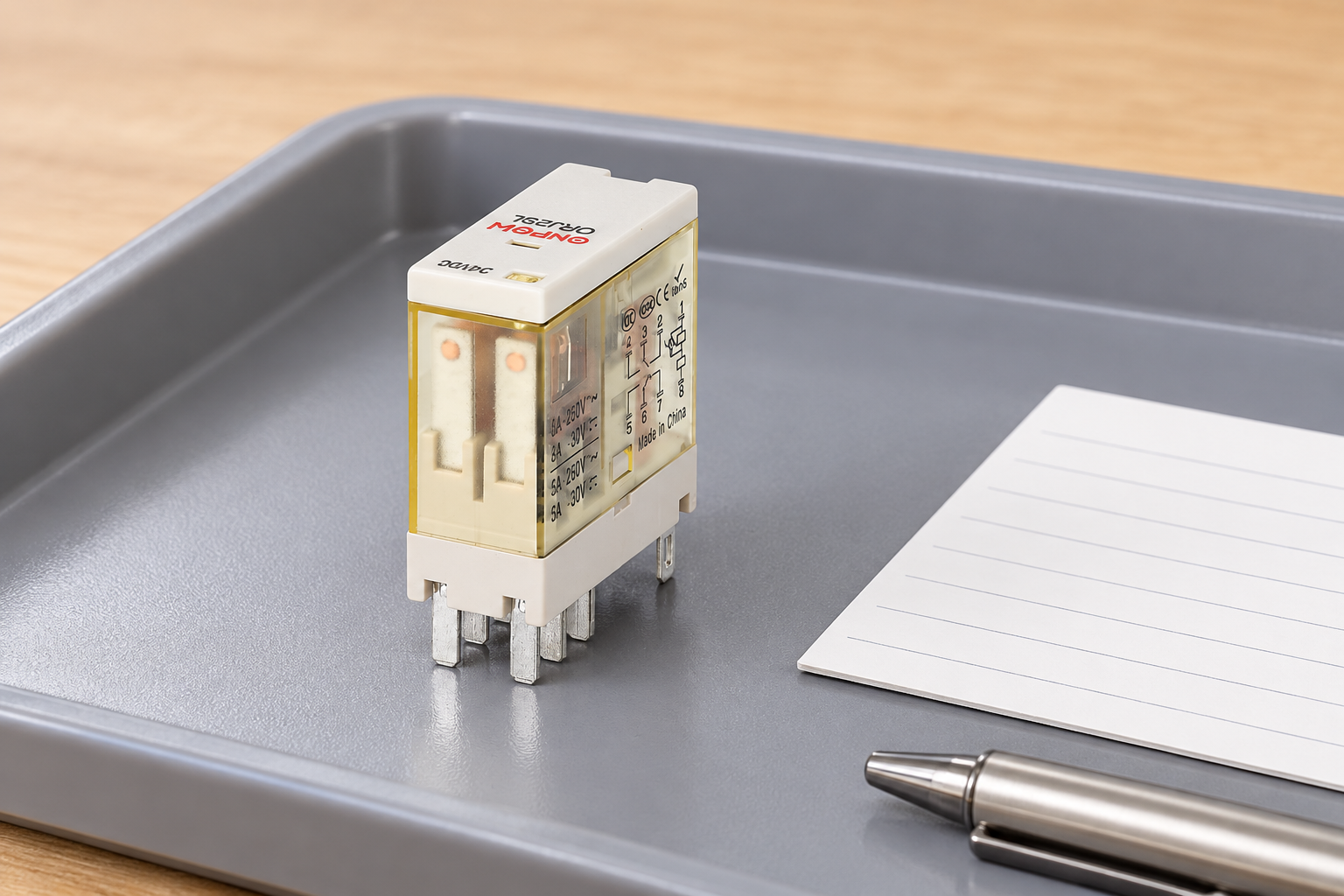
The table organizes an investigation. It does not assign a fault to an observation or prescribe an energized test. Use the exact relay and socket documentation to establish limits and the responsible maintenance procedure to collect evidence.
Compare coil, contact and connection conditions
A coil supply issue and a contact load issue require different corrective work. Record the load category, switching frequency and relevant operating cycle when contact or socket heating is suspected. A nominal current value alone may omit important switching conditions. Keep measured coil supply information separate from load-circuit measurements in the report.
Review contact ratings against the actual duty. Do not assume that an ampere marking covers every motor, lamp, capacitive input or inductive load. A temperature observation may prompt a wider application review even when the relay still operates. The relay contact load guide provides the related selection context.
A terminal connection can also be affected by assembly condition, conductor preparation or compatibility. Follow the approved socket instructions and isolation procedure; do not improvise tightening values from another terminal system. If heat damage is visible, assess the socket and conductor as well as the removable relay. Replacing only the relay can leave a damaged interface in service.
Review trends without inventing a universal limit
Compare readings made at the same locations and under comparable duty, supply and ambient conditions. Label differences in the test setup rather than presenting them as component deterioration. A cooler reading after a cabinet door was left open is not evidence that a replacement cured the root cause.
Use reference units carefully. Two relays of the same apparent size may have different coil power or thermal design. Even identical parts in different positions can experience different surrounding temperatures. A comparison is useful when its assumptions are documented, not merely because one device feels warmer than its neighbour.
Keep the manufacturer’s allowed operating conditions, any temperature-rise method and the equipment acceptance requirement together. If the data is incomplete, ask the supplier for clarification. A missing limit is a documentation gap; it is not permission to choose a convenient threshold from an unrelated relay.
Prepare a useful supplier enquiry
Send the full model and coil code, socket identification, date or batch information when available, circuit context, energization duty, surrounding temperature and measurement method. Include photographs of the intact assembly and a time-based record if the symptom develops gradually. Describe observations separately from suspected causes.
Ask which measurements can be compared with the published data, whether the duty is covered and what additional information is required. Avoid asking the supplier to approve an installation from a single thermal photograph. The complete equipment assessment remains with the responsible designer or operator.
After corrective work, repeat the relevant controlled check and preserve the before-and-after conditions. Record what was changed, who reviewed the result and whether any unresolved uncertainty remains. This makes the next maintenance decision faster and reduces the chance of replacing the same component repeatedly without solving the application problem.
よくある質問
Is it normal for an energized relay coil to become warm?
Heat generation is expected, but acceptability depends on the exact coil, duty, environment and specified limits. Warmth alone does not prove either correct operation or a fault.
Can I judge relay temperature by touching the case?
No. Touch is not a controlled temperature measurement and can expose a person to burns or electrical hazards. Use an approved inspection method and the specified acceptance criteria.
Does an infrared case reading show winding temperature?
No. It measures an interpreted surface temperature under the instrument’s conditions. Internal winding temperature is a different quantity and requires an appropriate method or manufacturer-supported relationship.
Why can the replacement relay become hot again?
The original cause may remain in the supply, load, socket, duty or cabinet environment. Confirm the exact replacement variant and investigate the application evidence rather than assuming repeated component defects.
Further learning
Khan Academy explains electrical power and energy. This supports the discussion of coil power and heating, not a product temperature limit or an approved live-test procedure.
カスタマイズ
ONPOW undertakes a variety of custom needs for push-button development. Confirm whether packaging, marking or documentation OEM/ODM applies to Relay Coil Heating: A Practical Inspection Guide in the quotation.
最小注文数量、リードタイム、および取引条件はここに掲載されていません。販売担当者に確認してください。 sales@onpow.com.



