

When choosing an illuminated push button switch, light color may seem like a minor detail, but it directly affects how operators interact with equipment, identify machine status, and respond to changes in operating conditions.
Some applications require only a single, clear signal, such as a green light indicating that equipment is operating normally. Others require multiple colors to indicate different operating modes, warnings, or equipment conditions. In these cases, you need to choose between RGB and single-color LED push button switches.
So, which option is better for your application? The answer depends on how the switch will be used, how many signals need to be displayed, and how much flexibility the control system requires.
1. RGB vs. Single-Color LED Push Button Switches: Key Differences
The core difference is simple: a single-color LED push button switch emits only one fixed color, while an RGB model can produce multiple colors by mixing red, green, and blue light.
| Feature | RGB LED Push Button Switch | Single-Color LED Push Button Switch |
|---|---|---|
| Light colors | Multiple colors, depending on the product design | One fixed color |
| Status indication | Can use different colors to display multiple equipment statuses | Uses one color for a specific signal |
| Control requirements | Usually requires a compatible controller or corresponding wiring | Simpler integration |
| Wiring and setup | Wiring may be more complex, depending on the model | Usually simpler wiring |
| Flexibility | High, supporting multiple visual signals | Suitable for clearly defined single signals |
| Initial cost | May be higher, depending on the product design | More cost-effective |
| Typical applications | Automation equipment, advanced control panels, multi-status systems | Industrial machinery, power control, simple control panels |
Please note: RGB functionality varies by product. Some switches support multiple preset colors, while others offer more flexible color control. Wiring, voltage, and control requirements also depend on the specific model.
2. What Is a Single-Color LED Push Button Switch?
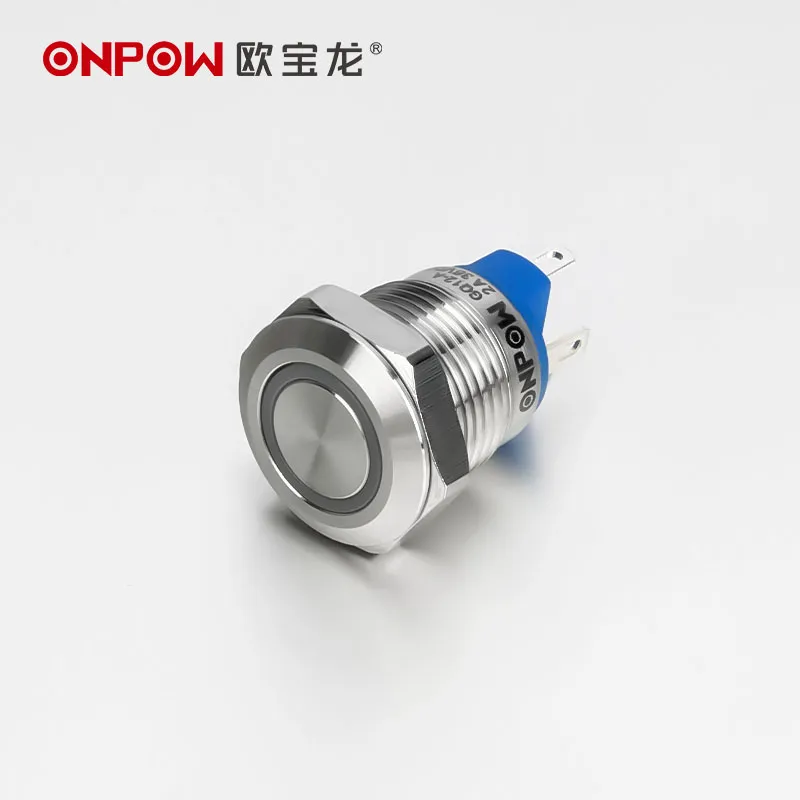
A single-color LED push button switch uses an LED that emits only one specified color, such as red, green, blue, yellow, or white.
When the switch is illuminated, the light provides a clear visual signal to the operator. For example, a green illuminated push button may indicate that equipment is ready, while a red button may indicate a stop function or another important control.
When Should You Choose a Single-Color Switch?
A single-color illuminated push button switch is suitable when:
- Each button requires only one light color.
- The equipment has simple operating conditions.
- You want simple wiring and convenient installation.
- You need to control equipment costs.
- The light color does not need to change during operation.
For many industrial control panels, a single-color switch is entirely sufficient. It provides a clear visual signal without adding unnecessary control complexity.
For example, a machine may use a green illuminated button for starting and a red button for stopping. Each button has a fixed function and does not need to change its light color.
The main advantage is simplicity. If an application requires only one clear signal, a single-color LED push button switch is usually the more practical solution.
3. What Is an RGB LED Push Button Switch?
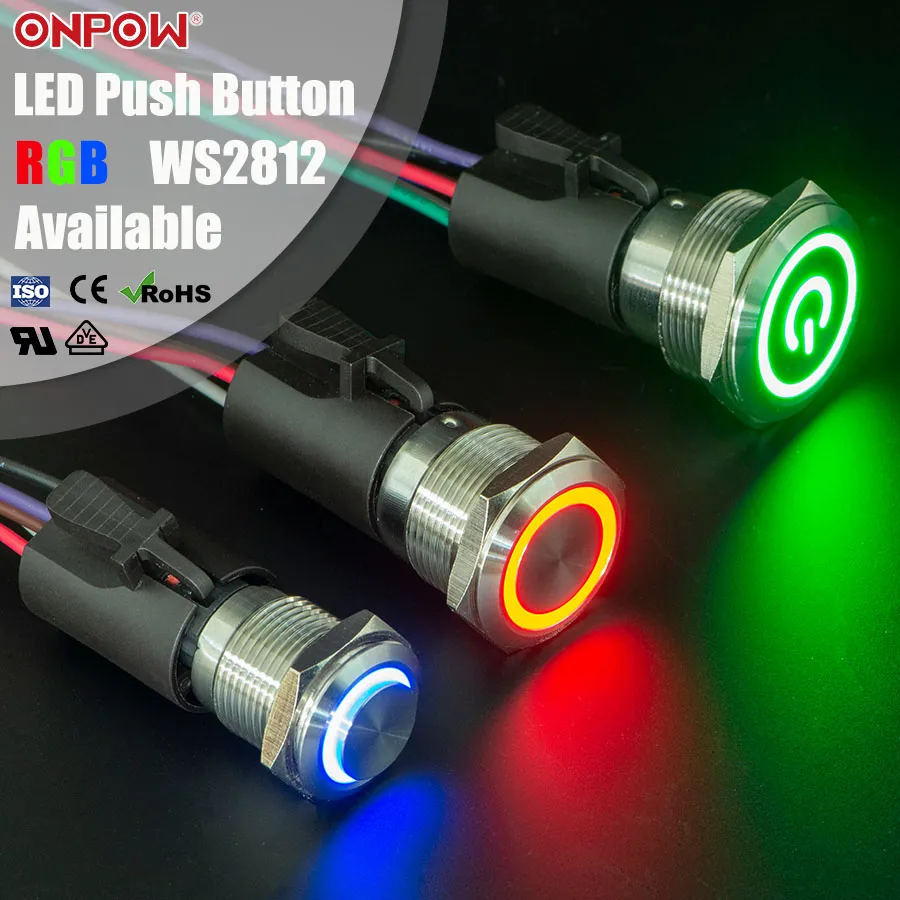
An RGB LED push button switch integrates red, green, and blue light sources to produce multiple colors. Depending on the product design, it may display red, green, blue, yellow, cyan, magenta, white, and other colors.
Unlike a single-color switch, the same RGB button can change its light color to represent different equipment statuses.
For example, the light may be green when the equipment is ready, blue during the setup process, and red when an alarm occurs.
When Should You Choose an RGB Switch?
An RGB LED push button switch may be a better choice when:
- The same button needs to indicate multiple operating states.
- Operators need to identify equipment conditions quickly.
- You want to reduce the number of separate indicator lights.
- The equipment involves automated processes and dynamically changing statuses.
- The control system or signaling requirements may change in the future.
Consider an automated production machine: a single illuminated button can display green when the equipment is ready, yellow when attention is required, and red when a fault occurs. Operators can identify the current status without relying entirely on a display screen or separate indicator lights.
However, RGB lighting does not automatically make a control panel easier to operate. Color definitions must be consistent, and operators need to understand what each color represents.
The main advantage is flexibility. RGB switches are particularly suitable when the same physical control needs to communicate multiple operating conditions.
4. RGB vs. Single-Color: Which Is Better for Your Application?
Neither option is universally better. The right choice depends on your actual operating requirements.
When to Choose a Single-Color LED Push Button Switch
- Dedicated start and stop controls: Use single-color switches for dedicated start or stop functions.
- Fixed button functions: Each button has a clearly defined function, and a fixed color is sufficient.
- Simple control systems: The equipment does not require complex visual signaling.
- No need to change light colors: RGB functionality would add unnecessary complexity and reduce cost-effectiveness.
- Simple installation: Single-color models generally offer simpler wiring and integration, depending on the available voltage and product configuration.
- Cost-sensitive projects: If multi-color functionality is unnecessary, there is no need to pay extra for unused RGB features.
When to Choose an RGB LED Push Button Switch
- Multiple statuses on the same button: One button needs to indicate several equipment conditions.
- Clearer status identification: Different colors help operators distinguish between ready, running, standby, and fault conditions.
- Multiple operating modes: RGB lighting makes changes in equipment status easier to recognize without adding a separate button for every condition.
- Flexible visual signaling: If the control logic may change, RGB lighting offers more options, provided the switch and controller support the required functionality.
- Clearer control panel indications: A well-designed color scheme helps operators identify critical information quickly, especially in multi-machine or multi-process environments.
Important note: When different colors represent different operating conditions, color switching must be controlled reliably and consistently. For safety-critical signals, applicable machinery standards must be followed. Color alone must not be used as the sole basis for safety-related decisions.
5. Can RGB LED Push Buttons Replace Multiple Single-Color Switches?
They can in some applications, but not in all cases. If the same button is used to display multiple operating states, an RGB switch can reduce the number of additional indicator lights required.
For example, a single RGB illuminated push button can be configured as follows:
- Green: Equipment ready
- Blue: Setup mode
- Yellow: Attention required
- Red: Fault condition
This design can make a control panel more compact and its information easier to understand.
However, if operators need to perform multiple independent physical operations, an RGB switch cannot replace multiple independent buttons. Changing the light color does not add new switching functions.
For example, if a machine requires separate start, stop, and reset operations, it still needs three independent controls, even if all three use RGB lighting.
Another practical point: Color should supplement labels and operating procedures, not replace labels. This is especially important when operators need to identify alarms or safety-related conditions quickly.
6. How to Choose the Right LED Push Button Switch for Your Project
For industrial equipment manufacturers, control panel integrators, and automation engineers, the right switch must match the electrical design, panel layout, and application requirements.
온포우 offers a range of LED push button switches for various industrial control applications, with multiple sizes, light colors, voltage options, and contact configurations available. Single-color solutions can be selected for simple signaling applications, while multi-color models can be chosen when more flexible visual indication is required.
온포우 RGB LED Push Button Switch
To learn more about our illuminated push button switches, please visit our [제품] page.
If you are unsure which model to choose, start by confirming the panel cutout size, operating voltage, contact configuration, and lighting requirements. These key parameters will help you identify a suitable model more accurately and avoid selecting unnecessary features.
If you need further selection advice, please visit our [문의하기] page to discuss your requirements with our team.



