

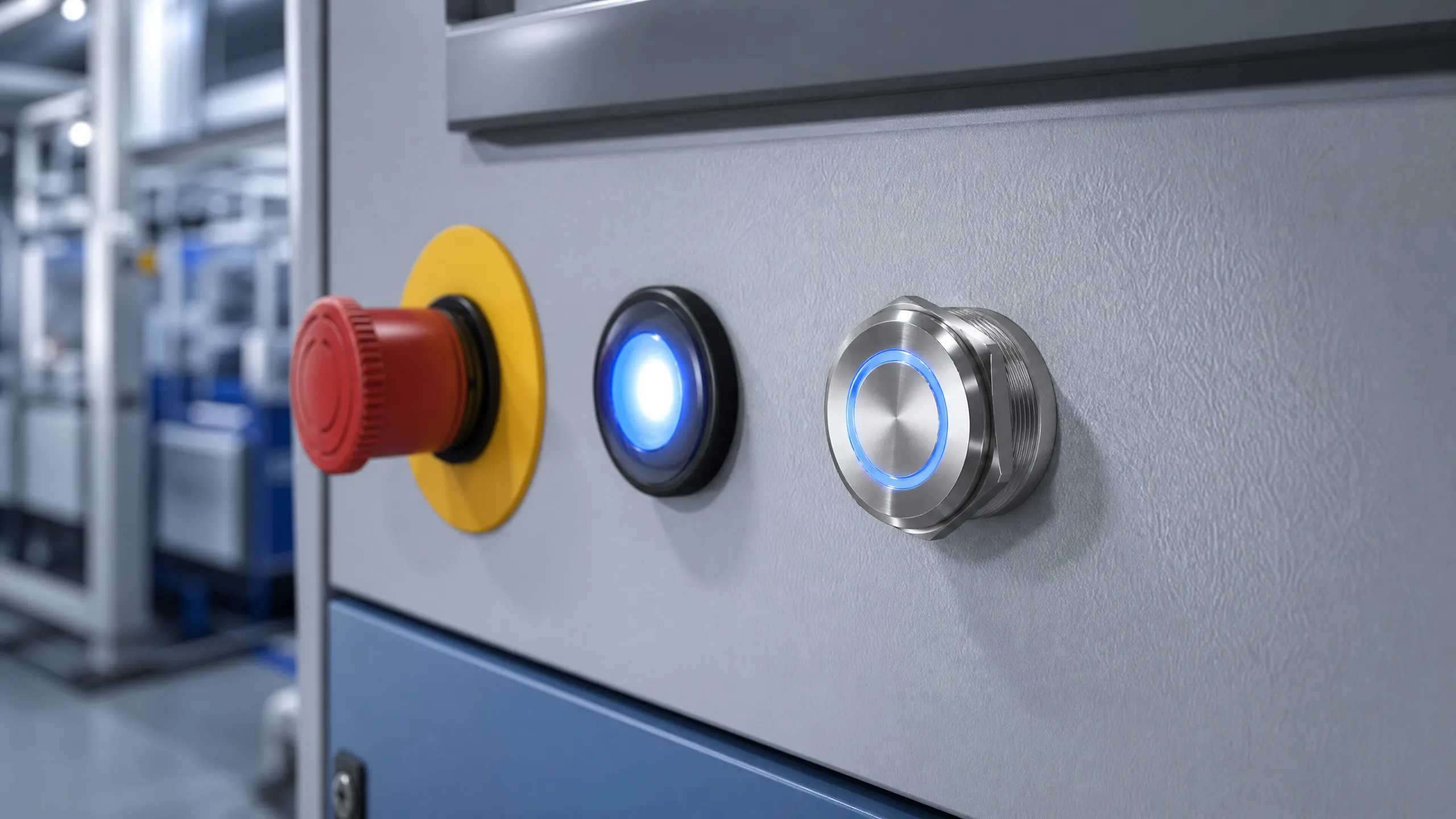
Industry Demand for Waterproof Control Components
Waterproof control components are becoming more important as industrial equipment is used in more complex working environments. Machine control systems, packaging machinery, food processing equipment, access control systems, outdoor enclosures, and transportation equipment may face moisture, dust, cleaning processes, vibration, or temperature changes.
In these conditions, a standard switch may not always provide sufficient sealing or stable long-term operation. A waterproof control switch, especially one designed for panel-mount applications, helps protect the operator interface from water ingress and contamination when properly installed.
According to the International Federation of Robotics’ World Robotics 2024 reporting, global installations of industrial robots reached 541,302 units in 2023, reflecting continued investment in automated production environments. This figure does not directly measure push button switch demand, but it does indicate broader growth in machine control systems where reliable operator interface components are commonly required.
Note: Automation growth should be understood as market context, not as a direct measurement of waterproof switch demand.
For buyers, this means more attention is being placed on practical details: whether the switch fits the panel cutout, whether the sealing structure matches the application environment, whether the contact configuration works with the control circuit, and whether the same specification can be supplied consistently across repeat orders.
What Is a Waterproof Momentary Push Button Switch?
A waterproof momentary push button switch is a sealed electrical switch that changes circuit status only while it is pressed. When the operator releases the actuator, the internal return spring brings the button back to its original position. This makes it suitable for start, reset, signal input, door release, temporary control, and PLC input circuits.
Unlike a latching switch, which stays in its changed position until pressed again, a momentary switch is designed for short-duration operation. In industrial automation and low-voltage control circuits, this behavior is useful when the control system only needs a pulse signal or temporary command.
A typical waterproof momentary switch includes an actuator, return spring, contact bridge, fixed contact, O-ring seal, sealing gasket, threaded housing, mounting nut, terminal pins or wire leads, and sometimes an LED indicator. Its waterproof performance depends not only on the switch head, but also on gasket compression, installation quality, terminal protection, and cable entry design.
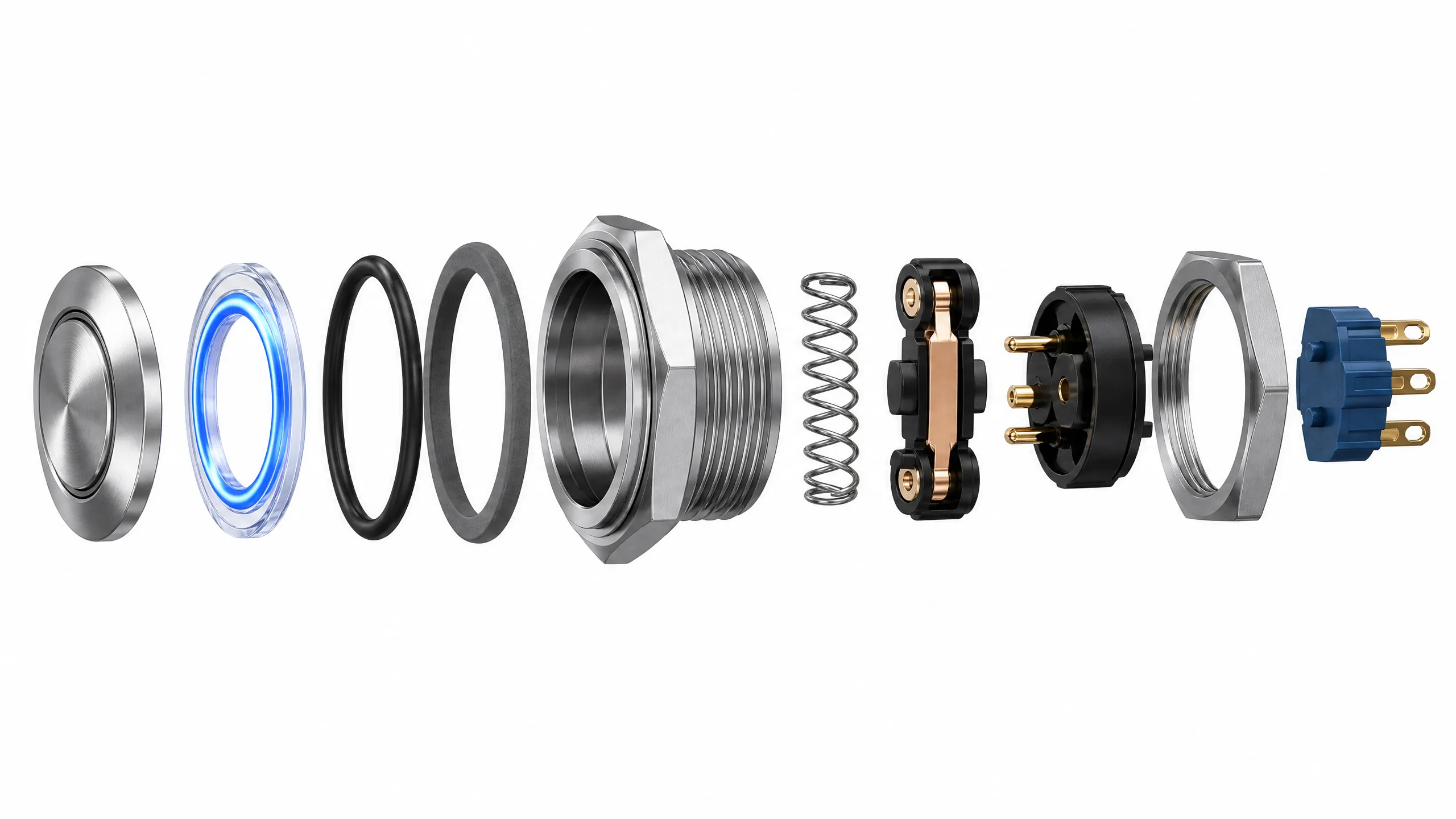
The table below summarizes common specifications buyers often review before selecting a model.
| Specyfikacja | Common Options | Buyer Relevance |
|---|---|---|
| Operation Type | Momentary / Latching | Determines whether the switch resets automatically |
| Contact Type | NO / NC / NO+NC | Defines circuit behavior |
| Mounting Size | 8mm, 12mm, 16mm, 19mm, 22mm | Must match the panel cutout |
| Stopień ochrony IP | IP65 / IP67 | Indicates dust and water protection level |
| Housing Material | Stainless steel, brass nickel-plated, plastic | Affects durability, corrosion resistance, and cost |
| Terminal Type | Solder, screw, pin, wire leads | Influences wiring and assembly method |
| LED Option | Non-LED, ring LED, dot LED | Supports visual status indication |
For compact equipment, buyers may consider a small waterproof push button switch or mini waterproof push button. For industrial control panels that require quick operator recognition, an LED waterproof push button switch with ring illumination may be preferred.
In many projects, buyers may also need matching control interface components such as indicators, emergency stop buttons, selector switches, warning lights, or switch boxes. Reviewing these components together can help improve panel compatibility and reduce sourcing complexity.
How Waterproof Momentary Push Button Switches Are Manufactured
A reliable waterproof push button switch is not defined by appearance alone. Its performance depends on material selection, housing processing, sealing design, contact assembly, LED integration, terminal structure, and final inspection.
Material Preparation and Component Selection
Material selection is one of the first steps in production. Stainless steel housing is often used for humid, outdoor, corrosive, or high-strength applications. Brass nickel-plated housing provides a balance between machinability, structural strength, surface stability, and cost. Plastic housing may be suitable for lightweight devices, compact panels, or applications with lower mechanical stress.
Internal parts also matter. Silver alloy contacts can support stable conductivity in low-voltage control circuits. The return spring affects reset force and operating feel. Sealing gaskets and O-rings influence water resistance. Terminal pins, solder terminals, screw terminals, or pre-wired cable structures affect assembly workflow for OEM electrical assemblies.
For B2B procurement, production consistency is important because buyers often need stable model availability across repeat orders, not only one-time samples.
Housing Processing and Surface Finishing
For metal push button switches, housing processing may include CNC machining, stamping, threading, polishing, nickel plating, or stainless steel finishing. These steps affect both appearance and installation performance.
For panel-mounted switches, dimensional tolerance is especially important. The threaded housing, mounting nut, panel cutout, and panel thickness must match correctly. Even a small deviation may affect installation fit, gasket compression, or the ability to secure the switch firmly on an electrical distribution cabinet or compact control panel.
Surface finishing is also relevant to application conditions. Stainless steel may be preferred where corrosion resistance and mechanical strength are important. Nickel-plated brass can be suitable for many industrial control applications where cost and process stability are both considered.
Sealing Structure and IP Rating
The sealing structure of a waterproof push button switch usually involves a front-panel O-ring, sealing gasket, actuator shaft sealing, rear housing structure, and sometimes cable or terminal protection. For LED models, the illuminated ring or window must also be considered in the sealing design.
IP ratings are commonly interpreted according to IEC 60529, the international standard used to describe degrees of protection provided by enclosures. The following table provides a general reference.
| Stopień ochrony IP | General Meaning | Typical Application |
|---|---|---|
| IP65 | Dust-tight and protected against water jets | Indoor machinery, washdown panels, industrial control boxes |
| IP67 | Dust-tight and protected against temporary immersion | Outdoor terminals, marine panels, exposed equipment enclosures |
Note: Actual sealing performance also depends on installation quality, gasket compression, cable entry design, and the operating environment.
This is why an IP67 momentary push button switch is not automatically the right choice for every application. For some indoor machinery, IP65 may be sufficient. For outdoor equipment enclosures, marine control panels, or exposed terminals, IP67 front sealing may be more appropriate.
Contact, LED, and Terminal Assembly
The momentary function depends on the cooperation between the actuator, return spring, contact bridge, and fixed contacts. When the button is pressed, the contact changes state. When released, the spring returns the actuator to its original position.
For normally open contact, the circuit closes when pressed. For normally closed contact, the circuit opens when pressed. Some industrial applications require NO+NC contact configuration for more flexible control logic.
Many waterproof push button switches are available with LED ring illumination, dot LED, or power-symbol illumination. LED voltage may vary by project, commonly including 12V, 24V, 110V, or 220V options depending on the control system.
Terminal design also affects assembly. Solder terminals may be suitable for compact electronic devices. Screw terminals can simplify field wiring. Pin terminals may be used in specific panel layouts. Pre-wired cable options are often useful for OEM projects because they reduce wiring time and help standardize assembly.
Key Specifications Buyers Should Confirm Before Sampling
In many B2B projects, sample issues are not caused by the switch being unusable. More often, they happen because specifications were not fully aligned before sampling. For control panel builders, machine builders, and electrical procurement managers, technical confirmation is usually more valuable than relying on a product photo alone.
Before requesting samples, buyers should confirm mounting hole size, panel thickness, operation type, contact configuration, rated voltage, rated current, IP rating, terminal type, LED voltage, LED color, wire length, and housing material. If the switch will be used in an outdoor equipment enclosure or marine control panel, corrosion resistance and cable sealing should also be reviewed.
The following table highlights several key parameters.
| Specyfikacja | Common Options | Why It Matters |
|---|---|---|
| Mounting Hole Size | 8mm, 12mm, 16mm, 19mm, 22mm | Ensures fit with the panel cutout |
| Panel Thickness | Project-specific | Affects thread length and gasket compression |
| Contact Configuration | NO, NC, NO+NC | Determines circuit response |
| Rated Voltage / Current | 12V, 24V, 110V, 220V; 1A–10A | Must match electrical load |
| Terminal Type | Solder, screw, pin, wire leads | Influences assembly and wiring |
| Stopień ochrony IP | IP65, IP67 | Should match moisture and dust exposure |
For a smoother sample review, buyers can prepare several engineering details before contacting the manufacturer:
- Panel and installation information
Panel drawing, mounting hole size, panel thickness, thread length requirement, and available installation space help confirm whether the switch can be mounted securely. - Electrical and control requirements
Rated voltage, rated current, LED voltage, contact configuration, and PLC input or low-voltage control circuit requirements help verify electrical compatibility. - Environmental and sealing expectations
Indoor or outdoor use, washdown exposure, dust, humidity, salt mist, and required IP rating should be discussed before sample approval. - Wiring and OEM assembly preferences
Terminal type, wire length, connector type, cable direction, packaging, and labeling requirements can affect assembly efficiency and repeat-order consistency.
This information helps manufacturers evaluate whether a standard model is suitable or whether an OEM adjustment is required.
Application-Based Solution Example: Outdoor Equipment Control Panel
A typical B2B application for a waterproof momentary push button switch can be found in outdoor equipment control panels used for access systems, charging equipment, transportation terminals, and industrial outdoor enclosures. In these projects, the engineering requirement is rarely limited to one switch model. The control interface usually needs several components to work together under the same installation, wiring, and environmental conditions.
For example, an outdoor control panel may require a 16mm or 19mm waterproof momentary push button switch for start, reset, or signal input. If the panel is connected to a low-voltage control circuit or PLC input module, the buyer may specify a normally open contact and a 12V or 24V LED ring for visual status indication. When the equipment is installed outdoors or in a semi-exposed location, stainless steel housing and IP67 front-panel sealing may be considered to improve resistance to moisture, dust, and repeated operation.
In the same panel, the momentary switch may need to work together with other human-machine interface components. A metal indicator can show power, running, or fault status. An emergency stop button may be required for safety interruption. A key or selector switch may be used for mode selection or maintenance access. A push button switch box can help simplify installation when the control interface is mounted outside the main enclosure.
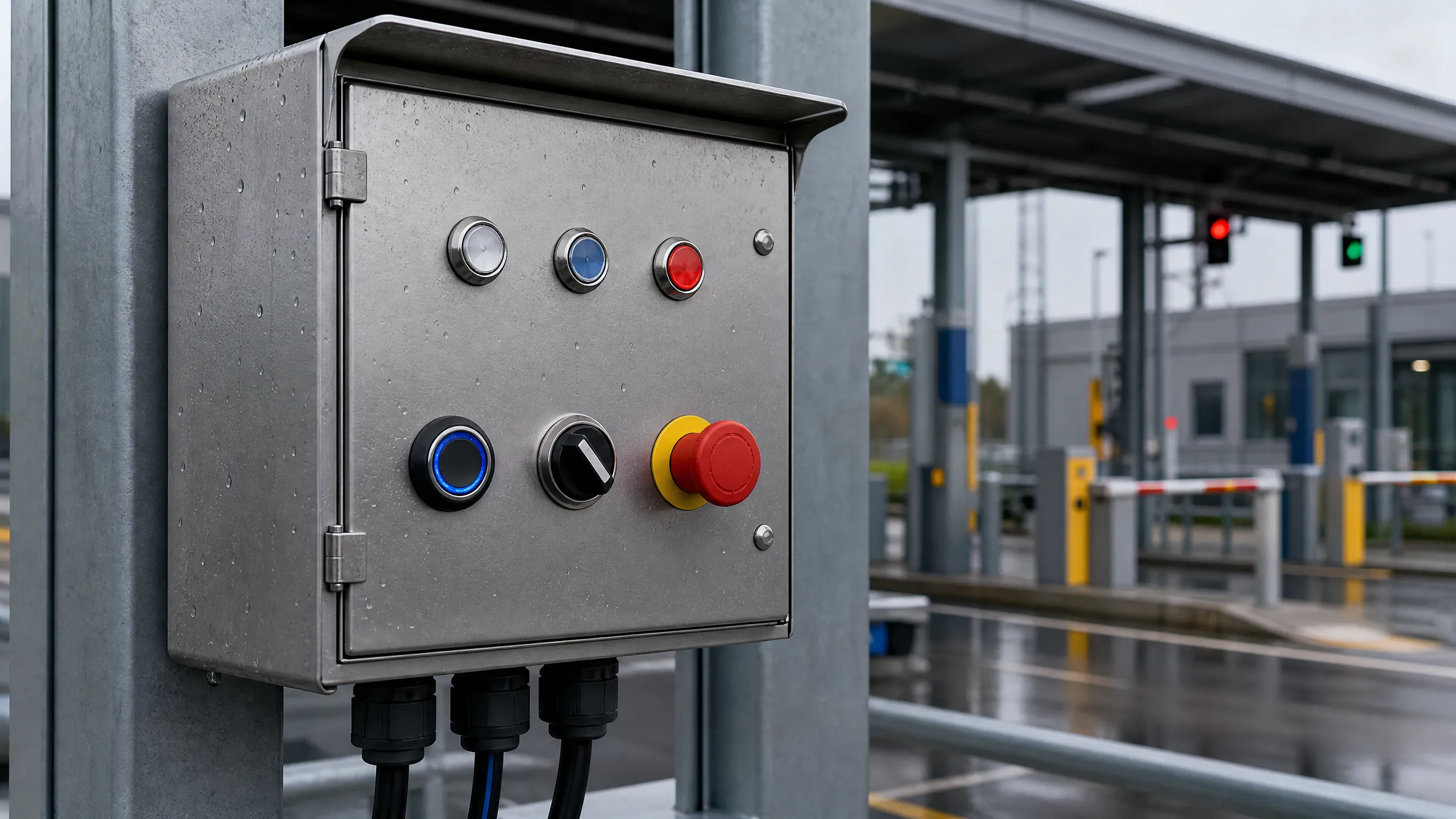
In this type of project, the buyer’s engineering team would typically confirm panel layout, mounting compatibility, electrical matching, environmental protection, wiring method, and field maintenance needs. For example, the momentary switch and indicator should use compatible LED voltages; the emergency stop button should match the required safety layout; the switch box should provide enough space for wiring and cable routing; and the selected components should maintain consistent appearance and mounting compatibility across repeated production batches.
This example shows why waterproof push button selection is often a system-level decision. The momentary switch may serve as the main control input, but its long-term reliability depends on how it works with indicators, emergency stops, selector switches, enclosures, wiring, and the overall control logic.
For manufacturers, supporting this type of project requires more than providing a standard catalog item. It requires understanding the panel layout, application environment, electrical design, operator behavior, and repeat-order requirements. For buyers, this approach can reduce compatibility risks and make the control panel easier to install, operate, and maintain over the equipment lifecycle.
OEM Options for Custom Waterproof Push Button Switch Projects
OEM customization should not be treated as “changing everything.” A practical OEM waterproof push button switch project usually starts by identifying which specifications are required by the application and which adjustments may affect tooling, cost, lead time, or production consistency.
For structure and installation, different equipment may require 8mm, 12mm, 16mm, 19mm, or 22mm mounting sizes. Compact control panels may use a mini waterproof push button, while larger industrial panels may benefit from a visible LED ring or larger actuator surface.
For electrical and wiring requirements, buyers may specify LED voltage, contact configuration, terminal type, wire length, or connector type. In OEM electrical assembly, pre-wired cable options can reduce field wiring and improve assembly efficiency. For access control systems, 12V or 24V LED indication is often used to match low-voltage circuits.
Appearance and identification may also be adjusted. LED color, button head shape, symbol marking, housing material, surface finishing, packaging, and labeling can help the component fit the final product design. For repeat orders, clear packaging labels and specification records help reduce warehouse confusion and assembly mistakes.
A manufacturer with experience in OEM waterproof push button switch projects can usually help buyers clarify which options are practical for sample approval and which changes may affect tooling, lead time, cost, or production consistency. This discussion is especially important when the project involves customized wire leads, special panel requirements, or long-term batch orders.
Quality Assurance Process for Industrial Waterproof Push Button Switches
Quality assurance should be explained through process, not slogans. For industrial waterproof push button switches, quality control usually begins before assembly and continues through final inspection.
Incoming material inspection may check housing dimensions, plating condition, sealing gasket size, spring elasticity, terminal condition, and LED component consistency. During assembly, in-process inspection focuses on contact position, button travel, reset status, LED polarity, terminal strength, and whether sealing parts are installed correctly.
After assembly, manufacturers may conduct electrical continuity testing, NO/NC logic testing, LED function testing, contact resistance testing, insulation resistance testing, operating force checks, and waterproof testing or sealing verification. For waterproof models, the test method should match the product design and customer requirements.
In practice, quality inspection usually focuses on several performance areas:
- Electrical reliability
Continuity, NO/NC logic, LED function, contact resistance, and insulation resistance help confirm that the switch performs correctly in the intended circuit. - Mechanical consistency
Button travel, operating force, reset feel, spring response, and actuator movement are checked to support consistent operation across production batches. - Sealing verification
Waterproof testing or sealing checks help evaluate whether the gasket, O-ring, actuator seal, and housing structure are assembled correctly. - Installation and visual quality
Thread condition, surface finish, terminal alignment, marking, accessories, packaging, and labeling are reviewed before shipment.
For OEM and repeat orders, these inspection points help reduce variation in installation fit, operating feel, electrical function, and sealing quality.
Note: Test conditions, sample size, and acceptance criteria may vary by switch model, IP rating, customer specification, and application environment. Buyers should confirm the required test information before mass production.
Management systems and certification background can also support supplier evaluation. For example, ISO9001, ISO14001, ISO45001, and relevant product certifications such as UL, VDE, CCC, CE LVD, or CE EMC may provide useful reference points. However, certifications should not replace project-specific validation, sample approval, or application testing.
How Buyers Can Evaluate a Waterproof Push Button Switch Manufacturer
Buyers often begin supplier evaluation by reviewing whether the manufacturer can provide clear technical documentation, including specification sheets, dimensional drawings, wiring information, and sample support. These materials help engineers determine whether a switch can fit a control panel, outdoor enclosure, or OEM electrical assembly.
Application understanding is equally important. A manufacturer familiar with industrial control panels, PLC input modules, HMI control interfaces, access control systems, and machine control systems can usually provide more practical guidance on IP rating, contact configuration, housing material, terminal style, and LED voltage.
Long-term cooperation also depends on production consistency. A sample may perform well, but repeat order consistency is what matters for OEM projects and bulk procurement. Buyers should pay attention to whether the supplier can maintain specification records, batch traceability, packaging consistency, and communication efficiency during specification changes.
In practice, a well-prepared inquiry usually includes mounting size, panel thickness, circuit voltage, contact type, IP requirement, terminal style, LED option, wire length, application environment, and estimated order quantity. The clearer the inquiry, the easier it is for the manufacturer to recommend a suitable waterproof push button switch or identify whether a custom option is needed.
Conclusion: From Component Selection to Long-Term Equipment Reliability
Wybieranie waterproof momentary push button switch is not only about price or appearance. For industrial control panels, automation equipment, outdoor systems, access control devices, and OEM projects, the key considerations include specification fit, installation reliability, contact stability, sealing structure, material selection, quality verification, and batch consistency.
A well-selected switch supports smoother installation, clearer operator interaction, and more stable control performance. For engineering and procurement teams, early specification discussion and sample approval can reduce redesign work before mass production.
Ten practical value of a waterproof push button switch becomes clearer when it is viewed as part of a complete control interface. In many real projects, it may work together with indicators, emergency stop buttons, warning lights, selector switches, or switch boxes. When these components are selected with the same operating environment, control logic, and installation requirements in mind, they can contribute to a more reliable and maintainable equipment design.
When the switch specification matches the application environment and production process, it becomes a small but important part of long-term equipment reliability.
FAQ About Waterproof Momentary Push Button Switches
1. What is a waterproof momentary push button switch?
A waterproof momentary push button switch is a sealed electrical switch that changes circuit status only while it is pressed and returns automatically after release. It is commonly used in industrial control panels, outdoor equipment, automation systems, access control systems, and OEM electrical assemblies.
2. What is the difference between momentary and latching push button switches?
A momentary switch resets after release, while a latching switch stays in its changed position until pressed again. Momentary switches are often used for start, reset, signal input, door release, and temporary control functions.
3. What does IP67 mean for a waterproof push button switch?
IP67 generally means the switch is dust-tight and protected against temporary immersion under defined test conditions. Actual performance also depends on installation method, gasket compression, cable sealing, and the application environment.
4. How do I choose a waterproof push button switch for a control panel?
Buyers should confirm mounting hole size, panel thickness, contact configuration, rated voltage, rated current, terminal type, IP rating, housing material, LED voltage, LED color, and wire length before sample approval.
5. Can waterproof push button switches be customized for OEM projects?
Yes. Common OEM options include mounting size, housing material, LED color, LED voltage, contact configuration, terminal type, wire length, connector type, symbol marking, packaging, and labeling.
6. Why is sample approval important before bulk orders?
Sample approval helps verify installation fit, wiring method, LED function, operating feel, sealing structure, and electrical performance before mass production. It also helps reduce specification changes during repeat orders.
Editorial Note
The technical information in this article is intended for general product selection and application reference. Actual switch performance may vary depending on model design, installation method, operating environment, wiring protection, and project-specific test requirements. Buyers should verify specifications and sample performance before mass production.
Bibliografia
- International Federation of Robotics. World Robotics 2024 Report: Industrial Robots. 2024. Official IFR press release:
https://ifr.org/ifr-press-releases/news/record-of-4-million-robots-working-in-factories-worldwide - International Electrotechnical Commission. IEC 60529: Degrees of Protection Provided by Enclosures — IP Code. Official IEC standard page:
https://webstore.iec.ch/publication/2452 - International Organization for Standardization. ISO 9001:2015 — Quality Management Systems — Requirements. Official ISO standard page:
https://www.iso.org/standard/62085.html - International Organization for Standardization. ISO 14001:2015 — Environmental Management Systems — Requirements with Guidance for Use. Official ISO standard page:
https://www.iso.org/standard/60857.html - International Organization for Standardization. ISO 45001:2018 — Occupational Health and Safety Management Systems — Requirements with Guidance for Use. Official ISO standard page:
https://www.iso.org/standard/63787.html - ONPOW Push Button Manufacture Co., Ltd. Product categories and company information. Official website:
https://onpowbutton.com/



