

A push button contact block is the rear switching module that converts operator movement into an electrical contact change. Select it by required contact state, number of circuits, operator compatibility, mounting system, voltage and load category, terminal method, switching frequency, environment, and failure behavior. “1NO” or “1NC” describes the normal mechanical state, not the complete machine function. The front operator, holder, contact block, enclosure, wiring, and control logic must be treated as one assembly and verified from the exact product documentation.
Regra de seleção: considere o dispositivo, o atuador, os contactos, o invólucro, a cablagem, a lógica de controlo, o utilizador e o movimento da máquina como um único sistema. Os exemplos de produtos ilustram apenas a forma; a adequação final deve resultar da documentação atual para o código de encomenda exato e da validação no equipamento acabado.
Como funciona o mecanismo
Pressing the operator transfers motion through a collar or holder to one or more modular contact blocks. Normally open contacts close after operation; normally closed contacts open. Momentary operators return when released, while maintained operators remain in their selected state until reset by their mechanism. Contact blocks may look interchangeable but differ in mounting keys, depth, travel, terminal layout, ratings, and direct-opening claims.
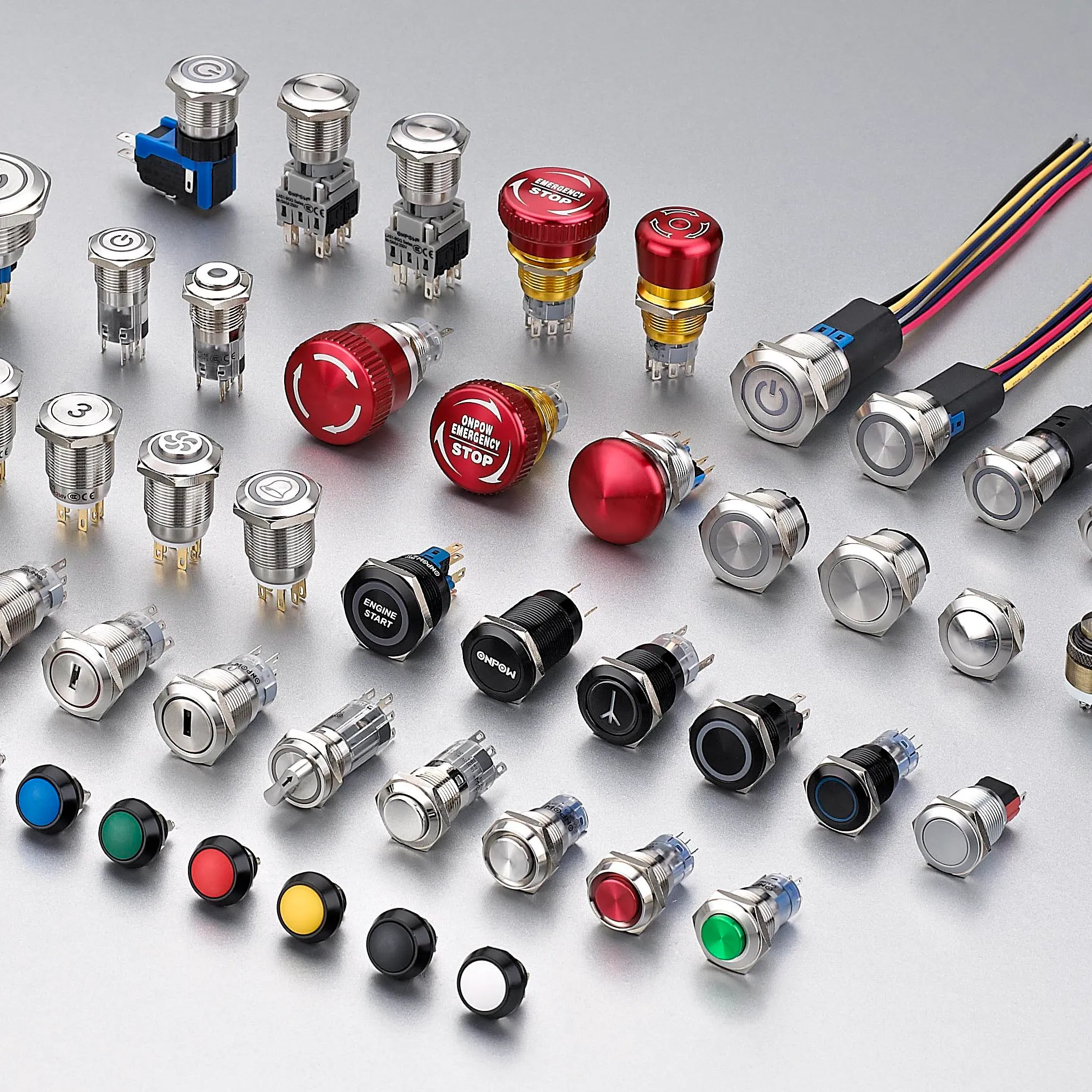
Critérios de seleção em relance
| Área de decisão | O que verificar | Razão de engenharia |
|---|---|---|
| Contact function | Define each NO and NC circuit from the required normal and operated states | Labels must match the machine state diagram. |
| Operator compatibility | Use the approved operator, holder, and block family | Similar dimensions do not prove mechanical compatibility. |
| Number and stacking | Check allowed block positions and rear depth | Extra blocks add space, force, and wiring complexity. |
| Electrical load | Verify voltage, current, AC/DC type, load category, inrush, and minimum load | Headline current alone is incomplete. |
| Terminal method | Choose screw, tab, clamp, solder, or connector for the wiring process | Termination affects inspection, torque, and serviceability. |
| Positive opening needs | Use only documented devices in a validated safety architecture | An NC marking alone does not establish safety behavior. |
| Ambiente | Protect rear blocks from dust, moisture, conductive debris, and chemicals | Front-panel sealing may not cover the rear assembly. |
| Maintenance | Provide identification, access, test points, and replacement control | A correct block can still be wired or replaced incorrectly. |
Esta tabela é propositadamente qualitativa. Os limites numéricos, classificações, binário, força, curso, declarações ambientais e valores de endurance devem ser obtidos na ficha técnica atual e avaliados sob as condições de aplicação.
Processo de seleção detalhado
Contact function
O que verificar: Define each NO and NC circuit from the required normal and operated states. Labels must match the machine state diagram. The requirement should be written in the project specification and traced to the exact model drawing or datasheet. Review worst-case tolerance, wear, contamination, maintenance access, and foreseeable misuse. If the available documentation does not define the boundary, keep the point open for supplier confirmation and sample testing rather than substituting an assumption.
Operator compatibility
O que verificar: Use the approved operator, holder, and block family. Similar dimensions do not prove mechanical compatibility. The requirement should be written in the project specification and traced to the exact model drawing or datasheet. Review worst-case tolerance, wear, contamination, maintenance access, and foreseeable misuse. If the available documentation does not define the boundary, keep the point open for supplier confirmation and sample testing rather than substituting an assumption.
Number and stacking
O que verificar: Check allowed block positions and rear depth. Extra blocks add space, force, and wiring complexity. The requirement should be written in the project specification and traced to the exact model drawing or datasheet. Review worst-case tolerance, wear, contamination, maintenance access, and foreseeable misuse. If the available documentation does not define the boundary, keep the point open for supplier confirmation and sample testing rather than substituting an assumption.
Electrical load
O que verificar: Verify voltage, current, AC/DC type, load category, inrush, and minimum load. Headline current alone is incomplete. The requirement should be written in the project specification and traced to the exact model drawing or datasheet. Review worst-case tolerance, wear, contamination, maintenance access, and foreseeable misuse. If the available documentation does not define the boundary, keep the point open for supplier confirmation and sample testing rather than substituting an assumption.
Terminal method
O que verificar: Choose screw, tab, clamp, solder, or connector for the wiring process. Termination affects inspection, torque, and serviceability. The requirement should be written in the project specification and traced to the exact model drawing or datasheet. Review worst-case tolerance, wear, contamination, maintenance access, and foreseeable misuse. If the available documentation does not define the boundary, keep the point open for supplier confirmation and sample testing rather than substituting an assumption.
Positive opening needs
O que verificar: Use only documented devices in a validated safety architecture. An NC marking alone does not establish safety behavior. The requirement should be written in the project specification and traced to the exact model drawing or datasheet. Review worst-case tolerance, wear, contamination, maintenance access, and foreseeable misuse. If the available documentation does not define the boundary, keep the point open for supplier confirmation and sample testing rather than substituting an assumption.
Ambiente
O que verificar: Protect rear blocks from dust, moisture, conductive debris, and chemicals. Front-panel sealing may not cover the rear assembly. The requirement should be written in the project specification and traced to the exact model drawing or datasheet. Review worst-case tolerance, wear, contamination, maintenance access, and foreseeable misuse. If the available documentation does not define the boundary, keep the point open for supplier confirmation and sample testing rather than substituting an assumption.
Maintenance
O que verificar: Provide identification, access, test points, and replacement control. A correct block can still be wired or replaced incorrectly. The requirement should be written in the project specification and traced to the exact model drawing or datasheet. Review worst-case tolerance, wear, contamination, maintenance access, and foreseeable misuse. If the available documentation does not define the boundary, keep the point open for supplier confirmation and sample testing rather than substituting an assumption.

Análise de candidatura
- Start and stop command stations. Record the expected command, response, release behavior, abnormal condition, and acceptance evidence for the assembled machine.
- Mode and reset controls. Record the expected command, response, release behavior, abnormal condition, and acceptance evidence for the assembled machine.
- Dual-circuit command arrangements. Record the expected command, response, release behavior, abnormal condition, and acceptance evidence for the assembled machine.
- Illuminated operators with separate lamp circuits. Record the expected command, response, release behavior, abnormal condition, and acceptance evidence for the assembled machine.
- Maintenance-friendly modular panels. Record the expected command, response, release behavior, abnormal condition, and acceptance evidence for the assembled machine.
Para cada aplicação, inclua o arranque, o funcionamento normal, a paragem, a perda de energia, o restabelecimento de energia, o modo de manutenção, a substituição de componentes e as falhas identificadas pela avaliação de risco. Um interruptor de controlo geral não deve ser tratado como uma função de segurança completa.
Lista de verificação de comissionamento
- Congele o requisito. Indique a ação pretendida, a condição normal, a alimentação, a carga, o movimento, o ambiente e o utilizador.
- Corresponda ao código de encomenda. Compare a peça entregue com o desenho aprovado, o diagrama de contactos, o atuador, o estilo de terminais e os acessórios.
- Inspecionar a instalação. Verifique o alinhamento, os elementos de fixação, a folga traseira, o encaminhamento de cabos, o alívio de tensão, a proteção de partes sob tensão e o acesso para manutenção.
- Testar todos os estados. Verificar o funcionamento e a libertação nos limites das tolerâncias, velocidades previstas, cargas, luvas, contaminação e condições ambientais.
- Testar condições anómalas. Incluir condutores desligados, mecanismos bloqueados ou danificados, perda de energia, contaminação e outras falhas plausíveis.
- Registe o resultado. Guardar o modelo, a revisão, o método de ensaio, as observações, os critérios de aceitação, a data e o aprovador.
Erros comuns
- Confusing normal state with desired machine state. Prevent this by assigning the check to a drawing, datasheet, wiring record, or commissioning test with a named acceptance criterion.
- Mixing contact blocks from another product family. Prevent this by assigning the check to a drawing, datasheet, wiring record, or commissioning test with a named acceptance criterion.
- Ignoring rear-panel clearance. Prevent this by assigning the check to a drawing, datasheet, wiring record, or commissioning test with a named acceptance criterion.
- Switching an unsuitable high-inrush load directly. Prevent this by assigning the check to a drawing, datasheet, wiring record, or commissioning test with a named acceptance criterion.
- Assuming front IP protection covers the terminals. Prevent this by assigning the check to a drawing, datasheet, wiring record, or commissioning test with a named acceptance criterion.
O que incluir num Pedido de Cotação (RFQ)
Provide the application, target market, applicable standards, machine function, supply and load, control interface, contact logic, mechanical drawing, motion path, panel dimensions, cable method, environment, operating frequency, quantity, documentation needs, and sample-validation plan. Ask the supplier to identify assumptions and exceptions. ONPOW offers relevant products in its application-specific product family and the broader industrial control product range.
Guias relacionados com a ONPOW
Referências fidedignas
- dispositivos para circuitos de controlo IEC 60947-5-1
- IEC 60529 degrees of protection provided by enclosures
- OSHA machine guarding requirements
- Requisitos de segurança elétrica da OSHA
Vídeo educativo
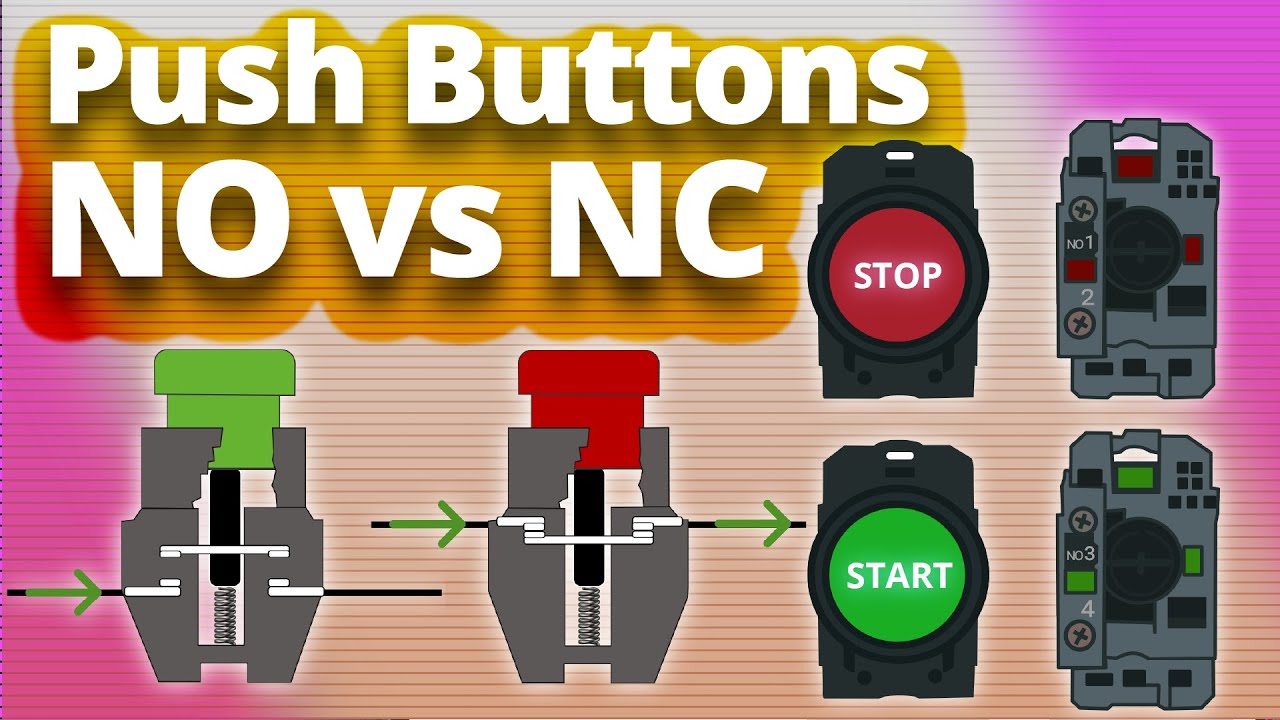
Push Buttons Explained: NO vs NC Types, Symbols, and Wiring Diagrams by Automatedo provides general background. Project decisions still require the applicable standards and product documentation.
Perguntas frequentes
What does 1NO mean?
One normally open contact circuit is open in the defined normal mechanical state and closes when operated.
Can NO and NC blocks be stacked?
Only within the operator family rules, allowed positions, force, depth, and ratings stated by the manufacturer.
Is an NC block suitable for emergency stop?
Not by marking alone. The complete emergency-stop device and safety architecture require documented behavior and validation.
How should terminals be checked?
Follow the stated termination method and torque, inspect conductor preparation and strain relief, and function-test every circuit.
Final decision
Approve the component only when the documented mechanical, electrical, environmental, usability, installation, and maintenance boundaries all fit the assembled system. Resolve unknowns through current manufacturer information and testing before production release.



