

A waterproof emergency stop button should be selected by its documented protection scope and the actual environment of the installed assembly. A front-panel IP rating does not automatically protect rear contacts, cable entries or the complete enclosure, and it does not establish outdoor suitability. Rain, cleaning chemicals, condensation, ultraviolet exposure and freezing introduce different questions. Start by confirming the required emergency stop behavior and exact component configuration, then evaluate sealing and environmental limits. This guide helps prepare that specification without treating a water-resistance label as proof of a complete safe machine installation.
Separate the safety function from environmental protection
The emergency stop function and environmental sealing are different requirements. A well-sealed ordinary pushbutton is not automatically suitable for an emergency stop application. Conversely, a correctly specified emergency operator can still be unsuitable for a particular cleaning regime or exposed installation. The purchasing record should evaluate both requirements instead of collapsing them into the word waterproof.
The HSE guidance on safe use of work equipment provides UK work-equipment context, including emergency controls. It does not approve an individual button or establish the protection of a finished panel. The HSE machinery safety introduction places emergency controls within wider risk reduction measures. Use those references to organize questions, then obtain the component documents and machine design review needed for the actual installation.
Specify the required operator action, contact configuration and relevant component characteristics independently of the sealing requirement. Confirm how operation is retained and released, how the controller evaluates the input and how restart is controlled. Product appearance and an emergency-related catalogue heading cannot answer all those questions. Where a page description is ambiguous, retain the uncertainty and ask for the controlled documentation for the exact ordering code.
Read the IP rating as a defined scope
The IEC 60529 publication page identifies the standard for degrees of protection provided by enclosures. An IP statement belongs to a defined product and test scope. Check what is rated, under which assembly conditions and with which required accessories. A front-panel statement should not be expanded into a claim that the exposed rear terminals withstand the same environment.
Ask whether the rating applies to the operator installed in a specified panel, to the complete switch assembly or to a supplied enclosure. Determine the required mounting surface, seals and installation instructions. If the published page only states front-panel protection, keep that limitation in the procurement record until further evidence is supplied. Do not create a whole-enclosure claim from the front label.
The two digits and any additional designations should be interpreted using the relevant documentation. Avoid a simple “higher number is always better” ranking. Different exposure tests and application conditions need to be checked rather than assumed equivalent. A selected component must match the actual requirement, not merely have the largest-looking catalogue designation.
Describe exposure before choosing a product
“Outside” and “washdown” are broad descriptions. An operator under a sheltered canopy may experience a different combination of water, sunlight and temperature from one on an exposed mobile machine. A cleaning process may use a directed jet, chemical solution or elevated temperature. Write down the real conditions instead of letting the supplier infer them from a short marketing term.
Record where water can reach the assembly: the front face, the panel joint, the rear compartment, cable entries and enclosure seams. Include the direction and frequency of exposure where known. Note whether water can accumulate around the operator or collect behind the panel. This review often reveals that the enclosure arrangement needs attention as well as the individual button.
Treat cleaning chemistry as its own compatibility question. A water-ingress designation does not establish resistance to every detergent, disinfectant, oil or solvent. Obtain material compatibility information for the actual substances and cleaning instructions. Do not create a concentration or cleaning-temperature limit when the manufacturer has not provided one. Unknown compatibility is a request for evidence, not a value to estimate.
Evaluate the panel joint and rear compartment
The installed seal depends on the assembly described by the manufacturer. Panel thickness, surface condition, hole quality and the required mounting parts can affect the joint. Follow the exact instructions for the selected operator; do not transfer a tightening value or washer arrangement from a visually similar switch. Excess force is not a reliable way to compensate for an unknown seal requirement.
Look at the rear compartment as a separate protection boundary. Exposed terminals should be housed and connected according to the selected equipment’s instructions and the machine design. A front-rated operator does not protect an open-backed panel from water entering elsewhere. Cable entries and other penetrations also need to be appropriate to the enclosure arrangement. Every opening matters to the completed assembly.
Consider maintenance access. If technicians repeatedly open the enclosure, identify how they will inspect and restore the sealing arrangement. A damaged seal, missing part or poorly closed door can undermine the intended protection. Use a documented inspection and reassembly procedure. Do not assume that installing a rated component once makes environmental protection permanent regardless of subsequent changes.
Check outdoor conditions beyond water ingress
Outdoor suitability includes questions that an IP statement alone does not answer. Review ultraviolet exposure, corrosion, operating temperature, freezing, mechanical impact and condensation. Obtain evidence for the exact component rather than treating general family descriptions as universal. A product may have a temperature range accompanied by conditions that matter in a freezing or humid location.
Condensation can occur within an enclosure even when direct water entry is controlled. The enclosure design may require a suitable environmental management approach selected for the application. Do not improvise drain holes or ventilation changes on a safety-related panel without reviewing their consequences. Those changes can alter protection boundaries and expose other equipment.
Impact protection is another distinct property. Where an IK designation is published, keep it separate from the IP designation and check the scope of the statement. A robust metal head does not guarantee resistance to every impact or abusive operating condition. The installed location and accessibility must also support emergency operation when required, rather than concealing the button behind environmental protection that obstructs use.
Use a practical specification table
The following qualitative table turns broad environment descriptions into questions a supplier and machine designer can answer. It deliberately does not assign universal ratings or numeric limits. Use the actual exposure record and exact documentation to make the final selection.
| Requirement | Question to resolve | Evidence or action |
|---|---|---|
| Front water exposure | What reaches the head and panel joint? | Documented front protection and installation conditions |
| Rear protection | Can moisture reach contacts through another opening? | Enclosure, cable entry and terminal protection review |
| Cleaning | Which methods, substances and temperatures are used? | Manufacturer cleaning and material compatibility information |
| Outdoor exposure | Are UV, corrosion, freezing and temperature covered? | Application-specific environmental confirmation |
| Mounting | Which panel dimensions, seal parts and instructions apply? | Exact operator installation drawing |
| Safety function | Does the supplied action and contact arrangement meet the design? | Controlled component documents and machine validation |
| Maintenance | How will sealing and operation be inspected after service? | Documented inspection and reassembly procedure |
Handle product-page claims with care
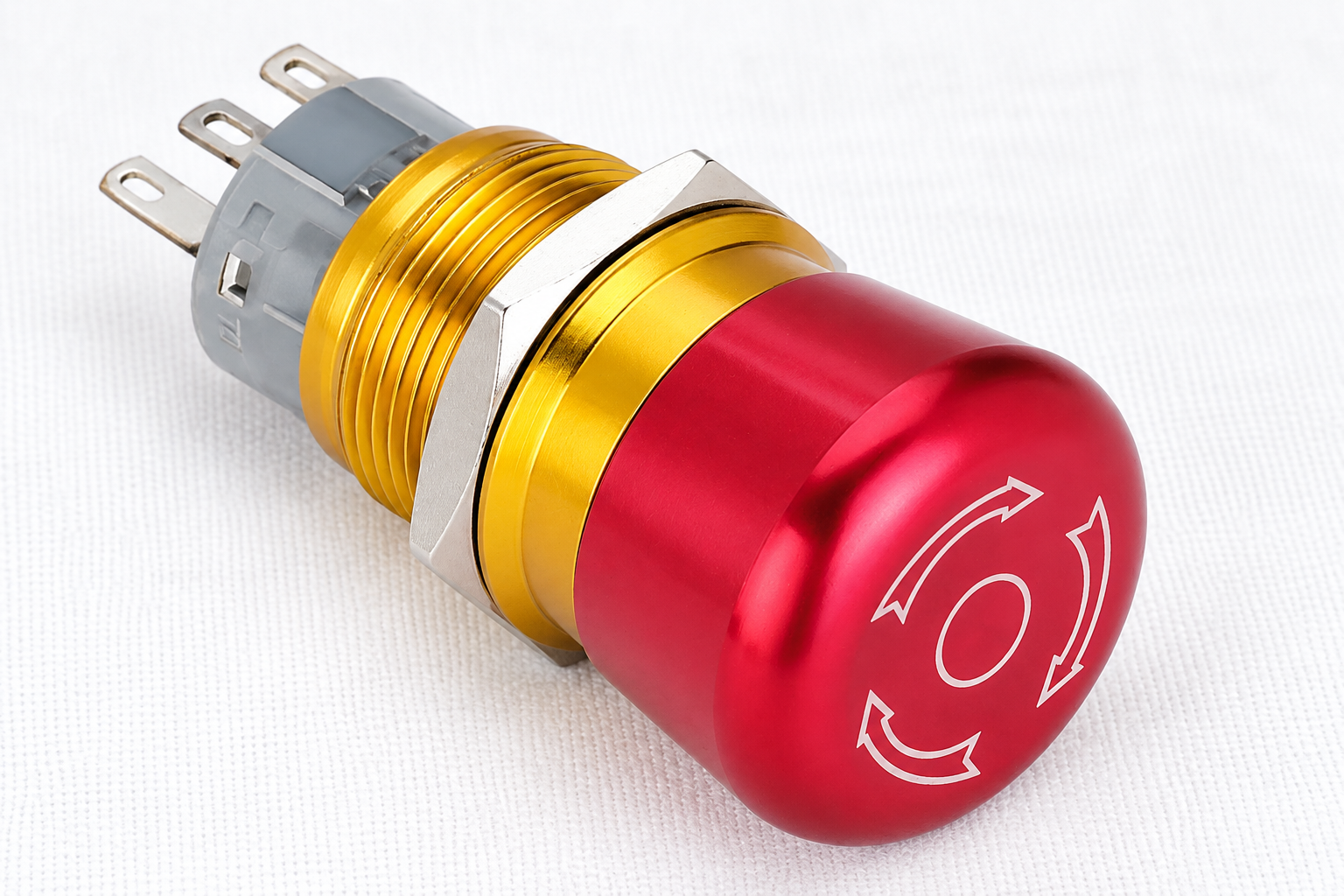
The ONPOW LAS1-AGQ-TSB product page publishes front-panel protection information and describes an optional customized protection level. An option described as customizable should not be presented as the standard supplied configuration. Ask for the exact quoted code and the documents covering that option before including it in a machine specification.
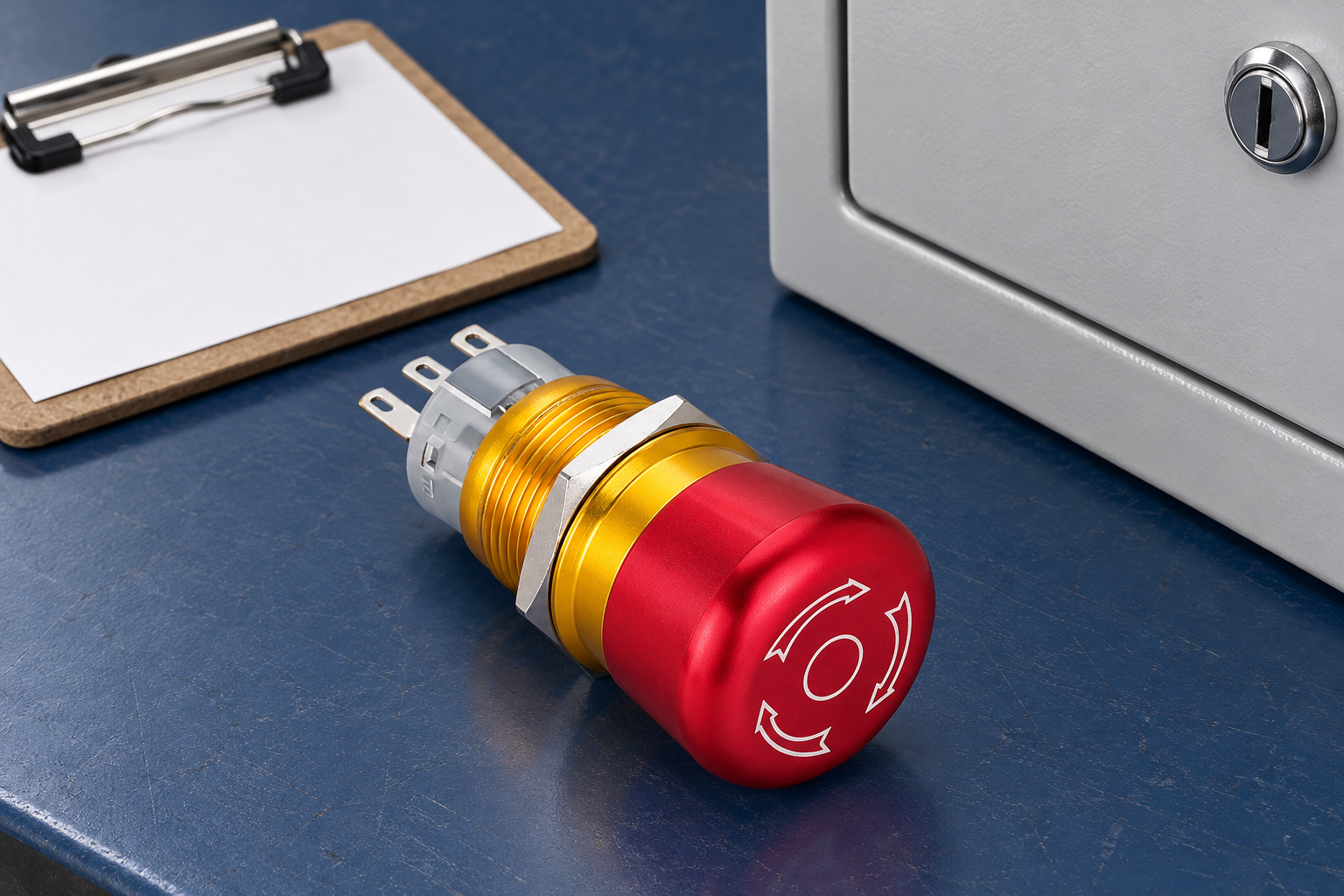
The page also includes a stated contact action that needs to be reconciled with the required emergency stop behavior. Do not assume that a mushroom head and emergency-related product grouping establish a retained stop function. The reference-based images in this article illustrate the physical product and inspection context. They do not certify an installed safety function, an outdoor rating or compatibility with a cleaning process.
Request clarification of any conflicting or incomplete description before ordering. Keep the original page information, supplier response and approved specification together so that procurement can see which configuration was actually confirmed. This is especially useful when a family includes several head styles, contact arrangements and optional seals. The final purchase order should identify the supplied configuration, not just the marketing category.
Inspect without inventing a water test
A receiving inspection can verify the ordering code, supplied parts, visible condition and documents against the order. Check for missing seal components, damage, incorrect contact assemblies and discrepancies in the labels. Record those observations before installation. Do not interpret a dry visual inspection as proof that an IP test has been passed.
After installation, competent personnel should follow the approved environmental and functional verification procedures. A random hose test can be unsafe and may not represent the manufacturer’s rated test conditions. Use the specified acceptance criteria rather than creating a dramatic demonstration for a photograph. Functional validation must also verify the intended stop, reset and restart behavior of the complete machine.
Maintenance records should distinguish environmental damage from control-system faults. Moisture, corrosion or mechanical damage may require component replacement and investigation of the enclosure boundary, while a reset problem may involve a different part of the circuit. Use the separate emergency stop troubleshooting guide to organize observations. Read the emergency stop selection and cover guide for related protection-scope questions and the emergency stop versus emergency switching-off article for functional terminology.
Prepare the enquiry and the review records
Send the exposure description, panel details, required operator behavior, contact needs, controller interface and documentation request to the supplier. Clearly mark requirements that need confirmation. Avoid asking for a generic outdoor waterproof button when the real environment includes chemicals, freezing or vulnerable rear contacts. Contact ONPOW with that information before approving a final configuration.
The educational video below examines why a series emergency stop circuit failed. It provides context for keeping the physical button, contact arrangement and the complete safety function distinct. It does not verify sealing, authorize a particular emergency stop circuit or substitute for the exact equipment instructions.
Frequently asked questions
Does a front-panel IP rating protect the rear contacts?
Not automatically. Confirm the published rating scope and protect the rear compartment, terminals and cable entries through the complete enclosure design.
Is waterproof the same as suitable for outdoor use?
No. Outdoor selection also requires reviewing temperature, freezing, sunlight, corrosion, condensation and other application conditions beyond water ingress.
Can I assume a customized rating is standard?
No. Confirm the exact quoted configuration and documentation. An available customization is not proof that every supplied unit includes it.
Does a red mushroom head prove the required emergency behavior?
No. Verify the exact operator action, contact characteristics and complete machine design. Appearance and product category alone are insufficient.
Should receiving inspection include spraying water on the button?
Use the approved inspection and verification procedures. An improvised spray test may be unsafe, outside the stated test conditions and unable to establish the claimed protection.



