

A heavy-duty panel toggle switch is selected by documented mechanical and electrical duty, not by lever size or marketing language. Review load category, inrush, DC interruption, operating cycles, sealing, impact, vibration, terminals, panel construction and the consequences of failure in the complete machine. This guide explains a safe identification and verification process for engineers, panel builders, maintenance teams and buyers. It does not replace the current datasheet, machine risk assessment or locally applicable electrical requirements. The method keeps each decision traceable during purchasing, assembly, commissioning and later service.
Schnelle Entscheidung
Beginnen Sie mit der Funktion, nicht mit der Polzahl. Schreiben Sie die erforderlichen stabilen und tastenden Zustände auf, identifizieren Sie jeden Kontakt- und Lampenkreis und gleichen Sie dann die dokumentierte Nennleistung mit der tatsächlichen Last ab. Halten Sie die Stromversorgung während der Identifizierung getrennt. Testen Sie nach der Installation sowohl den elektrischen Zustand als auch die Maschinenreaktion. Wenn die Anwendung gefährliche Bewegungen steuert, verwenden Sie die erforderliche Sicherheitsarchitektur, anstatt einen Allzweckschalter als vollständige Sicherheitsfunktion zu behandeln.
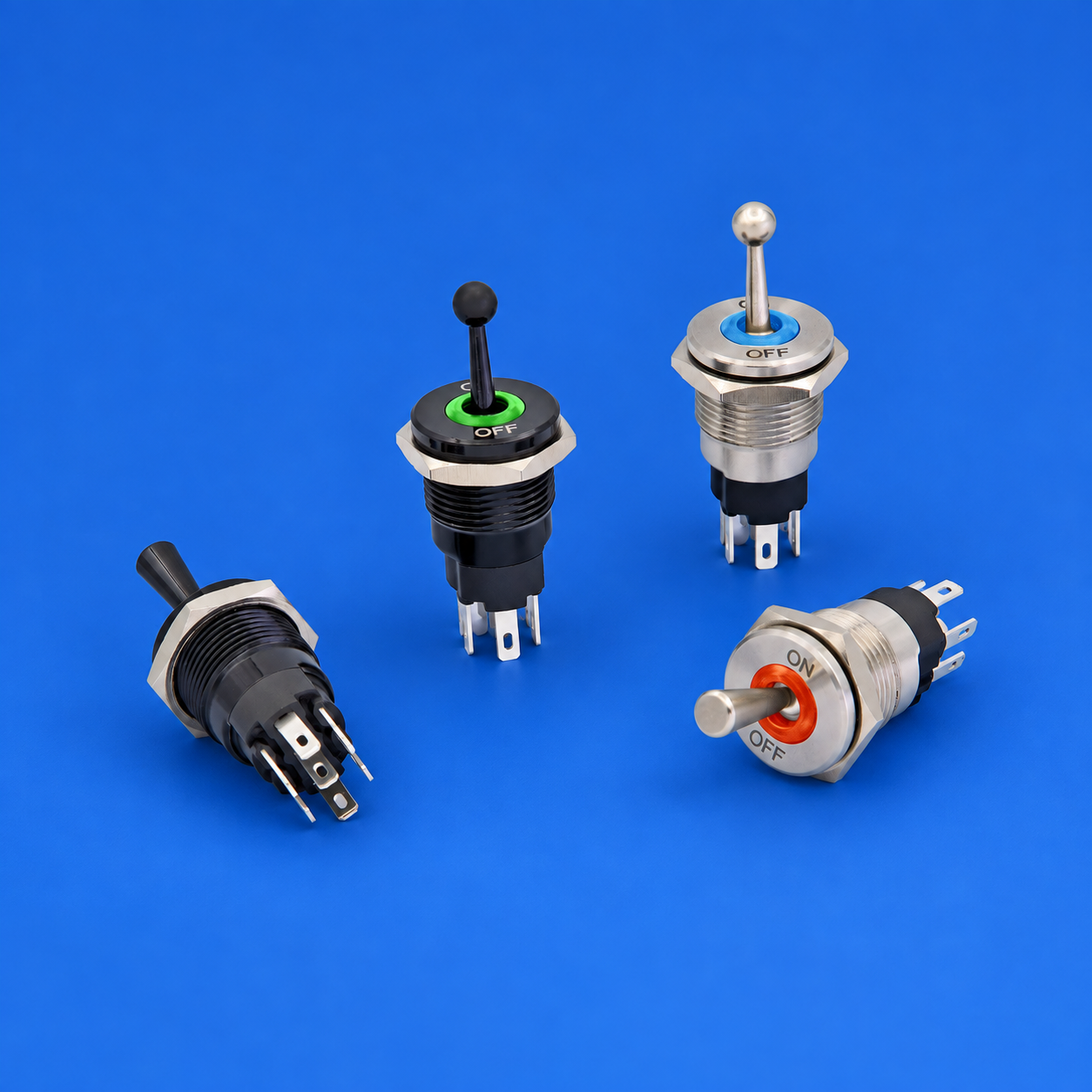
Auswahl- und Verdrahtungskriterien
| Entscheidung | Was zu überprüfen ist | technischer Grund |
|---|---|---|
| Electrical duty | Match voltage, current, frequency and load category | A large ampere number may apply only to a particular resistive AC test. |
| Inrush | Obtain startup current for lamps, motors, capacitors and power supplies | Short peaks can weld or erode contacts. |
| DC switching | Use an explicit DC rating for the system voltage | DC arcs do not cross zero naturally like AC arcs. |
| Mechanical duty | Compare operating frequency, force and endurance test conditions | A robust lever does not prove contact endurance. |
| Panel retention | Check thread engagement, nut, anti-rotation and vibration | Loose mounting changes operation and damages conductors. |
| Environmental duty | Verify ingress, temperature, shock, corrosion and chemicals | Heavy duty is not a standardized replacement for these limits. |
| Terminations | Size conductors and connection method for the actual circuit | Terminal heating and strain can limit the installed assembly. |
| Failure strategy | Use a relay, contactor or redundant architecture where consequences require it | Component rating and system safety are different decisions. |
Diese Tabelle ist absichtlich qualitativ gehalten. Numerische Bewertungen, Drehmomente, Leitergrößen, Isolationsabstände, Lebensdauer- und Umweltgrenzwerte müssen den genehmigten Dokumenten für das genaue Gerät und der vollständigen Gerätetechnik entnommen werden. Ähnlich aussehende Schalter können unterschiedliche interne Anschlüsse verwenden.
Verstehen Sie die Kontaktlogik vor dem Verdrahten
Pol beschreibt, wie viele unabhängige gemeinsame Kontaktwege zusammenarbeiten. Schaltstellung (Throw) beschreibt, wie viele feste Kontakte jeder gemeinsame Kontakt anwählen kann. Diese Begriffe geben weder die Anzahl der Hebelstellungen an, noch ob eine Stellung rastend oder tastend ist, ob Kontakte beim Umschalten überlappen oder wie eine Kontrolllampe angeschlossen ist. Diese Details erfordern eine Kontakttabelle für jede einzelne Stellung.
Zeichnen Sie eine Matrix mit Klemmen oben und Aktorpositionen an der Seite. Markieren Sie nur Verbindungen, die durch die aktuelle Zeichnung oder durch isolierte Messungen unterstützt werden. Fügen Sie eine klare Blickrichtung wie “Ansicht der hinteren Klemmen bei nach oben gerichtetem Aktor” hinzu. Diese einfache Aufzeichnung verhindert, dass gespiegelte Diagramme, gedrehte Bauteile und Kabelsatz-Kammernummern bei der Montage oder späteren Wartung verwechselt werden.
Electrical duty
Was zu überprüfen ist: Match voltage, current, frequency and load category. A large ampere number may apply only to a particular resistive AC test. The engineering record should name the exact order code, drawing revision, supply, load and operating state used for the decision. Check the component in its installed orientation because panel thickness, wire routing, adjacent hardware and actuator access can change the result.
Wie man es überprüft: Vergleichen Sie das aktuelle Hersteller-Kontaktdiagramm mit einer isolierten Durchgangsprüfung. Protokollieren Sie den gemessenen Zustand vor der Betätigung, in jeder rastenden Position und nach dem Loslassen aus jeder tastenden Position. Wenn Dokumentation und Messung nicht übereinstimmen, stoppen Sie und klären Sie die Abweichung, bevor Sie die Spannung einschalten. Leiten Sie niemals eine Klemmenfunktion von der Pin-Position, der Metallfarbe oder einem Diagramm für einen ähnlich aussehenden Schalter ab.
Inrush
Was zu überprüfen ist: Obtain startup current for lamps, motors, capacitors and power supplies. Short peaks can weld or erode contacts. The engineering record should name the exact order code, drawing revision, supply, load and operating state used for the decision. Check the component in its installed orientation because panel thickness, wire routing, adjacent hardware and actuator access can change the result.
Wie man es überprüft: Vergleichen Sie das aktuelle Hersteller-Kontaktdiagramm mit einer isolierten Durchgangsprüfung. Protokollieren Sie den gemessenen Zustand vor der Betätigung, in jeder rastenden Position und nach dem Loslassen aus jeder tastenden Position. Wenn Dokumentation und Messung nicht übereinstimmen, stoppen Sie und klären Sie die Abweichung, bevor Sie die Spannung einschalten. Leiten Sie niemals eine Klemmenfunktion von der Pin-Position, der Metallfarbe oder einem Diagramm für einen ähnlich aussehenden Schalter ab.
DC switching
Was zu überprüfen ist: Use an explicit DC rating for the system voltage. DC arcs do not cross zero naturally like AC arcs. The engineering record should name the exact order code, drawing revision, supply, load and operating state used for the decision. Check the component in its installed orientation because panel thickness, wire routing, adjacent hardware and actuator access can change the result.
Wie man es überprüft: Vergleichen Sie das aktuelle Hersteller-Kontaktdiagramm mit einer isolierten Durchgangsprüfung. Protokollieren Sie den gemessenen Zustand vor der Betätigung, in jeder rastenden Position und nach dem Loslassen aus jeder tastenden Position. Wenn Dokumentation und Messung nicht übereinstimmen, stoppen Sie und klären Sie die Abweichung, bevor Sie die Spannung einschalten. Leiten Sie niemals eine Klemmenfunktion von der Pin-Position, der Metallfarbe oder einem Diagramm für einen ähnlich aussehenden Schalter ab.
Mechanical duty
Was zu überprüfen ist: Compare operating frequency, force and endurance test conditions. A robust lever does not prove contact endurance. The engineering record should name the exact order code, drawing revision, supply, load and operating state used for the decision. Check the component in its installed orientation because panel thickness, wire routing, adjacent hardware and actuator access can change the result.
Wie man es überprüft: Vergleichen Sie das aktuelle Hersteller-Kontaktdiagramm mit einer isolierten Durchgangsprüfung. Protokollieren Sie den gemessenen Zustand vor der Betätigung, in jeder rastenden Position und nach dem Loslassen aus jeder tastenden Position. Wenn Dokumentation und Messung nicht übereinstimmen, stoppen Sie und klären Sie die Abweichung, bevor Sie die Spannung einschalten. Leiten Sie niemals eine Klemmenfunktion von der Pin-Position, der Metallfarbe oder einem Diagramm für einen ähnlich aussehenden Schalter ab.
Panel retention
Was zu überprüfen ist: Check thread engagement, nut, anti-rotation and vibration. Loose mounting changes operation and damages conductors. The engineering record should name the exact order code, drawing revision, supply, load and operating state used for the decision. Check the component in its installed orientation because panel thickness, wire routing, adjacent hardware and actuator access can change the result.
Wie man es überprüft: Vergleichen Sie das aktuelle Hersteller-Kontaktdiagramm mit einer isolierten Durchgangsprüfung. Protokollieren Sie den gemessenen Zustand vor der Betätigung, in jeder rastenden Position und nach dem Loslassen aus jeder tastenden Position. Wenn Dokumentation und Messung nicht übereinstimmen, stoppen Sie und klären Sie die Abweichung, bevor Sie die Spannung einschalten. Leiten Sie niemals eine Klemmenfunktion von der Pin-Position, der Metallfarbe oder einem Diagramm für einen ähnlich aussehenden Schalter ab.
Environmental duty
Was zu überprüfen ist: Verify ingress, temperature, shock, corrosion and chemicals. Heavy duty is not a standardized replacement for these limits. The engineering record should name the exact order code, drawing revision, supply, load and operating state used for the decision. Check the component in its installed orientation because panel thickness, wire routing, adjacent hardware and actuator access can change the result.
Wie man es überprüft: Vergleichen Sie das aktuelle Hersteller-Kontaktdiagramm mit einer isolierten Durchgangsprüfung. Protokollieren Sie den gemessenen Zustand vor der Betätigung, in jeder rastenden Position und nach dem Loslassen aus jeder tastenden Position. Wenn Dokumentation und Messung nicht übereinstimmen, stoppen Sie und klären Sie die Abweichung, bevor Sie die Spannung einschalten. Leiten Sie niemals eine Klemmenfunktion von der Pin-Position, der Metallfarbe oder einem Diagramm für einen ähnlich aussehenden Schalter ab.
Terminations
Was zu überprüfen ist: Size conductors and connection method for the actual circuit. Terminal heating and strain can limit the installed assembly. The engineering record should name the exact order code, drawing revision, supply, load and operating state used for the decision. Check the component in its installed orientation because panel thickness, wire routing, adjacent hardware and actuator access can change the result.
Wie man es überprüft: Vergleichen Sie das aktuelle Hersteller-Kontaktdiagramm mit einer isolierten Durchgangsprüfung. Protokollieren Sie den gemessenen Zustand vor der Betätigung, in jeder rastenden Position und nach dem Loslassen aus jeder tastenden Position. Wenn Dokumentation und Messung nicht übereinstimmen, stoppen Sie und klären Sie die Abweichung, bevor Sie die Spannung einschalten. Leiten Sie niemals eine Klemmenfunktion von der Pin-Position, der Metallfarbe oder einem Diagramm für einen ähnlich aussehenden Schalter ab.
Failure strategy
Was zu überprüfen ist: Use a relay, contactor or redundant architecture where consequences require it. Component rating and system safety are different decisions. The engineering record should name the exact order code, drawing revision, supply, load and operating state used for the decision. Check the component in its installed orientation because panel thickness, wire routing, adjacent hardware and actuator access can change the result.
Wie man es überprüft: Vergleichen Sie das aktuelle Hersteller-Kontaktdiagramm mit einer isolierten Durchgangsprüfung. Protokollieren Sie den gemessenen Zustand vor der Betätigung, in jeder rastenden Position und nach dem Loslassen aus jeder tastenden Position. Wenn Dokumentation und Messung nicht übereinstimmen, stoppen Sie und klären Sie die Abweichung, bevor Sie die Spannung einschalten. Leiten Sie niemals eine Klemmenfunktion von der Pin-Position, der Metallfarbe oder einem Diagramm für einen ähnlich aussehenden Schalter ab.
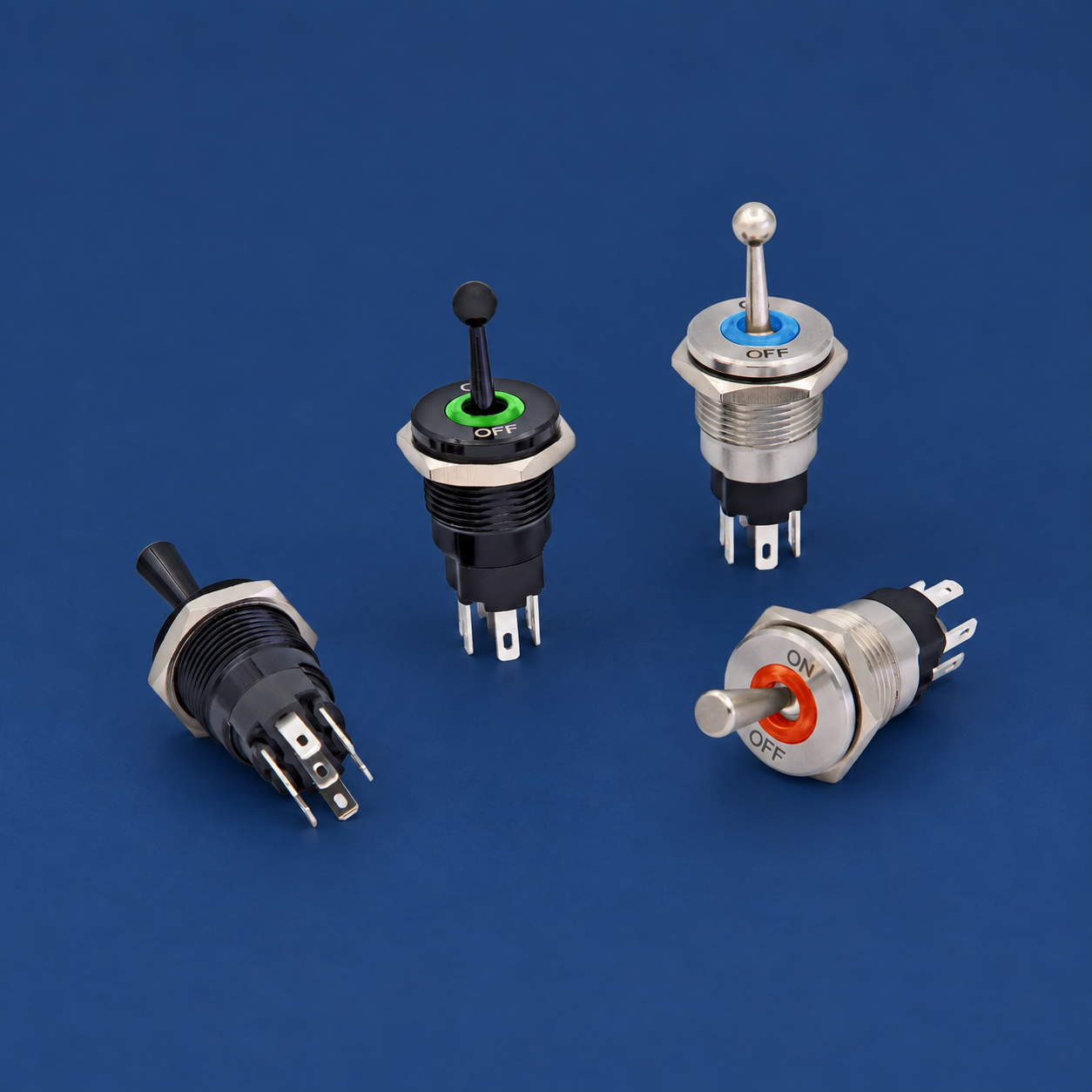
Sichere Identifizierung und Inbetriebnahmereihenfolge
- Definiere die Funktion. Geben Sie an, was jede Aktuatorposition ansteuern soll, was beim Loslassen passiert und wie der Normalzustand nach einem Stromausfall sein muss.
- Confirm identity. Photograph the marking and record the complete order code. Retrieve the matching current drawing rather than a family brochure.
- Isolate energy. Follow the site procedure for disconnecting and controlling hazardous energy. Prove the circuit is de-energized with appropriate equipment before touching conductors.
- Separate the component. Disconnect enough conductors to prevent parallel circuit paths from corrupting continuity measurements. Label every removed conductor.
- Map contacts. Test all terminal pairs in all positions. Repeat the sequence to detect intermittent behavior and note any spring-return action.
- Identify lamps separately. Use the published lamp diagram and voltage. Do not apply an unknown test voltage to an LED or electronic module.
- Review the load. Check normal current, inrush, AC or DC, inductive energy, switching frequency, protection and the consequence of a contact failing open or closed.
- Install mechanically. Confirm cutout, panel thickness, anti-rotation, fasteners, sealing, rear clearance, conductor support and accessible labels.
- Perform an unpowered check. Verify point-to-point wiring and insulation before energizing. Make sure unused terminals cannot contact adjacent conductive parts.
- Commission under control. Energize according to the equipment procedure, test each command and indication, then test loss and restoration of power and the credible faults identified by the risk assessment.
Load and protection boundaries
Contact ratings are conditional. A resistive laboratory load does not represent every motor, solenoid, lamp, heater, electronic power supply or capacitive input. DC interruption can sustain an arc differently from AC. Inductive loads release stored energy when opened, and cold lamps or capacitors may draw high inrush. Obtain the load data and apply only a rating that explicitly covers the intended conditions.
The switch is also not the branch-circuit protective device. Conductor size, fuse or breaker selection, short-circuit capability, grounding, insulation and enclosure protection belong to the wider equipment design. Where the operator should carry only a low-energy command, use a properly selected relay, contactor or controller input and verify the interface. Suppression components must suit the supply, load and failure behavior.
Common mistakes
- Electrical duty: A large ampere number may apply only to a particular resistive AC test. Prevent this by completing the related verification step—match voltage, current, frequency and load category—and retaining the evidence with the machine documentation.
- Inrush: Short peaks can weld or erode contacts. Prevent this by completing the related verification step—obtain startup current for lamps, motors, capacitors and power supplies—and retaining the evidence with the machine documentation.
- DC switching: DC arcs do not cross zero naturally like AC arcs. Prevent this by completing the related verification step—use an explicit dc rating for the system voltage—and retaining the evidence with the machine documentation.
- Mechanical duty: A robust lever does not prove contact endurance. Prevent this by completing the related verification step—compare operating frequency, force and endurance test conditions—and retaining the evidence with the machine documentation.
- Panel retention: Loose mounting changes operation and damages conductors. Prevent this by completing the related verification step—check thread engagement, nut, anti-rotation and vibration—and retaining the evidence with the machine documentation.
- Environmental duty: Heavy duty is not a standardized replacement for these limits. Prevent this by completing the related verification step—verify ingress, temperature, shock, corrosion and chemicals—and retaining the evidence with the machine documentation.
What to include in an RFQ
Provide the contact form, actuator positions, maintained or momentary action, center state, lamp function and voltage, supply, load category, normal and inrush current, switching frequency, panel cutout, panel thickness, rear-space limit, terminal preference, environment, ingress requirement, temperature range, vibration, required documentation, quantity and target market. Ask the supplier to return the exact contact table and dimensional drawing for the proposed order code.
Use the ONPOW industrial control product range to identify candidate families. Final selection must be based on the exact model documentation and validation in the completed assembly. For an unusual harness or control sequence, provide a terminal-view sketch and ask the supplier to mark any assumptions before samples are ordered.
Related ONPOW guides
- Toggle switch position basics
- Toggle switch and push button comparison
- Normally open and normally closed contacts
Authoritative references
- IEC 60947-5-1 control-circuit devices
- IEC 60204-1 electrical equipment of machines
- OSHA electrical safety requirements
Educational video
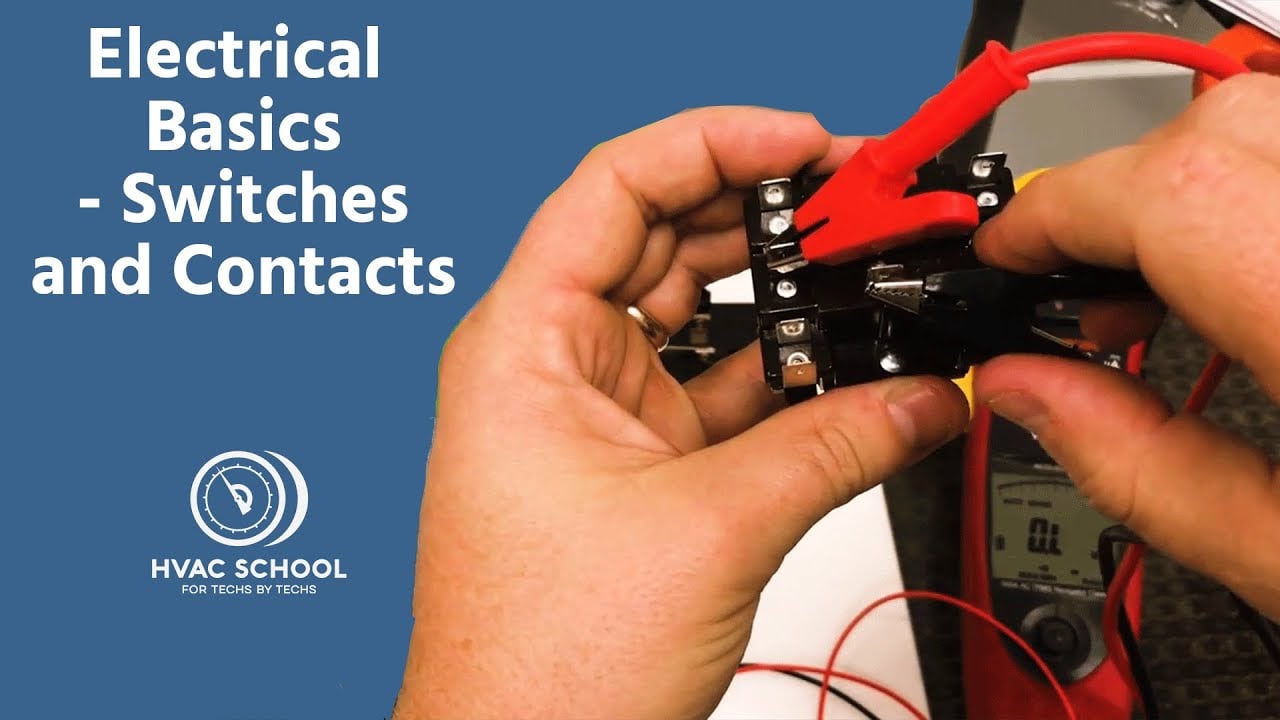
Electrical Basics – Switches and Contacts by HVAC School provides general background. The exact switch and equipment still require their own documentation and validation.
Frequently asked questions
Können die Anschlusspositionen auf einem Foto dieses Kippschalters identifiziert werden?
Nein. Ein Foto kann zwar die Verpackung und die Anzahl der Anschlüsse zeigen, aber es kann nicht zuverlässig die interne Kontaktanordnung, die Blickrichtung, den Lampenkreis oder die Nennleistung feststellen. Verwenden Sie die exakte Modellzeichnung und einen isolierten Test.
Gilt der aufgedruckte Amperewert für jede Last?
Nein. Der zulässige Wert hängt von der Spannung, AC oder DC, der Lastkategorie, dem Einschaltstrom, der Schalthäufigkeit, der Temperatur und den Hersteller-Testbedingungen ab. Wählen Sie aus den für die jeweilige Anwendung angegebenen Nennwerten aus.
Kann ein Durchgangsprüfer verwendet werden, um Kontakte zu identifizieren?
Ja, wenn alle Quellen isoliert und gespeicherte Energie entladen ist. Prüfen Sie jede Position, berücksichtigen Sie, dass Lampenstromkreise Widerstandswerte erzeugen können, und vergleichen Sie die Matrix mit der Dokumentation des Herstellers.
Soll der Schalter einen Motor- oder Magnetspulenstrom direkt schalten?
Nur wenn die genaue Last und Einschaltdauer innerhalb der dokumentierten Nennwerte liegen. Bei höherem Einschaltstrom, häufigem Betrieb oder sicherheitskritischen Maschinen ist ein entsprechend ausgewähltes Relais oder Schütz oft die bessere Schnittstelle.
Welche Informationen gehören in das endgültige Verdrahtungsprotokoll?
Erfassen Sie den Bestellcode, die Ansichtsrichtung der Klemmen, die Kontaktmatrix, die Leiterkennzeichnungen, die Schutzeinrichtung, die Einspeisung, die Last, die Beschriftungen, die Prüfergebnisse, die Dokumentenrevisionen und das Genehmigungsdatum.
Final verification rule
Approve the installation only when the exact device identity, contact matrix, lamp behavior, mechanical fit, environmental boundary, load rating, protective measures, labels and test results all agree. Resolve every discrepancy before energizing production equipment. Keep the final record with the machine so a later replacement is checked against evidence rather than appearance.



