

A guarded push button switch uses a raised ring, shroud, cover, recess, or other physical feature to reduce unintended operation. The guard must address a documented hazard or nuisance scenario without making the intended command difficult, invisible, hard to clean, or slow to reach. Guarding is especially sensitive around emergency functions: a normal command guard must not be copied onto an emergency-stop control unless the applicable requirements and risk assessment support the exact design. Evaluate the operator, guard, panel, user, gloves, approach direction, and environment as one interface.
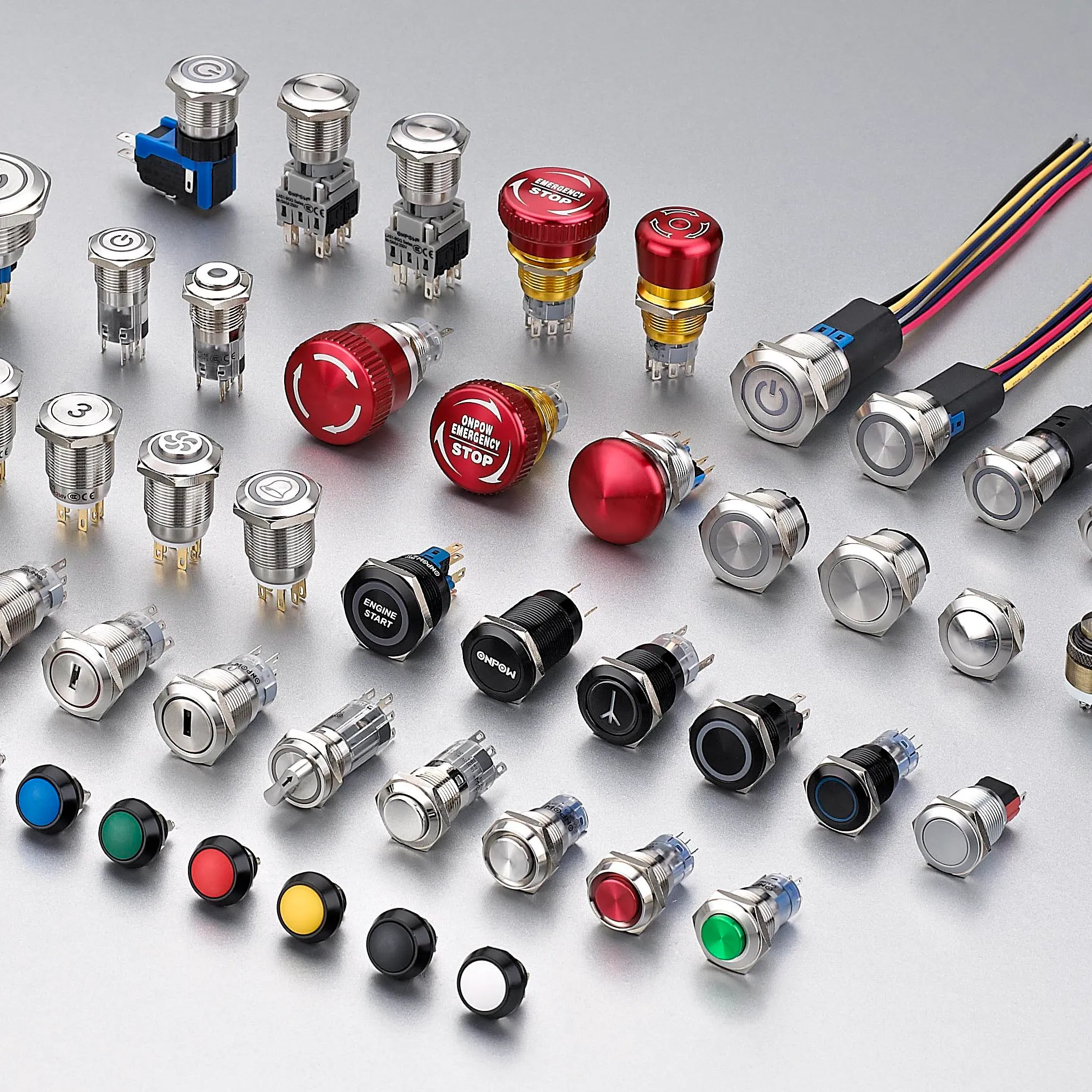
Regla de selección: trate el dispositivo, el actuador, los contactos, la carcasa, el cableado, la lógica de control, el usuario y el movimiento de la máquina como un solo sistema. Los ejemplos de productos ilustran únicamente la forma; la idoneidad final debe provenir de la documentación actual para el código de pedido exacto y de la validación en el equipo terminado.
Cómo funciona el mecanismo
The guard changes the physical access path to the operator. It may block broad contact from tools, clothing, moving material, or a person leaning against the panel while still permitting a deliberate finger action. A hinged cover adds another action and can collect contamination. A fixed shroud can reduce side access. A recessed mounting changes reach. These differences should be tested with real users and foreseeable accidental contacts.
Criterios de selección de un vistazo
| Área de decisión | Qué verificar | Razón de ingeniería |
|---|---|---|
| Unintended contact | Identify the actual object, direction, force, and frequency | The guard geometry must address a real scenario. |
| Intentional access | Test finger size, gloves, reach, posture, and required speed | Protection that prevents proper use creates a new problem. |
| Visibility | Keep the operator state and legend readable | Users must identify the command before acting. |
| Guard form | Compare fixed shroud, raised ring, hinged cover, or recess | Each changes access and cleaning differently. |
| Emergency boundary | Separate ordinary command protection from emergency-stop requirements | Emergency access and function need dedicated validation. |
| Medio ambiente | Check debris traps, washdown, corrosion, and impact | A guard can collect contamination around the operator. |
| Montaje | Verify cutout, guard retention, panel thickness, and rear clearance | Loose or rotating accessories defeat the design. |
| Human validation | Test expected users and foreseeable misuse | A drawing cannot prove usability by itself. |
Esta tabla es intencionalmente cualitativa. Los límites numéricos, clasificaciones, par, fuerza, recorrido, declaraciones ambientales y valores de resistencia deben tomarse de la hoja de datos actual y evaluarse bajo las condiciones de la aplicación.
Proceso de selección detallado
Unintended contact
Qué verificar: Identify the actual object, direction, force, and frequency. The guard geometry must address a real scenario. The requirement should be written in the project specification and traced to the exact model drawing or datasheet. Review worst-case tolerance, wear, contamination, maintenance access, and foreseeable misuse. If the available documentation does not define the boundary, keep the point open for supplier confirmation and sample testing rather than substituting an assumption.
Intentional access
Qué verificar: Test finger size, gloves, reach, posture, and required speed. Protection that prevents proper use creates a new problem. The requirement should be written in the project specification and traced to the exact model drawing or datasheet. Review worst-case tolerance, wear, contamination, maintenance access, and foreseeable misuse. If the available documentation does not define the boundary, keep the point open for supplier confirmation and sample testing rather than substituting an assumption.
Visibility
Qué verificar: Keep the operator state and legend readable. Users must identify the command before acting. The requirement should be written in the project specification and traced to the exact model drawing or datasheet. Review worst-case tolerance, wear, contamination, maintenance access, and foreseeable misuse. If the available documentation does not define the boundary, keep the point open for supplier confirmation and sample testing rather than substituting an assumption.
Guard form
Qué verificar: Compare fixed shroud, raised ring, hinged cover, or recess. Each changes access and cleaning differently. The requirement should be written in the project specification and traced to the exact model drawing or datasheet. Review worst-case tolerance, wear, contamination, maintenance access, and foreseeable misuse. If the available documentation does not define the boundary, keep the point open for supplier confirmation and sample testing rather than substituting an assumption.
Emergency boundary
Qué verificar: Separate ordinary command protection from emergency-stop requirements. Emergency access and function need dedicated validation. The requirement should be written in the project specification and traced to the exact model drawing or datasheet. Review worst-case tolerance, wear, contamination, maintenance access, and foreseeable misuse. If the available documentation does not define the boundary, keep the point open for supplier confirmation and sample testing rather than substituting an assumption.
Medio ambiente
Qué verificar: Check debris traps, washdown, corrosion, and impact. A guard can collect contamination around the operator. The requirement should be written in the project specification and traced to the exact model drawing or datasheet. Review worst-case tolerance, wear, contamination, maintenance access, and foreseeable misuse. If the available documentation does not define the boundary, keep the point open for supplier confirmation and sample testing rather than substituting an assumption.
Montaje
Qué verificar: Verify cutout, guard retention, panel thickness, and rear clearance. Loose or rotating accessories defeat the design. The requirement should be written in the project specification and traced to the exact model drawing or datasheet. Review worst-case tolerance, wear, contamination, maintenance access, and foreseeable misuse. If the available documentation does not define the boundary, keep the point open for supplier confirmation and sample testing rather than substituting an assumption.
Human validation
Qué verificar: Test expected users and foreseeable misuse. A drawing cannot prove usability by itself. The requirement should be written in the project specification and traced to the exact model drawing or datasheet. Review worst-case tolerance, wear, contamination, maintenance access, and foreseeable misuse. If the available documentation does not define the boundary, keep the point open for supplier confirmation and sample testing rather than substituting an assumption.

Revisión de la solicitud
- Preventing hip or shoulder contact on crowded panels. Record the expected command, response, release behavior, abnormal condition, and acceptance evidence for the assembled machine.
- Protecting a reset button near material flow. Record the expected command, response, release behavior, abnormal condition, and acceptance evidence for the assembled machine.
- Reducing tool contact during maintenance. Record the expected command, response, release behavior, abnormal condition, and acceptance evidence for the assembled machine.
- Shielding an exposed command on mobile equipment. Record the expected command, response, release behavior, abnormal condition, and acceptance evidence for the assembled machine.
- Recessing a non-emergency control in a public interface. Record the expected command, response, release behavior, abnormal condition, and acceptance evidence for the assembled machine.
Para cada aplicación, incluya el inicio, la operación normal, el apagado, la pérdida de energía, la restauración de energía, el modo de mantenimiento, el reemplazo de componentes y las fallas identificadas por la evaluación de riesgos. Un interruptor de control general no debe tratarse como una función de seguridad completa.
Lista de verificación de puesta en marcha
- Congelar el requisito. Indique la acción prevista, condición normal, alimentación, carga, movimiento, entorno y usuario.
- Coincidir con el código de pedido. Compare la pieza entregada con el dibujo aprobado, el esquema de contactos, el actuador, el tipo de terminal y los accesorios.
- Inspeccionar la instalación. Verificar alineación, elementos de sujeción, holgura trasera, recorrido de cables, alivio de tensión, protección de partes activas y acceso para mantenimiento.
- Prueba cada estado. Verificar el funcionamiento y la liberación en los extremos de tolerancia, velocidades previstas, cargas, guantes, contaminación y condiciones ambientales.
- Probar condiciones anormales. Incluya conductores desconectados, mecanismos bloqueados o dañados, pérdida de energía, contaminación y otras fallas creíbles.
- Registrar el resultado. Guardar modelo, revisión, método de prueba, observaciones, criterios de aceptación, fecha y aprobador.
Errores comunes
- Adding a cover without testing gloved access. Evite esto asignando la comprobación a un plano, hoja de datos, registro de cableado o prueba de puesta en marcha con un criterio de aceptación nombrado.
- Obscuring the legend or illumination. Evite esto asignando la comprobación a un plano, hoja de datos, registro de cableado o prueba de puesta en marcha con un criterio de aceptación nombrado.
- Creating a pocket that traps liquid or debris. Evite esto asignando la comprobación a un plano, hoja de datos, registro de cableado o prueba de puesta en marcha con un criterio de aceptación nombrado.
- Using a normal guard on an emergency stop by analogy. Evite esto asignando la comprobación a un plano, hoja de datos, registro de cableado o prueba de puesta en marcha con un criterio de aceptación nombrado.
- Failing to identify the accidental-contact direction. Evite esto asignando la comprobación a un plano, hoja de datos, registro de cableado o prueba de puesta en marcha con un criterio de aceptación nombrado.
Qué incluir en una solicitud de cotización (RFQ)
Proporcione la aplicación, el mercado objetivo, las normas aplicables, la función de la máquina, la alimentación y la carga, la interfaz de control, la lógica de contactos, el dibujo mecánico, la trayectoria de movimiento, las dimensiones del panel, el método de cableado, el entorno, la frecuencia de operación, la cantidad, las necesidades de documentación y el plan de validación de muestras. Pida al proveedor que identifique las suposiciones y excepciones. ONPOW ofrece productos relevantes en su familia de productos específica de la aplicación y lo más amplio gama de productos de control industrial.
Guías relacionadas de ONPOW
- Cómo funciona un microinterruptor
- Microinterruptor vs interruptor de límite
- Vida mecánica vs. vida eléctrica
Referencias autorizadas
- aparatos para circuitos de control IEC 60947-5-1
- IEC 60529 grados de protección proporcionados por las envolventes
- Requisitos de protección de maquinaria de OSHA
- Requisitos de seguridad eléctrica de OSHA
Video educativo

Machine Guarding Safety Meeting Video by Weeklysafety provides general background. Project decisions still require the applicable standards and product documentation.
Preguntas frecuentes
What does a push button guard do?
It changes the access path so broad or unintended contact is less likely to operate the button.
Is a hinged cover always safer?
No. It adds an action and may delay use, trap debris, or remain open; test the actual risk and workflow.
Can an emergency stop be guarded?
Only when the exact arrangement complies with applicable requirements and the risk assessment; do not assume an ordinary shroud is acceptable.
How should a guard be tested?
Use real users, gloves, lighting, cleaning conditions, intended actions, and credible accidental-contact scenarios.
Decisión final
Apruebe el componente únicamente cuando los límites documentados de mecánica, electricidad, medio ambiente, usabilidad, instalación y mantenimiento se ajusten al sistema ensamblado. Resuelva las incógnitas mediante información actual del fabricante y pruebas antes de la liberación para producción.



