

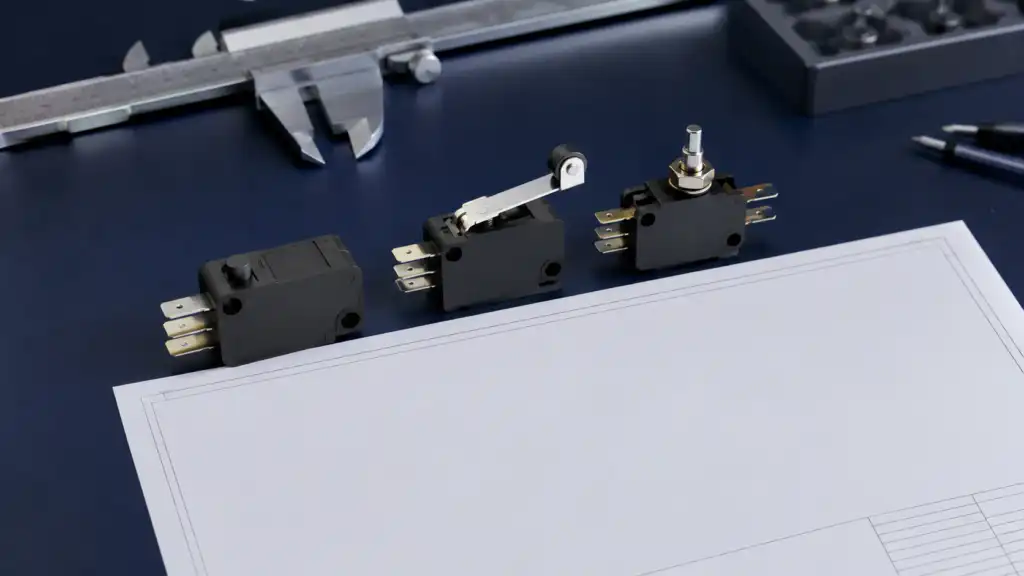
Industrial micro switch selection requires separate mechanical, electrical, environmental, and installation checks. Begin carefully with the machine movement: direction, speed, available force, operating point, overtravel, and reset margin. Then define the real electrical load, including AC or DC operation, inrush, minimum current, switching frequency, and control input behavior. Finally, check package size, terminals, sealing, temperature, vibration, mounting, documentation, and maintenance access. A familiar body shape or headline current rating is not enough to prove that a switch fits the application.
Règle de sélection : traitez l'appareil, l'actionneur, les contacts, le boîtier, le câblage, la logique de commande, l'utilisateur et le mouvement de la machine comme un seul système. Les exemples de produits n'illustrent que la forme ; l'aptitude finale doit provenir de la documentation actuelle pour le code de commande exact et de la validation dans l'équipement fini.
Comment fonctionne le mécanisme
Most industrial micro switches use a snap-action mechanism that transfers slowly applied actuator force into a rapid contact change. This helps repeatability and reduces the time contacts spend between states. The external actuator and internal mechanism form one mechanical chain. Contact material and geometry form a separate electrical boundary. Both boundaries must be satisfied at the same time, and the complete machine must be tested under realistic tolerances.

Critères de sélection en un coup d'œil
| Zone de décision | Que vérifier | Raison technique |
|---|---|---|
| Actuator | Match plunger, lever, or roller to the target motion | Geometry determines force, reach, speed, and wear. |
| Operating force | Confirm the available force at worst-case alignment | Insufficient force causes missed operation; excessive force damages parts. |
| Travel | Check pretravel, operating point, overtravel, and release travel | The target must operate and reset reliably without bottoming out. |
| Contact form | Map COM, NO, and NC to the required state logic | Terminal position must come from the exact diagram. |
| Charger | Define voltage, current, AC/DC type, inrush, and minimum load | A resistive rating cannot be applied blindly to another load. |
| Frequency and life | Estimate realistic operations and switching duty | Mechanical and electrical life are different limits. |
| Environnement | Check dust, moisture, oil, temperature, shock, and vibration | The installation may require a sealed assembly or enclosure. |
| Mounting and terminals | Verify holes, torque, clearances, terminal style, and strain relief | Integration errors can dominate switch performance. |
Ce tableau est intentionnellement qualitatif. Les limites numériques, les valeurs nominales, le couple, la force, la course, les déclarations environnementales et les valeurs d'endurance doivent être tirés de la fiche technique actuelle et évalués dans les conditions de l'application.
Processus de sélection détaillé
Actuator
À vérifier : Match plunger, lever, or roller to the target motion. Geometry determines force, reach, speed, and wear. The requirement should be written in the project specification and traced to the exact model drawing or datasheet. Review worst-case tolerance, wear, contamination, maintenance access, and foreseeable misuse. If the available documentation does not define the boundary, keep the point open for supplier confirmation and sample testing rather than substituting an assumption.
Operating force
À vérifier : Confirm the available force at worst-case alignment. Insufficient force causes missed operation; excessive force damages parts. The requirement should be written in the project specification and traced to the exact model drawing or datasheet. Review worst-case tolerance, wear, contamination, maintenance access, and foreseeable misuse. If the available documentation does not define the boundary, keep the point open for supplier confirmation and sample testing rather than substituting an assumption.
Travel
À vérifier : Check pretravel, operating point, overtravel, and release travel. The target must operate and reset reliably without bottoming out. The requirement should be written in the project specification and traced to the exact model drawing or datasheet. Review worst-case tolerance, wear, contamination, maintenance access, and foreseeable misuse. If the available documentation does not define the boundary, keep the point open for supplier confirmation and sample testing rather than substituting an assumption.
Contact form
À vérifier : Map COM, NO, and NC to the required state logic. Terminal position must come from the exact diagram. The requirement should be written in the project specification and traced to the exact model drawing or datasheet. Review worst-case tolerance, wear, contamination, maintenance access, and foreseeable misuse. If the available documentation does not define the boundary, keep the point open for supplier confirmation and sample testing rather than substituting an assumption.
Charger
À vérifier : Define voltage, current, AC/DC type, inrush, and minimum load. A resistive rating cannot be applied blindly to another load. The requirement should be written in the project specification and traced to the exact model drawing or datasheet. Review worst-case tolerance, wear, contamination, maintenance access, and foreseeable misuse. If the available documentation does not define the boundary, keep the point open for supplier confirmation and sample testing rather than substituting an assumption.
Frequency and life
À vérifier : Estimate realistic operations and switching duty. Mechanical and electrical life are different limits. The requirement should be written in the project specification and traced to the exact model drawing or datasheet. Review worst-case tolerance, wear, contamination, maintenance access, and foreseeable misuse. If the available documentation does not define the boundary, keep the point open for supplier confirmation and sample testing rather than substituting an assumption.
Environnement
À vérifier : Check dust, moisture, oil, temperature, shock, and vibration. The installation may require a sealed assembly or enclosure. The requirement should be written in the project specification and traced to the exact model drawing or datasheet. Review worst-case tolerance, wear, contamination, maintenance access, and foreseeable misuse. If the available documentation does not define the boundary, keep the point open for supplier confirmation and sample testing rather than substituting an assumption.
Mounting and terminals
À vérifier : Verify holes, torque, clearances, terminal style, and strain relief. Integration errors can dominate switch performance. The requirement should be written in the project specification and traced to the exact model drawing or datasheet. Review worst-case tolerance, wear, contamination, maintenance access, and foreseeable misuse. If the available documentation does not define the boundary, keep the point open for supplier confirmation and sample testing rather than substituting an assumption.

Examen de la demande
- Compact position detection. Record the expected command, response, release behavior, abnormal condition, and acceptance evidence for the assembled machine.
- Presence sensing inside equipment. Record the expected command, response, release behavior, abnormal condition, and acceptance evidence for the assembled machine.
- Cam sequencing. Record the expected command, response, release behavior, abnormal condition, and acceptance evidence for the assembled machine.
- Door-position feedback after risk assessment. Record the expected command, response, release behavior, abnormal condition, and acceptance evidence for the assembled machine.
- Counting and indexing with controlled motion. Record the expected command, response, release behavior, abnormal condition, and acceptance evidence for the assembled machine.
Pour chaque application, inclure le démarrage, le fonctionnement normal, l'arrêt, la perte de courant, le rétablissement du courant, le mode de maintenance, le remplacement de composants et les défauts identifiés par l'évaluation des risques. Un interrupteur de commande général ne doit pas être considéré comme une fonction de sécurité complète.
Liste de contrôle de mise en service
- Geler le besoin. Indiquer l'action prévue, la condition normale, l'alimentation, la charge, le mouvement, l'environnement et l'utilisateur.
- Faites correspondre le code de commande. Comparez la pièce livrée avec le dessin approuvé, le schéma de contacts, l'actionneur, le style de borne et les accessoires.
- Inspecter l'installation. Vérifier l'alignement, les éléments de fixation, le dégagement arrière, le cheminement des câbles, le soulagement de traction, la protection des pièces sous tension et l'accès pour l'entretien.
- Tester chaque état. Vérifier le fonctionnement et le déclenchement aux extrêmes de tolérance, aux vitesses prévues, aux charges, avec des gants, en présence de contamination et dans diverses conditions environnementales.
- Tester les conditions anormales. Inclure les conducteurs débranchés, les mécanismes bloqués ou endommagés, la perte d'alimentation, la contamination et autres défauts crédibles.
- Enregistrez le résultat. Enregistrer le modèle, la révision, la méthode d'essai, les observations, les critères d'acceptation, la date et l'approbateur.
Erreurs courantes
- Selecting by dimensions alone. Prévenez cela en affectant la vérification à un dessin, une fiche technique, un schéma de câblage ou un essai de mise en service avec un critère d'acceptation nommé.
- Using the audible click as electrical proof. Prévenez cela en affectant la vérification à un dessin, une fiche technique, un schéma de câblage ou un essai de mise en service avec un critère d'acceptation nommé.
- Applying a resistive rating to an inductive load. Prévenez cela en affectant la vérification à un dessin, une fiche technique, un schéma de câblage ou un essai de mise en service avec un critère d'acceptation nommé.
- Letting the target use the switch as a stop. Prévenez cela en affectant la vérification à un dessin, une fiche technique, un schéma de câblage ou un essai de mise en service avec un critère d'acceptation nommé.
- Assuming all three-terminal pinouts match. Prévenez cela en affectant la vérification à un dessin, une fiche technique, un schéma de câblage ou un essai de mise en service avec un critère d'acceptation nommé.
Que faut-il inclure dans une demande de prix
Fournissez l'application, le marché cible, les normes applicables, la fonction de la machine, l'alimentation et la charge, l'interface de commande, la logique de contact, le dessin mécanique, la trajectoire de mouvement, les dimensions du panneau, la méthode de câblage, l'environnement, la fréquence de fonctionnement, la quantité, les besoins en documentation et le plan de validation des échantillons. Demandez au fournisseur d'identifier les hypothèses et les exceptions. ONPOW propose des produits pertinents dans sa famille de produits spécifique à une application et le plus large gamme de produits de contrôle industriel.
Guides ONPOW associés
- Comment fonctionne un micro-interrupteur
- Micro-interrupteur vs fin de course
- Vie mécanique contre vie électrique
Références autorisées
- appareils de circuit de commande CEI 60947-5-1
- CEI 60529 degrés de protection procurés par les enveloppes
- Exigences d'OSHA concernant la protection des machines
- Exigences de sécurité électrique de l'OSHA
Vidéo éducative
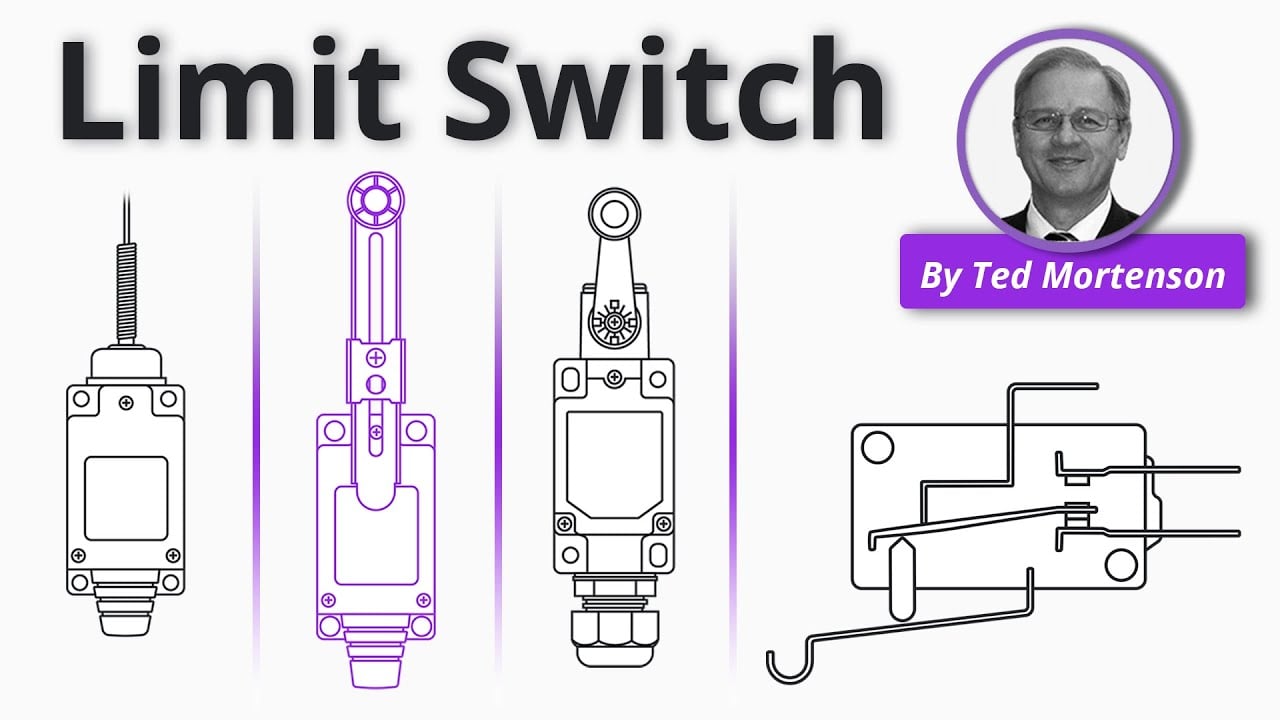
Limit Switch Explained par RealPars fournit un contexte général. Les décisions de projet nécessitent toujours les normes applicables et la documentation du produit.
Foire aux questions
What is the first selection step?
Document the machine motion and required operating state before comparing catalog models.
What do COM, NO, and NC mean?
They identify the moving contact and its normal mechanical connections; verify the exact terminal diagram.
Can a micro switch switch a motor directly?
Only if the exact load and inrush fall within the stated rating and category; larger loads often need an interface device.
How should samples be approved?
Test the exact order code in the complete mechanism at tolerance, load, and environmental extremes.
Décision finale
Approuvez le composant uniquement lorsque les limites documentées relatives à la mécanique, à l'électricité, à l'environnement, à l'ergonomie, à l'installation et à la maintenance correspondent toutes au système assemblé. Résolvez les inconnues grâce aux informations actuelles du fabricant et à des tests avant le lancement de la production.
Customization
ONPOW undertakes a variety of custom needs for push-button development. Confirm whether packaging, marking or documentation OEM/ODM applies to Industrial Micro Switch Selection: A Practical Engineering Checklist in the quotation.
Minimum order quantity, lead time and trade terms are not published here; confirm them with sales at sales@onpow.com.



