

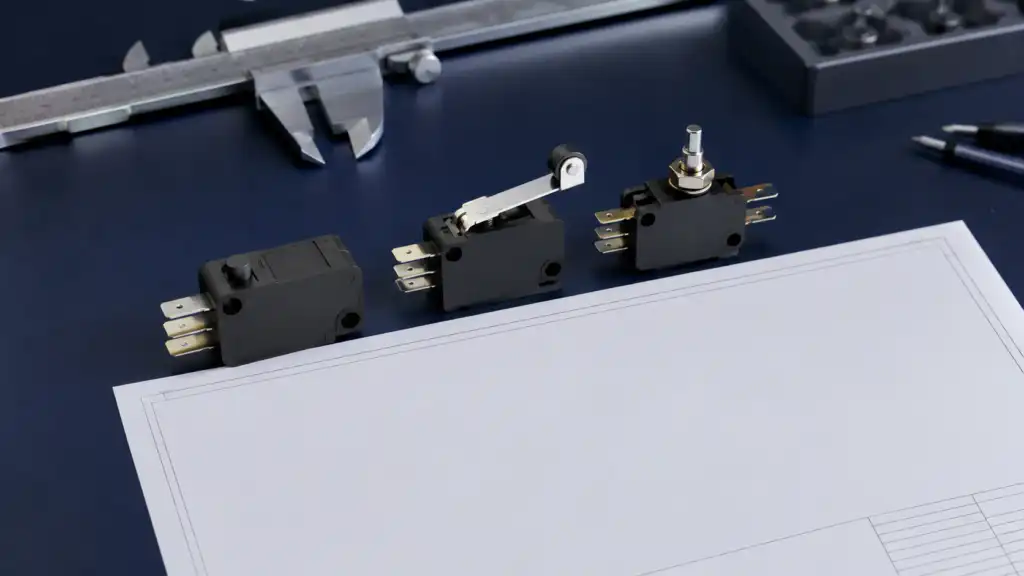
Industrial micro switch selection requires separate mechanical, electrical, environmental, and installation checks. Begin carefully with the machine movement: direction, speed, available force, operating point, overtravel, and reset margin. Then define the real electrical load, including AC or DC operation, inrush, minimum current, switching frequency, and control input behavior. Finally, check package size, terminals, sealing, temperature, vibration, mounting, documentation, and maintenance access. A familiar body shape or headline current rating is not enough to prove that a switch fits the application.
Regla de selección: trate el dispositivo, el actuador, los contactos, la carcasa, el cableado, la lógica de control, el usuario y el movimiento de la máquina como un solo sistema. Los ejemplos de productos ilustran únicamente la forma; la idoneidad final debe provenir de la documentación actual para el código de pedido exacto y de la validación en el equipo terminado.
Cómo funciona el mecanismo
Most industrial micro switches use a snap-action mechanism that transfers slowly applied actuator force into a rapid contact change. This helps repeatability and reduces the time contacts spend between states. The external actuator and internal mechanism form one mechanical chain. Contact material and geometry form a separate electrical boundary. Both boundaries must be satisfied at the same time, and the complete machine must be tested under realistic tolerances.

Criterios de selección de un vistazo
| Área de decisión | Qué verificar | Razón de ingeniería |
|---|---|---|
| Actuator | Match plunger, lever, or roller to the target motion | Geometry determines force, reach, speed, and wear. |
| Operating force | Confirm the available force at worst-case alignment | Insufficient force causes missed operation; excessive force damages parts. |
| Travel | Check pretravel, operating point, overtravel, and release travel | The target must operate and reset reliably without bottoming out. |
| Contact form | Map COM, NO, and NC to the required state logic | Terminal position must come from the exact diagram. |
| Cargar | Define voltage, current, AC/DC type, inrush, and minimum load | A resistive rating cannot be applied blindly to another load. |
| Frequency and life | Estimate realistic operations and switching duty | Mechanical and electrical life are different limits. |
| Medio ambiente | Check dust, moisture, oil, temperature, shock, and vibration | The installation may require a sealed assembly or enclosure. |
| Mounting and terminals | Verify holes, torque, clearances, terminal style, and strain relief | Integration errors can dominate switch performance. |
Esta tabla es intencionalmente cualitativa. Los límites numéricos, clasificaciones, par, fuerza, recorrido, declaraciones ambientales y valores de resistencia deben tomarse de la hoja de datos actual y evaluarse bajo las condiciones de la aplicación.
Proceso de selección detallado
Actuator
Qué verificar: Match plunger, lever, or roller to the target motion. Geometry determines force, reach, speed, and wear. The requirement should be written in the project specification and traced to the exact model drawing or datasheet. Review worst-case tolerance, wear, contamination, maintenance access, and foreseeable misuse. If the available documentation does not define the boundary, keep the point open for supplier confirmation and sample testing rather than substituting an assumption.
Operating force
Qué verificar: Confirm the available force at worst-case alignment. Insufficient force causes missed operation; excessive force damages parts. The requirement should be written in the project specification and traced to the exact model drawing or datasheet. Review worst-case tolerance, wear, contamination, maintenance access, and foreseeable misuse. If the available documentation does not define the boundary, keep the point open for supplier confirmation and sample testing rather than substituting an assumption.
Travel
Qué verificar: Check pretravel, operating point, overtravel, and release travel. The target must operate and reset reliably without bottoming out. The requirement should be written in the project specification and traced to the exact model drawing or datasheet. Review worst-case tolerance, wear, contamination, maintenance access, and foreseeable misuse. If the available documentation does not define the boundary, keep the point open for supplier confirmation and sample testing rather than substituting an assumption.
Contact form
Qué verificar: Map COM, NO, and NC to the required state logic. Terminal position must come from the exact diagram. The requirement should be written in the project specification and traced to the exact model drawing or datasheet. Review worst-case tolerance, wear, contamination, maintenance access, and foreseeable misuse. If the available documentation does not define the boundary, keep the point open for supplier confirmation and sample testing rather than substituting an assumption.
Cargar
Qué verificar: Define voltage, current, AC/DC type, inrush, and minimum load. A resistive rating cannot be applied blindly to another load. The requirement should be written in the project specification and traced to the exact model drawing or datasheet. Review worst-case tolerance, wear, contamination, maintenance access, and foreseeable misuse. If the available documentation does not define the boundary, keep the point open for supplier confirmation and sample testing rather than substituting an assumption.
Frequency and life
Qué verificar: Estimate realistic operations and switching duty. Mechanical and electrical life are different limits. The requirement should be written in the project specification and traced to the exact model drawing or datasheet. Review worst-case tolerance, wear, contamination, maintenance access, and foreseeable misuse. If the available documentation does not define the boundary, keep the point open for supplier confirmation and sample testing rather than substituting an assumption.
Medio ambiente
Qué verificar: Check dust, moisture, oil, temperature, shock, and vibration. The installation may require a sealed assembly or enclosure. The requirement should be written in the project specification and traced to the exact model drawing or datasheet. Review worst-case tolerance, wear, contamination, maintenance access, and foreseeable misuse. If the available documentation does not define the boundary, keep the point open for supplier confirmation and sample testing rather than substituting an assumption.
Mounting and terminals
Qué verificar: Verify holes, torque, clearances, terminal style, and strain relief. Integration errors can dominate switch performance. The requirement should be written in the project specification and traced to the exact model drawing or datasheet. Review worst-case tolerance, wear, contamination, maintenance access, and foreseeable misuse. If the available documentation does not define the boundary, keep the point open for supplier confirmation and sample testing rather than substituting an assumption.

Revisión de la solicitud
- Compact position detection. Record the expected command, response, release behavior, abnormal condition, and acceptance evidence for the assembled machine.
- Presence sensing inside equipment. Record the expected command, response, release behavior, abnormal condition, and acceptance evidence for the assembled machine.
- Cam sequencing. Record the expected command, response, release behavior, abnormal condition, and acceptance evidence for the assembled machine.
- Door-position feedback after risk assessment. Record the expected command, response, release behavior, abnormal condition, and acceptance evidence for the assembled machine.
- Counting and indexing with controlled motion. Record the expected command, response, release behavior, abnormal condition, and acceptance evidence for the assembled machine.
Para cada aplicación, incluya el inicio, la operación normal, el apagado, la pérdida de energía, la restauración de energía, el modo de mantenimiento, el reemplazo de componentes y las fallas identificadas por la evaluación de riesgos. Un interruptor de control general no debe tratarse como una función de seguridad completa.
Lista de verificación de puesta en marcha
- Congelar el requisito. Indique la acción prevista, condición normal, alimentación, carga, movimiento, entorno y usuario.
- Coincidir con el código de pedido. Compare la pieza entregada con el dibujo aprobado, el esquema de contactos, el actuador, el tipo de terminal y los accesorios.
- Inspeccionar la instalación. Verificar alineación, elementos de sujeción, holgura trasera, recorrido de cables, alivio de tensión, protección de partes activas y acceso para mantenimiento.
- Prueba cada estado. Verificar el funcionamiento y la liberación en los extremos de tolerancia, velocidades previstas, cargas, guantes, contaminación y condiciones ambientales.
- Probar condiciones anormales. Incluya conductores desconectados, mecanismos bloqueados o dañados, pérdida de energía, contaminación y otras fallas creíbles.
- Registrar el resultado. Guardar modelo, revisión, método de prueba, observaciones, criterios de aceptación, fecha y aprobador.
Errores comunes
- Selecting by dimensions alone. Evite esto asignando la comprobación a un plano, hoja de datos, registro de cableado o prueba de puesta en marcha con un criterio de aceptación nombrado.
- Using the audible click as electrical proof. Evite esto asignando la comprobación a un plano, hoja de datos, registro de cableado o prueba de puesta en marcha con un criterio de aceptación nombrado.
- Applying a resistive rating to an inductive load. Evite esto asignando la comprobación a un plano, hoja de datos, registro de cableado o prueba de puesta en marcha con un criterio de aceptación nombrado.
- Letting the target use the switch as a stop. Evite esto asignando la comprobación a un plano, hoja de datos, registro de cableado o prueba de puesta en marcha con un criterio de aceptación nombrado.
- Assuming all three-terminal pinouts match. Evite esto asignando la comprobación a un plano, hoja de datos, registro de cableado o prueba de puesta en marcha con un criterio de aceptación nombrado.
Qué incluir en una solicitud de cotización (RFQ)
Proporcione la aplicación, el mercado objetivo, las normas aplicables, la función de la máquina, la alimentación y la carga, la interfaz de control, la lógica de contactos, el dibujo mecánico, la trayectoria de movimiento, las dimensiones del panel, el método de cableado, el entorno, la frecuencia de operación, la cantidad, las necesidades de documentación y el plan de validación de muestras. Pida al proveedor que identifique las suposiciones y excepciones. ONPOW ofrece productos relevantes en su familia de productos específica de la aplicación y lo más amplio gama de productos de control industrial.
Guías relacionadas de ONPOW
- Cómo funciona un microinterruptor
- Microinterruptor vs interruptor de límite
- Vida mecánica vs. vida eléctrica
Referencias autorizadas
- aparatos para circuitos de control IEC 60947-5-1
- IEC 60529 grados de protección proporcionados por las envolventes
- Requisitos de protección de maquinaria de OSHA
- Requisitos de seguridad eléctrica de OSHA
Video educativo
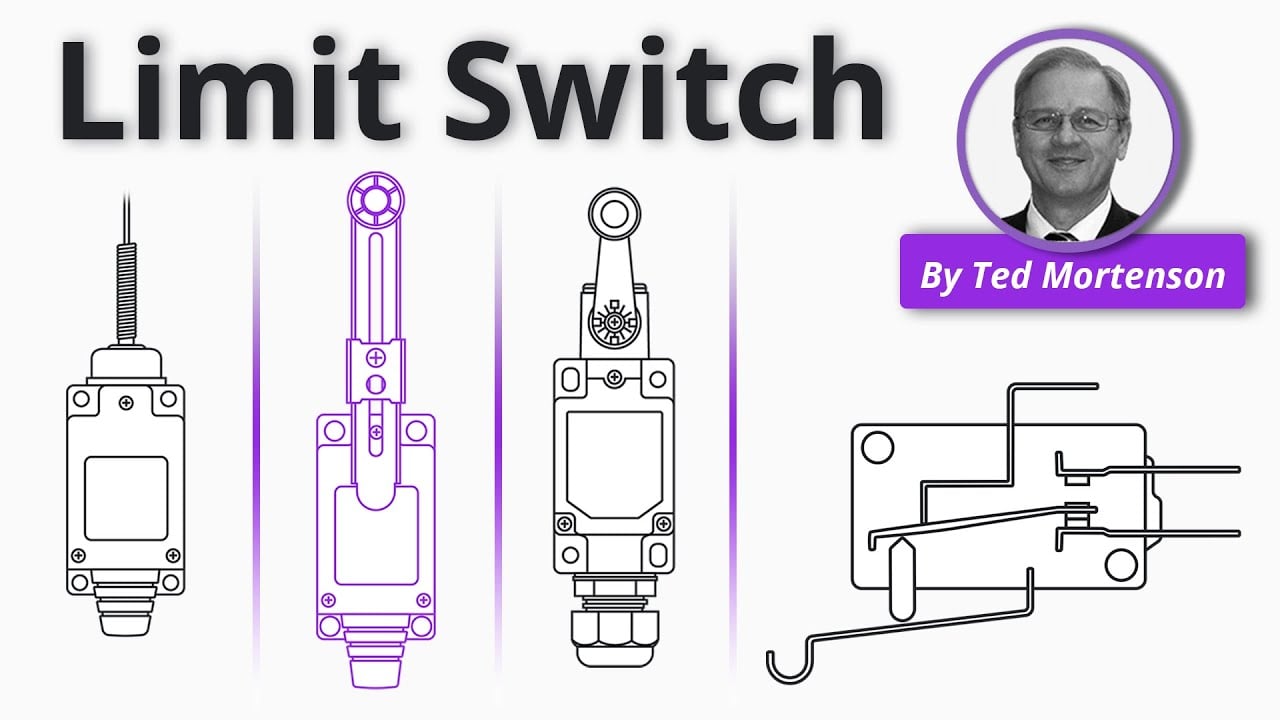
Limit Switch Explained de RealPars proporciona antecedentes generales. Las decisiones de proyecto aún requieren las normas aplicables y la documentación del producto.
Preguntas frecuentes
What is the first selection step?
Document the machine motion and required operating state before comparing catalog models.
What do COM, NO, and NC mean?
They identify the moving contact and its normal mechanical connections; verify the exact terminal diagram.
Can a micro switch switch a motor directly?
Only if the exact load and inrush fall within the stated rating and category; larger loads often need an interface device.
How should samples be approved?
Test the exact order code in the complete mechanism at tolerance, load, and environmental extremes.
Decisión final
Apruebe el componente únicamente cuando los límites documentados de mecánica, electricidad, medio ambiente, usabilidad, instalación y mantenimiento se ajusten al sistema ensamblado. Resuelva las incógnitas mediante información actual del fabricante y pruebas antes de la liberación para producción.
Customization
ONPOW undertakes a variety of custom needs for push-button development. Confirm whether packaging, marking or documentation OEM/ODM applies to Industrial Micro Switch Selection: A Practical Engineering Checklist in the quotation.
Minimum order quantity, lead time and trade terms are not published here; confirm them with sales at sales@onpow.com.



