

A push button plastic stress relaxation report describes how the force or stress needed to hold a specimen at a fixed deformation changes with time. Check the imposed strain, temperature, measurement period and sample identity before using the result. It is different from a creep report, which follows deformation under a sustained load, and it does not by itself prove panel retention or switch operating life. For purchasing, the useful task is to decide whether the evidence represents the relevant material and conditions. This guide provides a practical way to review that evidence and define the next engineering question.
Define the retained-force question first
A purchasing request often begins with a concern about whether a molded component will maintain its contribution to an assembly over time. Before ordering a test, identify the actual part and function. A plastic housing, an actuator and an assembly fixing arrangement should not be treated as the same object simply because they belong to one button.
Write the question in terms that engineering can evaluate. Are you comparing two declared materials, investigating a changed component, or assessing an assembled mounting arrangement? A material specimen test may support the first two questions. The third requires a justified connection to the real geometry, interfaces and installation conditions, and may need a separate assembly assessment.
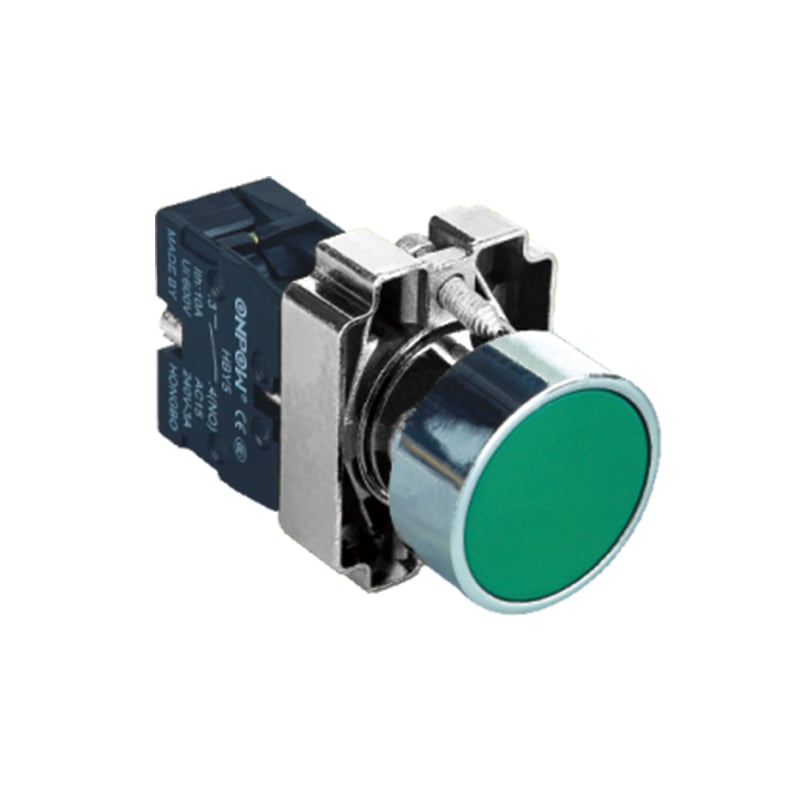
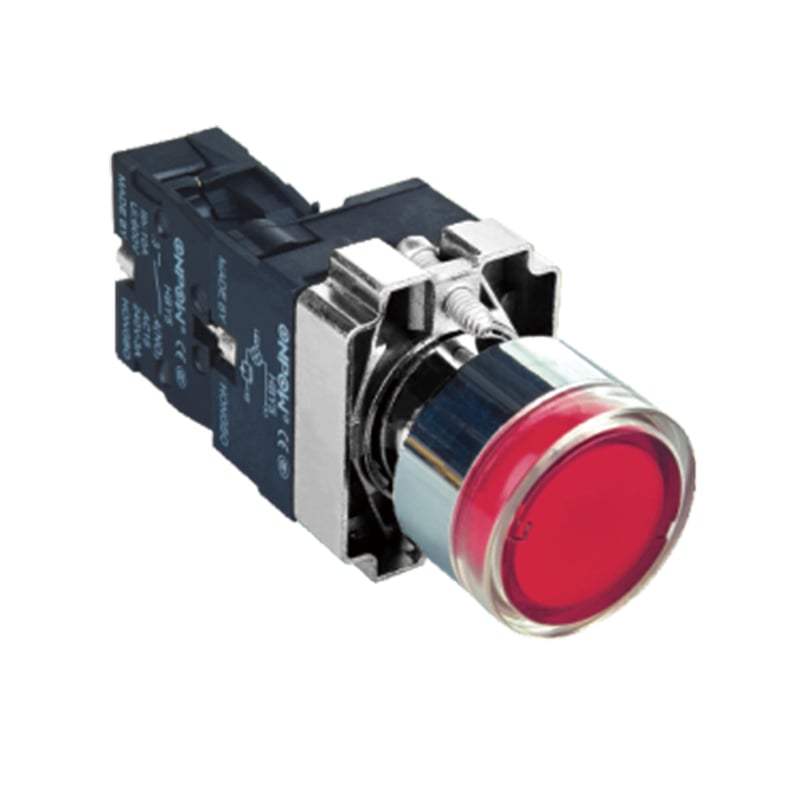
使用する ONPOW HBY5製品ページ to identify an actual product configuration in an inquiry. The original product photographs here are identification examples. They do not show a relaxation experiment and do not establish the material, retained force or service life of any ordered variant.
Distinguish relaxation from creep and cyclic life
In a relaxation experiment, the specimen is brought to a specified deformation and its force response is followed while that deformation is maintained. In a creep experiment, the applied load is maintained and the changing deformation is observed. The distinction determines what the axes mean and which practical question the evidence can answer.
その Polymer Service Merseburg relaxation guide discusses force measurement, deformation control and temperature conditions for different loading arrangements. It also identifies an older referenced plastics standard as withdrawn. Do not describe that historical reference as a current universal testing requirement; ask the laboratory to state the agreed method and its status.
For the complementary constant-load question, see the plastic tensile creep guide. Neither test should be confused with repeatedly operating a complete switch. A material response under one sustained condition and the endurance of a mechanism under operating cycles require different evidence.
Connect the specimen to the supplied component
Request the declared material, batch reference, specimen source and preparation history. A molded laboratory specimen may provide useful controlled material data, but it is not automatically equivalent to a finished component. A piece cut from a component may better identify the delivered material while introducing its own preparation and geometry limitations.
Ask whether orientation, dimensions and conditioning were recorded. If the specimen came from an actual part, keep a photograph showing where it was removed. If it came from a resin batch, ask how that batch is linked to the delivered molding. The purpose is to make the scope of the evidence explicit, rather than to assume that every sample must be prepared in the same way.
When comparing alternatives, define comparable specimen sources in advance. A report on one carefully prepared test bar and another on an unknown finished piece may not support the intended ranking. The laboratory should explain the differences and recommend a comparison plan suited to the question before the purchasing team pays for additional work.
Read the test controls as part of the result
Fixed machine displacement and controlled specimen strain are not always interchangeable descriptions. Ask how deformation was established, measured and maintained, and whether fixture movement or specimen slippage was assessed. A falling measured force is difficult to interpret if the test record does not establish the condition being held.
Temperature, initial deformation and the loading history also belong beside the curve. Record the ramp into the holding stage, the definition of time zero and the duration of observation. Avoid comparing a force recorded immediately after loading with a value from a different report whose observation starts after an undocumented settling period.
A University of Toronto research paper on polymer relaxation illustrates why time-dependent material response must be interpreted within a defined experiment and model. Its studied composites are not evidence about ONPOW materials. Use it for the measurement concept, not to assign its results or composition to a button shown in a photograph.
Use a structured report review
This table is a proposed buyer checklist, based on the measurement controls discussed in the references above. It does not prescribe a universal holding strain, test temperature, duration or pass threshold.
| 証拠項目 | What the report should clarify | 判断に影響する理由 |
|---|---|---|
| Sample traceability | Material declaration and specimen source | Defines which supplied component is represented |
| Loading arrangement | Tensile, compression or other agreed mode | Prevents comparison of unlike responses |
| Held condition | How deformation was measured and controlled | Establishes whether relaxation was actually evaluated |
| Time reference | Loading ramp, start point and observation period | Makes retained-force comparisons meaningful |
| 環境 | cURL Too many subrequests by single Worker invocation. To configure this limit, refer to https://developers.cloudflare.com/workers/wrangler/configuration/#limits | cURL Too many subrequests by single Worker invocation. To configure this limit, refer to https://developers.cloudflare.com/workers/wrangler/configuration/#limits |
| 結果 | cURL Too many subrequests by single Worker invocation. To configure this limit, refer to https://developers.cloudflare.com/workers/wrangler/configuration/#limits | cURL Too many subrequests by single Worker invocation. To configure this limit, refer to https://developers.cloudflare.com/workers/wrangler/configuration/#limits |
| Interpretation | cURL Too many subrequests by single Worker invocation. To configure this limit, refer to https://developers.cloudflare.com/workers/wrangler/configuration/#limits | cURL Too many subrequests by single Worker invocation. To configure this limit, refer to https://developers.cloudflare.com/workers/wrangler/configuration/#limits |
cURL Too many subrequests by single Worker invocation. To configure this limit, refer to https://developers.cloudflare.com/workers/wrangler/configuration/#limits.
Interpret normalized curves without losing scale
cURL Too many subrequests by single Worker invocation. To configure this limit, refer to https://developers.cloudflare.com/workers/wrangler/configuration/#limits.
cURL Too many subrequests by single Worker invocation. To configure this limit, refer to https://developers.cloudflare.com/workers/wrangler/configuration/#limits.
Check whether the graph shows individual specimens or only an average. An apparently smooth line may conceal spread that matters to the application. Ask how many samples were examined and how variability was reported. Do not invent a minimum sample count from a generic guide; agree on a sampling plan appropriate to the material question and consequence of failure.
Keep short observations separate from long-term predictions
A report can contain both measured data and a prediction extending beyond the experiment. Mark the boundary clearly. Ask which interval was observed and which was modeled, what assumptions were used and how the prediction was validated. A fitted line that looks convincing within the test window does not automatically establish behavior over a much longer service period.
If evidence from several temperatures was combined, request the technical basis and limitations. Do not independently convert a short elevated-temperature test into a service-life claim. The material, environment and relevant failure mechanism must support any acceleration approach. Engineering should decide whether the proposed interpretation is appropriate to the ordered component.
For a separate dimensional question, the plastic thermal expansion guide discusses temperature-dependent length change. It does not measure force relaxation. Keeping these documents distinct helps prevent a thermal dimension result being used to answer a mechanical retention question that it never tested.
Evaluate assembly retention through a separate link
A material result may help explain an assembly concern, but actual retained mounting force depends on the complete arrangement. Component geometry, interfaces, other materials and installation conditions can all affect the relevant measurement. Ask the supplier and responsible engineer which assembly evidence is needed rather than translating a specimen curve directly into a panel-retention promise.
Record the exact assembly configuration and installation requirement if an assembly assessment is commissioned. Use the manufacturer-approved instructions and a qualified testing plan. This guide does not supply generic tightening values or authorize modifications. A material comparison should not become an improvised installation procedure.
When a result does not meet a defined requirement, preserve the tested samples and configuration records while investigating. Avoid changing several conditions at once and then calling the new result a direct comparison. A documented sequence of changes makes it easier to identify which factor matters and whether the revised evidence covers the product actually being purchased.
Prepare an inquiry that the supplier can answer
Send the ordered model, component of concern, intended function and the evidence already available. State whether the question concerns a material comparison or complete assembly retention. Ask for the declared material connection, full report, test controls and any known limitations. Request clarification of the actual measured period before discussing a service interval.
Agree on acceptance criteria with engineering before testing. There is no single retained-force percentage or relaxation time that approves every push button application. The useful criterion must connect a defined test to a defined requirement. If that connection is not yet established, treat the report as supporting information and keep the final application decision open.
Store the supplier response, report revision and disposition together. Note which component and batch were accepted, which questions were resolved and what additional evidence remains necessary. Contact ONPOW with the exact product and document requirements so availability and scope can be checked without assuming unverified material or assembly performance.
For the wider evidence review, use the 実験室認証範囲ガイド to check which activities a laboratory document actually covers. Keep the accreditation review separate from acceptance of the specific material result.
よくある質問
Is stress relaxation the same as creep?
No. Stress relaxation follows force or stress while deformation is held. Creep follows deformation under a sustained load. Check which condition the report actually controlled before applying its conclusion.
Does a material relaxation curve prove panel retention?
No. The curve concerns the tested specimen and conditions. A complete mounting arrangement needs a justified link to its actual geometry, interfaces and installation conditions, potentially including separate assembly evidence.
Can a short test establish years of service life?
Not on its own. Any longer-term prediction needs a documented model, applicable assumptions and validation. Keep the measured period visibly separate from the predicted interval.
What should be requested when only a percentage is supplied?
Ask for the starting force or stress, the reference time, held deformation, environment, measured interval and underlying curve. Those details are necessary to understand what the reported percentage means.
さらに詳しく学ぶ
NPTEL explains creep and stress relaxation. The lecture supports distinguishing controlled load from controlled deformation; it does not validate an ONPOW assembly or service life.
noc20 me05 lec06 Creep and stress relaxation — NPTEL – Indian Institute of Science, Bengaluru



