

パネルインジケーターライトの明るさには、すべての機械に共通の単一の値はありません。オペレーターがパネルの最も明るい想定環境光の下で認識できるインジケーターを選び、次に薄暗い条件で再確認して眩しさを避けてください。利用可能な場合は、完全な製品バリアントとその示す光度測定データを比較してください。パネルのルクス値をランプの出力とみなさないでください。距離、視角、レンズ、色、反射、視覚適応はすべて人々の認識に影響します。最後に、エンクロージャの密封性と環境適性を別々に評価してください:明るいインジケーターが自動的に耐候性を持つわけではなく、防水等級だけでは屋外使用に適した設置とはなりません。.
簡単な回答:明るさはフィールドの視認性で選び、「最も明るい」主張で選ばないこと
制御パネルの場合、「どのパイロットライトが最も明るいか」ではなく、「意図した操作員が最も不利な照明条件下で正しい信号を識別できるか」が重要です。実際のパネル、そのレンズと取り付け位置から始め、通常の動作状態で機械とともにインジケーターを確認してください。薄暗い作業場で見やすい設定や部品でも、近くの窓や作業灯によって見えにくくなることがあります。同じ光源でも、部屋が暗くなるときつく感じることもあります。.
正確な電気的および光学的バリアントが重要です。LEDの色、レンズの形状、供給電圧、内部回路、製品の構造は結果に影響します。最新のデータシートを確認するか、サプライヤーに特定の注文コードを確認してください。インジケーターの光度や明るさを製品写真や公称電圧から推測しないでください。.
明るさ、ルクス、カンデラ、輝度は互換性がありません
「明るさ」という言葉は非公式に使われることが多いですが、光度測定は異なる量を表します。NISTは光度測定を人間の視覚感度に重み付けした測定と説明しています。照度はルクスで測定され、表面に到達する光を示します。光度は特定の方向のカンデラで測定され、輝度は見かけの表面から放射または反射される光のカンデラ毎平方メートルで測定されます。これらの単位は異なる質問に答えるものであり、パネルのルクスメーターの読み取り値はインジケーターの明るさの仕様ではありません。.
製品を比較する買い手は、まずメーカーが報告する量と試験条件を確認してください。あるデータシートが光度値を示し、別のものが光束を示している場合、それらの数値は直接的な順位付けにはなりません。正確なバリアントについて光度測定値が公開されていない場合は、閾値を設定せず、意図したパネル上の検証済み製品サンプルと比較してください。.
| あなたが確認していること | 一般的な量または証拠 | 確認できる内容 | 証明できないこと |
|---|---|---|---|
| パネルに当たる環境光 | 照度、ルクスで | 測定点でパネル表面に到達する光の量 | 指示器の放出強度またはその色があらゆる角度で識別可能かどうか |
| 特定の方向に放出される光 | ルーメンで表される光度 | 記載された試験条件下での指向性出力 | あらゆる視角または距離からの外観 |
| 見かけ上の放出または反射された表面 | 輝度(カンデラ/平方メートル)で表される2 | 視認方向における見かけ上の面積あたりの光量 | すべての操作員または機械に共通の合格/不合格基準値 |
| 実機上での人間の認識 | 操作位置での制御された視覚検査 | 信号が試験条件下で識別可能かどうか | 安全基準の遵守または未試験の条件下での性能 |
上記の定義はNISTのフォトメトリーリソースに従うものであり、実地検査は適用特定の検証であり、必要な製品試験やリスク評価の代替ではありません。. NISTのフォトメトリー概要 さまざまな測定量とそれらが光源や信号の評価において果たす役割について説明している。.
パネルインジケーターが見やすくなるかどうかを変える五つの条件
1. 環境光と反射
ガラス越しの明るい日光、高天井の照明、局所的な作業灯、研磨されたエンクロージャからの反射は、照明されたレンズとその周囲との見かけのコントラストを低減させることがあります。レンズに直接反射が落ちているかどうか、全体の部屋のレベルだけでなく確認してください。マットなパネル仕上げ、より良い照明器具の向き、小さなパネル角度の変更、または操作員の通常の視野内でインジケーターを動かすことで、異なるランプを選択せずに視認性の問題を解決できる場合があります。.
メーターの読み取りだけで受け入れ可能性が確定するとは考えないでください。ルクスメーターを使用する場合は、その設置場所と方法を記録してください。なぜなら、その読み取り値はその地点での入射環境光を測定しているからです。記録された条件下での人の認識確認と併用してください。測定出力が契約上の要件である場合は、適切に較正された計測器と、指定された量に一致する方法を使用してください。.
2. 視距離と視線
小さなインジケーターは腕の長さの範囲では明らかですが、数メートル離れた駅からは認識しにくい場合があります。レンズは、操作者が横から近づいたり、高いプラットフォームから見下ろしたり、保護窓越しにパネルを見る場合にも、目立たなくなることがあります。実際の立位および座位の位置から、最も遠い通常の操作点や通常の斜め角度を含めてテストしてください。.
信号を大きなセルや機械の周囲で見なければならない場合、パネル取り付けのパイロットライトは単独では適切な形状ではない可能性があります。より大きなまたはリモートの信号装置、タワーライト、HMIメッセージ、または他の承認された表示が必要かどうかを検討してください。配置の不備を補うために未検証のランプを選択したり、安全性を主張したりしないでください。.
3. レンズ、ベゼル、取り付けジオメトリ
同じLED光源でも、フラット、ドーム型、拡散型、着色型、または埋め込み型のレンズの背後では見え方が異なることがあります。深いベゼルや近くのガードは視野角を制限することがあります。狭い見た目の面を持つレンズは正面からは強く見えますが、斜めからは急速に見えなくなることがあります。拡散レンズは複数の方向から認識しやすい場合がありますが、集中度が低く見えることもあります。実際のパネルの切り欠きと、意図したベゼル、レジェンド、隣接するコントロールとともにサンプルを比較してください。.
インジケーターがフラッシュ、突き出し、フード付き、または隣接する装置によって部分的に影に覆われているかどうかを確認してください。パネルドアが最終角度にある場合は、設置時にそれを観察してください。ONPOW AD16シリーズ製品ページ は、サイトのパネルインジケーターファミリーをレビューする出発点です。仕様を決定する前に、最新のモデル、利用可能なレンズ色、寸法、端子、電気バージョンを現在の製品ドキュメントから確認してください。.
4. 色と視覚適応
二つの色付き光源の見かけの明るさは、比較可能な設定で測定されていても異なることがあり、観察者の適応は明るい環境と暗い環境の間で変化します。緑の信号、赤の警告、琥珀色の表示は、それぞれ別個の視覚タスクとしてテストすべきであり、すべての三つが点灯しているからといって同じ視認性を持つと仮定しないでください。合意された色の意味を保持し、ラベルや記号を提供して、操作者が色だけに頼らなくて済むようにしてください。.
その インジケータライトの色ガイド 一般的な色の規則と、なぜプロジェクトが独自の機械状態の意味を定義する必要があるのかについて説明しています。明るさの調整は、そのシステムをぼやけさせてはいけません。例えば、一つの色を無関係な隣接状態のように見せたり、印刷されたレジェンドを薄くしたりしないことです。.
5. 昼夜および通常/暗操作
Some machines operate in a production hall by day and are checked in a darkened area at night. A lamp selected only under bright ambient conditions might cause glare after dark; one selected only at night might be missed during daytime. Check each intended operating mode and, if the panel is dimmable, verify the documented dimming range and control method for the exact product. Do not assume an ordinary panel indicator supports dimming or that reducing its supply voltage is an approved way to do so.
操作パネルでの実用的な明るさ検証
The following process helps a panel designer or purchaser compare options without pretending that a subjective check replaces a formal photometric test:
- Define the signal and the person who must see it. Record what the indicator means, the operator’s normal position, and the response expected.
- List the lighting conditions that actually occur: bright daylight, overhead lighting, reflections, low-light inspection, and any protective visor or viewing window.
- Confirm the exact indicator variant. Match voltage and circuit type, color, lens, mounting, terminal arrangement, and current product documentation.
- Install the sample in the intended cutout and panel finish. Include adjacent push buttons, legends, guards, and door hardware because they can change reflections and spacing.
- Check recognition from the normal and farthest routine viewing positions. Repeat at the practical side angles and during every relevant ambient-light condition.
- Ask more than one representative operator to identify the signal and state what action it means. A visible lamp can still be confusing if its legend or color assignment is ambiguous.
- Check for glare or distraction in dim conditions, then repeat after the panel has warmed to its normal operating condition if thermal change is relevant to the installation.
- Record the variant, ambient condition, observer position, angle, result, and any instrument used. If an acceptance specification calls for measured photometric data, have the supplier provide the relevant value and measurement conditions.
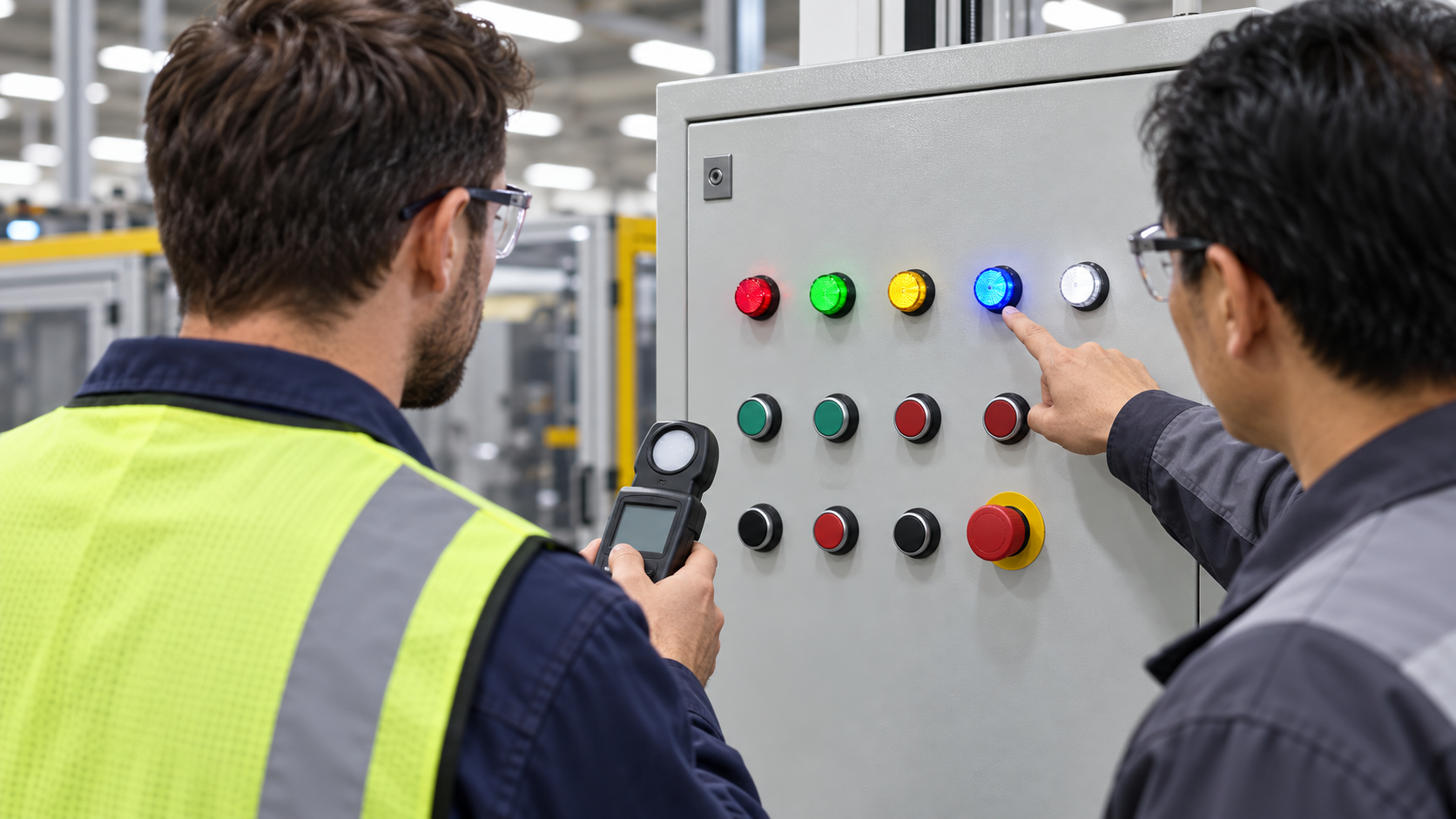
This comparison is useful for selection and acceptance, but it is not a numerical standard. If a risk assessment, customer specification, or applicable regulation requires a defined visibility level, use that requirement and a competent measurement method. Do not borrow a threshold from emergency-alarm rules and apply it to an ordinary pilot lamp: the device purpose and test conditions are different.
屋内外の設置:明るさと保護を別々に扱う
“Indoor versus outdoor” describes an installation environment, not a brightness class. An outdoor machine may be shaded or viewed under an enclosure; an indoor machine may face strong sunlight through a window or intense reflected light. Describe the actual light reaching the panel rather than assuming every outdoor location is brighter than every indoor location.
Environmental protection is a separate selection decision. Confirm the specified protection of the complete installed assembly, including the indicator’s front seal, panel surface and cutout, mounting hardware, enclosure, cable entries, and rear terminals. A rating for one component does not automatically certify the assembled cabinet, and a water-resistant front does not establish suitability for UV exposure, temperature cycling, corrosion, cleaning chemicals, impact, or standing water. The selected ingress-protection test and rating must match the applicable project requirement; do not infer it from the word “waterproof” or from a product photo.
For a genuine outdoor application, ask the panel builder or supplier to confirm the exact model’s current environmental limits and the installation details that preserve them. Then repeat the visibility test under the real ambient light, with reflections, weather shields, covers, or glazing installed. Keep the two records separate: one for visual recognition and one for environmental qualification.
選択に関するよくある間違い
Choosing the highest advertised number
“Brighter” does not automatically mean easier or safer to read. The stated quantity, viewing direction, lens, ambient light, and operator position matter. Compare only like-for-like specifications and confirm their test conditions.
Measuring only panel illuminance
A lux meter can describe light arriving at the panel. It does not directly measure the indicator’s output. Use it to document ambient conditions, then perform a recognition check or a formal measurement appropriate to the required quantity.
Checking from one position
The panel may look clear from the person installing it and be unreadable to an operator standing to the side. Test routine sight lines and distances, not just a straight-on close-up.
Equating “waterproof” with outdoor-ready
Ingress protection is only one environmental consideration. Seal installation, enclosure details, UV, temperature, corrosion, and cable entry all matter. Brightness does not establish any of these conditions.
Assuming higher voltage means a brighter indicator
Voltage identifies an electrical supply variant; it is not a universal brightness scale. Compare the exact product’s verified optical data and field result, not nominal voltage alone. For related selection context, see 12Vと24VのLEDインジケーターライトの比較 そして metal versus plastic indicator-light housings.

インジケーターライトのRFQに送る質問事項
Include these details when asking a supplier to recommend a panel indicator:
- exact machine state, required operator action, and agreed signal color;
- normal and farthest viewing distance, expected sight angle, and viewing window or visor;
- actual ambient-light conditions, including daylight, task lights, reflections, and dim operation;
- panel cutout, thickness, bezel, lens style, legend, front protection, and rear clearance;
- AC or DC supply, nominal voltage, circuit details, and any required dimming behavior;
- the optical quantity requested, its unit, and the test condition if a numeric comparison is required;
- temperature, vibration, cleaning, moisture, chemicals, UV, corrosion, and other environmental conditions;
- whether the acceptance check is a visual recognition test, a measured photometric requirement, or both.
その ONPOW信号ランプ範囲 そして インジケーターライト選択ガイド can help narrow the product family. Ask ONPOW to confirm the exact available variant and current specifications; the article and product images are not substitutes for an approved datasheet.
教育ビデオ:光度測定値が何を示すか
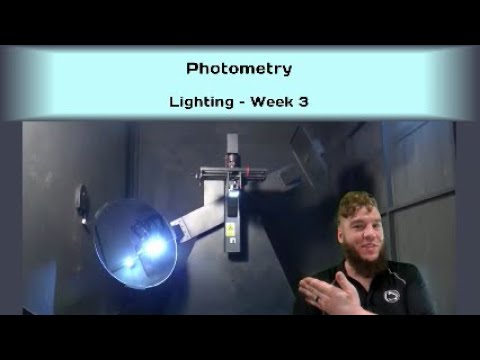
The following educational video, “Photometry,” by J. Mundinger of Penn State’s Lighting Lab, introduces photometric quantities such as luminance and illuminance. Penn State’s Lighting Lab lists J. Mundinger as a research technologist. The video provides background for understanding why ambient lux and a lamp’s directional output are different measurements; it does not specify ONPOW product performance or a required acceptance threshold.
よくある質問
How bright should a panel indicator light be?
すべてのパネルに適合する単一の値はありません。通常および最も遠い定期観察位置で、最も明るい想定環境条件下で正しい信号を認識できることを確認し、薄暗い条件での眩しさもチェックしてください。プロジェクトや規制で定められた光度要件がある場合は、それを使用してください。.
ルクスメーターはインジケーターライトの明るさを測定しますか?
パネルの照度を測定する場合はそうではありません。ルクスは表面に到達する光を表します。ランプの放出出力を測定するには、指向性のある光度や輝度など、指定された光度測定量に適した計測器と設定が必要です。.
より明るいLEDインジケーターは屋外で常に見やすいですか?
いいえ。直射日光や反射により信号が判別しづらくなることがありますが、レンズの向き、グレア、角度、距離、色彩、視覚適応も重要です。実際の装置と設置場所の実際の照明条件下でテストしてください。.
Does a waterproof indicator automatically suit outdoor use?
いいえ。正確な保護等級と設置を確認し、その後、紫外線、温度、腐食、化学物質、衝撃、ケーブルエントリー、およびエンクロージャーを適用可能な範囲で評価してください。視認性と環境適合性は別々の確認事項です。.
より明るさを得るために高電圧モデルを選ぶべきですか?
いいえ。電圧は電気的仕様であり、信頼できる明るさの指標ではありません。比較可能な条件下で正確なバリアントの光学情報を比較し、意図したパネルでの視認性を確認してください。.
最終チェックリスト
cURL Too many subrequests by single Worker invocation. To configure this limit, refer to https://developers.cloudflare.com/workers/wrangler/configuration/#limits.
cURL Too many subrequests by single Worker invocation. To configure this limit, refer to https://developers.cloudflare.com/workers/wrangler/configuration/#limits cURL Too many subrequests by single Worker invocation. To configure this limit, refer to https://developers.cloudflare.com/workers/wrangler/configuration/#limits; cURL Too many subrequests by single Worker invocation. To configure this limit, refer to https://developers.cloudflare.com/workers/wrangler/configuration/#limits; cURL Too many subrequests by single Worker invocation. To configure this limit, refer to https://developers.cloudflare.com/workers/wrangler/configuration/#limits; cURL Too many subrequests by single Worker invocation. To configure this limit, refer to https://developers.cloudflare.com/workers/wrangler/configuration/#limits.



