

In industrial equipment, control panels, and electrical control systems, not every button should be operated freely by anyone. Some functions require restricted access, such as starting a machine, switching operating modes, or controlling specific equipment. In these situations, a key switch is a practical choice.
Unlike ordinary push button switches, a key switch typically requires a matching key for operation. It can help reduce unauthorized operation while making equipment control clearer and more convenient.
So, what exactly is a key switch? How does it work, and how can you choose the right model for your equipment? This article explains its working principle, common types, and practical applications.
What Is a Key Switch?
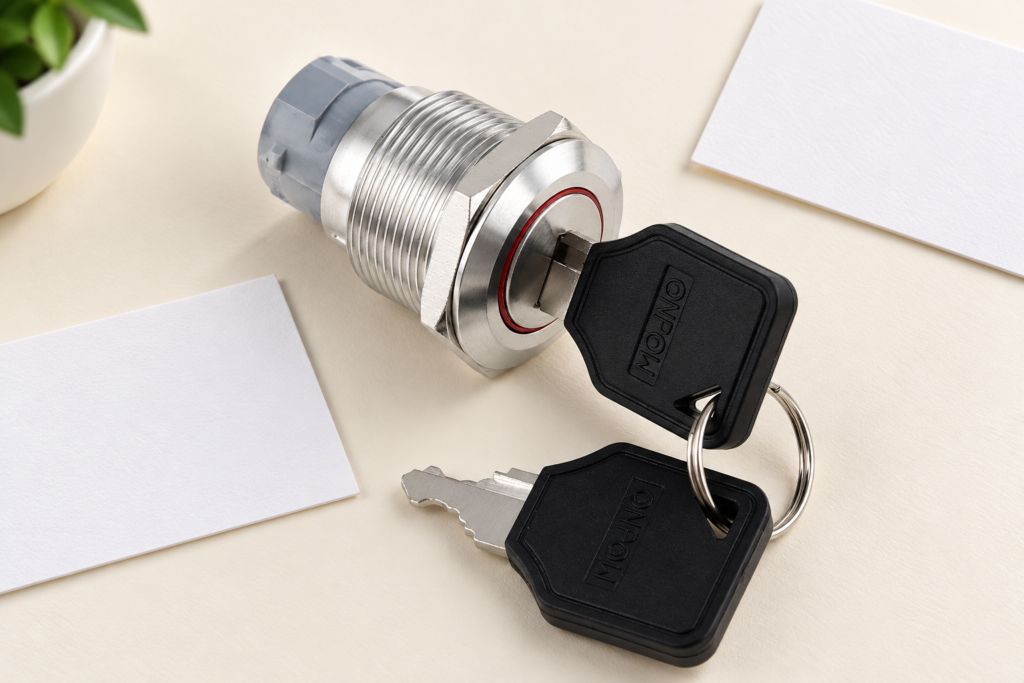
A key switch is a switch that uses an inserted and turned key to control circuit continuity or change an electrical state. It typically consists of a lock cylinder mechanism and electrical contacts, although the specific structure depends on the switch design.
When a user inserts the matching key into the lock cylinder and turns it, the internal mechanical mechanism moves the contacts to a different state, allowing the circuit to be connected, disconnected, or switched.
Key switches are commonly used in industrial control panels, automation equipment, electrical cabinets, machinery, and systems where access to certain operations needs to be restricted. Depending on the design, they can be used to start or stop equipment, switch operating modes, or allow authorized personnel to perform specific operations.
It is important to note that a key switch does not necessarily provide a complete safety interlocking function. It is primarily used for operational control or access management. The presence of a key alone does not mean that the equipment meets the relevant safety requirements.
How Does a Key Switch Work?
A key switch works by using a mechanical action to change the state of its internal electrical contacts. Although the internal structures vary between models, the basic operating process is generally straightforward.
1. Insert the Matching Key
The operator inserts the matching key into the lock cylinder. The cylinder mechanism is designed to recognize or restrict key operation and provide the mechanical conditions needed for the subsequent turning action.
2. Turn the Key
When the key is turned to a designated position, the internal mechanism moves the switch contacts. Depending on the product design, the key may have one or more operating positions, such as OFF, ON, or other control positions.
3. Change the Circuit State
When the contact state changes, the connected control circuit responds accordingly by connecting, disconnecting, or switching the circuit. For example, in a suitable control system, turning the key can send a start-permission signal to the control circuit or switch the equipment’s operating mode.
4. Maintain or Return to a Designated Position
Key switches differ in how they reset. Some models remain in the selected position after the key is turned, while others use a spring-return mechanism. Whether the key can be removed in a particular position also depends on the specific model.
Therefore, when selecting a key switch, you should look beyond its appearance and confirm the contact configuration, operating positions, reset mechanism, and key-removal positions to ensure they meet your equipment’s requirements.
What Are the Common Types of Key Switches?
Different types of equipment have different operating and control requirements, so key switches are available in various designs. When selecting a model, you can start by distinguishing them according to the following factors.
1. By Operating Positions
- Two-position key switches: These are typically used for simple state changes, such as OFF/ON switching, and are suitable for equipment that requires clear control positions.
- Three-position key switches: These can be used to select among three control states, such as different operating modes. The specific functions depend on the contact configuration and circuit design.
It is important to note that the number of operating positions does not directly determine the number of electrical contact sets in a switch. These specifications should be checked separately.
2. By Contact Configuration
Key switches are available with different contact configurations, such as normally open (NO), normally closed (NC), or combinations of both.
A normally open contact is typically open when the switch is in its unactuated state, while a normally closed contact is typically closed. When selecting a model, you should also confirm how the contacts change state at each key position.
If the key switch needs to connect to a PLC, relay, or other control device, choose a contact configuration that meets the requirements of the control circuit.
3. By Key Operation and Reset Method
Some key switches maintain their state in a designated position, while others may use a spring-return mechanism. Key-removal positions can also vary. For example, some models allow the key to be removed only in the OFF position, while others allow removal in multiple positions.
These differences directly affect daily operation, so it is advisable to confirm the operating position diagram and key-removal conditions before purchasing.
What Are the Practical Applications of Key Switches?
The value of a key switch lies not only in controlling a circuit but also in providing a simple way to manage access to equipment functions. The following are some common applications.
- Industrial Machinery and Automation Equipment
- Electrical Cabinets and Control Panels
- Public and Commercial Equipment
- Equipment Requiring Different Levels of Operating Access
What Is the Difference Between a Key Switch and an Ordinary Push Button Switch?
Both types of switches can be used to control electrical circuits, but they serve different purposes.
| Comparison | Key Switch | Ordinary Push Button Switch |
|---|---|---|
| Operating method | Typically operated by inserting and turning a key | Operated by pressing the button |
| Access control | Can restrict operation to people who have the matching key | Generally allows more direct operation |
| Common applications | Mode selection, operation authorization, and state switching | Starting, stopping, resetting, and function control |
| Operating state | Can maintain its state or reset according to the design | Can be momentary or latching |
| Key selection factors | Key positions, contact configuration, and key-removal conditions | Button design, contact configuration, and operating method |
It is important to note that a key switch provides a certain degree of operational restriction, but it is not equivalent to a professional anti-theft device or safety interlocking system. If a project requires a higher level of protection, an appropriate solution should be selected based on the actual requirements.
Related Articles:
- Key Switch Spare Keys: A Practical Access Control Procedure
- Industrial Key Switch Troubleshooting: Lock, Actuator or Contact Fault?
- 12V en 24V toetsschakelaars: contactbelasting en invoerselectie
- Momentary Key Switches: Keuze van de springretourwerking
ONPOW Key Switches
LAS0 Series:VIEW DATA SHEET
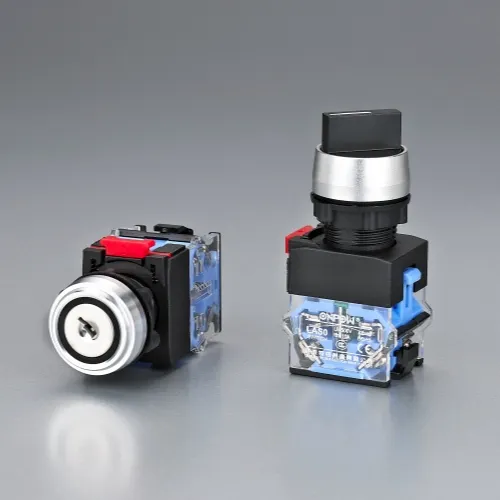
- Paneeluitsnijding Afmeting Φ22, Ui:500V, Ith:10A
- Stekkerdoisschakelaarhouder, anti-val en eenvoudig te installeren
- 1 tot 8 groepen schakelaars kunnen vrij worden gecombineerd
- Certificaat: CCC/CE
ONPOW offers 10 standard series of key switches to meet a variety of application and control requirements. Explore our product pages to find the right solution for your project. If you need a customized key switch or have technical questions, feel free to contact our team for expert assistance



