

Qualify piezo switch manufacturers by asking whether they can deliver a documented, repeatable configuration that works in your panel and controller. A good evaluation connects the drawing, sample, test evidence, production controls and purchase order. Price, a long cycle-life claim or a smooth metal face cannot answer those questions alone. Start with your application requirements, compare suppliers against the same evidence checklist, and approve the exact ordered configuration. This guide helps equipment builders and purchasing teams organize that process without presenting an unverified ranking of manufacturers or treating catalog claims as independent certification.
Define what you need before comparing suppliers
Begin with a one-page application brief. State the panel location, mounting constraints, expected operator use, controller input and illumination requirements. Describe environmental exposure in concrete terms, including cleaning procedures when relevant. Identify whether the button makes an ordinary operating request or whether the application has a safety function requiring a separately assessed component and system.
Separate requirements from preferences. A confirmed electrical interface is a requirement; a preferred housing finish may allow alternatives. Mark which conditions must be answered before a sample order and which can be settled during qualification. This prevents an attractive quotation from becoming the default specification before engineering has reviewed it.
When several suppliers are compared, send the same brief to each. A low price for an unspecified output mode should not be compared with a quotation for a fully defined illuminated configuration. Keep a record of each assumption and clarify unanswered details before awarding a technical score. Unknown information is a gap, not evidence of either good or bad performance.
Ask for an exact part definition
Obtain a complete order code, drawing revision and clear description of the supplied configuration. Include face design, housing material, mounting arrangement, output mode, leads or terminals and illumination options. Request a wiring diagram and identify which information belongs to the exact part rather than to the broader product family.
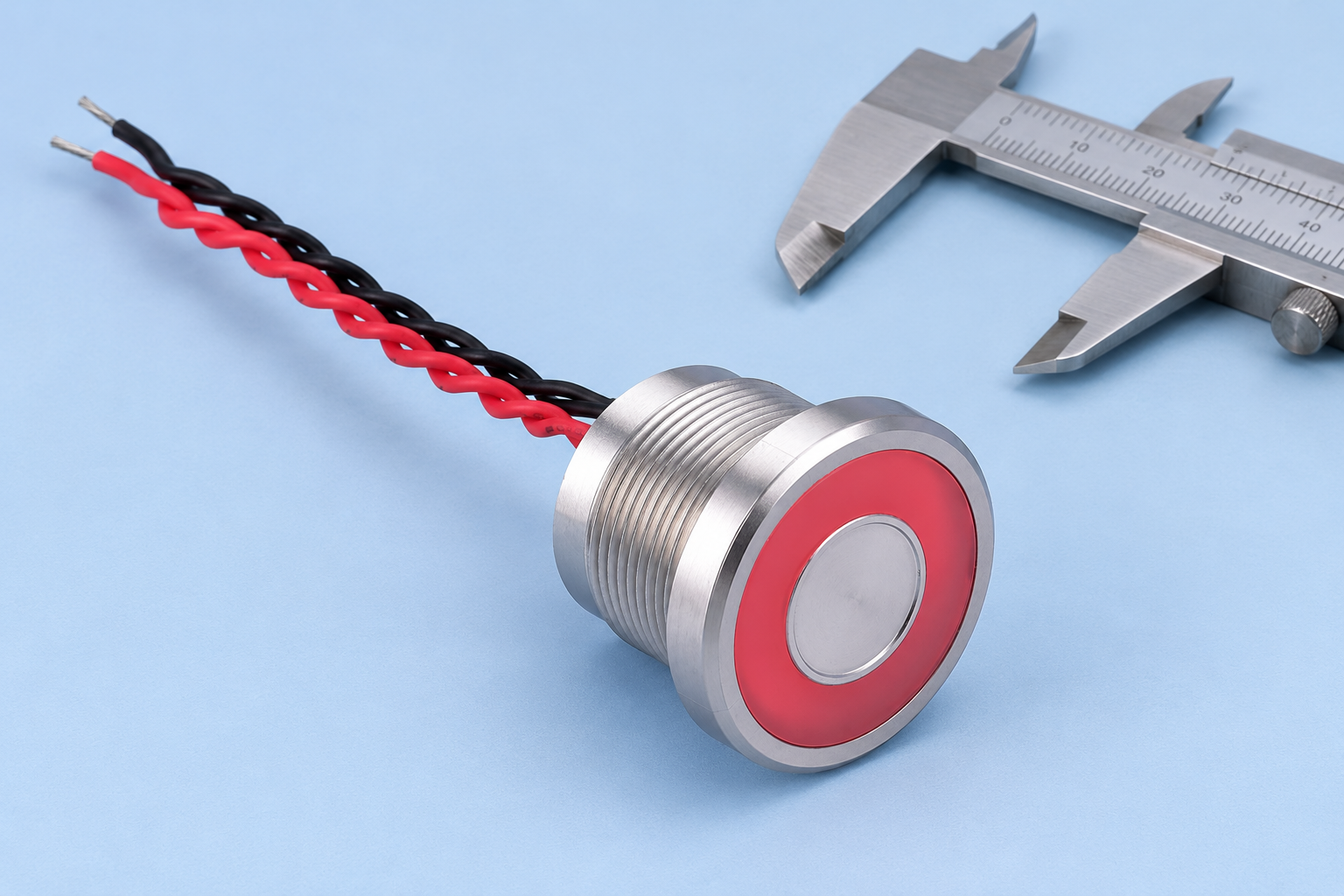
The ONPOW PS223P10YNT1L page is an example of a product page to use as the beginning of an inquiry. Its photographs and family information help identify a candidate. They do not establish your panel cutout, controller compatibility or cleaning qualification without the corresponding ordered configuration and approved documentation.
Ask how the manufacturer distinguishes revisions and customized options. A housing that looks identical can contain a different output or lamp option. Your receiving team needs a way to identify the supplied part without powering it up to discover its behavior. Agree on markings, packaging identification and document references before approving a volume order.
Verify the electrical interface with evidence
Ask for output topology, permitted supply conditions, polarity, idle leakage, active-state behavior and pulse or latching operation. Terms such as NO, momentary and touch switch can leave important interface details unresolved. Wire count and color are not enough to establish a dry contact, isolation or direct PLC compatibility.
Compare the supplier’s data against the exact receiving input. Include input filtering, event capture and power recovery behavior. If an intermediate driver, isolation stage or load interface is needed, include it in the reviewed design. Do not accept a demonstration connected to a different controller as proof that your application will work.
The momentary piezo switch guide helps frame the operating-mode question. For the underlying sensing physics, UCSC’s piezoelectric demonstration explains mechanical-to-electrical conversion. That principle does not identify a finished panel switch’s output circuit. Supplier qualification concerns the assembled device and its documented behavior, rather than a raw piezo element alone.
Compare suppliers with a practical evidence table
Use a common table to organize the review. Do not turn this into a claim that one company has capabilities you have not verified. For each supplier, record the evidence received, unresolved question and person responsible for the decision.
| Qualification area | Evidence to request | What your team should check | Common unresolved gap |
|---|---|---|---|
| Configuration | Exact drawing and complete order code | Sample and quotation identify the same version | Generic family sheet only |
| Electrical output | Wiring, limits and behavior description | Match against controller input and timing | NO label without topology or leakage details |
| Montagem | Cutout, panel and seal instructions | Representative panel installation | IP claim without installation conditions |
| Testing | Method, sample configuration and acceptance result | Evidence applies to the intended option | Headline rating without test scope |
| Production control | Revision and outgoing inspection process | Agreed changes and records can be tracked | Samples cannot be linked to production identity |
| Commercial supply | Written lead-time, quantity and change terms | Conditions fit the purchasing plan | Verbal promise without defined configuration |
A simple evidence status such as received, clarified or pending is more useful than an unexplained numerical score. If you choose weighted scoring, define the weights internally before reviewing quotations and keep mandatory technical conditions outside a price trade-off.
Check the scope of certificates and test reports
A supplier may provide organizational certificates, product declarations or laboratory reports. Read the scope rather than grouping them under a single “certified” heading. Identify the issuing organization, covered entity or product, relevant configuration, dates and any limitations. Where authenticity or current validity matters, use the issuer’s supported verification process.
ISO’s conformity assessment guidance explains different forms of attestation. In a purchasing review, the practical consequence is to ask what each document actually covers. Do not describe a management-system certificate as proof that every switch option meets a particular electrical, environmental or safety requirement.
For numerical test evidence, ask how measurements were made and which instruments and uncertainties matter to the decision. NIST’s metrological traceability policy provides useful background: measurement traceability is not an endorsement of a supplier or a guarantee of future product performance. Keep traceability evidence connected to the actual reported result and qualification question.
Qualify a representative sample
Agree on the test plan before the sample arrives. Identify the exact configuration and document its condition on receipt. Inspect the face, body, thread, lead arrangement and supplied identification against the drawing. Install it using the proposed production mounting instructions in a representative panel. A test on an unsupported loose button may miss installation-dependent behavior.
Check ordinary operating sequences, output capture and indication meaning with the intended input arrangement. Include the application’s approved power recovery tests. Where environmental exposure matters, define the permitted evaluation procedure and acceptance criteria with competent personnel. Do not improvise destructive or energized exposure tests to see whether a catalog claim is believable.
Record results in a way another engineer can reproduce. Link the sample identity, drawing, controller configuration, setup and observations. If a test fails, separate a component fault from an interface or installation error before judging the manufacturer. A useful supplier can explain the documented limits and help investigate the evidence without replacing it with a sales promise.
Review repeatability and change control
A successful sample proves that one identified sample passed the defined tests. It does not, by itself, prove that every future delivery will match. Ask how the manufacturer controls the released configuration, identifies batches and communicates changes. Discuss which changes require your approval, including output electronics, lead arrangements, seal materials, mounting features or documentation that affect qualification.
Agree on incoming checks for production shipments. These may include identification, dimensional checks and defined functional sampling appropriate to your quality plan. Avoid copying a generic sampling rate without considering consequences, expected volumes and customer requirements. Keep the chosen approach in a controlled purchasing or inspection document.
If customization is proposed, establish who owns the drawing and which configuration is the reference for repeat orders. Make clear whether a quotation covers a standard item, a modified standard item or a development project. Those categories affect approval, testing and change handling, even when the final operators look similar.

Evaluate support using real questions
Use the qualification process to assess technical communication. Send focused questions that need a documented answer: the output topology, exact seal arrangement, supplied lead identification or applicability of a particular test report. Keep responses with the drawing and note whether the answer resolves the issue or introduces a new assumption.
Ask how a field problem should be reported. Useful information includes part identity, installation photographs, controller type, symptom sequence and relevant conditions. A clear return or investigation process helps both teams distinguish handling damage, installation faults and device defects. Agree on what evidence is needed before replacing products or changing a design.
Do not invent service response times or warranty promises on behalf of a manufacturer. Request the current written commercial terms, including how customized parts are handled. Where long-term availability is important, ask about change notification and replacement compatibility; a similar catalog product may still need a fresh interface and mounting review.
Compare the landed supply proposal
Evaluate price only after the technical configuration is aligned. Include packaging, documentation, shipping terms and any sample or tooling requirements in the comparison. Confirm the minimum order, lead time and production release conditions directly in the quotation. None should be inferred from a product photograph or an older conversation about a different model.
Keep the approved technical specification attached to the purchase order. State the exact part, drawing revision, required documents and any inspection or change-notification agreement. Ask the supplier to identify deviations explicitly before accepting the order. This is more reliable than assuming a short product name captures every option discussed by email.
For ONPOW inquiries, use the piezoelectric switch overview to identify the technology and a relevant product page to identify the candidate. Then contact ONPOW with your application brief and evidence requests. The outcome should be a reviewable configuration and qualification record, not a generic statement that a piezo button is robust.
Educational background for the review team
Oficiencia’s Portuguese demonstration, supported by the University of São Paulo physics group, shows the piezoelectric principle. Use it as optional context for team members unfamiliar with the technology. It does not audit any manufacturer, demonstrate production testing or verify a commercial switch rating.
Perguntas frequentes
What should I request first from a piezo switch manufacturer?
Send an application brief and ask for the exact configuration, drawing, wiring information and relevant limits. Align those details before comparing price or ordering a qualification sample.
Does a successful sample guarantee production consistency?
No. A sample establishes its own results under defined conditions. Agree on configuration control, identification, incoming checks and change notification for future deliveries.
Can an organizational certificate replace product testing?
No. Read what the certificate covers and assess product-specific evidence separately. A document covering a management system does not establish every device option’s application suitability.
How should I compare suppliers with missing information?
Use the same evidence checklist and leave unanswered conditions pending. Do not treat an unverified claim as a passed requirement or compare prices for different configurations.
Is this article a verified ranking of manufacturers?
No. It provides a qualification method. Manufacturer-specific capabilities, current commercial terms and exact product approvals require direct evidence for the proposed purchase.



