

Spare push button switches should be stored in a controlled, identified condition that preserves the complete ordered assembly until installation. Use the manufacturer’s actual storage and handling requirements, protect the parts from damage and contamination, and retain the information needed to select the correct spare later. Do not assign a universal shelf life, temperature or humidity limit from the switch’s operating-life rating. This guide concerns unused spares before installation; it separates storage controls from incoming inspection and from the electrical or mechanical endurance expected during service.
Establish exactly what is being stored
Identify whether the spare is a complete switch, operator, rear contact block, lamp component or prewired assembly. Similar front faces can hide different contact arrangements, lamp supplies, actions or connection options. A storage system that records only diameter and color may leave the maintenance team unable to identify the correct replacement.
Keep the manufacturer’s full code and any equipment-specific part number together. Include the relevant drawing or bill-of-materials reference and revision. Where a kit contains several parts, record its contents rather than separating them into unlabelled bins and assuming that their original relationship will be remembered.
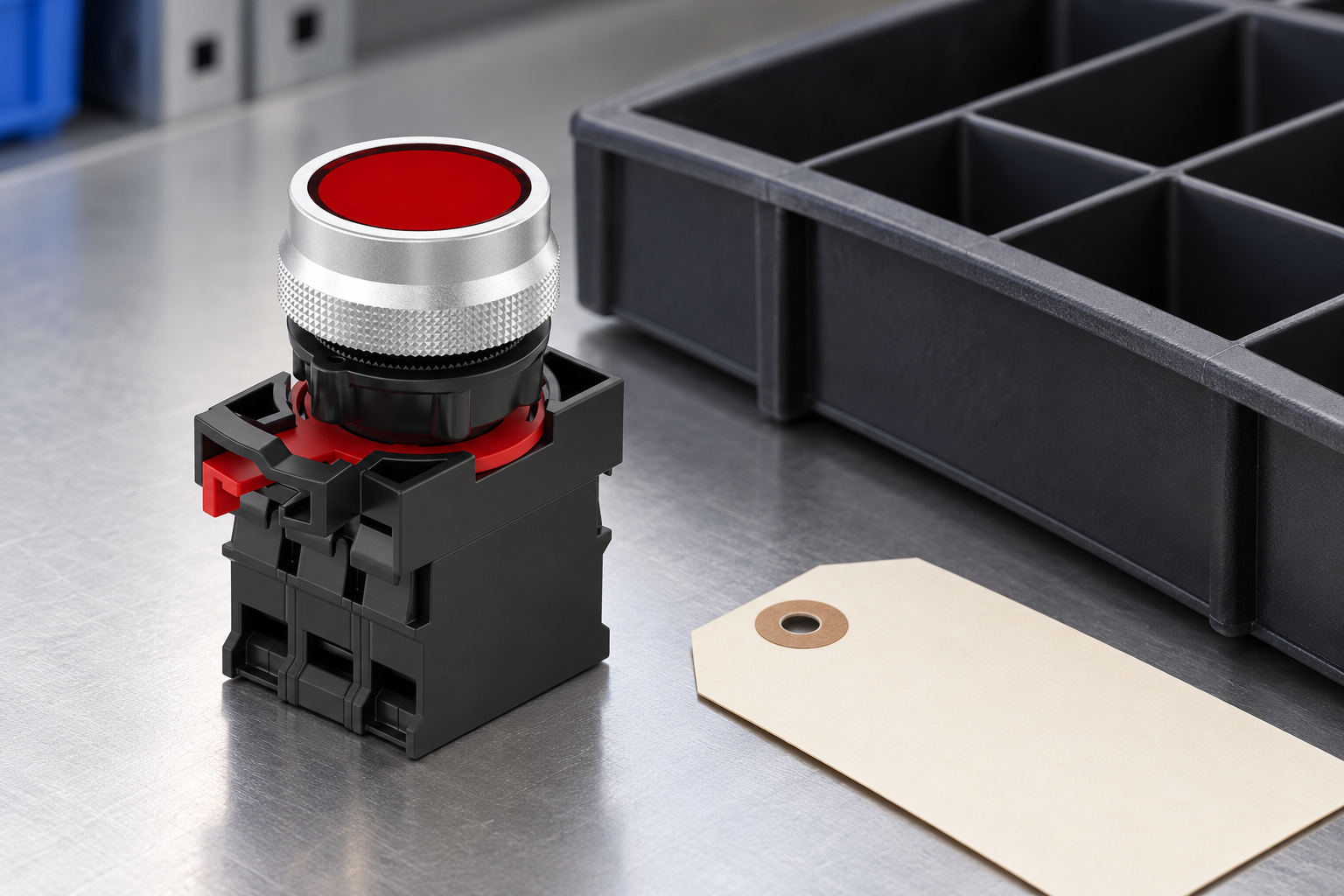
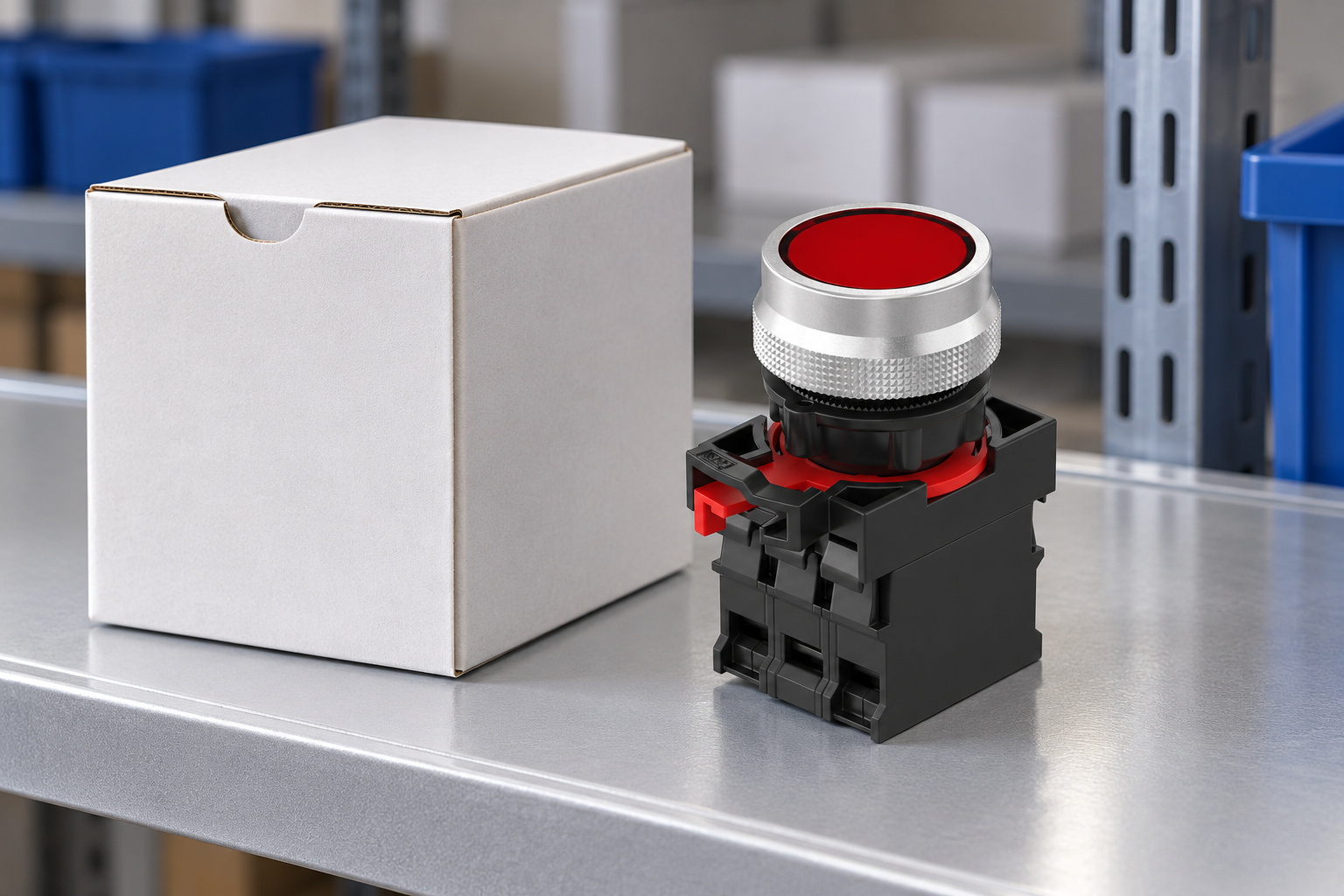
The ONPOW26-11 product page provides a real product-form reference. The illustrations in this article show an intact spare beside storage props. They do not approve a particular tray, packaging material or environmental condition for that model.
Separate storage limits from operating life
Mechanical life and electrical life concern defined operating duties and conditions. They do not establish how long an unused part may remain in a warehouse or how it should be stored. A high operating-cycle figure should therefore not be converted into a claim that every spare has an unlimited shelf life.
Obtain the applicable storage requirements for the complete configuration. Materials, contacts, seals, markings, electronic options and packaging can have different considerations. Keep any shelf-life statement linked to its scope and starting point rather than applying it to all items in a product family.
For the wider life-rating distinction, consult mechanical versus electrical life. A storage plan should preserve the supplied condition and traceability while leaving service-life assessment to its own documented application requirements.
Record manufacturer requirements without filling gaps with guesses
Request the permitted storage environment, packaging and handling instructions for the actual assembly. If the documentation provides limits or special conditions, put them into the stock-control record with their source and revision. Do not copy values from a visually similar product or from a generic warehouse checklist.
Keep “not specified” distinct from “unrestricted.” When necessary information is missing, ask the supplier whether the proposed storage arrangement is acceptable. Describe the real conditions, including relevant environmental changes and expected storage period, so that the answer addresses the actual situation.
Avoid presenting a neat internal stock rule as a manufacturer rating. A company can define a conservative inspection or review interval for its own spares, but the record should identify it as that company’s process rather than a claimed ONPOW shelf-life limit.
Use a practical storage-control table
The table below is a qualitative checklist. It contains no universal environmental or time values because those must come from the product’s actual requirements and the equipment owner’s controlled process.
| Control area | What to record or protect | Why it matters at installation |
|---|---|---|
| Identity | Full code, revision and equipment reference | Prevents selection by appearance alone |
| Supply scope | Complete assembly or identified component kit | Avoids losing required mating parts |
| Packaging | Approved protection and handling instructions | Preserves condition without unverified materials |
| Ambiente | Applicable manufacturer storage conditions | Makes exposure and deviations reviewable |
| Traceability | Receipt, lot and supplier information where supplied | Supports investigation and stock review |
| Stock status | Released, awaiting review or rejected | Prevents uncertain parts returning to service |
| Release check | Required inspection and verification record | Distinguishes stored condition from service suitability |
Make the controls proportionate to the actual component and equipment. The purpose is a usable spare-parts process, not a collection of arbitrary labels that cannot be traced to requirements or a defined maintenance need.
Protect the assembly from mechanical loading
Store parts so that their shape and accessible features are not unintentionally loaded or damaged. Consider the operator, threaded mounting section, rear body, terminals and any attached lead or connector. Use the manufacturer’s packaging and handling guidance rather than assuming that a bulk container is suitable for every device.
Do not force a prewired assembly into a space that puts the conductors or connection under strain. Keep the approved bend and support requirements with the harness where applicable. A spare can look satisfactory from the front while a terminal, lead or rear mounting feature has been damaged during storage.
Avoid using a switch’s operating mechanism as a packing support. Any packaging arrangement that loads the actuator or interferes with a key, latch or release feature should be reviewed against the actual instructions. The photograph of a part beside a tray is an editorial example, not evidence that the shown tray is an approved shipping or long-term storage solution.
Keep contamination and cleaning decisions controlled
Prevent avoidable exposure to dust, liquids and process residues in accordance with the product’s storage instructions. Do not assume that an ingress-protection rating describes an uninstalled component in an open storage bin. A front-face rating in a specified panel arrangement is different from the condition of a loose spare.
If a part becomes contaminated, record the condition and obtain the appropriate disposition. Do not apply a convenient solvent, lubricant or abrasive treatment simply to restore its appearance. The complete assembly may contain materials or interfaces whose compatibility is not apparent from the metal face.
Keep cleaning or preparation actions traceable. A part that has been altered, exposed or reworked should not silently return to the same stock status as untouched supplied material. The responsible personnel should decide what evidence is needed before it can be released for installation.
Retain contacts, keys and accessories as identified parts
A complete spare or kit may depend on a documented operator, holder, rear block, key or accessory combination. Preserve that relationship in the stock record and packaging. Do not assume that a loose part from another bin is a permitted substitute because it appears to attach or operate.
Where a component is separately replaceable, identify its approved pairing and supply scope. The contact block replacement guide explains why matching the visible head is insufficient. Storage should make the correct pairing easier to establish, not remove the evidence that came with the delivery.
Manage keys under the equipment owner’s access-control procedure where relevant. A labelled switch body without the required key or documented key arrangement may not be a usable spare. Do not attempt to make an incomplete kit serviceable by bypassing the authorization mechanism.
Use stock rotation and review as documented processes
Maintain receipt and supplier information where available, and apply the organization’s defined stock-rotation method. Rotation can help manage older material, but it does not establish that a part remains acceptable after an undocumented exposure or that a newer delivery is automatically correct for the equipment.
Define when stored material needs review. Triggers can include a packaging failure, an environmental deviation, an uncertain identity, an obsolete drawing or a proposed substitution. The review interval and decision rule should be identified as the equipment owner’s process unless the manufacturer specifies them.
Do not relabel the date to hide uncertainty. Preserve the original available records and distinguish a new inspection date from a manufacturing, receipt or shelf-life date. Clear date meaning is essential when a maintenance team later needs to reconstruct what happened to a spare.
Check a spare before installing it
Confirm the required equipment configuration and compare the actual spare’s identity with the drawing or parts list. Inspect for relevant visible damage, contamination, missing pieces and compromised packaging. Treat unclear or inconsistent identification as a discrepancy rather than making a best visual guess.
Use the applicable approved inspection and verification process. A continuity beep alone does not establish all contact, insulation, lamp or load requirements, and a clean appearance is not a complete acceptance test. Any required electrical checks must use a suitable method and safe procedure for the exact assembly.
The incoming inspection guide helps organize documentation and discrepancy evidence. For contact-material considerations, the gold versus silver contact discussion explains a separate selection boundary; it does not authorize cleaning or reconditioning a stored contact surface.
Keep uncertain stock out of the released-spares flow
Use a clear status for parts awaiting identification, technical review or disposition. Keep them distinguishable from released stock so that a rushed repair does not turn an unresolved question into an installed component. The record should state the reason for review and the person or function responsible for the decision.
Preserve failed or suspect parts when the equipment’s procedure calls for investigation. Do not mix used removals with unused spares without a defined, documented process. Similar appearance cannot establish the history or remaining suitability of a removed switch.
Contact ONPOW with the exact code, available lot or supplier information, storage conditions and photographs if exposure or long storage raises a question. Ask what inspection or disposition evidence is appropriate for that configuration rather than requesting a universal shelf-life number.
Specify the storage information in purchasing
Include documentation and packaging expectations in the inquiry, particularly where the equipment depends on a configured kit or prewired assembly. Ask for applicable storage and handling requirements and identify any special warehouse or transport conditions that need review.
Keep the accepted information with the spare-parts record and revisit it when a supplier, configuration or packaging method changes. A purchasing substitution can alter the storage or handling assumptions even when the front operator remains visually similar.
The goal is a spare that can be identified, inspected and installed through a controlled process when needed. Good storage records reduce avoidable uncertainty, while the exact product and equipment requirements remain the basis for the final service decision.
Perguntas frequentes
Does mechanical life define an unused switch’s shelf life?
No. Operating endurance and storage acceptability address different conditions. Obtain any applicable storage or shelf-life requirements for the exact configured product.
Can all metal push buttons be stored in one bulk bin?
Do not assume so. Protect identity and relevant mechanical features using the approved packaging and handling arrangement. Different configurations and accessories must remain distinguishable.
Can I clean an old spare and return it to released stock?
Only through the appropriate approved process and disposition. Record the condition and any treatment, and confirm compatibility rather than applying an unverified cleaner or lubricant.
Is a continuity check enough before installation?
No. It is only one possible screening observation. Identity, condition, configuration and any required electrical or functional verification remain separate acceptance questions.
References and scope
HSE work equipment maintenance guidance supports planned maintenance and suitable records. NASA’s cable and harness workmanship standard page provides an example of controlled handling and workmanship, not ONPOW storage limits or shelf-life approval. Exact storage, packaging and release requirements must come from the relevant manufacturer and equipment documentation.
Further learning
University background on inspection and quality control, using casting examples. It complements the traceability and release checks; it does not specify storage conditions or shelf life for an ONPOW device.



