

A guarded push button switch uses a raised ring, shroud, cover, recess, or other physical feature to reduce unintended operation. The guard must address a documented hazard or nuisance scenario without making the intended command difficult, invisible, hard to clean, or slow to reach. Guarding is especially sensitive around emergency functions: a normal command guard must not be copied onto an emergency-stop control unless the applicable requirements and risk assessment support the exact design. Evaluate the operator, guard, panel, user, gloves, approach direction, and environment as one interface.
Selection rule: treat the device, actuator, contacts, enclosure, wiring, control logic, user, and machine motion as one system. Product examples illustrate form only; final suitability must come from the current documentation for the exact order code and from validation in the finished equipment.
How the mechanism works
The guard changes the physical access path to the operator. It may block broad contact from tools, clothing, moving material, or a person leaning against the panel while still permitting a deliberate finger action. A hinged cover adds another action and can collect contamination. A fixed shroud can reduce side access. A recessed mounting changes reach. These differences should be tested with real users and foreseeable accidental contacts.
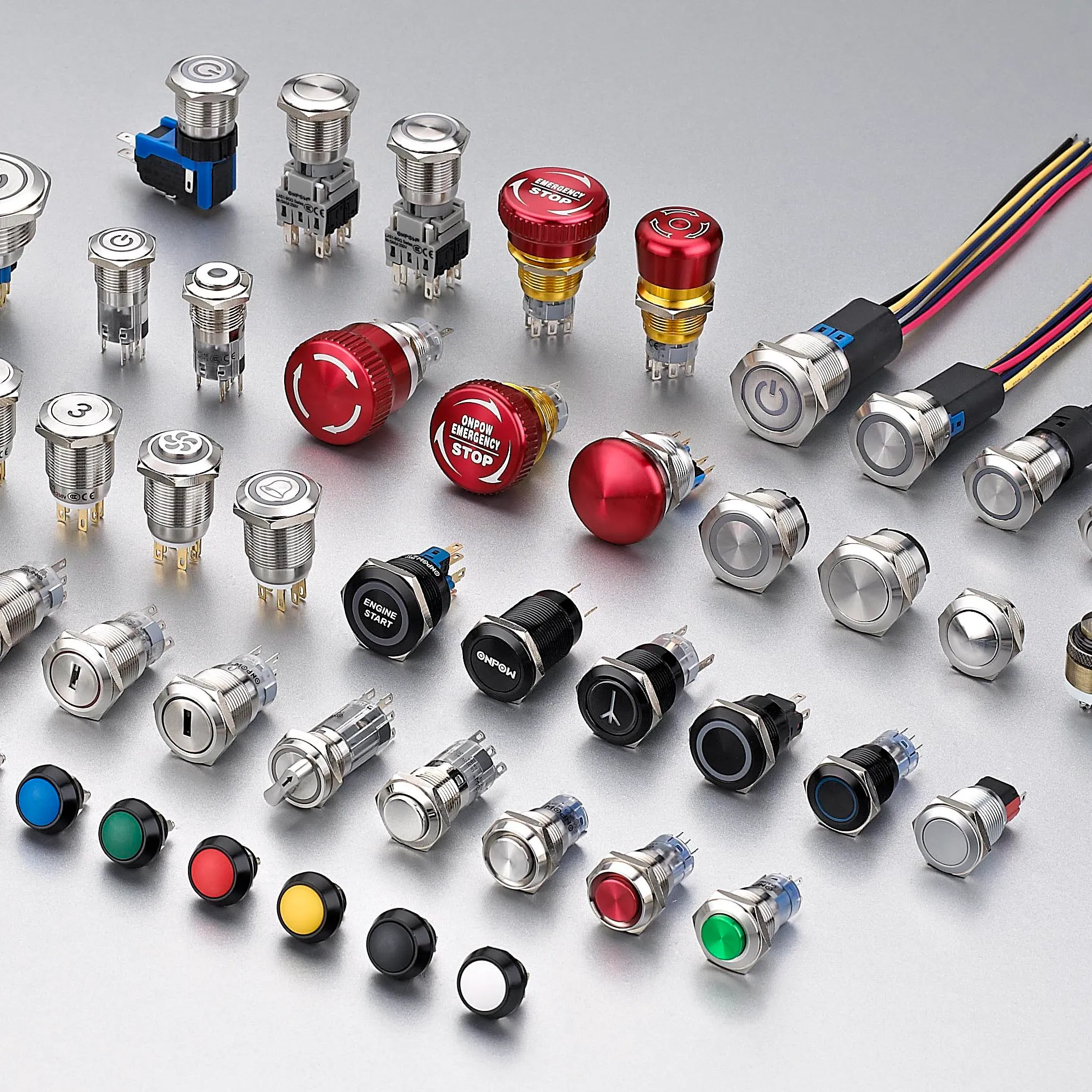
Selection criteria at a glance
| Decision area | What to verify | Engineering reason |
|---|---|---|
| Unintended contact | Identify the actual object, direction, force, and frequency | The guard geometry must address a real scenario. |
| Intentional access | Test finger size, gloves, reach, posture, and required speed | Protection that prevents proper use creates a new problem. |
| Visibility | Keep the operator state and legend readable | Users must identify the command before acting. |
| Guard form | Compare fixed shroud, raised ring, hinged cover, or recess | Each changes access and cleaning differently. |
| Emergency boundary | Separate ordinary command protection from emergency-stop requirements | Emergency access and function need dedicated validation. |
| Environment | Check debris traps, washdown, corrosion, and impact | A guard can collect contamination around the operator. |
| Mounting | Verify cutout, guard retention, panel thickness, and rear clearance | Loose or rotating accessories defeat the design. |
| Human validation | Test expected users and foreseeable misuse | A drawing cannot prove usability by itself. |
This table is intentionally qualitative. Numerical limits, ratings, torque, force, travel, environmental claims, and endurance values must be taken from the current datasheet and evaluated under the application conditions.
Detailed selection process
Unintended contact
What to verify: Identify the actual object, direction, force, and frequency. The guard geometry must address a real scenario. The requirement should be written in the project specification and traced to the exact model drawing or datasheet. Review worst-case tolerance, wear, contamination, maintenance access, and foreseeable misuse. If the available documentation does not define the boundary, keep the point open for supplier confirmation and sample testing rather than substituting an assumption.
Intentional access
What to verify: Test finger size, gloves, reach, posture, and required speed. Protection that prevents proper use creates a new problem. The requirement should be written in the project specification and traced to the exact model drawing or datasheet. Review worst-case tolerance, wear, contamination, maintenance access, and foreseeable misuse. If the available documentation does not define the boundary, keep the point open for supplier confirmation and sample testing rather than substituting an assumption.
Visibility
What to verify: Keep the operator state and legend readable. Users must identify the command before acting. The requirement should be written in the project specification and traced to the exact model drawing or datasheet. Review worst-case tolerance, wear, contamination, maintenance access, and foreseeable misuse. If the available documentation does not define the boundary, keep the point open for supplier confirmation and sample testing rather than substituting an assumption.
Guard form
What to verify: Compare fixed shroud, raised ring, hinged cover, or recess. Each changes access and cleaning differently. The requirement should be written in the project specification and traced to the exact model drawing or datasheet. Review worst-case tolerance, wear, contamination, maintenance access, and foreseeable misuse. If the available documentation does not define the boundary, keep the point open for supplier confirmation and sample testing rather than substituting an assumption.
Emergency boundary
What to verify: Separate ordinary command protection from emergency-stop requirements. Emergency access and function need dedicated validation. The requirement should be written in the project specification and traced to the exact model drawing or datasheet. Review worst-case tolerance, wear, contamination, maintenance access, and foreseeable misuse. If the available documentation does not define the boundary, keep the point open for supplier confirmation and sample testing rather than substituting an assumption.
Environment
What to verify: Check debris traps, washdown, corrosion, and impact. A guard can collect contamination around the operator. The requirement should be written in the project specification and traced to the exact model drawing or datasheet. Review worst-case tolerance, wear, contamination, maintenance access, and foreseeable misuse. If the available documentation does not define the boundary, keep the point open for supplier confirmation and sample testing rather than substituting an assumption.
Mounting
What to verify: Verify cutout, guard retention, panel thickness, and rear clearance. Loose or rotating accessories defeat the design. The requirement should be written in the project specification and traced to the exact model drawing or datasheet. Review worst-case tolerance, wear, contamination, maintenance access, and foreseeable misuse. If the available documentation does not define the boundary, keep the point open for supplier confirmation and sample testing rather than substituting an assumption.
Human validation
What to verify: Test expected users and foreseeable misuse. A drawing cannot prove usability by itself. The requirement should be written in the project specification and traced to the exact model drawing or datasheet. Review worst-case tolerance, wear, contamination, maintenance access, and foreseeable misuse. If the available documentation does not define the boundary, keep the point open for supplier confirmation and sample testing rather than substituting an assumption.

Application review
- Preventing hip or shoulder contact on crowded panels. Record the expected command, response, release behavior, abnormal condition, and acceptance evidence for the assembled machine.
- Protecting a reset button near material flow. Record the expected command, response, release behavior, abnormal condition, and acceptance evidence for the assembled machine.
- Reducing tool contact during maintenance. Record the expected command, response, release behavior, abnormal condition, and acceptance evidence for the assembled machine.
- Shielding an exposed command on mobile equipment. Record the expected command, response, release behavior, abnormal condition, and acceptance evidence for the assembled machine.
- Recessing a non-emergency control in a public interface. Record the expected command, response, release behavior, abnormal condition, and acceptance evidence for the assembled machine.
For every application, include startup, normal operation, shutdown, loss of power, restoration of power, maintenance mode, component replacement, and the faults identified by the risk assessment. A general control switch should not be treated as a complete safety function.
Commissioning checklist
- Freeze the requirement. State the intended action, normal condition, supply, load, motion, environment, and user.
- Match the order code. Compare the delivered part with the approved drawing, contact diagram, actuator, terminal style, and accessories.
- Inspect installation. Check alignment, fasteners, rear clearance, cable routing, strain relief, protection of live parts, and access for service.
- Test every state. Verify operation and release at tolerance extremes, expected speeds, loads, gloves, contamination, and environmental conditions.
- Test abnormal conditions. Include disconnected conductors, blocked or damaged mechanisms, power loss, contamination, and other credible faults.
- Record the result. Save model, revision, test method, observations, acceptance criteria, date, and approver.
Common mistakes
- Adding a cover without testing gloved access. Prevent this by assigning the check to a drawing, datasheet, wiring record, or commissioning test with a named acceptance criterion.
- Obscuring the legend or illumination. Prevent this by assigning the check to a drawing, datasheet, wiring record, or commissioning test with a named acceptance criterion.
- Creating a pocket that traps liquid or debris. Prevent this by assigning the check to a drawing, datasheet, wiring record, or commissioning test with a named acceptance criterion.
- Using a normal guard on an emergency stop by analogy. Prevent this by assigning the check to a drawing, datasheet, wiring record, or commissioning test with a named acceptance criterion.
- Failing to identify the accidental-contact direction. Prevent this by assigning the check to a drawing, datasheet, wiring record, or commissioning test with a named acceptance criterion.
What to include in an RFQ
Provide the application, target market, applicable standards, machine function, supply and load, control interface, contact logic, mechanical drawing, motion path, panel dimensions, cable method, environment, operating frequency, quantity, documentation needs, and sample-validation plan. Ask the supplier to identify assumptions and exceptions. ONPOW offers relevant products in its application-specific product family and the broader industrial control product range.
Related ONPOW guides
Authoritative references
- IEC 60947-5-1 control-circuit devices
- IEC 60529 degrees of protection provided by enclosures
- OSHA machine guarding requirements
- OSHA electrical safety requirements
Educational video

Machine Guarding Safety Meeting Video by Weeklysafety provides general background. Project decisions still require the applicable standards and product documentation.
Frequently asked questions
What does a push button guard do?
It changes the access path so broad or unintended contact is less likely to operate the button.
Is a hinged cover always safer?
No. It adds an action and may delay use, trap debris, or remain open; test the actual risk and workflow.
Can an emergency stop be guarded?
Only when the exact arrangement complies with applicable requirements and the risk assessment; do not assume an ordinary shroud is acceptable.
How should a guard be tested?
Use real users, gloves, lighting, cleaning conditions, intended actions, and credible accidental-contact scenarios.
Final decision
Approve the component only when the documented mechanical, electrical, environmental, usability, installation, and maintenance boundaries all fit the assembled system. Resolve unknowns through current manufacturer information and testing before production release.



