

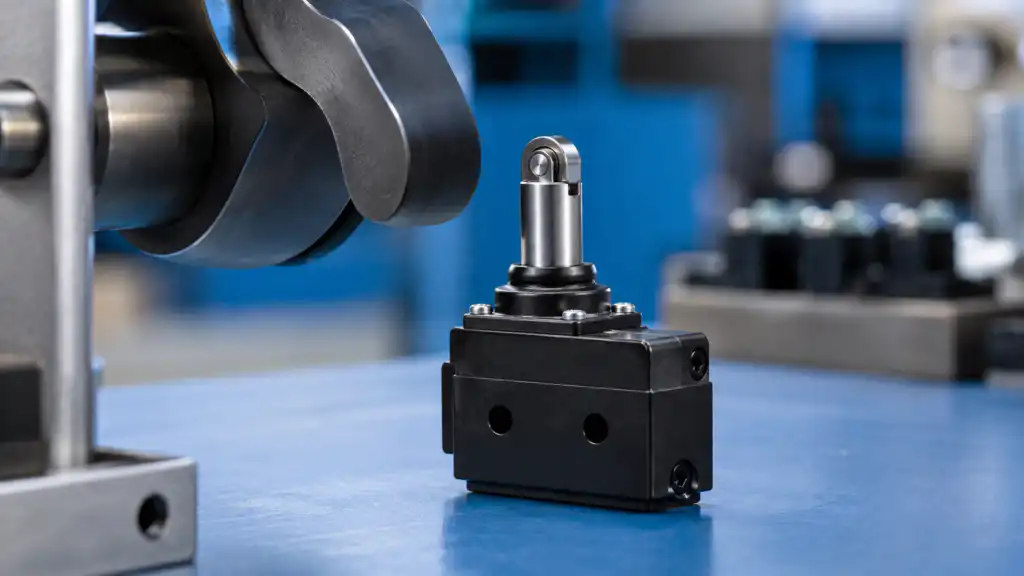
A roller plunger limit switch combines direct plunger motion with a small rolling element at the contact point. It is useful when a cam approaches generally along the plunger axis but also moves laterally across the switch. The roller can reduce sliding friction and surface wear compared with a plain plunger. It does not correct poor alignment, excessive impact, insufficient overtravel, or an unsuitable enclosure. Selection should start with the cam path, approach speed, operating force, allowed travel, repeatability, and environment, followed by an assembled-machine validation.
Auswahlregel: Betrachten Sie das Gerät, den Aktor, die Kontakte, das Gehäuse, die Verdrahtung, die Steuerungslogik, den Benutzer und die Maschinenbewegung als ein einziges System. Produktbeispiele veranschaulichen lediglich die Bauform; die endgültige Eignung muss sich aus der aktuellen Dokumentation für die genaue Bestellnummer und aus der Validierung in der fertigen Ausrüstung ergeben.
Wie der Mechanismus funktioniert
As the cam contacts the roller, the plunger moves toward the switch body. The internal mechanism changes state at the operating point and returns after the cam retreats past the release point. The difference creates useful hysteresis. The roller bearing, plunger guide, seals, return spring, and internal contacts all contribute to behavior. A cam that drives too deeply or hits from the side can damage the mechanism even when the electrical circuit is correct.

Auswahlkriterien auf einen Blick
| Entscheidungsbereich | Was zu überprüfen ist | technischer Grund |
|---|---|---|
| Cam profile | Use a smooth lead-in and lead-out compatible with the switch drawing | Sharp edges create impact and unstable motion. |
| Approach direction | Keep the resulting force close to the permitted plunger axis | Side force can bind the guide or accelerate wear. |
| Operating travel | Cross the operating point under every tolerance condition | Too little stroke causes missed signals. |
| Overtravel | Provide margin without reaching the mechanical limit | Controlled overtravel absorbs variation without using the switch as a stop. |
| Speed | Compare minimum and maximum cam speed with the device limits | Very slow or fast motion can change switching behavior and impact. |
| Roller material | Match the roller and cam surfaces to wear and contamination conditions | A roller is still a mechanical contact interface. |
| Mounting rigidity | Prevent bracket movement and fastener loosening | Small mounting shifts change the operating point. |
| Umwelt | Check ingress, temperature, oil, chips, vibration, and cable sealing | Protection must apply to the complete installed assembly. |
Diese Tabelle ist absichtlich qualitativ gehalten. Numerische Grenzwerte, Nennwerte, Drehmoment, Kraft, Verfahrweg, Umwelteinflüsse und Haltbarkeitswerte müssen dem aktuellen Datenblatt entnommen und unter den Anwendungsbedingungen bewertet werden.
Detaillierter Auswahlprozess
Cam profile
Was zu überprüfen ist: Use a smooth lead-in and lead-out compatible with the switch drawing. Sharp edges create impact and unstable motion. The requirement should be written in the project specification and traced to the exact model drawing or datasheet. Review worst-case tolerance, wear, contamination, maintenance access, and foreseeable misuse. If the available documentation does not define the boundary, keep the point open for supplier confirmation and sample testing rather than substituting an assumption.
Approach direction
Was zu überprüfen ist: Keep the resulting force close to the permitted plunger axis. Side force can bind the guide or accelerate wear. The requirement should be written in the project specification and traced to the exact model drawing or datasheet. Review worst-case tolerance, wear, contamination, maintenance access, and foreseeable misuse. If the available documentation does not define the boundary, keep the point open for supplier confirmation and sample testing rather than substituting an assumption.
Operating travel
Was zu überprüfen ist: Cross the operating point under every tolerance condition. Too little stroke causes missed signals. The requirement should be written in the project specification and traced to the exact model drawing or datasheet. Review worst-case tolerance, wear, contamination, maintenance access, and foreseeable misuse. If the available documentation does not define the boundary, keep the point open for supplier confirmation and sample testing rather than substituting an assumption.
Overtravel
Was zu überprüfen ist: Provide margin without reaching the mechanical limit. Controlled overtravel absorbs variation without using the switch as a stop. The requirement should be written in the project specification and traced to the exact model drawing or datasheet. Review worst-case tolerance, wear, contamination, maintenance access, and foreseeable misuse. If the available documentation does not define the boundary, keep the point open for supplier confirmation and sample testing rather than substituting an assumption.
Speed
Was zu überprüfen ist: Compare minimum and maximum cam speed with the device limits. Very slow or fast motion can change switching behavior and impact. The requirement should be written in the project specification and traced to the exact model drawing or datasheet. Review worst-case tolerance, wear, contamination, maintenance access, and foreseeable misuse. If the available documentation does not define the boundary, keep the point open for supplier confirmation and sample testing rather than substituting an assumption.
Roller material
Was zu überprüfen ist: Match the roller and cam surfaces to wear and contamination conditions. A roller is still a mechanical contact interface. The requirement should be written in the project specification and traced to the exact model drawing or datasheet. Review worst-case tolerance, wear, contamination, maintenance access, and foreseeable misuse. If the available documentation does not define the boundary, keep the point open for supplier confirmation and sample testing rather than substituting an assumption.
Mounting rigidity
Was zu überprüfen ist: Prevent bracket movement and fastener loosening. Small mounting shifts change the operating point. The requirement should be written in the project specification and traced to the exact model drawing or datasheet. Review worst-case tolerance, wear, contamination, maintenance access, and foreseeable misuse. If the available documentation does not define the boundary, keep the point open for supplier confirmation and sample testing rather than substituting an assumption.
Umwelt
Was zu überprüfen ist: Check ingress, temperature, oil, chips, vibration, and cable sealing. Protection must apply to the complete installed assembly. The requirement should be written in the project specification and traced to the exact model drawing or datasheet. Review worst-case tolerance, wear, contamination, maintenance access, and foreseeable misuse. If the available documentation does not define the boundary, keep the point open for supplier confirmation and sample testing rather than substituting an assumption.

Bewerbungsprüfung
- Conveyor position confirmation. Record the expected command, response, release behavior, abnormal condition, and acceptance evidence for the assembled machine.
- Indexing table home detection. Record the expected command, response, release behavior, abnormal condition, and acceptance evidence for the assembled machine.
- Door or cover position feedback in a protected mechanism. Record the expected command, response, release behavior, abnormal condition, and acceptance evidence for the assembled machine.
- Cam-driven sequence control. Record the expected command, response, release behavior, abnormal condition, and acceptance evidence for the assembled machine.
- End-position feedback where lateral cam travel is unavoidable. Record the expected command, response, release behavior, abnormal condition, and acceptance evidence for the assembled machine.
Für jede Anwendung sind der Anlauf, der Normalbetrieb, das Herunterfahren, der Stromausfall, die Wiederherstellung der Stromversorgung, der Wartungsmodus, der Austausch von Komponenten und die durch die Risikobeurteilung identifizierten Fehler einzubeziehen. Ein allgemeiner Steuerschalter sollte nicht als vollständige Sicherheitsfunktion betrachtet werden.
Inbetriebnahme-Checkliste
- Die Anforderung einfrieren. Geben Sie die beabsichtigte Aktion, den Normalzustand, die Versorgung, die Last, die Bewegung, die Umgebung und den Benutzer an.
- Den Bestellcode zuordnen. Vergleichen Sie das gelieferte Teil mit der genehmigten Zeichnung, dem Kontaktdiagramm, dem Antrieb, der Anschlusstechnik und dem Zubehör.
- Installation inspizieren. Überprüfen Sie Ausrichtung, Befestigungselemente, hinteren Freiraum, Kabelführung, Zugentlastung, Schutz von unter Spannung stehenden Teilen und den Servicezugang.
- Teste jeden Staat. Überprüfen Sie Funktion und Auslösung bei Toleranzextremen, erwarteten Geschwindigkeiten, Lasten, Handschuhen, Verschmutzung und Umgebungsbedingungen.
- Teste anormale Zustände. Schließen Sie getrennte Leiter, blockierte oder beschädigte Mechanismen, Stromausfall, Verschmutzung und andere plausible Fehler ein.
- Ergebnis aufzeichnen. Speichern Sie Modell, Revisionsstand, Testmethode, Beobachtungen, Annahmekriterien, Datum und Genehmigenden.
Common mistakes
- Driving the roller past its allowed stroke. Prevent this by assigning the check to a drawing, datasheet, wiring record, or commissioning test with a named acceptance criterion.
- Placing the cam corner directly against the roller. Prevent this by assigning the check to a drawing, datasheet, wiring record, or commissioning test with a named acceptance criterion.
- Treating the switch as a safety function without a validated architecture. Prevent this by assigning the check to a drawing, datasheet, wiring record, or commissioning test with a named acceptance criterion.
- Selecting from contact current alone. Prevent this by assigning the check to a drawing, datasheet, wiring record, or commissioning test with a named acceptance criterion.
- Testing only at nominal alignment. Prevent this by assigning the check to a drawing, datasheet, wiring record, or commissioning test with a named acceptance criterion.
What to include in an RFQ
Provide the application, target market, applicable standards, machine function, supply and load, control interface, contact logic, mechanical drawing, motion path, panel dimensions, cable method, environment, operating frequency, quantity, documentation needs, and sample-validation plan. Ask the supplier to identify assumptions and exceptions. ONPOW offers relevant products in its application-specific product family and the broader industrial control product range.
Related ONPOW guides
Authoritative references
- IEC 60947-5-1 control-circuit devices
- IEC 60529 degrees of protection provided by enclosures
- OSHA machine guarding requirements
- OSHA electrical safety requirements
Educational video
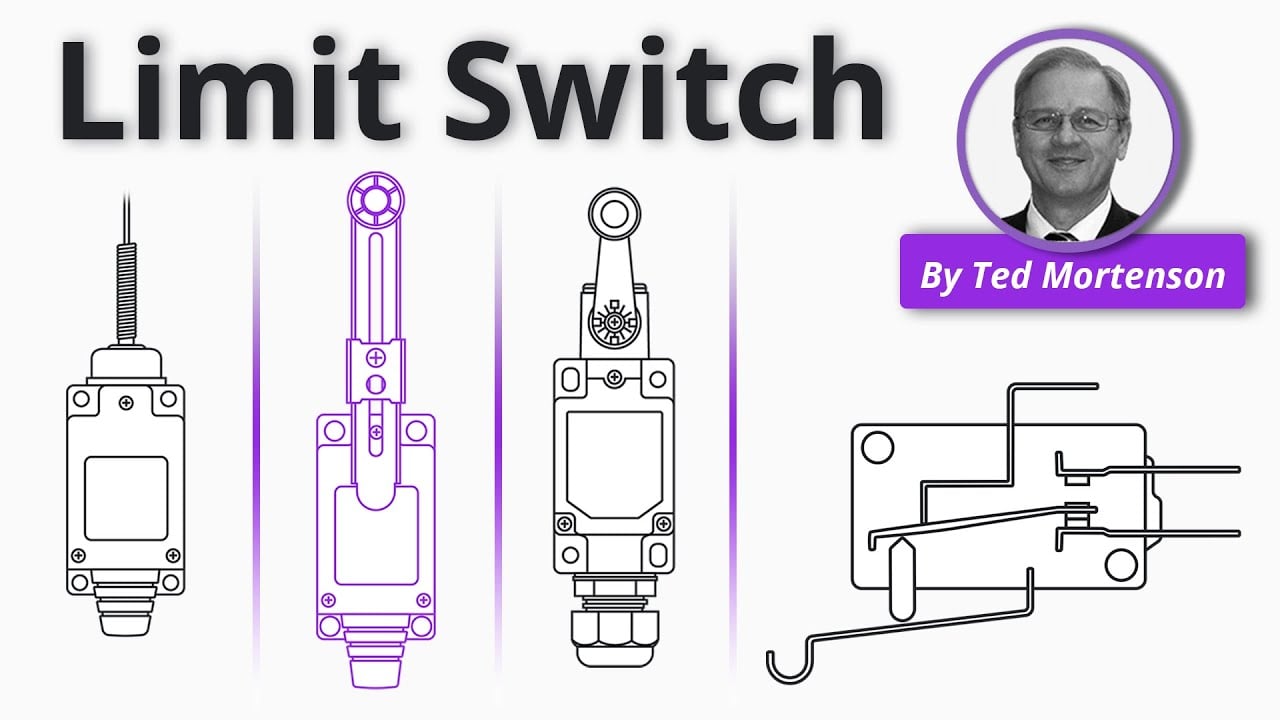
Limit Switch Explained by RealPars provides general background. Project decisions still require the applicable standards and product documentation.
Allgemeine Fragen
Why use a roller instead of a plain plunger?
A roller can reduce sliding friction when a moving cam passes across the actuator.
Can the cam approach from any direction?
No. Use the direction and angle permitted by the exact manufacturer drawing.
How much overtravel is needed?
Enough to maintain operation across tolerances without exceeding the documented limit; use the exact model data.
Does a roller plunger improve electrical rating?
No. Actuator style does not replace checking voltage, current, load category, and inrush.
Final decision
Approve the component only when the documented mechanical, electrical, environmental, usability, installation, and maintenance boundaries all fit the assembled system. Resolve unknowns through current manufacturer information and testing before production release.
Anpassung
ONPOW undertakes a variety of custom needs for push-button development. Confirm whether packaging, marking or documentation OEM/ODM applies to Roller Plunger Limit Switch Selection for Industrial Machines in the quotation.
Die Mindestbestellmenge, die Lieferzeit und die Handelsbedingungen werden hier nicht veröffentlicht; bestätigen Sie diese bei der Vertriebsabteilung. sales@onpow.com.



