

A push button temperature change test report should show which configuration was exposed, how temperature changed, how long the specimen remained at each condition and which functions were checked. An ambient operating temperature range and a temperature cycling report answer different questions. Neither should be used to invent a cycle life or claim that every switch in a product family has passed the same exposure. For procurement, compare the report with the intended panel environment and installation, then document the limits of the evidence before approving the part for a temperature-sensitive application.
Separate an operating range from a change-of-temperature test
A specified operating range describes conditions under which the manufacturer permits a defined product to operate, subject to its stated limitations. A change-of-temperature test describes an exposure applied to particular specimens under a particular procedure. One does not automatically provide all the information contained in the other.
The public scope of IEC 60068-2-14 describes tests using specified ambient temperature changes to examine their effects on specimens. The relevant specification and test plan must still define the applicable conditions and required outcomes. A reference to the standard is not a universal temperature rating for a panel switch.
This distinction matters when a project involves repeated starts in a cold building, temperature variation inside a cabinet or movement between storage and use. Describe the actual concern first. A test chosen only because its title sounds severe can produce a document that misses the relevant installation or functional condition.
Identify the complete switch configuration
Review the order code, revision, operator, contact arrangement, terminal style, illumination option and accessories. Connect these to the specimen labels, photographs and description in the report. Ask whether the tested samples were production units or a different development configuration.
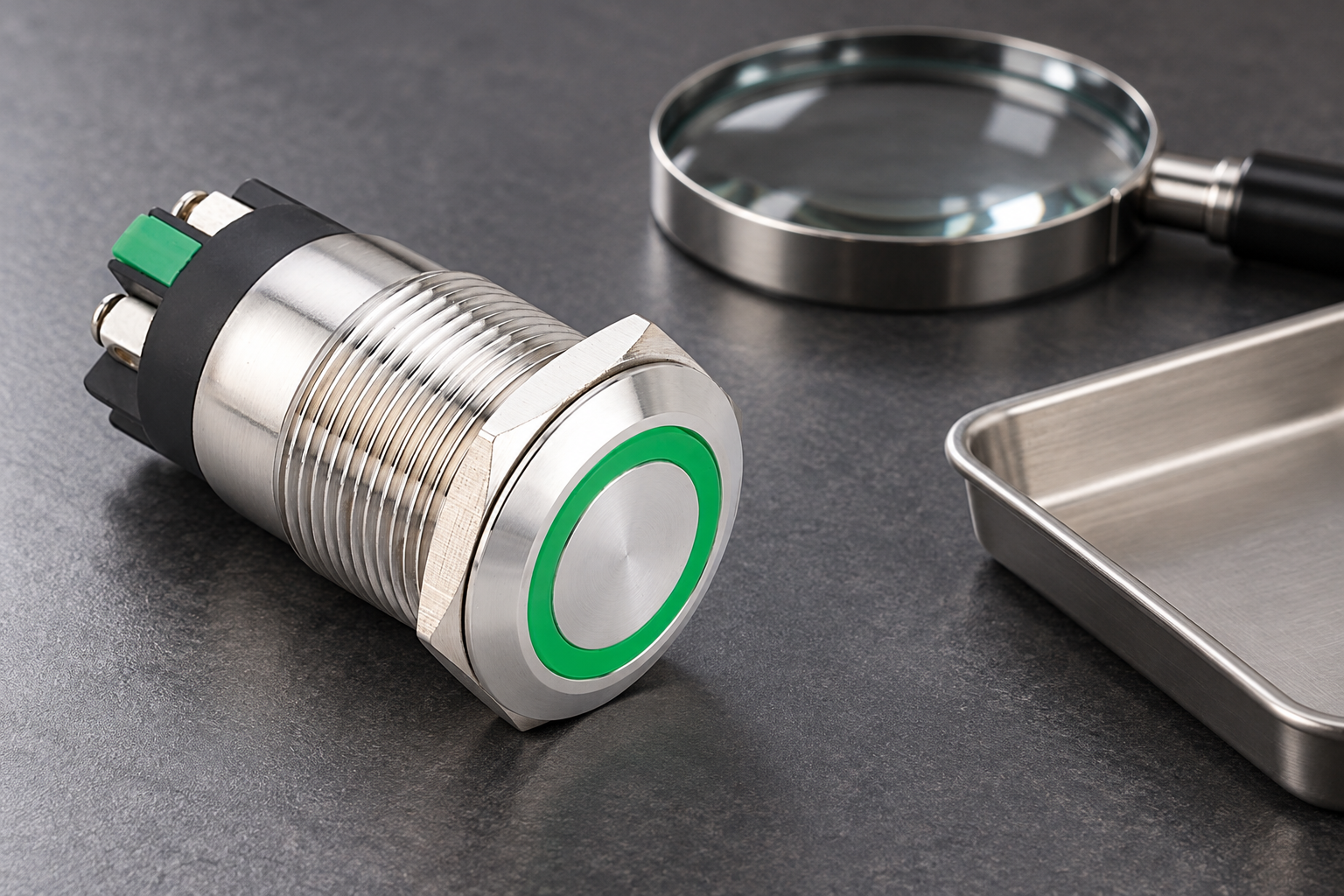
The ONPOW LAS1GQ-11E/L/S product page is an identification example for this guide. Its photo shows the visible ring operator, metal threaded body and rear contact carrier. It cannot establish the internal materials, temperature limits, seal performance or thermal test history. Request the applicable specifications and supporting documentation for the exact ordered variant.
If a family report is supplied, ask how it covers variations in illuminated parts, contact modules or accessories. Similar exterior geometry does not prove equivalent thermal behavior. A supplier may have a justified coverage explanation, but that explanation should be documented and reviewed rather than inferred by the buyer.

Read the full temperature profile
Record the temperature levels, number of cycles, exposure periods, transition conditions and any stabilization criteria specified by the method and plan. Do not copy only the hottest and coldest values into the purchasing summary. Those endpoints leave out how the specimen moved between them and how long it experienced the conditions.
Distinguish chamber air temperature from the temperature of the specimen where the procedure requires that distinction. A small loose component and an assembly installed in a panel can respond differently to the same ambient change. Ask what was measured, where sensors were located and what evidence supports the reported exposure.
Do not relabel a gradual temperature change as a rapid thermal shock, or assume that a rapid transfer result covers every slower cycling environment. The chosen method, specimen response and acceptance purpose matter. Where a customer specification names a procedure, compare the actual report against that procedure rather than replacing it with a more dramatic description.
Understand why materials and assemblies matter
Materials generally change dimensions with temperature, and different materials can respond differently. OpenStax explains thermal expansion as background physics. That principle helps explain why a multi-part assembly deserves review, but it does not provide the material coefficients or stress limits for the pictured ONPOW switch.
For a switch, the practical questions concern the assembled operator, contact support, illumination parts, seals and attachment to the panel. Ask which functions and interfaces the qualification addressed. Do not estimate their behavior by assigning generic material properties to parts whose exact composition has not been confirmed.
Keep the product photographs in their proper role. They can help identify the visible sample and explain the documentation process. They are not evidence that the product was placed in a chamber, passed a specified number of cycles or retained a particular rating afterward. The illustrations in this guide depict document review rather than a completed test.
A temperature report review table
Use the following table to organize an evidence request. It deliberately sets no generic temperature endpoints, cycle counts or electrical limits; these must come from the applicable specification and approved plan.
| Review item | Evidence to locate | Why it changes the decision |
|---|---|---|
| Configuration | Exact order code, revision and sample photographs | Prevents extending a result to an unreviewed variant |
| Exposure profile | Levels, transitions, exposure periods and cycle count | Defines what the specimens actually experienced |
| Temperature evidence | Control and measurement locations, stabilization record where required | Separates chamber settings from specimen conditions |
| Operating state | Powered or unpowered condition and circuit details | Defines the electrical and thermal boundary |
| Functional checks | Before, during and after measurements as specified | Shows which acceptance criteria were evaluated |
| Recovery and disposition | Recovery conditions, observations, deviations and retests | Explains the limits of the final conclusion |
Review powered and unpowered conditions
A report should state whether the specimen was powered, and which circuits or indicator functions were active where applicable. Electrical operation may contribute heat or affect the functions being monitored. A test performed on an unpowered switch should not silently become proof of every energized condition.
Ask which loads, supply conditions and functional states were specified. Do not supply a generic load or test voltage simply to fill a gap in the report. The intended circuit and manufacturer’s limits must guide the test plan, and qualified personnel should approve any electrical test arrangement.
For an illuminated switch, establish whether the light source and its associated configuration were included. A contact-only check does not establish the illumination function. Conversely, observing a light after recovery does not prove uninterrupted contact behavior during the temperature changes. Keep each function connected to its actual measurement.
Consider the panel and moisture boundaries separately
A loose specimen and a switch installed in an enclosure do not share every thermal condition. The panel, nearby equipment, ventilation and internal heat sources can affect the environment. Compare the tested arrangement with the proposed installation, including the complete mounting stack.
Temperature variation can also be relevant to moisture management, but a temperature-change report is not automatically an ingress or condensation qualification. The existing control panel condensation guide addresses the moisture question separately. Do not infer a humidity exposure from a temperature profile that did not include one.
Similarly, a front-panel protection claim should be reviewed under its own documented installation and test boundary. A test report for one environmental effect should not be used as a shortcut around another requirement. Keeping these questions separate makes the supplier’s evidence package easier to assess and prevents broad claims that the original report never made.
Read recovery conditions and final observations
The time and conditions between exposure and final checks can affect how results should be interpreted. Identify the recovery conditions required by the method and what the laboratory actually recorded. If a function was evaluated only after recovery, describe it that way rather than claiming continuous operation throughout the test.
Review appearance, operation and electrical observations against the stated acceptance criteria. A statement of “no visible damage” may be relevant, but it does not replace a specified contact or insulation assessment. Where an insulation resistance review is relevant, confirm the approved electrical test boundary rather than improvising an additional test on an assembled panel.
Keep deviations visible. If a sample was adjusted, repaired, replaced or retested, request the reason and authorized disposition. A later satisfactory result can be useful without erasing the earlier event. The approved configuration and conclusion should remain traceable to the actual record.
Do not translate cycles into field years without a model
A defined number of laboratory cycles is an exposure count, not a direct calendar-life guarantee. A life prediction needs a justified relationship between the laboratory conditions, failure mechanism and service environment. An arbitrary conversion from cycles to years can mislead purchasing and maintenance teams.
For a project that needs a service-life assessment, involve the responsible reliability or equipment engineer. Provide the expected operating environment, duty conditions and relevant failure criteria. Ask what evidence and assumptions are needed rather than expecting a component report to answer a broader lifetime question by itself.
Use precise language in the purchase record: identify the report, specimens, conditions and acceptance conclusion. Avoid phrases such as “all-temperature proof” or “lifetime tested.” The narrower statement is more useful because later reviewers can understand what was accepted and when the decision should be revisited.
Prepare the supplier request before ordering
Send the exact configuration, intended operating environment and applicable project requirements. Describe whether the concern is operation at temperature, repeated changes, storage exposure or a particular transition. Ask for current specifications, available reports and a clear explanation of coverage and limitations.
If additional testing is necessary, agree on the specimen, mounting, powered state, measurements, recovery conditions and acceptance criteria before commissioning it. A clearly scoped quotation helps prevent disagreement over whether the completed report answered the request. Separate existing evidence retrieval from a new qualification activity.
Retain the accepted report and configuration references with the purchasing file. Review later changes to materials, illumination options, contact modules or installation through the agreed approval process. A previous report remains useful evidence, but its existence alone does not establish coverage for every future change.
Pertanyaan yang sering diajukan
Does an operating temperature range prove temperature cycling qualification?
No. The operating range and the defined cycling exposure provide different information. Review the applicable specification and report to determine which requirements have actually been addressed.
Can a report’s cycle count be converted directly into service years?
No universal conversion is justified. A field-life prediction needs an appropriate model, known service conditions and evidence that the relevant degradation mechanisms are represented.
Does a temperature-change test prove resistance to condensation?
Not automatically. Review whether humidity or moisture conditions were included and what acceptance criteria applied. Temperature exposure alone does not establish an ingress or condensation claim.
What is the most useful first question for the supplier?
Ask which current report covers the exact order code and intended condition. Request the specimen description, full exposure profile, functional checks and limitations before discussing a general pass statement.
Further learning
Khan Academy India explains thermal expansion. This supports the discussion of temperature effects in assemblies; it does not identify the internal materials or qualify the pictured ONPOW product.



