

A heavy duty push button switch is not a single standard grade name. Treat the phrase as a procurement filter: compare mechanical and electrical life cycles, IP and IK boundaries, front materials and terminals, and Ith versus the actual switched control load before you buy from a catalogue slogan.
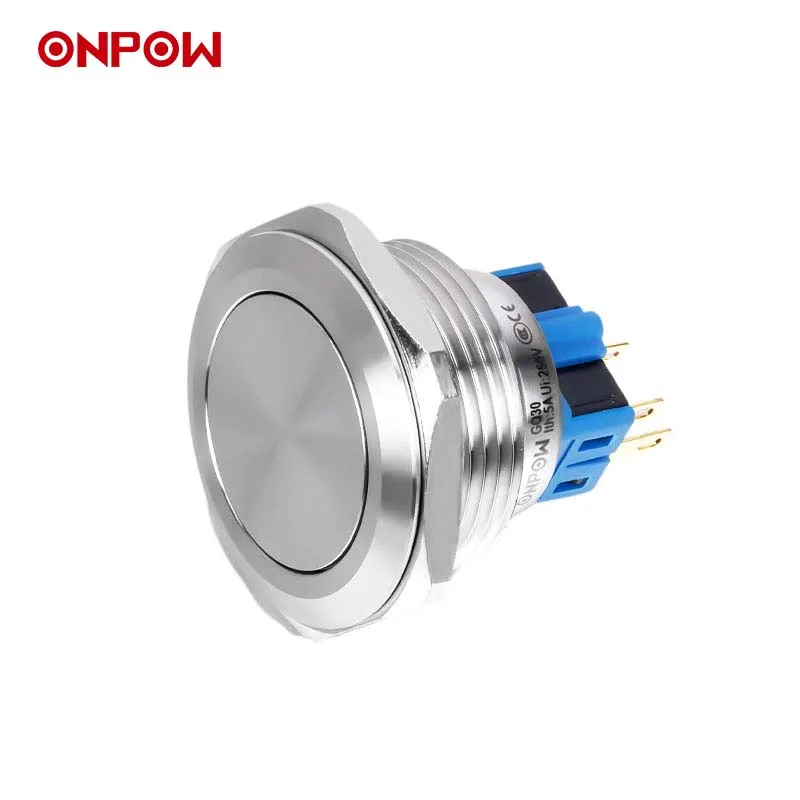
Part 1. What does heavy duty mean on a push button switch?
Catalogues use “heavy duty” to signal industrial toughness, yet the phrase rarely maps to one IEC product class by itself. Buyers who shortlist on the slogan alone often discover later that the missing inputs were cycles, ingress/impact ratings, materials, and the meaning of the published current field.
Decode the claim into four buyer questions:
- How many mechanical and electrical operations must the actuator survive?
- What IP/IK face is required for washdown, dust, or impact?
- Which front material and terminal style match the enclosure and harness?
- What does the current field actually mean for the control circuit being switched?
| Marketing phrase | Buyer translation | Evidence to request |
|---|---|---|
| Heavy duty | Documented life + environment + materials | Cycle figures, IP/IK, material callouts |
| Anti-vandal / industrial metal | Impact and abuse expectations | IK rating and front construction |
| High current | Named electrical field under conditions | Ui, Ith, and any operational-duty notes |
| Washdown ready | Ingress boundary on the stated face | IP Code and gasket/panel details |
For adjacent material trade-offs, see the metal vs plastic push button comparison inside the ONPOW blog guides cluster. Diameter standards such as the 22mm push button switch guide remain a separate decision from the duty decode below.
Part 2. How do mechanical and electrical life cycles define duty?
Cycle life is often the first honest separator between a light HMI button and a unit expected to survive production floors. Mechanical life describes operations of the mechanism; electrical life describes contact performance under stated electrical conditions. Mixing the two numbers, or ignoring both, creates false confidence.
Ask suppliers to state:
- mechanical life under the published test framing;
- electrical life under the published electrical conditions;
- whether the figures are typical, minimum, or catalogue-grade statements;
- expected operations per hour or per shift on your machine.
| Life field | What it helps estimate | Common buyer mistake |
|---|---|---|
| Mechanical life | Actuator endurance from pressing and releasing | Treating it as electrical switching proof |
| Electrical life | Contact endurance under stated conditions | Ignoring voltage, load type, and frequency |
| Combined “long life” slogan | Nothing without numbers | Accepting adjectives instead of figures |
From the field: Controls discussions often complain that buttons “die after a year of gloved hammering,” which is a mechanical-abuse and cycle-planning problem—not an IP sticker problem. — industrial controls discussion pattern
On the ONPOW GQ30-L-11/S 30mm stainless push button page, listed values include mechanical life ≥1,000,000 and electrical life ≥50,000. Quote those as model page fields for RFQ comparison; do not convert them into unlimited shop-floor warranties without matching duty conditions.
Part 3. How should IP and IK ratings bound harsh-environment claims?
Harsh-environment language needs a standard boundary. IP Codes describe ingress protection; IK Codes describe mechanical impact degrees. A stainless photo without either rating is incomplete evidence for washdown or abuse claims.
Authority framing:
- IEC 60529 defines IP Code degrees of protection provided by enclosures;
- IEC 62262 defines IK Code degrees of protection against mechanical impacts.
For GQ30-L-11/S, the product page lists front IP65, with IP67 made to order, and IK09. Keep those statements tied to the model page and the stated front/order options. Enclosure design, gasket compression, and cable entry still affect the installed result.
Environment checklist before you accept a “heavy duty” label:
- Is washdown aimed at the operator face or the whole cabinet?
- Is dust, oil mist, or outdoor exposure part of the duty?
- Are impacts from tools, carts, or accidental strikes credible?
- Does the panel thickness support the gasket and nut stack?
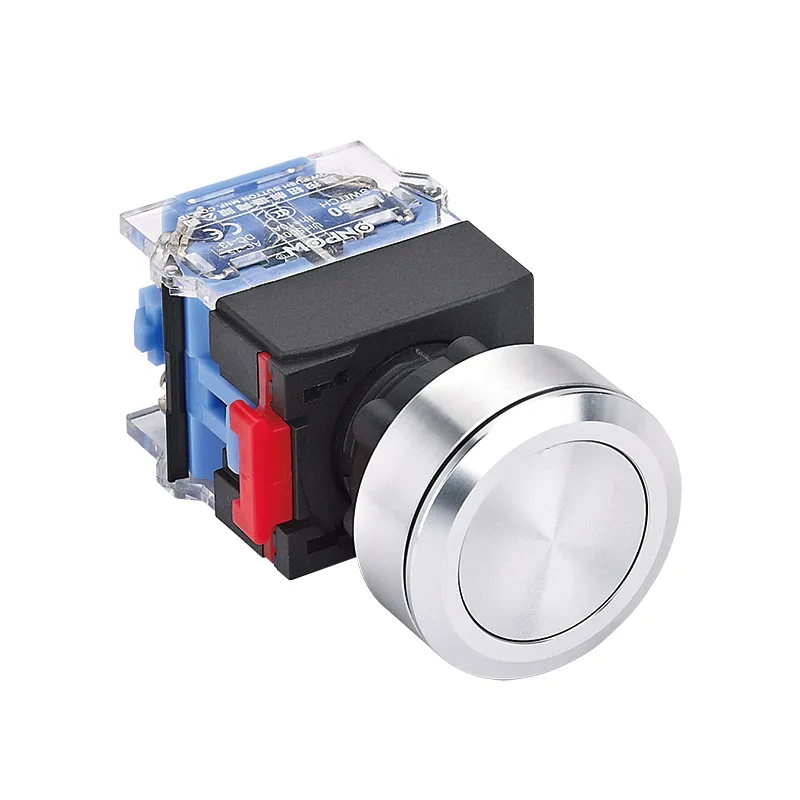
Tip: Use IP and IK to bound environment claims, then confirm the manufacturer’s stated face and order options for the exact SKU—standards define the code language, not your enclosure design (IEC 60529 IP Code).
Part 4. Which materials and terminals support industrial service?
Materials communicate different failure modes. Stainless fronts often appear in RFQs that expect abrasion resistance, cleaning chemicals, or a metal appearance on the door. Plastic can still be the correct answer for moderate indoor duty when cycles and IP targets are met at lower mass or cost. The metal vs plastic push button comparison covers that fork in more detail.
Terminal style changes assembly and service:
- screw terminals favor field wiring and larger conductors on many industrial panels;
- pin terminals can favor compact harnesses and board-oriented builds;
- contact material notes matter when the circuit is sensitive to resistance or plating choices.
GQ30-L-11/S page-listed construction notes include a stainless button/body, PA base, screw terminal, and silver alloy contact context on the product page family data. Use those fields when the RFQ explicitly calls for metal front hardware and screw termination—not as proof that every metal SKU on a category card shares the same values.
| Buyer need | Material / terminal signal | Confirm on the model page |
|---|---|---|
| Gloved industrial HMI | Larger metal actuator, clear travel | Diameter, operating feel notes if listed |
| Washdown or dust | IP face + gasketable front | IP65 / IP67 MTO language |
| Impact abuse | IK + metal front | IK09 or equivalent listed value |
| Field service wiring | Screw terminal preference | Terminal type and wire range if listed |
Browse the metal push button switch family for diameter and style context, then return to a specific model page before freezing claims. Category cards may show marketing listings; do not elevate those badges into model-level approvals unless the exact SKU documentation supports them.
Part 5. How do you read Ith versus the switched control load?
Current headlines create the most expensive misunderstandings. A page may list Ith 20A while the buyer still needs to know what is being made and broken in the real circuit.
The Eaton IEC low-voltage switchgear application guide explains conventional free-air thermal current, Ith, as a temperature-rise test concept for unenclosed equipment in free air. That framing is not automatically identical to a rated operational switching current for every load type.
Practical reading rules for this buying guide:
- treat Ui and Ith as named model fields under their definitions;
- compare them with the control-circuit voltage and current you actually switch;
- if the load path is a power duty with incomplete operational evidence, separate the operator interface from the power device architecture.
Important: Do not rewrite an RFQ as “directly switches 20A” when the available evidence only lists
Ith 20A—use the thermal-current definition in the Eaton application guide and escalate duty architecture questions separately.
For the deeper direct-load versus contactor-coil decision tree, use the sibling 20A Ith versus direct-load decision article. This guide stops at field decoding so buyers can shortlist “heavy duty” candidates without duplicating that architecture thesis. Control-circuit coil commands remain a common industrial pattern described in resources such as Control.com motor starter wiring.
Fit Boundary
Choose a documented heavy-duty metal path when cycles, IP/IK, materials, and control-circuit fields are written into the RFQ and matched to a model page.
Do not buy on slogan alone when the only evidence is a catalogue adjective or an unverified amp headline.
Escalate architecture when the button is being asked to carry an unproven power switching duty—see the 20A sibling guide rather than inventing claims here.
Confirm first: expected operations, environment, diameter standard, terminal style, Ui/Ith versus load path, and quantity.
Part 6. Which ONPOW metal models fit documented heavy-duty panels?
When the decode points to a large metal actuator with screw terminals and documented IP/IK/life fields, ONPOW’s GQ30-L-11/S is a concrete model path to evaluate.
| Listed field (GQ30-L-11/S) | Buyer use |
|---|---|
| φ30mm installation diameter | Large industrial target on metal doors |
| Ui 250V / Ith 20A | Named insulation and thermal-current fields for RFQ comparison |
| Mechanical life ≥1,000,000 / electrical life ≥50,000 | Cycle targets for industrial HMI service |
| Front IP65 (IP67 MTO) / IK09 | Environment and impact boundaries |
| Screw terminal; stainless button/body; PA base | Field wiring and metal-front construction notes |
Product recommendation: shortlist GQ30-L-11/S when the RFQ calls for a φ30mm stainless screw-terminal actuator and the listed life, IP/IK, and Ui/Ith fields match the control-panel requirement. Use the metal push button switch family only to browse related diameters and styles before returning to model-level evidence.
Why not recommend it as a universal default:
- plant standards already locked on 22mm modular accessories may not want a φ30mm hole;
- Ith 20A is not proof of motor or direct-load switching for every application;
- category marketing certificates must not be copied onto this model without SKU evidence.
Part 7. What RFQ inputs separate marketing claims from purchasable specs?
Replace “need heavy duty buttons” with a purchasable checklist:
- expected mechanical operations and electrical switching frequency;
- control-circuit voltages/currents and contact arrangement (NO/NC);
- whether the button commands a control circuit or is being asked to carry a power path;
- IP target on the operator face and any IP67 MTO need;
- IK or impact notes;
- preferred front material (for example stainless) and base constraints;
- terminal type and wire gauge;
- diameter standard (22mm / 30mm / other) and panel thickness;
- illumination or legend requirements;
- quantity, documentation pack, and delivery timing.
If any of items 1–4 is blank, the supplier cannot honestly validate a “heavy duty” claim. Send the completed package through send duty and environment details for model confirmation.
Next step: open the GQ30-L-11/S product page, compare the listed fields with the RFQ checklist, and request confirmation before panel punching.
FAQs
What makes a push button switch heavy duty?
Documented cycles, IP/IK boundaries, materials/terminals, and correctly read electrical fields—not the catalogue adjective alone. Ask for those inputs before accepting the label.
How many cycles should a heavy duty push button last?
There is no single universal number. Match published mechanical and electrical life figures to your expected operations. GQ30-L-11/S lists mechanical life ≥1,000,000 and electrical life ≥50,000 on its product page as model evidence points.
What IP rating do heavy duty push buttons need?
Need depends on dust, washdown, and enclosure design. Many industrial metal fronts target IP65-class front protection; GQ30-L-11/S lists front IP65 with IP67 made to order. Confirm the face and order option for your SKU.
Is Ith the same as the load I can switch?
Not automatically. Ith is a conventional thermal-current concept used in temperature-rise testing of unenclosed equipment in free air. Compare it carefully with your switched control load and escalate incomplete power-duty cases separately.
Are metal push buttons always more heavy duty than plastic?
No. Metal fronts often help with abuse appearance and impact expectations, but plastic can meet moderate industrial duty when cycles and IP targets are documented. Choose from environment and life evidence, not material prejudice alone.
What specs should I put on a heavy duty push button RFQ?
Include cycle targets, voltages/currents, contact arrangement, IP/IK, materials, terminals, diameter, illumination/legend needs, quantity, and documentation requirements. Slogan-only RFQs produce mismatched samples.
When is a larger metal diameter better for industrial panels?
Larger diameters help when gloved operators, legend space, or plant metal standards need a bigger target. They are not automatically “more heavy duty” electrically—still verify cycles, IP/IK, and current-field meaning.
References
- IEC 60947-5-1 — Control circuit devices and switching elements
- IEC 60529 — Degrees of protection provided by enclosures (IP Code)
- IEC 62262 — Degrees of protection against mechanical impacts (IK code)
- Eaton consulting application guide for IEC low-voltage switchgear
- Control.com — How to Wire Motor Starters and Contactors



