

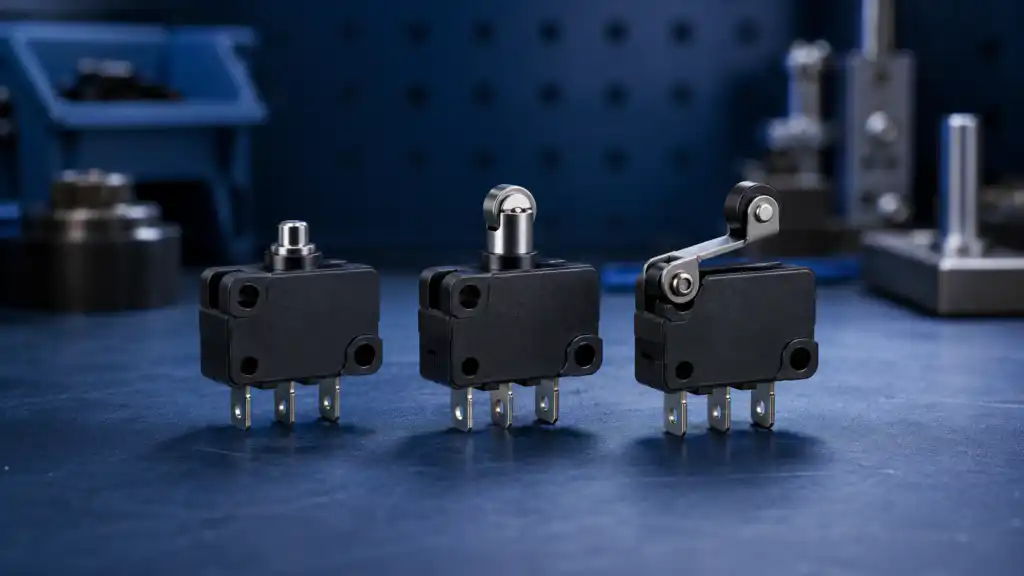
Limit switch actuator types translate machine motion into reliable switch operation. A plunger accepts direct axial movement, a roller reduces sliding friction, a lever increases reach and changes mechanical advantage, and a rod or whisker tolerates wider approach variation. The actuator is not a cosmetic option: it determines approach direction, required force, permitted speed, travel, repeatability, and exposure to impact. Select the actuator only after the machine motion and tolerance stack are documented, then verify the exact switch drawing and test the assembled mechanism.
Aturan pemilihan: perlakukan perangkat, aktuator, kontak, rumah pelindung, pengkabelan, logika kontrol, pengguna, dan pergerakan mesin sebagai satu sistem. Contoh produk hanya mengilustrasikan bentuk; kesesuaian akhir harus berasal dari dokumentasi saat ini untuk kode pesanan yang tepat dan dari validasi pada peralatan yang telah selesai.
Bagaimana mekanisme tersebut bekerja
The actuator transfers external movement to an internal snap-action or slow-action contact mechanism. Reliable operation requires the moving target to cross the operating point while staying inside the permitted overtravel and force limits. Release motion must also cross the reset point. Cam shape, alignment, speed, vibration, and wear can change the effective stroke, so a switch that clicks on a bench may still be unreliable in the machine.

Kriteria pemilihan sekilas
| Area keputusan | Apa yang harus diverifikasi | Alasan teknik |
|---|---|---|
| Straight plunger | Direct axial approach with tightly controlled alignment | Compact and repeatable, but poorly suited to side loading. |
| Roller plunger | Direct approach where the target also slides across the actuator | Rolling contact reduces rubbing but adds height and a rotating part. |
| Hinge lever | A cam approaches from the side and additional reach is needed | The lever changes force and travel at the internal plunger. |
| Roller lever | Repeated cam travel across the actuator | The roller reduces sliding wear and helps a cam pass smoothly. |
| Adjustable lever | The operating radius must be tuned during setup | Adjustment adds flexibility but must be locked and documented. |
| Rod or whisker | The target position varies across a wider area | Flexible reach tolerates misalignment but usually reduces positional precision. |
| Fork or special head | The mechanism requires bidirectional or application-specific engagement | Use only with the exact manufacturer motion diagram. |
| Sealed actuator assembly | Dust, oil, spray, or condensation can reach the switch | The complete housing and cable entry must match the environment. |
Tabel ini secara sengaja bersifat kualitatif. Batas numerik, peringkat, torsi, gaya, jarak gerak, klaim lingkungan, dan nilai ketahanan harus diambil dari lembar data saat ini dan dievaluasi berdasarkan kondisi aplikasi.
Proses seleksi terperinci
Straight plunger
Apa yang harus diverifikasi: Direct axial approach with tightly controlled alignment. Compact and repeatable, but poorly suited to side loading. The requirement should be written in the project specification and traced to the exact model drawing or datasheet. Review worst-case tolerance, wear, contamination, maintenance access, and foreseeable misuse. If the available documentation does not define the boundary, keep the point open for supplier confirmation and sample testing rather than substituting an assumption.
Roller plunger
Apa yang harus diverifikasi: Direct approach where the target also slides across the actuator. Rolling contact reduces rubbing but adds height and a rotating part. The requirement should be written in the project specification and traced to the exact model drawing or datasheet. Review worst-case tolerance, wear, contamination, maintenance access, and foreseeable misuse. If the available documentation does not define the boundary, keep the point open for supplier confirmation and sample testing rather than substituting an assumption.
Hinge lever
Apa yang harus diverifikasi: A cam approaches from the side and additional reach is needed. The lever changes force and travel at the internal plunger. The requirement should be written in the project specification and traced to the exact model drawing or datasheet. Review worst-case tolerance, wear, contamination, maintenance access, and foreseeable misuse. If the available documentation does not define the boundary, keep the point open for supplier confirmation and sample testing rather than substituting an assumption.
Roller lever
Apa yang harus diverifikasi: Repeated cam travel across the actuator. The roller reduces sliding wear and helps a cam pass smoothly. The requirement should be written in the project specification and traced to the exact model drawing or datasheet. Review worst-case tolerance, wear, contamination, maintenance access, and foreseeable misuse. If the available documentation does not define the boundary, keep the point open for supplier confirmation and sample testing rather than substituting an assumption.
Adjustable lever
Apa yang harus diverifikasi: The operating radius must be tuned during setup. Adjustment adds flexibility but must be locked and documented. The requirement should be written in the project specification and traced to the exact model drawing or datasheet. Review worst-case tolerance, wear, contamination, maintenance access, and foreseeable misuse. If the available documentation does not define the boundary, keep the point open for supplier confirmation and sample testing rather than substituting an assumption.
Rod or whisker
Apa yang harus diverifikasi: The target position varies across a wider area. Flexible reach tolerates misalignment but usually reduces positional precision. The requirement should be written in the project specification and traced to the exact model drawing or datasheet. Review worst-case tolerance, wear, contamination, maintenance access, and foreseeable misuse. If the available documentation does not define the boundary, keep the point open for supplier confirmation and sample testing rather than substituting an assumption.
Fork or special head
Apa yang harus diverifikasi: The mechanism requires bidirectional or application-specific engagement. Use only with the exact manufacturer motion diagram. The requirement should be written in the project specification and traced to the exact model drawing or datasheet. Review worst-case tolerance, wear, contamination, maintenance access, and foreseeable misuse. If the available documentation does not define the boundary, keep the point open for supplier confirmation and sample testing rather than substituting an assumption.
Sealed actuator assembly
Apa yang harus diverifikasi: Dust, oil, spray, or condensation can reach the switch. The complete housing and cable entry must match the environment. The requirement should be written in the project specification and traced to the exact model drawing or datasheet. Review worst-case tolerance, wear, contamination, maintenance access, and foreseeable misuse. If the available documentation does not define the boundary, keep the point open for supplier confirmation and sample testing rather than substituting an assumption.

Tinjauan aplikasi
- Map the full target path, not just its final position. Record the expected command, response, release behavior, abnormal condition, and acceptance evidence for the assembled machine.
- Check approach and departure angles at tolerance extremes. Record the expected command, response, release behavior, abnormal condition, and acceptance evidence for the assembled machine.
- Keep the actuator out of the role of a mechanical hard stop. Record the expected command, response, release behavior, abnormal condition, and acceptance evidence for the assembled machine.
- Measure available overtravel after the electrical operating point. Record the expected command, response, release behavior, abnormal condition, and acceptance evidence for the assembled machine.
- Test slow, normal, and maximum machine speed. Record the expected command, response, release behavior, abnormal condition, and acceptance evidence for the assembled machine.
Untuk setiap aplikasi, sertakan penyalaan, pengoperasian normal, penutupan, kehilangan daya, pemulihan daya, mode pemeliharaan, penggantian komponen, dan kesalahan yang diidentifikasi oleh penilaian risiko. Sakelar kendali umum tidak boleh dianggap sebagai fungsi keselamatan yang lengkap.
Daftar periksa komisioning
- Bekukan persyaratan tersebut. Sebutkan tindakan yang dimaksud, kondisi normal, suplai, beban, gerakan, lingkungan, dan pengguna.
- Cocokkan kode pesanan. Bandingkan komponen yang dikirim dengan gambar yang disetujui, diagram kontak, aktuator, jenis terminal, dan aksesoris.
- Periksa instalasi. Periksa penyelarasan, pengencang, jarak bebas bagian belakang, perutean kabel, pelepas regangan, perlindungan komponen aktif, dan akses untuk servis.
- Uji setiap status. Verifikasi pengoperasian dan pelepasan pada batas toleransi, kecepatan yang diharapkan, beban, sarung tangan, kontaminasi, dan kondisi lingkungan.
- Uji kondisi abnormal. Sertakan konduktor yang terputus, mekanisme yang terhalang atau rusak, kehilangan daya, kontaminasi, dan gangguan lain yang masuk akal.
- Catat hasilnya. Simpan model, revisi, metode pengujian, pengamatan, kriteria penerimaan, tanggal, dan pihak yang menyetujui.
Common mistakes
- Choosing by catalog photograph instead of the motion drawing. Prevent this by assigning the check to a drawing, datasheet, wiring record, or commissioning test with a named acceptance criterion.
- Allowing a cam edge to strike a lever sideways. Prevent this by assigning the check to a drawing, datasheet, wiring record, or commissioning test with a named acceptance criterion.
- Using excessive overtravel to compensate for poor alignment. Prevent this by assigning the check to a drawing, datasheet, wiring record, or commissioning test with a named acceptance criterion.
- Ignoring the release point and reset margin. Prevent this by assigning the check to a drawing, datasheet, wiring record, or commissioning test with a named acceptance criterion.
- Assuming a roller makes every impact acceptable. Prevent this by assigning the check to a drawing, datasheet, wiring record, or commissioning test with a named acceptance criterion.
What to include in an RFQ
Provide the application, target market, applicable standards, machine function, supply and load, control interface, contact logic, mechanical drawing, motion path, panel dimensions, cable method, environment, operating frequency, quantity, documentation needs, and sample-validation plan. Ask the supplier to identify assumptions and exceptions. ONPOW offers relevant products in its application-specific product family and the broader industrial control product range.
Related ONPOW guides
Authoritative references
- IEC 60947-5-1 control-circuit devices
- IEC 60529 degrees of protection provided by enclosures
- OSHA machine guarding requirements
- OSHA electrical safety requirements
Educational video
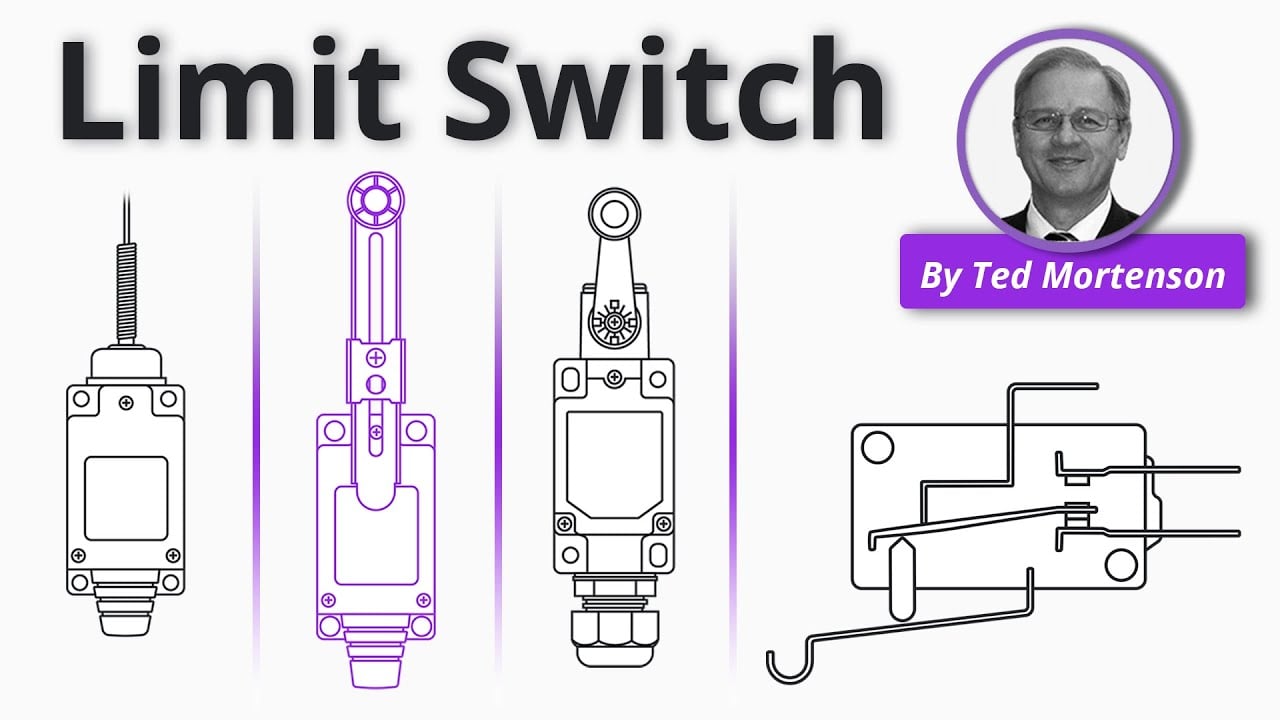
Limit Switch Explained by RealPars provides general background. Project decisions still require the applicable standards and product documentation.
Frequently asked questions
Aktuator mana yang paling akurat?
Keakuratan bergantung pada sakelar, pemasangan, cam, gaya, suhu, keausan, dan tumpukan toleransi yang tepat. Plunyer seringkali bersifat langsung, tetapi data model dan pengujian terakit yang menentukan.
Kapan rol harus digunakan?
Gunakan rol ketika bubungan atau target melintasi aktuator dan gesekan gelincir yang berkurang sangat berguna.
Dapatkah limit switch menghentikan pergerakan mesin secara mekanis?
Tidak. Mesin memerlukan penahan mekanis terpisah saat diperlukan; aktuator sakelar harus tetap berada dalam batas jarak tempuh yang didokumentasikan.
Apakah sakelar mikro sama dengan sakelar batas?
Sakelar mikro mungkin merupakan elemen pengalihan internal, sedangkan sakelar batas sering kali menggambarkan keseluruhan unit penginderaan posisi yang terpasang.
Final decision
Approve the component only when the documented mechanical, electrical, environmental, usability, installation, and maintenance boundaries all fit the assembled system. Resolve unknowns through current manufacturer information and testing before production release.
Customization
ONPOW undertakes a variety of custom needs for push-button development. Confirm whether packaging, marking or documentation OEM/ODM applies to Limit Switch Actuator Types: How to Match Motion, Force, and Travel in the quotation.
Minimum order quantity, lead time and trade terms are not published here; confirm them with sales at sales@onpow.com.



