

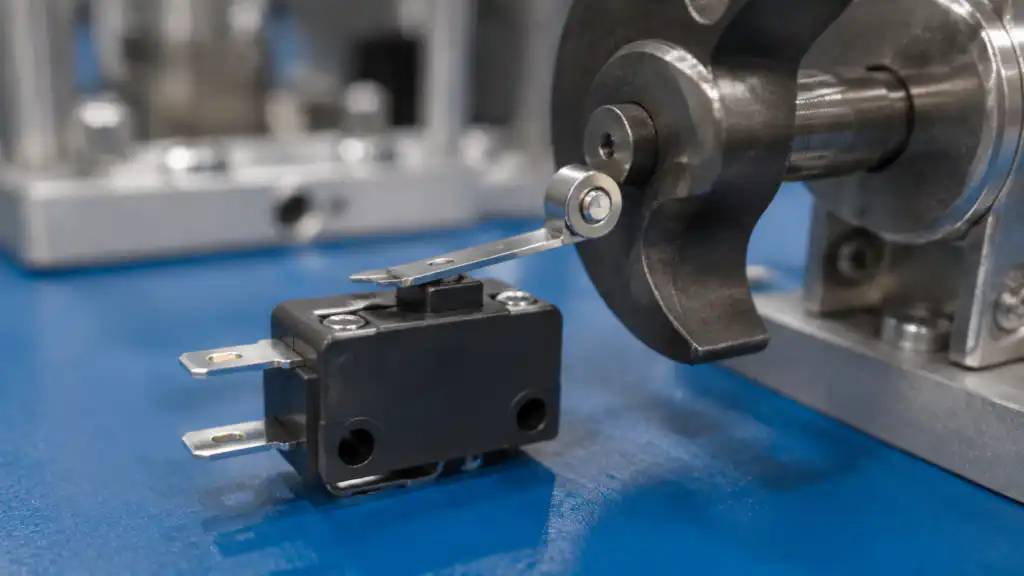
A micro switch roller is used when a moving target or cam needs to pass across the actuator with less sliding friction than a plain lever or plunger. Roller plunger and roller lever designs behave differently: the plunger accepts mainly axial force, while a lever changes reach, force, and travel before moving the internal mechanism. Select the arrangement from the actual motion path and tolerance stack. Verify roller diameter, lever geometry, operating force, pretravel, overtravel, release point, speed, mounting, and environmental limits for the exact order code.
Regra de seleção: considere o dispositivo, o atuador, os contactos, o invólucro, a cablagem, a lógica de controlo, o utilizador e o movimento da máquina como um único sistema. Os exemplos de produtos ilustram apenas a forma; a adequação final deve resultar da documentação atual para o código de encomenda exato e da validação no equipamento acabado.
Como funciona o mecanismo
The roller rotates at the cam interface while the plunger or lever transfers motion to the snap mechanism. On a lever, contact at a larger radius generally changes the travel and force relationship at the internal plunger. Moving the cam contact point or changing the approach angle can therefore alter effective operation. The roller reduces rubbing but does not eliminate bearing wear, impact, contamination, or misalignment.

Critérios de seleção em relance
| Área de decisão | O que verificar | Razão de engenharia |
|---|---|---|
| Roller arrangement | Choose roller plunger for direct stroke or roller lever for side-travel reach | The two forms transmit motion differently. |
| Cam direction | Follow the permitted approach shown in the drawing | Reverse or side impact may bend the lever or bind the plunger. |
| Contact radius | Keep the cam on the intended roller track | Off-center contact can create uneven wear. |
| Lever length | Use the documented geometry and adjustment range | Length changes effective force and movement. |
| Operating margin | Cross the operating point under every tolerance condition | Nominal operation can hide missed signals. |
| Release margin | Ensure the cam retreats far enough for reset | Incomplete release can leave the circuit in the wrong state. |
| Speed and impact | Use a smooth profile and permitted operating speed | The roller is not an impact absorber. |
| Contamination | Consider chips, fibers, dust, oil, and moisture at the roller | Debris can stop rotation or alter the motion path. |
Esta tabela é propositadamente qualitativa. Os limites numéricos, classificações, binário, força, curso, declarações ambientais e valores de endurance devem ser obtidos na ficha técnica atual e avaliados sob as condições de aplicação.
Processo de seleção detalhado
Roller arrangement
O que verificar: Choose roller plunger for direct stroke or roller lever for side-travel reach. The two forms transmit motion differently. The requirement should be written in the project specification and traced to the exact model drawing or datasheet. Review worst-case tolerance, wear, contamination, maintenance access, and foreseeable misuse. If the available documentation does not define the boundary, keep the point open for supplier confirmation and sample testing rather than substituting an assumption.
Cam direction
O que verificar: Follow the permitted approach shown in the drawing. Reverse or side impact may bend the lever or bind the plunger. The requirement should be written in the project specification and traced to the exact model drawing or datasheet. Review worst-case tolerance, wear, contamination, maintenance access, and foreseeable misuse. If the available documentation does not define the boundary, keep the point open for supplier confirmation and sample testing rather than substituting an assumption.
Contact radius
O que verificar: Keep the cam on the intended roller track. Off-center contact can create uneven wear. The requirement should be written in the project specification and traced to the exact model drawing or datasheet. Review worst-case tolerance, wear, contamination, maintenance access, and foreseeable misuse. If the available documentation does not define the boundary, keep the point open for supplier confirmation and sample testing rather than substituting an assumption.
Lever length
O que verificar: Use the documented geometry and adjustment range. Length changes effective force and movement. The requirement should be written in the project specification and traced to the exact model drawing or datasheet. Review worst-case tolerance, wear, contamination, maintenance access, and foreseeable misuse. If the available documentation does not define the boundary, keep the point open for supplier confirmation and sample testing rather than substituting an assumption.
Operating margin
O que verificar: Cross the operating point under every tolerance condition. Nominal operation can hide missed signals. The requirement should be written in the project specification and traced to the exact model drawing or datasheet. Review worst-case tolerance, wear, contamination, maintenance access, and foreseeable misuse. If the available documentation does not define the boundary, keep the point open for supplier confirmation and sample testing rather than substituting an assumption.
Release margin
O que verificar: Ensure the cam retreats far enough for reset. Incomplete release can leave the circuit in the wrong state. The requirement should be written in the project specification and traced to the exact model drawing or datasheet. Review worst-case tolerance, wear, contamination, maintenance access, and foreseeable misuse. If the available documentation does not define the boundary, keep the point open for supplier confirmation and sample testing rather than substituting an assumption.
Speed and impact
O que verificar: Use a smooth profile and permitted operating speed. The roller is not an impact absorber. The requirement should be written in the project specification and traced to the exact model drawing or datasheet. Review worst-case tolerance, wear, contamination, maintenance access, and foreseeable misuse. If the available documentation does not define the boundary, keep the point open for supplier confirmation and sample testing rather than substituting an assumption.
Contamination
O que verificar: Consider chips, fibers, dust, oil, and moisture at the roller. Debris can stop rotation or alter the motion path. The requirement should be written in the project specification and traced to the exact model drawing or datasheet. Review worst-case tolerance, wear, contamination, maintenance access, and foreseeable misuse. If the available documentation does not define the boundary, keep the point open for supplier confirmation and sample testing rather than substituting an assumption.

Análise de candidatura
- Cam-operated sequence detection. Record the expected command, response, release behavior, abnormal condition, and acceptance evidence for the assembled machine.
- Conveyor product sensing with controlled contact. Record the expected command, response, release behavior, abnormal condition, and acceptance evidence for the assembled machine.
- Machine home-position feedback. Record the expected command, response, release behavior, abnormal condition, and acceptance evidence for the assembled machine.
- Door or tray position inside equipment. Record the expected command, response, release behavior, abnormal condition, and acceptance evidence for the assembled machine.
- Repeated indexing where a rolling interface reduces wear. Record the expected command, response, release behavior, abnormal condition, and acceptance evidence for the assembled machine.
Para cada aplicação, inclua o arranque, o funcionamento normal, a paragem, a perda de energia, o restabelecimento de energia, o modo de manutenção, a substituição de componentes e as falhas identificadas pela avaliação de risco. Um interruptor de controlo geral não deve ser tratado como uma função de segurança completa.
Lista de verificação de comissionamento
- Congele o requisito. Indique a ação pretendida, a condição normal, a alimentação, a carga, o movimento, o ambiente e o utilizador.
- Corresponda ao código de encomenda. Compare a peça entregue com o desenho aprovado, o diagrama de contactos, o atuador, o estilo de terminais e os acessórios.
- Inspecionar a instalação. Verifique o alinhamento, os elementos de fixação, a folga traseira, o encaminhamento de cabos, o alívio de tensão, a proteção de partes sob tensão e o acesso para manutenção.
- Testar todos os estados. Verificar o funcionamento e a libertação nos limites das tolerâncias, velocidades previstas, cargas, luvas, contaminação e condições ambientais.
- Testar condições anómalas. Incluir condutores desligados, mecanismos bloqueados ou danificados, perda de energia, contaminação e outras falhas plausíveis.
- Registe o resultado. Guardar o modelo, a revisão, o método de ensaio, as observações, os critérios de aceitação, a data e o aprovador.
Erros comuns
- Letting the cam run off the roller edge. Prevent this by assigning the check to a drawing, datasheet, wiring record, or commissioning test with a named acceptance criterion.
- Bending a lever to compensate for mounting error. Prevent this by assigning the check to a drawing, datasheet, wiring record, or commissioning test with a named acceptance criterion.
- Ignoring the release direction. Prevent this by assigning the check to a drawing, datasheet, wiring record, or commissioning test with a named acceptance criterion.
- Assuming a larger roller always improves repeatability. Prevent this by assigning the check to a drawing, datasheet, wiring record, or commissioning test with a named acceptance criterion.
- Using the actuator as a hard stop. Prevent this by assigning the check to a drawing, datasheet, wiring record, or commissioning test with a named acceptance criterion.
O que incluir num Pedido de Cotação (RFQ)
Provide the application, target market, applicable standards, machine function, supply and load, control interface, contact logic, mechanical drawing, motion path, panel dimensions, cable method, environment, operating frequency, quantity, documentation needs, and sample-validation plan. Ask the supplier to identify assumptions and exceptions. ONPOW offers relevant products in its application-specific product family and the broader industrial control product range.
Guias relacionados com a ONPOW
Referências fidedignas
- dispositivos para circuitos de controlo IEC 60947-5-1
- IEC 60529 degrees of protection provided by enclosures
- OSHA machine guarding requirements
- Requisitos de segurança elétrica da OSHA
Vídeo educativo
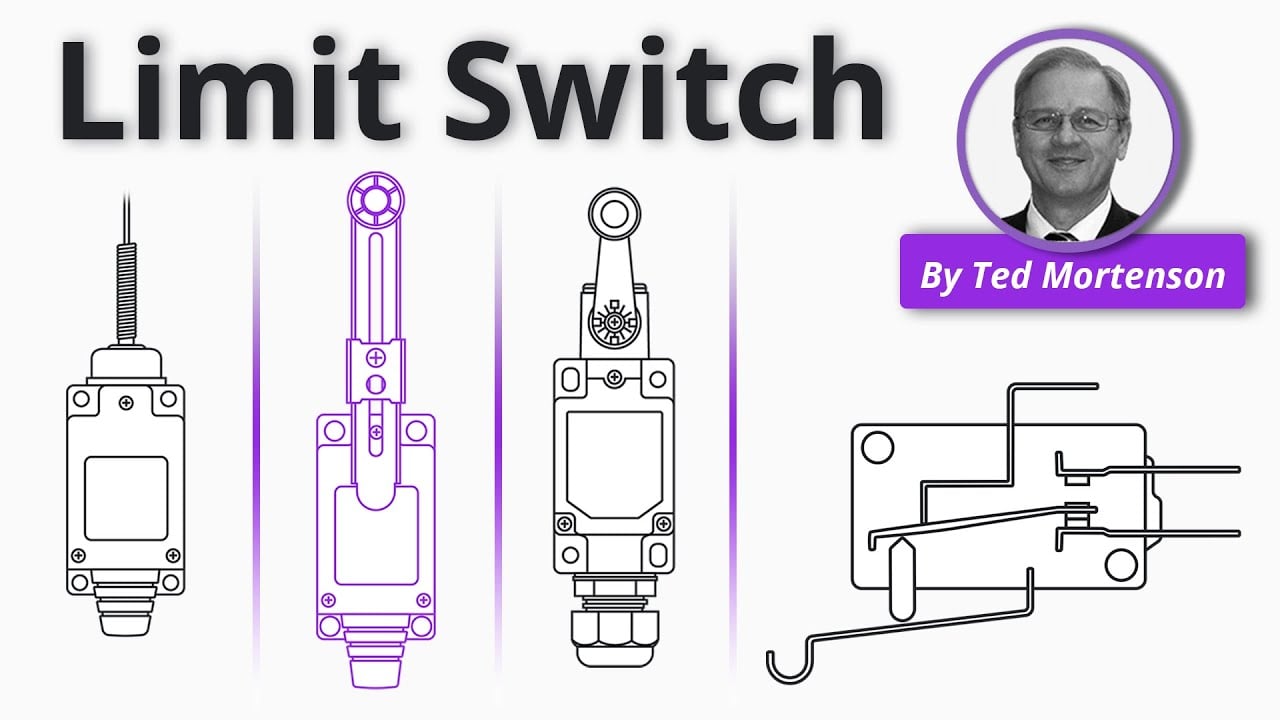
Limit Switch Explained by RealPars provides general background. Project decisions still require the applicable standards and product documentation.
Perguntas frequentes
What is the difference between a roller lever and roller plunger?
A roller lever pivots and changes mechanical leverage; a roller plunger moves primarily along its axis.
Does the roller reduce operating force?
The effect depends on the complete lever geometry and switch design; use the exact force and travel data.
Can the lever be bent during installation?
Do not modify it unless the manufacturer explicitly permits an adjustment method.
How is wear checked?
Inspect roller rotation, surface condition, lever alignment, mounting security, operating point, and reliable electrical change.
Final decision
Approve the component only when the documented mechanical, electrical, environmental, usability, installation, and maintenance boundaries all fit the assembled system. Resolve unknowns through current manufacturer information and testing before production release.
Personalização
ONPOW undertakes a variety of custom needs for push-button development. Confirm whether packaging, marking or documentation OEM/ODM applies to Micro Switch Roller Selection: Lever, Plunger, and Cam Geometry in the quotation.
A quantidade mínima de encomenda, o prazo de entrega e os termos comerciais não estão publicados aqui; confirme-os com a equipa de vendas. sales@onpow.com.



